
Quick summary
#Lawful permanent residents who qualify to naturalize under the 5-year rule, 3-year marriage-to-citizen rule, or certain military-service paths.
When you are eligible to apply for naturalization, including possible early filing within the USCIS 90-day window for qualifying 5-year and 3-year cases.
After filing, the case moves to biometrics or biometrics reuse, then the interview, civics and English testing, and finally the oath ceremony if approved.
Green card details, names, and dates across USCIS records and identity documents Travel, address, tax, and marital history that support your filing basis Any disability exception, military-service, or conditional-residence documents tied to the case
Overview (What is Form N-400?)
#N-400 is the application that moves a lawful permanent resident from green card status toward U.S. citizenship. USCIS uses it to review continuous residence, physical presence, state residence, good moral character, English and civics eligibility, and route-specific naturalization requirements. For some applicants, the strategic issue is not just whether they want citizenship now, but whether the underlying green card record is ready for review.
That matters especially when a conditional resident still has I-751 pending, when long trips abroad may raise continuity questions, or when a disability exception through N-648 may be part of the case.
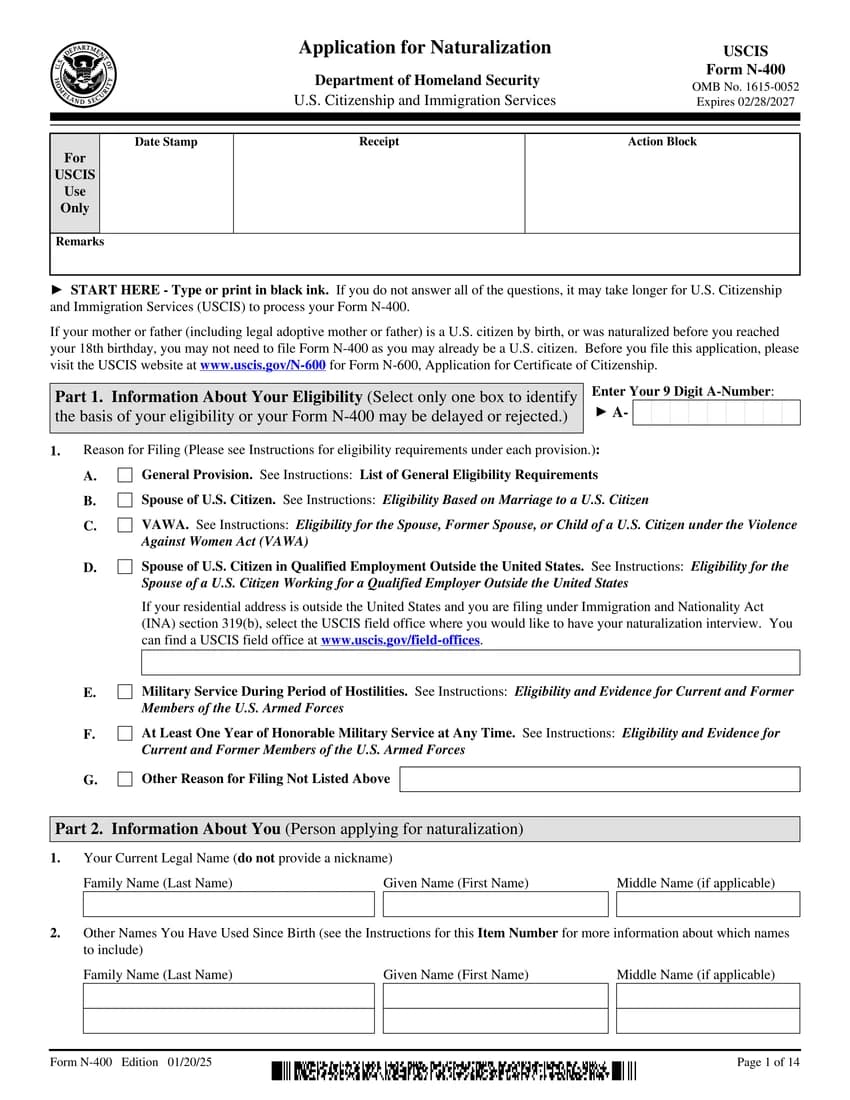
First page of N-400 form
Source: N-400 PDF
Context and workflow
#N-400 is usually the final major USCIS filing before the naturalization interview, civics and English testing, and the oath ceremony. USCIS says many applicants can file up to 90 calendar days before completing the continuous-residence requirement under the 5-year or 3-year rule. Before filing, it helps to decide which basis you are using, whether your travel and tax records are clean, and whether any related issue such as I-751 or N-648 needs to be planned first.
Why this matters
- Inconsistencies often trigger returns or follow-up requests because they create uncertainty in the case record.
- This form acts as a cross-check point: details here must match other forms and supporting documents.
Where it fits in the workflow
- Starts the USCIS naturalization review for a lawful permanent resident who wants U.S. citizenship.
- Moves through receipt, biometrics or biometrics reuse, interview, English and civics testing, and the oath ceremony.
- Requires USCIS to evaluate continuous residence, physical presence, and good moral character across the statutory period.
- May connect to I-751, N-648, or military-service records depending on the filing basis.
Who uses it
Applicants must generally be at least 18 and already be lawful permanent residents before filing N-400. Common paths include the 5-year LPR rule, the 3-year marriage-to-U.S.-citizen rule, and certain military-service routes. If your permanent residence is still conditional, I-751 remains part of the picture. If you are seeking an exception to the English or civics requirement because of a qualifying disability, N-648 may need to accompany the case.
When it is used
- When you meet the eligibility requirements for naturalization as a lawful permanent resident
- After completing the required residency or physical presence period (if applicable)
- When you are ready to apply for formal recognition of U.S. citizen status
- After becoming eligible under the 5-year permanent resident rule or the 3-year marriage-to-U.S.-citizen rule
- After qualifying military service when naturalization is available through that route
- When filing N-400 alongside I-751 (Conditions must be removed before naturalizing)
- When filing N-400 alongside N-648 (Medical certification for disability exception if needed)
Requirements snapshot
#- Naturalization usually depends on lawful permanent residence, continuous residence, physical presence, and state-residence rules under the filing basis you are using.
- Marriage-based 3-year filings often need proof of the spouse’s U.S. citizenship and continued marital union, while military filings follow different evidence rules.
- Travel history, tax compliance, criminal-history disclosures, and good-moral-character evidence can matter as much as the basic eligibility timeline.
Eligibility Category Codes
#Eligibility information for this form. Confirm your category in the official instructions before filing.
This is a shortlist of common categories. The official instructions include many more.
| Code | Who applies |
|---|---|
| General | Applicants must be at least 18 years old and have been a lawful permanent resident for a certain period. |
| Eligibility | Form N-400 is used to apply for U.S. citizenship through naturalization. It collects information about the applicant's eligibility, background, and personal details to determine if they meet the requirements for naturalization. |
Failure prevention (What causes Form N-400 rejections?)
#Technical rejections
- Submitting the application before meeting residency requirements.
- Failing to sign the application correctly.
- Ensure form edition is current
Substantive weaknesses
- To avoid filing before meeting continuous residence or physical presence: Verify you meet the 5-year (or 3-year if marriage-based) requirement before filing.
- To avoid failing the civics or english test: Study the 100 civics questions; request accommodations if you qualify for an exception.
- To avoid incorrect or incomplete biographical or travel history: List all trips outside the U.S. and ensure all addresses and employment match records.
- To avoid missing required photos or supporting documents: Include two passport-style photos and proof of status as required per instructions.
What it asks for (What does Form N-400 ask for?)
#- Biographic information including your legal name, other names used, and A-Number details
- Residence history, physical presence, and all trips outside the United States during the relevant statutory period
- Employment, school, and marital-history details that support the filing basis
- Questions about taxes, selective service, criminal history, and other good-moral-character issues
- English and civics exception information where applicable, including disability-based requests
- Identity and green card information that must match your USCIS record
- Applicant, interpreter, preparer, and signature certifications
Sources for this section
What you need (What do you need for Form N-400?)
#- A copy of your Permanent Resident Card (green card)
- The current edition of N-400
- Travel history, address history, and employment history that match your records
- Tax returns or marital-union evidence when those records support your filing basis
- If applying under the 3-year rule, evidence tied to the qualifying marriage and spouse citizenship
- If seeking a medical disability exception, the supporting certification through N-648
- A filing plan for the correct fee, reduced fee, or fee-waiver route because reduced-fee and fee-waiver requests must be filed on paper rather than online
Sources for this section
Checklist (What is the Form N-400 checklist?)
#- Download the current N-400 and instructions from the official USCIS website
- Review the N-400 instructions for statutory requirements and required evidence
- Confirm your filing basis and whether you can use the 90-day early-filing rule if you are applying under the 5-year or 3-year continuous-residence path.
- Collect documentation that verifies your green card status, your filing basis, and your required presence in the United States.
- Complete all required sections of N-400
- Confirm the form is signed and dated in all required fields
- Confirm your mailing address is current and correct
- If requesting a reduced fee or fee waiver, prepare the paper filing with the correct supporting documentation instead of trying to file online.
- Sign and date your Form N-400, ensuring all required supporting documents accompany your submission.
Sources for this section
Fees
#| Component | Amount |
|---|---|
| Filing FeeUSCIS lists different N-400 fee treatment depending on whether you file online, file on paper, or request a reduced fee or fee waiver. | See official schedule |
| Biometrics Services FeeBiometrics may be required unless USCIS reuses prior fingerprints or waives the appointment. | See official schedule |
Can the Form N-400 fee be waived?
Sometimes. USCIS permits fee-waiver requests for qualifying applicants, but those requests must be filed on paper with the required supporting documentation rather than through online filing.
What happens if I submit the wrong fee?
USCIS can reject the application for incorrect fee handling. Before filing, check the current fee calculator and make sure you are using the right method for full fee, reduced fee, or fee waiver.
Fee waiver: USCIS says reduced-fee and fee-waiver requests must be filed on paper rather than online. Review the current fee rules before choosing the filing method.
USCIS currently lists different N-400 fee amounts for online and paper filing, and reduced-fee or fee-waiver requests cannot be filed online. Verify the current rules before submitting.
Processing times
#| Category | Processing time |
|---|---|
| Application for Naturalization | 5.5 to 15 monthsas of January 2026 |
- Processing times for N-400 vary by field office workload, interview scheduling, and whether USCIS needs more evidence or clarifications.
- Naturalization timing is not only about form review. Biometrics, interview availability, English and civics testing, and oath scheduling all affect the total case length.
- The USCIS processing-times tool helps estimate the queue, but it does not guarantee when your interview or oath will actually be scheduled.
- While pending, keep your address current and monitor the case through your USCIS account or receipt number.
Where to file
#USCIS allows N-400 online filing through a USCIS online account, and also accepts paper filing by mail to the correct direct filing address.
File online
Create a USCIS online account to file N-400 online, pay online, receive updates, and manage contact information. This option is not available if you are requesting a reduced fee or fee waiver.
Submit application
File by mail if you choose paper filing or if your case requires a reduced-fee or fee-waiver request. Use the correct direct filing address so the case is not delayed.
Paper filers still receive instructions for creating an online account after USCIS accepts the case, so you can track the application either way.
Form sections (What sections does Form N-400 have?)
#Personal Information
Applicant identification.
- Full name and A-Number if applicable
- Date of birth and nationality
- Current address and contact
Eligibility
Basis for the application.
- Category or classification claimed
- Supporting evidence type
- Dates establishing eligibility
Supporting Documents
Required attachments.
- Identity and status documents
- Category-specific evidence
- Fee payment or waiver request
Choose your path
#Choose your path based on your eligibility category. Each block summarizes who qualifies, what to file, common mistakes, and typical processing time.
5-Year LPR
5-year
LPRs with 5+ years of permanent residence, 30 months physical presence, and continuous residence.
File with:
- Green card
- Tax returns for 5 years
- Travel records
- 2 passport photos
Common mistakes:
- Trips abroad exceeding 6 months breaking continuous residence
- Not having 30 months physical presence within 5-year period
- Failing to disclose all trips abroad
Typical processing: 8-14 months
3-Year Marriage to U.S. Citizen
3-year
LPRs married to and living with U.S. citizen spouse for 3+ years. Must still be married at time of oath.
File with:
- Green card
- Marriage certificate
- Evidence of marital union (joint taxes, lease, bank accounts)
- Spouse's citizenship evidence
Common mistakes:
- Divorcing or separating before naturalization oath
- Not maintaining marital union during the 3-year period
- Insufficient evidence of living together
Typical processing: 8-12 months
Military Service
military
Current or former U.S. Armed Forces members. Peacetime: 1 year service. Wartime: any period of service during designated conflict.
File with:
- DD-214
- N-426 Request for Certification of Military Service
- Military ID
Common mistakes:
- Not obtaining N-426 certification before filing
- Dishonorable discharge disqualifying applicant
- Not filing during or within 6 months of service for expedited processing
Typical processing: 5-8 months
Category comparison
#| Category code | Eligibility | Typical filing companion | Auto-extension? | Premium processing? |
|---|---|---|---|---|
| 5-year | LPR for 5+ years with continuous residence and physical presence | Green card copy and tax returns | N/A | No |
| 3-year (marriage) | LPR for 3+ years married to and living with U.S. citizen spouse | Marriage certificate and joint evidence | N/A | No |
| Military | Current or former U.S. military member | Military records (N-426 certification) | N/A | No |
| 1-year (military wartime) | 1 year military service during wartime | DD-214 and N-426 | N/A | No |
Strategy tips
#Mistake severity
#| Mistake type | Severity | How to avoid |
|---|---|---|
| Filing before meeting continuous residence or physical presence | Rejection | Verify you meet the 5-year (or 3-year if marriage-based) requirement before filing. |
| Failing the civics or English test | Delay | Use the USCIS study resources and request an exception or accommodation in advance if you may qualify. |
| Incorrect or incomplete biographical or travel history | RFE | List all trips outside the U.S. and ensure all addresses and employment match records. |
| Missing required photos or supporting documents | Delay | Include photos only when the instructions for your situation require them, and make sure the packet matches your filing basis. |
Examples (What are examples for Form N-400?)
#- An applicant who has been a lawful permanent resident for 6 years, lived in the same state for 4 months, and provided all required documentation, including proof of continuous residence, filed Form N-400 and was approved for naturalization.
- A lawful permanent resident for 3 years applied for naturalization but was denied due to not meeting the 5-year residency requirement.
- An applicant who traveled outside the U.S. for 8 months without providing proof of continuous residence filed Form N-400 and faced delays in processing due to missing documentation.
- Strong application: LPRs with 5+ years of permanent residence, 30 months physical presence, and cont submits with required evidence; receives Employment Authorization Document (EAD) in approximately 8-14 months.
- Strong application: LPRs married to and living with U.S. citizen spouse for 3+ years. Must still be submits with required evidence; receives Employment Authorization Document (EAD) in approximately 8-12 months.
- Strong application: Current or former U.S. Armed Forces members. Peacetime: 1 year service. Wartime: submits with required evidence; receives Employment Authorization Document (EAD) in approximately 5-8 months.
Common misconceptions (What misconceptions surround Form N-400?)
#- You must meet all statutory requirements including residency, physical presence, and good moral character where applicable
- N-400 has more than one fee component (e.g. Filing Fee and Biometrics Services Fee); paying only one or paying the wrong amount can result in rejection of the entire filing.
- A fee waiver for N-400 is not automatic — only specific qualifying categories are eligible, and a waiver request can be denied while the underlying form is still expected to be filed.
- N-400 cannot always be filed in any way — the correct filing method depends on the applicant's category, and using the wrong channel can result in rejection.
- N-400 can be rejected before substantive review for technical errors such as “Submitting the application before meeting residency requirements.”
- A complete N-400 can still be denied on the merits — issues like “To avoid filing before meeting continuous residence or physical presence: Verify you meet…” are evaluated by the reviewer even when paperwork is clean.
Edge cases and variations
#- If you are asked to submit or update N-400, treat it as a package update: check every place the same details appear and keep them consistent.
Scenarios
#An applicant files the application with all required supporting documents and the correct fee.
Application accepted. Biometrics may be scheduled. Case proceeds to adjudication.
Follow the evidence checklist for your category. Missing documents trigger RFEs or denial.
An applicant files before the eligibility window (e.g., I-751 outside the 90 days before conditional residence expires).
Application rejected. Fee returned. Must refile when eligible.
Verify eligibility dates carefully. Filing too early is as problematic as filing late.
An applicant forgets to sign the form.
Application rejected. Must resubmit with signature. Unsigned forms are not accepted.
Sign and date the form. Review the signature block before mailing.
Key differentiators
#- Unlike Form I-485: Application to Register Permanent Residence or Adjust Status: Required for: Green card required before naturalization (Citizenship pathway)
- Unlike Form I-751: Petition to Remove Conditions on Residence: Required for: Conditions must be removed before naturalizing (Citizenship pathway)
- Unlike Form N-648: Medical Certification for Disability Exceptions: Filed together: Medical certification for disability exception if needed (Citizenship pathway)
Why it matters
#What happens after you submit
#- Receive the USCIS receipt notice and save the receipt number for case tracking.
- Attend biometrics if USCIS schedules an application support center appointment, or watch for a notice that USCIS reused earlier biometrics.
- Prepare for the naturalization interview and the English and civics tests unless you qualify for an exception.
- Respond quickly to any request for evidence or interview follow-up.
- Attend the oath ceremony if approved and complete the final citizenship step.
Verification
#This guide is based on official USCIS instructions for Form N-400 and is updated with changes in form editions or filing rules. Always check the official USCIS website for the latest requirements.
Resources
#Free United States planning tools
#Itemize the government fees that go alongside Form N-400.
United States eligibility checker
See which United States visas your profile fits before you finalize Form N-400.
United States processing times
Get the typical wait time for the visa associated with Form N-400.
United States interview practice
Practice United States interview questions if your filing route includes one.