On this page
Who This Is For
#Why Invest in the United States?
Imagine stepping into the U.S. market—a global powerhouse with over $20 trillion in GDP and a hub for innovation and entrepreneurship. For foreign nationals, investing in the United States isn't just about financial gain; it's a pathway to living and working in one of the world's most dynamic economies. The EB-5 Immigrant Investor Visa is particularly compelling, requiring a minimum investment of $900,000 in a targeted employment area, or $1.8 million elsewhere, leading to a green card for you and your family.
Who Should Consider This Pathway?
The "Invest in the United States" program is designed for individuals who are not only looking to grow their wealth but also to integrate into the U.S. business landscape. You might be an ideal candidate if:
- You have significant capital ready for investment: Whether through the EB-5 Visa or as an E-2 Treaty Investor, substantial financial resources are essential.
- You possess extraordinary abilities: Those with exceptional talents in fields like science, art, or business might qualify to self-petition under the O-1 Visa.
- You are already in the U.S. on a nonimmigrant visa: If your current visa does not authorize employment, you might be eligible to change your status to a classification that does, such as transitioning from an F1 Student Visa to an employment-based visa.
Eligibility Criteria
To successfully navigate this path, you'll need to meet specific eligibility requirements:
- Investment Amount: For the EB-5 Visa, the minimum investment is $900,000 in a targeted employment area.
- Job Creation: Your investment must create or preserve at least 10 full-time jobs for qualifying U.S. workers.
- Business Plan: A comprehensive business plan is required, outlining how your investment will lead to job creation.
Steps to Get Started
- Assess Your Financial Readiness: Ensure you meet the financial thresholds for the chosen visa category.
- Choose the Right Visa Type: Decide between options like the E-2 Visa or the EB-5 based on your investment goals.
- Prepare Your Petition: Gather evidence of your current immigration status and eligibility for employment authorization.
- Submit Your Application: File your petition with the appropriate U.S. agency. If you are outside the United States, apply for a visa from the U.S. Department of State.
Key Considerations
- Compliance: Adhering to the conditions of your employment authorization is crucial to avoid pitfalls.
- Legal Guidance: Consider consulting with an immigration attorney to navigate the complexities of U.S. immigration law.
Investing in the United States opens doors to a world of opportunities, not merely as a financial endeavor but as a means to immerse yourself in a culturally rich and economically vibrant environment. Whether through the EB-5 program or other employment-based visas, the right investment can pave the way for a successful transition to life in the U.S.
Eligibility Criteria
#Basic Eligibility Requirements
- Lawful Status: You must be in the United States under a lawful nonimmigrant status that does not provide employment authorization to apply for a change of status.
- Visa Application: If you are outside the United States, you must apply for a visa through the U.S. Department of State.
- Self-Petitioning: If applying under certain classifications, such as an alien with extraordinary ability or as a nonimmigrant E-1 or E-2 principal treaty trader or investor, you may be eligible to self-petition.
- Adjustment of Status: Eligible applicants may apply for an adjustment of status to become a lawful permanent resident.
Qualifications and Experience
- Investment Visa Types: Different types of investment visas, such as the E-2 Treaty Investor Visa and the EB-5 Immigrant Investor Program, have specific eligibility criteria regarding the amount of capital investment and source of funds. For instance, the EB-5 visa requires a minimum investment of $1.8 million (or $900,000 in targeted employment areas).
- Business Role: For the E-1 and E-2 visas, you must be entering the U.S. solely to engage in substantial trade or to develop and direct the operations of an enterprise in which you have invested a substantial amount of capital.
Income and Financial Thresholds
- EB-5 Immigrant Investor Program: Requires a minimum investment of $1.8 million or $900,000 in a targeted employment area.
- E-2 Treaty Investor Visa: While there is no fixed minimum investment amount, the investment must be substantial and sufficient to ensure the successful operation of the enterprise.
Age, Language, and Other Requirements
- Age: There are no specific age restrictions for investment-based visas, but applicants must be of legal age to enter contracts.
- Language Proficiency: While there is no formal language requirement, proficiency in English may be advantageous, especially for business operations and compliance.
- Points System: Unlike some other visa categories, investment visas do not operate on a points-based system. Eligibility is primarily determined by meeting the financial and operational requirements.
Application Process
- Review Eligibility: Understand your specific eligibility category and any required documentation. For more details on employment-based visa processes, you can refer to the US Employment Immigration Overview.
- File Petition: If necessary, submit a petition with the U.S. Citizenship and Immigration Services (USCIS).
- Visa Application: Apply for a visa from the U.S. Department of State if you are outside the United States.
- Submit Documentation: Provide evidence of your current immigration status and any personal information required for your application.
- Comply with Conditions: Ensure compliance with all conditions of your employment authorization and the terms of your admission to the United States. Failure to do so could jeopardize your status.
For more guidance on the application process and to understand potential pitfalls, read about Why Visas Get Denied.
Successful navigation of the U.S. immigration landscape as an investor requires meeting specific criteria and understanding the detailed requirements of each visa category. By ensuring you meet these standards, you can move forward with confidence toward achieving your investment goals in the United States.
How It Compares to Alternatives
#
How Does the 'Invest in the United States' Compare to Other Visa Options?
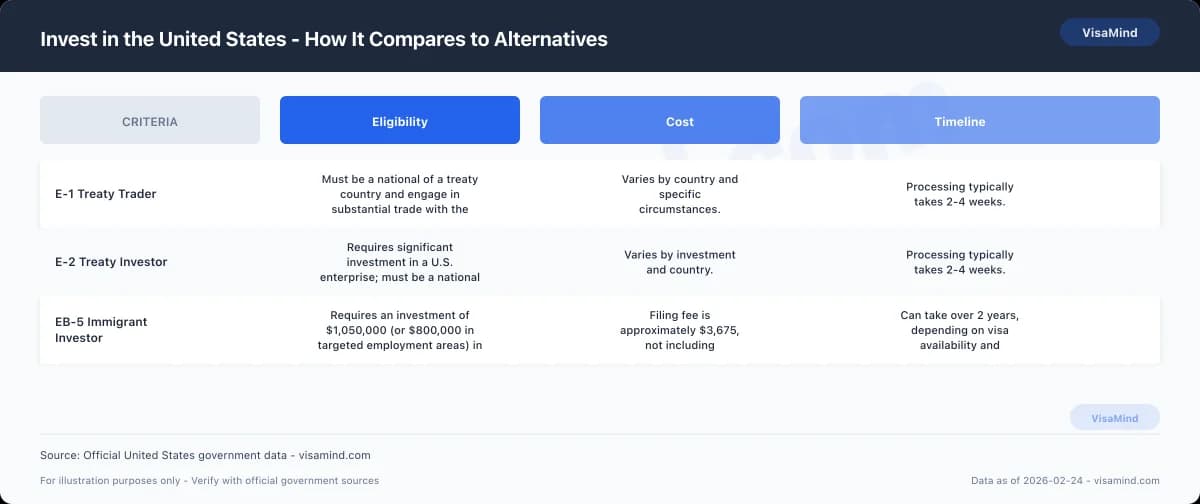
When you are considering moving to the United States for work or investment purposes, it's crucial to understand how the 'Invest in the United States' form stands against other visa options. Below is a comparison of some key visa types available for investors and employees looking to work in the U.S.
| Visa Type | Eligibility | Cost | Timeline |
|---|---|---|---|
| E-1 Treaty Trader | Must be a national of a treaty country and engage in substantial trade with the United States. | Varies by country and specific circumstances. | Processing typically takes 2-4 weeks. |
| E-2 Treaty Investor | Requires significant investment in a U.S. enterprise; must be a national of a treaty country. | Varies by investment and country. | Processing typically takes 2-4 weeks. |
| EB-5 Immigrant Investor | Requires an investment of $1,050,000 (or $800,000 in targeted employment areas) in a new commercial enterprise that creates at least 10 full-time jobs. | Filing fee is approximately $3,675, not including additional legal or administrative fees. | Can take over 2 years, depending on visa availability and processing times. |
Which Visa is Best for You?
-
E-1 and E-2 Visas: These nonimmigrant visas are ideal if you are from a treaty country and are looking to engage in trade or invest a substantial amount in the U.S. They offer a quicker processing time and the ability to renew indefinitely as long as the trade or investment is ongoing.
-
EB-5 Visa: This immigrant visa is suitable if you are looking for a permanent residency option through significant investment. It requires a higher financial commitment and a longer timeline but ultimately leads to a green card.
What Are the Key Differences?
-
Investment Requirements: The EB-5 requires a significant capital investment, whereas the E-1 and E-2 focus more on trade volume or investment in an enterprise.
-
Residency Outcomes: The EB-5 leads to permanent residency, while E-1 and E-2 are nonimmigrant visas that allow you to live in the U.S. as long as your trade or investment activities continue.
-
Processing Time: Nonimmigrant visas like E-1 and E-2 are faster to obtain compared to the EB-5, which involves a more complex approval process.
For more detailed information on these options and to determine which is most suitable for your situation, you can explore U.S. Employment Immigration Overview. Understanding these distinctions can help guide you in making the best decision for your immigration goals.
The Application Process
#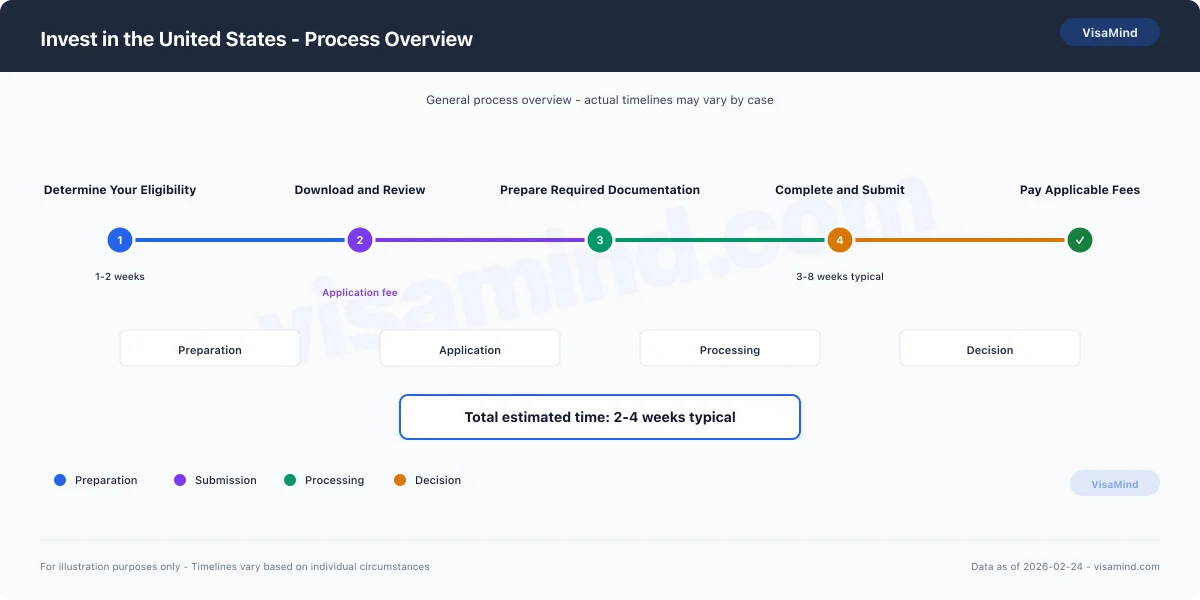
Step-by-Step Guide to the Application Process
-
Determine Your Eligibility
Begin by confirming that you meet the eligibility criteria for the Invest in the United States program. If you are currently in the U.S. under a lawful nonimmigrant status without employment authorization, consider applying for a change of status to a classification that permits employment. Alternatively, if you are eligible, you can apply for an adjustment of status to become a lawful permanent resident. Specific classifications, such as E-1, E-2, or an alien with extraordinary ability, may allow you to self-petition.
-
Download and Review Forms
Access the current Invest in the United States form and accompanying instructions from the USCIS website. Carefully review the instructions related to your specific eligibility category before proceeding. This ensures that you understand the required documentation and specific steps for your application.
-
Prepare Required Documentation
Gather all necessary documents to support your application. This includes evidence of your current immigration status and proof of eligibility for the requested employment authorization. Ensure that all documents are complete and accurate to avoid delays in processing.
-
Complete and Submit the Application
Complete all sections of the application form, ensuring that you sign and date where required. Submit the form along with the necessary supporting evidence. If filing within the United States, submit your application to the appropriate USCIS service center.
-
Pay Applicable Fees
Pay any required fees associated with your application. The amount may vary depending on the specific visa classification and whether you are applying for a change of status or adjustment of status. Check the USCIS fee schedule for the most up-to-date information.
-
Await Decision and Prepare for Next Steps
After submitting your application, wait for a decision from USCIS. Processing times can vary, and you can check current timelines through the Visa Processing Times Explained guide. If approved, follow any additional instructions provided by USCIS, such as attending an interview or providing biometric data.
What If You Are Applying from Outside the U.S.?
-
File a Petition if Required
If your classification requires a petition, file it with the appropriate U.S. agency before applying for a visa.
-
Apply for a Visa
If residing outside the United States, you must apply for a visa through the U.S. Department of State. Complete the necessary forms, such as the DS-160, and schedule an interview at a U.S. consulate or embassy.
-
Prepare for Your Visa Interview
Gather all required documents for your visa interview. Refer to the US Visa Interview Prep guide for detailed information on preparing for your interview, including what to expect and common questions.
Documents and Evidence
#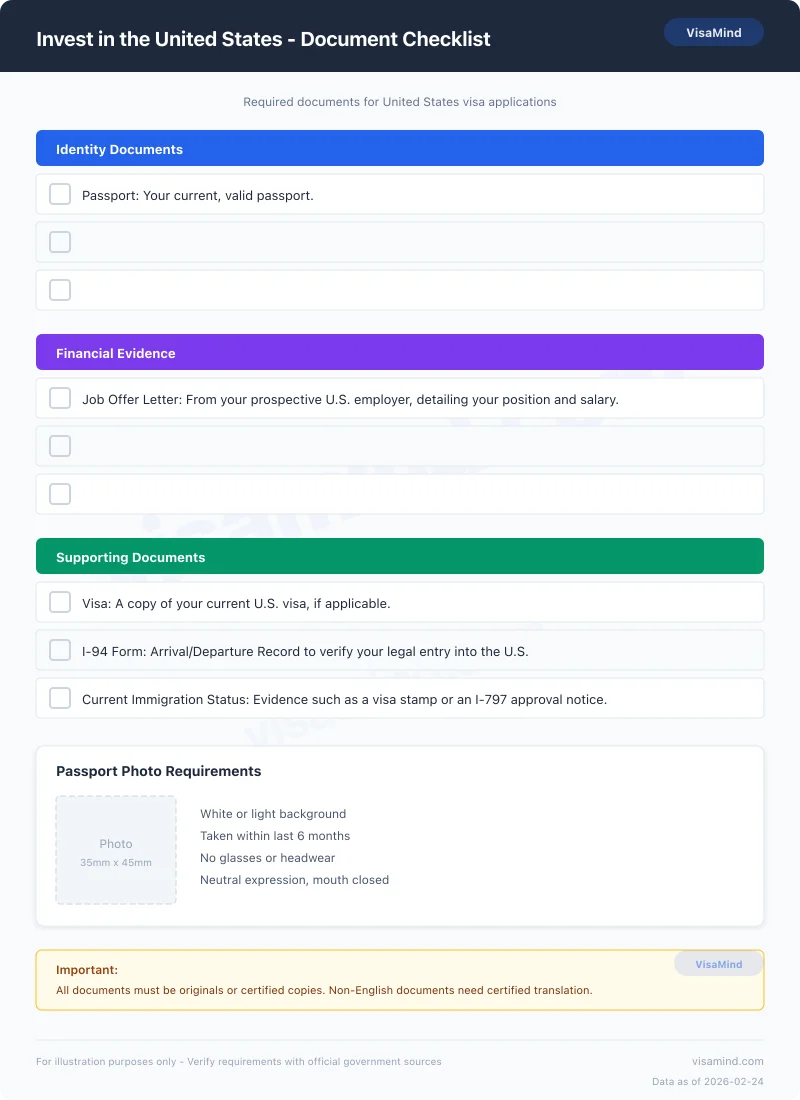
Required Documents for "Invest in the United States" Form
When applying for employment-based nonimmigrant and immigrant visa classifications, you need to gather and prepare several essential documents. These documents serve as evidence of your eligibility and help facilitate the application process.
Personal Identification and Immigration Status
- Passport: Your current, valid passport.
- Visa: A copy of your current U.S. visa, if applicable.
- I-94 Form: Arrival/Departure Record to verify your legal entry into the U.S.
- Current Immigration Status: Evidence such as a visa stamp or an I-797 approval notice.
Employment and Financial Documentation
- Job Offer Letter: From your prospective U.S. employer, detailing your position and salary.
- Proof of Investment: For E-1 and E-2 visas, evidence of substantial trade or investment in a U.S. enterprise.
- Business Plan: If applicable, detailing your investment or business venture in the U.S.
Supporting Evidence
- Educational Credentials: Diplomas, transcripts, or certificates relevant to your employment.
- Professional Experience: Letters from previous employers or professional references.
- Tax Returns: Previous year's tax returns if you have been residing in the U.S.
Are Translations Required?
If any of your documents are not in English, you must provide certified translations. This ensures that all information is accurately understood by U.S. immigration authorities.
- Certified Translation: A signed statement from the translator confirming the accuracy of the translation.
- Original and Translated Document: Submit both the original document and its certified translation.
How to Submit Your Application
Follow these steps to ensure your application is complete and submitted correctly:
- Download the Form: Obtain the invest-in-us form and instructions from the official USCIS website.
- Complete the Form: Fill out all required sections. Ensure accuracy and completeness to avoid delays.
- Gather Required Documents: Assemble all identification, financial, and supporting documents.
- Review and Sign: Carefully review your application and sign it as required.
- Submit the Application: Send your completed application and documents to the appropriate USCIS address.
Potential Pitfalls
Failure to comply with all conditions of your employment authorization and the terms of your admission to the United States can lead to complications. For more information on maintaining your status, refer to the US Employment Immigration Overview and Change Status Vs Extend Stay.
Costs and Financial Thresholds
#Costs and Financial Thresholds for Investing in the U.S.
When considering investing in the United States, it's crucial to understand the various financial requirements, including application fees, salary thresholds, and minimum investment amounts. Below, you'll find a comparison of key employment-based visas that cater to investors and entrepreneurs.
| Visa Type | Eligibility | Application Fee | Investment Minimum | Processing Timeline |
|---|---|---|---|---|
| E-1 Treaty Trader | Nationals of countries with which the U.S. maintains a treaty of commerce and navigation | $205 | No specific minimum, but must be substantial | Varies by U.S. consulate |
| E-2 Treaty Investor | Nationals of countries with which the U.S. maintains a treaty of commerce and navigation | $205 | Substantial investment in a bona fide enterprise, generally considered at least $100,000 | Varies by U.S. consulate |
| EB-5 Immigrant Investor | Open to any foreign nationals | $3,675 | $1,050,000 standard or $800,000 in a Targeted Employment Area | 12-24 months |
Key Financial Considerations
-
Application Fees: The fees range significantly depending on the visa type. For instance, the EB-5 Immigrant Investor Visa has a higher fee due to the complex nature of the application process and the significant investment involved.
-
Investment Minimums: The EB-5 Visa requires the highest investment, which could be reduced if the business is located in a Targeted Employment Area. Conversely, the E-1 and E-2 Visas do not have set minimums, though the investment must be substantial enough to ensure the success of the business.
How to Demonstrate Financial Capability
To demonstrate your financial capability for investment visas, you need to provide:
- Proof of Funds: Documentation showing the source of investment funds, such as bank statements or financial records.
- Business Plan: A comprehensive plan outlining how the investment will be used to develop and direct the business.
- Evidence of Investment: Receipts or proof of transactions showcasing the investment in the U.S. business.
For further guidance, reviewing resources like the US Visa Application Steps can provide clarity on navigating the application process. Understanding the financial landscape is essential for a successful investment journey in the United States.
Timeline and Processing
#What Are the Expected Processing Times?
When applying to Invest in the United States, the processing time can vary depending on the visa category and your specific circumstances. Generally, it ranges from a few months to over a year. For instance, processing times for the EB-5 Immigrant Investor Visa can range from 18 to 24 months. It is crucial to check the Visa Processing Times Explained for the most current estimates related to your application type.
Can You Expedite the Process?
Expedited processing is not universally available for all visa types under the 'Invest in the United States' program. However, certain situations might qualify for expedited processing if you can demonstrate a significant need. For example, if you are applying under the O-1 Visa for individuals with extraordinary ability, you might be eligible to request Premium Processing Service, which reduces processing time to 15 calendar days. More details on expedited options can be found in the US Visa Application Steps.
What Factors Affect Processing Speed?
Several factors can influence how quickly your application is processed:
- Completeness of Application: Ensure all sections are completed and required evidence is included.
- Eligibility Category: Different visa categories, such as E-1 Treaty Trader and E-2 Treaty Investor, have varying processing times.
- Current Immigration Status: If you are changing status from another nonimmigrant visa, such as F-1 Student Visa, the process might take longer.
- USCIS Workload: Seasonal fluctuations and current USCIS workload can impact timelines.
To avoid delays, carefully follow instructions specific to your visa category and consider consulting guides like Change Status Vs Extend Stay.
Summary Table: Processing Influencers
| Factor | Impact on Processing Time |
|---|---|
| Completeness of Application | Missing documents can cause delays |
| Eligibility Category | Different categories have varied timelines |
| USCIS Workload | High volume periods may slow processing |
| Current Immigration Status | Changing status may extend processing time |
Taking these factors into account will help you better estimate your application timeline and manage expectations effectively.
Rights and Conditions
#Work Rights and Employment Authorization
When you invest in the United States, you may be eligible to work under specific nonimmigrant and immigrant visa classifications. If you're currently in the U.S. on a visa that doesn't allow employment, you can apply to change your status to one that does. For instance, if you're classified as an E-1 or E-2 treaty trader or investor, you can self-petition for employment authorization. Additionally, those with extraordinary abilities may qualify under the O-1 visa classification.
Before beginning your employment in the U.S., you must:
- File a petition with the appropriate U.S. agency if your classification requires it.
- Provide evidence of your current immigration status and eligibility for employment authorization.
- Complete and submit the relevant forms, available on the official USCIS website.
Travel and Family Members
Traveling to and from the U.S. as an investor is generally straightforward, but certain conditions apply. If you live outside the U.S. and seek to work here, you must apply for a visa from the U.S. Department of State. Some travelers may be eligible for visa-free travel through the Visa Waiver Program, but this generally does not include work rights.
Family members, such as spouses and children, may accompany you under dependent visa categories like the F2 Dependent Visa or the J2 Dependent Visa, depending on your primary visa type. These visas may allow your family members to study or, in some cases, work in the U.S.
Restrictions and Compliance
It is crucial to comply with all conditions of your employment authorization and the terms of your admission to the United States. Failure to do so could result in revocation of your visa or future visa denials. Here are some key restrictions:
- You cannot work beyond the scope of your visa classification.
- Unauthorized employment can lead to severe penalties, including deportation.
- Ensure you understand the Us Entry Restrictions that may affect your travel plans.
For more detailed information, consider reviewing Us Adjustment Of Status Vs Consular Processing to understand your options for becoming a lawful permanent resident.
Common Mistakes
#What Are Common Mistakes When Applying for Employment-Based Visas?
-
Inadequate Documentation
- Failing to provide sufficient evidence of your current immigration status and eligibility for the requested employment authorization can lead to delays or denials. Ensure all necessary documents are submitted.
- Missing documents specific to your visa category, such as financial statements for an E-2 Treaty Investor Visa, can cause issues.
-
Incorrect Visa Classification
- Applying for the wrong visa classification is a frequent mistake. For example, if you're an investor, ensure you're applying under the correct category like E-1 Treaty Trader Visa or E-2 Treaty Investor Visa.
-
Non-compliance with Visa Conditions
- Once you have an employment-based visa, failing to comply with all conditions of your employment authorization and terms of your admission to the United States can result in revocation. Regularly review your visa conditions and consult resources like the US Visa Interview Checklist for compliance tips.
How to Avoid Pitfalls in the Application Process
-
Incomplete Forms
- Always download and complete the current "Invest in the United States" form and instructions from the official USCIS website. Double-check that all sections are filled out accurately before submission.
-
Lack of Understanding of Visa Requirements
- Each visa type has specific requirements. Familiarize yourself with these by reviewing guides such as the Why Visas Get Denied to understand common refusal reasons.
-
Ignoring Processing Times
- Failing to account for processing times can disrupt plans. Refer to Visa Processing Times Explained to set realistic timelines for your application.
Common Reasons for Visa Refusal
-
Misrepresentation of Information
- Providing inaccurate or misleading information can lead to immediate denial. Always ensure that all your submitted information is truthful and verified.
-
Inadequate Financial Proof for Investment Visas
- For visas like the EB-5 Immigrant Investor Visa, you must demonstrate the required financial investment. Be prepared with detailed financial documents to avoid refusal.
By being aware of these common mistakes and understanding how to avoid them, you increase your chances of a successful application for an employment-based visa in the United States.
Real Scenarios
#Navigating the 'Invest in the United States' Form
When considering investing in the United States, it's crucial to understand the 'Invest in the United States' form, designed for foreign nationals aiming to work in the U.S. through employment-based visas. This form outlines eligibility criteria for obtaining employment authorization and is a key step in your immigration process. If you are currently in the U.S. under a lawful nonimmigrant status that does not inherently provide employment authorization, you might be eligible to apply for a change of status to one that does.
Who Can Apply?
Eligibility to self-petition may apply if your classification falls under certain categories, such as an alien with extraordinary ability or a nonimmigrant E-1 or E-2 treaty trader or investor. For those living outside the United States, obtaining a visa through the U.S. Department of State is generally required before pursuing employment. The E 1 Visa and E 2 Visa are popular choices for treaty traders and investors, providing a pathway to work and invest in the U.S.
Steps to Follow
- File a Petition: If your classification requires it, ensure you file a petition with the appropriate U.S. agency.
- Download Forms: Obtain the current forms and instructions from the official USCIS website.
- Complete and Submit: Fill in all required sections, sign, and submit your form along with necessary evidence of your current immigration status.
Remember, failure to comply with the terms of your employment authorization can have significant consequences. To further understand the nuances of your visa options and requirements, explore our comprehensive guides on U.S. Visa Application Steps and Why Visas Get Denied.
FAQs
What documents do I need for an E-1 visa application?
Can I switch from an E-2 visa to an EB-5 visa in the United States?
What happens if I fail to comply with visa conditions?
Can family members accompany me on an E-2 visa?
Do I have work rights on an E-2 visa?
Is an E-2 visa a path to permanent residency?
Can I apply for a change of status from a tourist visa to an E-2 visa?
Sources
Last reviewed: February 24, 2026
VisaMind provides informational guidance only and is not a government agency. This is not legal advice. Requirements can change and eligibility depends on your specific facts. If your case is complex or high-stakes, consult a licensed immigration attorney.
Next steps
Requirements vary by nationality, purpose, timeline, and case details. VisaMind turns uncertainty into a sequenced checklist with official source citations.
Find my visa