Do You Need a Visa?
#Is a Visa Required to Visit the United States?
Did you know that citizens from 40 countries can travel to the United States for tourism or business without a visa? This is possible through the Visa Waiver Program (VWP), which allows eligible travelers to visit for up to 90 days without needing a traditional visa. However, not everyone qualifies for this program, and understanding your eligibility is key to a successful visit.
Exploring the Visa Waiver Program
The Visa Waiver Program is a popular option for short-term visitors, but it comes with specific requirements:
- Eligibility: Only travelers from participating countries can use the VWP. You must hold an electronic passport and intend to stay in the U.S. for 90 days or less for business or tourism.
- Authorization Process: Before boarding, you must apply for travel authorization through the Electronic System for Travel Authorization (ESTA). This is a separate process from obtaining a visa and requires you to provide personal identification details and your travel itinerary.
- Important Note: Failing to apply through the correct system may lead to delays or denial of entry.
Discover the list of Visa Waiver Program countries.
When Is a Visa Necessary?
If you're not from a VWP country or plan to stay longer than 90 days, you will need a visa. There are several types designed for different purposes:
- B1/B2 Visitor Visas: These are the most common visas for travelers not eligible for the VWP. The B1 Visa is for business, while the B2 Visa is for tourism. Learn more about the B1/B2 Visitor Visas.
- F1/F2 Visas: If your purpose is education, an F1 Visa might be necessary. The F2 Visa is for dependents of F1 visa holders. More about the F1 Student Visa.
- H-1B Visa: For those seeking employment in the U.S., the H-1B Visa is essential. Check out the H1B Document Checklist.
Steps to Obtain a Visa
- Determine the Visa Type: Identify the appropriate visa for your visit.
- Complete Form DS-160: This is the online application form for a U.S. nonimmigrant visa. Access the DS-160 form.
- Schedule an Interview: Most applicants between 14 and 79 years old must attend a visa interview.
- Prepare Your Documents: Gather all required documentation, including your passport, travel itinerary, and additional evidence supporting your application.
For more detailed steps, visit the US Visa Application Steps.
Understanding these options ensures you choose the right path and prepare the necessary documentation, paving the way for a hassle-free visit to the United States.
Types of Visitor Visas
#
Types of Visitor Visas to the United States
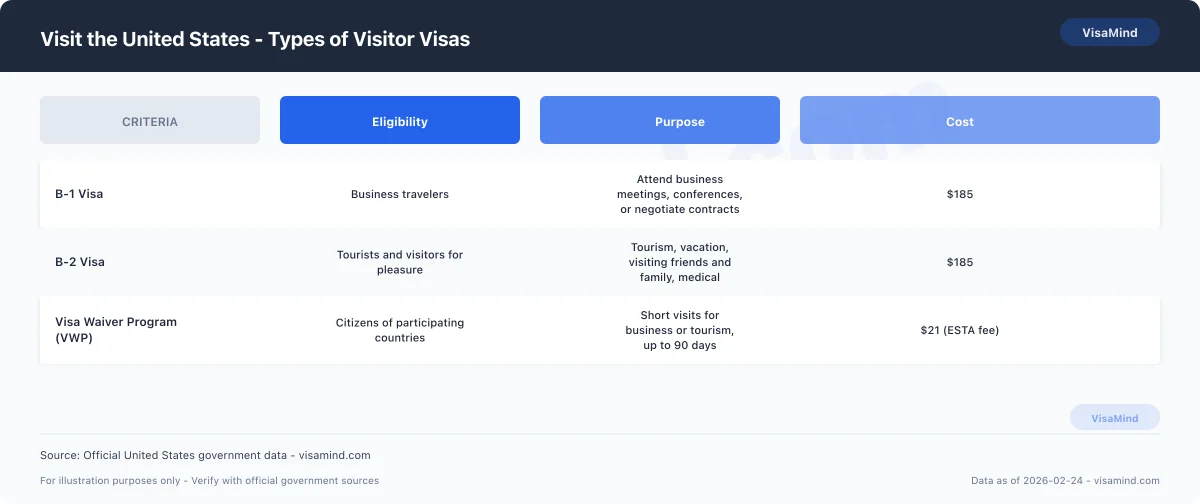
When planning a visit to the United States, it's important to understand the types of visitor visas available. Each visa type serves different purposes and has specific eligibility criteria. Here’s a detailed comparison of the primary visitor visas.
| Visa Type | Eligibility | Purpose | Cost | Processing Time |
|---|---|---|---|---|
| B-1 Visa | Business travelers | Attend business meetings, conferences, or negotiate contracts | $185 | Varies by location; typically 3-5 weeks |
| B-2 Visa | Tourists and visitors for pleasure | Tourism, vacation, visiting friends and family, medical treatment | $185 | Varies by location; typically 3-5 weeks |
| Visa Waiver Program (VWP) | Citizens of participating countries | Short visits for business or tourism, up to 90 days | $21 (ESTA fee) | Immediate to 72 hours |
Key Differences Between Visitor Visas
What Are the Eligibility Criteria?
-
B-1 and B-2 Visas: These visas require a formal application process through the DS-160 form. You must demonstrate ties to your home country, such as employment or family, to prove your intention to return.
-
Visa Waiver Program: Only available to citizens of specific countries. You must apply for travel authorization through the Electronic System for Travel Authorization (ESTA).
Costs and Processing Times
The B-1 and B-2 Visas have an application fee of $185. Processing times can vary significantly depending on the consulate but generally range from 3 to 5 weeks. In contrast, the Visa Waiver Program is much quicker, with an ESTA application fee of $21 and approval typically within 72 hours.
Considerations for Choosing a Visa
-
Purpose of Visit: Determine whether your visit is for business, leisure, or medical purposes. This will direct you towards either a B-1, B-2, or the VWP if eligible.
-
Duration of Stay: If your visit is longer than 90 days, you will need a B-1 or B-2 visa, as the VWP only allows stays up to 90 days.
-
Frequency of Travel: Frequent travelers might benefit from the VWP due to its streamlined process and lack of a formal visa application.
Understanding these key differences will help you select the appropriate visa for your visit to the United States. For more information on how to apply, you can refer to the US Visa Application Steps.
What You Need to Apply
#
Required Documents for a Visitor Visa
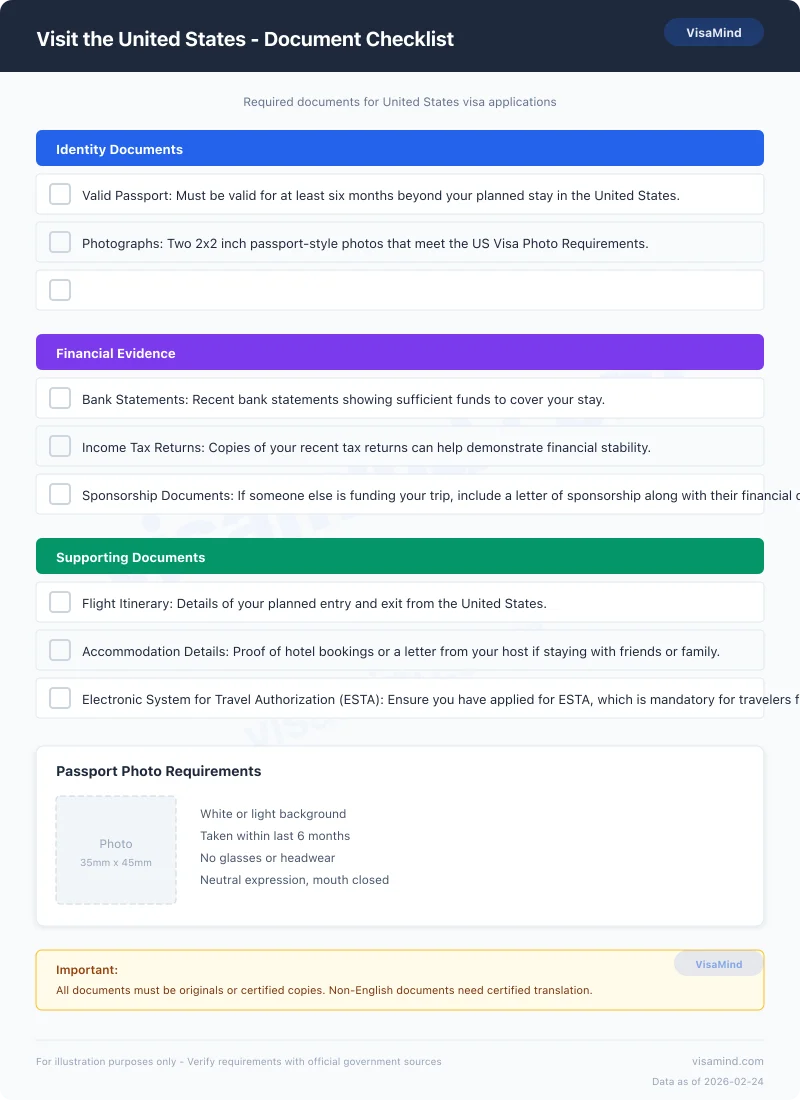
When applying for a visitor visa to the United States, you need to ensure that you have all the necessary documents ready for submission. Here's a detailed list of what you'll need:
Personal Identification
- Valid Passport: Must be valid for at least six months beyond your planned stay in the United States.
- Photographs: Two 2x2 inch passport-style photos that meet the US Visa Photo Requirements.
Financial Proof
- Bank Statements: Recent bank statements showing sufficient funds to cover your stay.
- Income Tax Returns: Copies of your recent tax returns can help demonstrate financial stability.
- Sponsorship Documents: If someone else is funding your trip, include a letter of sponsorship along with their financial documents.
Travel Itinerary
- Flight Itinerary: Details of your planned entry and exit from the United States.
- Accommodation Details: Proof of hotel bookings or a letter from your host if staying with friends or family.
Additional Country-Specific Requirements
Some countries have specific additional documentation requirements. It's important to check if there are any particular forms or evidence required based on your nationality. You can refer to the US Visa Waiver Program Countries to see if your country is part of the program.
For Visa Waiver Program (VWP) Countries
- Electronic System for Travel Authorization (ESTA): Ensure you have applied for ESTA, which is mandatory for travelers from VWP countries.
- DS-160 Confirmation: If required, complete and bring the DS-160 form as part of your application. More details can be found in the DS-160 form guide.
How to Submit Your Application
Once you have gathered all your documents, it's time to submit your application:
- Complete the Form: Use the Electronic System for Travel Authorization (ESTA) or the DS-160 for non-VWP countries.
- Review Instructions: Download and carefully review the instructions from the official USCIS website tailored to your eligibility category.
- Submit Application: Ensure all sections are completed, signed, and submitted with the required evidence. Avoid delays by using the correct system.
For more detailed steps on the application process, refer to the US Visa Application Steps.
By preparing these documents and following the outlined steps, you increase your chances of a smooth application process for visiting the United States.
The Application Process
#
Online Application vs. Embassy Application
When planning a visit to the United States, you have the option to apply for a visitor visa or use the Visa Waiver Program (VWP). Here's how you can navigate the application process:
Online Application via ESTA
-
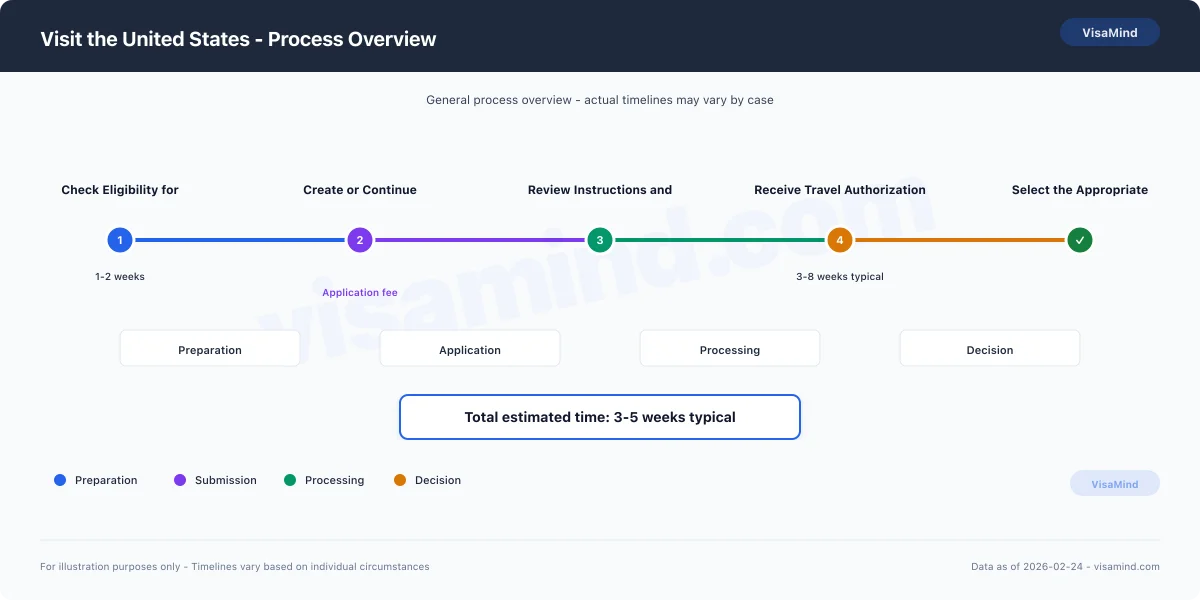
Check Eligibility for VWP: If you're from a participating country, you may be eligible for the Visa Waiver Program, which allows you to travel to the U.S. for tourism or business for up to 90 days without a visa. Confirm your eligibility by reviewing the U.S. Visa Waiver Program Countries.
-
Create or Continue Your ESTA Application: Access the Electronic System for Travel Authorization (ESTA) to begin a new application or continue an existing one. You'll need to provide personal identification details and your travel itinerary.
-
Review Instructions and Submit: Carefully review the instructions related to your eligibility category on the official USCIS website. Complete all required sections, sign, and submit your application along with any necessary evidence.
-
Receive Travel Authorization: Once your application is processed, you will receive your travel authorization. Ensure you have this documentation prior to your departure to the United States.
Embassy Application
For those who are not eligible for the VWP or prefer a different type of visitor visa, such as a B-1 or B-2 visa, follow these steps:
-
Select the Appropriate Visa Type: Determine whether a B-1 (business) or B-2 (tourism) visa suits your travel needs. For more details, refer to the B1 B2 Visitor Visa Checklist.
-
Complete the DS-160 Form: This form is a mandatory online application for a U.S. non-immigrant visa. Make sure all information is accurate and includes your travel plans.
-
Schedule an Appointment: Book an appointment at a U.S. Embassy or Consulate. Be prepared for an interview and have all required documents ready, including your DS-160 confirmation page and a valid passport.
-
Attend the Visa Interview: During your interview, you may be asked about your travel intentions and financial solvency. It's essential to demonstrate your intent to return to your home country after your visit.
-
Pay the Visa Application Fee: Fees vary depending on the visa type and country of application. Check the Visa Processing Times Explained to understand timelines and costs.
VFS Centers and Appointments
VFS centers are authorized to handle visa application submissions, offering a streamlined process for applicants:
-
Locate a VFS Center: Find a VFS center near you that supports U.S. visa applications. These centers facilitate document submission and biometric data collection.
-
Book an Appointment: Schedule an appointment through the VFS website for document submission and biometric services. Ensure you have all required documentation as per the checklist.
-
Submit Documents and Biometrics: Visit the VFS center at your appointment time to submit your documents and complete biometric collection, which includes fingerprinting and a photograph.
By following these steps, you can efficiently navigate the application process for visiting the United States, whether through the online ESTA system or by securing a visa at an embassy. For further guidance, explore the U.S. Visa Application Steps for more detailed instructions.
At the Border
#What to Expect at U.S. Immigration?
When you arrive at a U.S. port of entry, you will go through several steps during the immigration process. Each step is crucial to ensure your entry into the United States is smooth and meets all legal requirements. Being prepared can help expedite this process.
Fingerprinting and Photograph
One of the first things you can expect is to have your fingerprints taken. This is a standard procedure for visitors and is part of the United States' security measures. You will also have your photograph taken during this stage. These biometric screenings help verify your identity and match it with the details submitted in your Electronic System for Travel Authorization (ESTA) or visa application.
- Fingerprinting: Done digitally; takes only a few minutes.
- Photograph: Taken at the immigration kiosk; ensure you are facing the camera directly.
Immigration Interview
After biometric screening, you may be required to attend a brief interview with a Customs and Border Protection (CBP) officer. This is generally a short conversation where the officer asks about your travel intentions, duration of stay, and accommodation plans. It's important to answer truthfully and provide any supporting documents if requested, such as your travel itinerary or return ticket.
Possible Interview Questions:
- What is the purpose of your visit?
- How long do you intend to stay in the United States?
- Where will you be staying during your visit?
E-Gates: Are They an Option?
For travelers from Visa Waiver Program countries who have already registered with ESTA, e-gates may be an option. These automated kiosks streamline the entry process by allowing eligible travelers to scan their passports and complete the entry process quickly without direct interaction with a CBP officer.
E-Gate Process:
- Scan Passport: Insert your passport into the kiosk reader.
- Biometric Verification: Follow prompts for fingerprint scanning.
- Entry Receipt: Receive a printout that you present to a CBP officer for validation.
Important Considerations
- Prepare Documents: Keep your passport, ESTA approval, or visa easily accessible.
- Answer Honestly: Truthful responses help in smooth processing.
- Follow Instructions: Pay attention to signs and instructions at the port of entry.
For more detailed preparation, you can refer to the US Port of Entry Guide, which provides additional insights into what you can expect upon arrival in the United States.
Extending Your Stay
#Can You Extend Your Stay as a Visitor?
If you're visiting the United States on a B-1 or B-2 visitor visa, you might be wondering if it's possible to extend your stay beyond the initial period granted. Fortunately, extensions are indeed possible under certain conditions. To request an extension, you must file Form I-539, Application to Extend/Change Nonimmigrant Status, with the United States Citizenship and Immigration Services (USCIS). It's crucial to apply for an extension before your current authorized stay expires. Typically, you should aim to submit your application at least 45 days before the expiration date of your I-94 Arrival/Departure Record.
How to Apply for an Extension
When applying for an extension, there are a few key steps you need to follow:
-
Review the Eligibility Criteria: Ensure that you meet the requirements for extending your stay. This includes having a valid reason for the extension, such as unforeseen circumstances or additional time needed for tourism.
-
Complete Form I-539: Download the form and instructions from the official USCIS website to avoid any delays. Fill out the form thoroughly, ensuring all personal information, travel itinerary, and the reason for your extension are clearly detailed.
-
Prepare Supporting Documents: Gather necessary documents, such as a copy of your I-94, proof of financial support during your extended stay, and any other evidence that supports your request.
-
Pay the Application Fee: The fee for processing Form I-539 is $370, plus an additional $85 for the biometric services fee, if applicable. Confirm the total fee on the USCIS website as it may vary.
-
Submit Your Application: File the completed form, along with the required documents and fee, to the designated USCIS address.
What If Your Extension Is Denied?
If your application to extend your stay is denied, you must leave the United States before your current period of authorized stay expires. Overstaying can lead to serious consequences, including bans on re-entering the U.S. in the future. For more information on what happens if you overstay your visa, you can refer to the US Visa Overstay Consequences guide.
For travelers under the Visa Waiver Program, note that extensions are not permitted. If you believe you might need more time in the U.S., consider applying for a B-1/B-2 visitor visa instead. For further details on these visas, you can consult the B1 B2 Visitor Visa Checklist.
Common Mistakes Visitors Make
#Overstaying Your Visa
- Understand Your Visa's Validity: Visitor visas, such as the B1/B2, typically allow you to stay in the U.S. for up to six months. Overstaying can lead to serious consequences, including being barred from re-entry.
- Track Your Authorized Stay: The duration of your stay is determined by the U.S. Customs and Border Protection officer at the port of entry. Refer to your I-94 form for the exact date you must leave.
- Consequences of Overstaying: Overstaying your visa can result in a ban from visiting the U.S. for three to ten years depending on the length of the overstay. For more information, you might want to explore the U.S. Visa Overstay Consequences.
Working on a Tourist Visa
- Prohibited Activities: Engaging in any form of employment while on a visitor visa is prohibited. The B1/B2 visas are for tourism and business-related activities only.
- Alternative Options: If you wish to work in the U.S., consider applying for a work visa such as the H1b or L1a.
Financial Preparedness
- Proof of Sufficient Funds: You must demonstrate that you have enough financial resources to cover your stay in the U.S. without working.
- Documentation: Bring bank statements, sponsorship letters, or other financial documents to your visa interview or when entering the U.S. to prove financial stability.
- Insufficient Funds: Failing to show you have adequate funds can lead to visa denial or denial of entry upon arrival. For more details, review the B1/B2 Visitor Visa Checklist.
By avoiding these common pitfalls, you can ensure a smoother experience during your visit to the United States. Whether you're visiting for leisure or business, understanding these restrictions and requirements is crucial for a successful trip.
Real Scenarios
#Navigating the Visa Waiver Program
Imagine you're a traveler from Germany planning a two-week vacation to the United States. Fortunately, Germany is one of the participating countries in the Visa Waiver Program (VWP), allowing you to bypass the traditional visa application process. Instead, you will use the Electronic System for Travel Authorization (ESTA), which streamlines your travel authorization for tourism or short-term visits. To start, you'll need to create a new application or continue an existing one in the ESTA system. Be sure to download the current visit-us form and instructions from the official USCIS website to guide you through the process. It's crucial to review the instructions for your specific eligibility category before proceeding.
What Information Do You Need to Provide?
As you fill out your application, you'll be asked for personal identification details and your travel itinerary. This ensures that your information is up-to-date and accurate, which is vital to avoid potential delays. You must complete all required sections of the application, sign it, and submit it along with any required evidence. Missing out on providing key information or failing to submit the application through the correct system may result in significant processing delays.
Exploring Other Visa Options
If your travel plans extend beyond the 90-day limit of the VWP, or if your country is not part of the program, you might need to consider other visa options like the B1/B2 Visitor Visa. The B1/B2 visa caters to those visiting the U.S. for both business and tourism purposes, and you can find a comprehensive checklist in the B2 Visitor Tourism Guide. Additionally, if you are contemplating a longer stay, such as for work or study, exploring visas like the H1b for skilled workers or the F1 Student Visa might be beneficial.
Remember to consider the Visa Processing Times Explained to plan accordingly and avoid any last-minute surprises. Whether you are visiting for leisure or business, understanding your eligibility and the application process will help ensure a smooth entry into the United States.
FAQs
What happens if I stay in the United States longer than my visa allows?
Can I switch from a B1 visa to a B2 visa in the United States?
What documents do I need to apply for a United States visitor visa?
Can I work in the United States on a visitor visa?
What are common mistakes when applying for a United States visa?
Can I extend my stay in the United States on a visitor visa?
Can I switch from a tourist visa to a work visa in the United States?
Sources
Last reviewed: February 24, 2026
VisaMind provides informational guidance only and is not a government agency. This is not legal advice. Requirements can change and eligibility depends on your specific facts. If your case is complex or high-stakes, consult a licensed immigration attorney.
Next steps
Requirements vary by nationality, purpose, timeline, and case details. VisaMind turns uncertainty into a sequenced checklist with official source citations.
Find my visa