What the IR-5 Immigrant Visa (Parent of US Citizen) Covers
#The IR-5 Immigrant Visa lets a U.S. citizen sponsor a parent for permanent residence. It’s a family-based immigration option in the immediate relative category, requiring a petition with USCIS and visa processing through the U.S. Department of State.
Who this form is for
The IR-5 category is for a parent of a U.S. citizen who is at least 21 years old. The U.S. citizen child must start the process.
This visa isn’t available to lawful permanent residents sponsoring parents. The petitioner must be a U.S. citizen to file Form I-130 with USCIS.
Once USCIS approves the petition, your parent applies for the immigrant visa. If your parent is abroad, they complete Form DS-260 through the U.S. Department of State.
Key eligibility points:
- You’re a U.S. citizen.
- You’re at least 21 years old.
- The beneficiary is your parent.
| Requirement | Who Must Meet It |
|---|---|
| U.S. citizenship | You (the petitioner) |
| Minimum age of 21 | You (the petitioner) |
| Qualifying parent relationship | Your parent (the beneficiary) |
Purpose and legal basis
The IR-5 visa lets your parent immigrate permanently to the United States as your immediate relative. This falls under U.S. family-based immigration law.
You start by filing Form I-130 with USCIS to prove the parent-child relationship. USCIS reviews the petition for eligibility.
After approval, the case moves to immigrant visa processing with the U.S. Department of State. Your parent submits Form DS-260 and attends a visa interview at a U.S. consulate or embassy.
You’ll also submit Form I-864, Affidavit of Support, to accept financial responsibility for your parent. Fees change from time to time; check with USCIS and the U.S. Department of State for the latest details.
Who may be sponsored
You can sponsor:
- Your biological parent
- Your adoptive parent
You must be a U.S. citizen and at least 21 years old at the time of filing. If you don’t meet both, USCIS won’t approve the petition.
The IR-5 category applies to one parent per petition. To sponsor both parents, file a separate Form I-130 for each.
| Sponsor | Eligible Parent |
|---|---|
| U.S. citizen age 21+ | Biological parent |
| U.S. citizen age 21+ | Adoptive parent |
This visa doesn’t apply to other relatives. It’s strictly for your qualifying parent under the immediate relative category.
Eligibility Requirements
#To qualify for an IR-5 parent visa, you must meet age and citizenship rules and prove a valid parent‑child relationship. You’ll also need to document physical presence requirements if your citizenship was acquired at birth through a parent.
Sponsor qualification (age, status)
You must be a U.S. citizen to file for a parent under the IR-5 category. Lawful permanent residents can’t petition for parents.
You need to be at least 21 years old when you file Form I-130 with USCIS. Petitions filed before you turn 21 will be denied.
You’ll provide:
- Proof of U.S. citizenship (birth certificate or naturalization evidence)
- Government-issued ID
- Biographical info for you and your parent
- Evidence that you can submit Form I-864 later
After Form I-130 is approved, your parent completes Form DS-260 through the Department of State for immigrant visa processing.
| Requirement | Standard |
|---|---|
| Minimum age | 21 at time of I-130 filing |
| Immigration status | U.S. citizen only |
| Petition form | Form I-130 |
| Visa application form | Form DS-260 |
| Financial sponsorship | Form I-864 required |
Fees do change—refer to USCIS and Department of State sources for updates.
Parent-child relationship rules
You must prove a qualifying parent-child relationship. The burden of proof falls on you.
Submit:
- Your birth certificate listing your parent
- Legal records for name changes, if any
- Biographical details for both you and your parent
- Evidence clarifying any out-of-wedlock birth circumstances, if relevant
If you were born out of wedlock to a U.S. citizen mother, citizenship transmission rules depend on your date of birth. For births between December 24, 1952, and June 11, 2017, your mother must have been physically present in the U.S. or its territories for a continuous one-year period before your birth.
For births on or after June 12, 2017, your U.S. citizen mother must have been physically present in the U.S. or its territories for five years before your birth, with at least two years after age 14.
USCIS checks these facts closely when reviewing Form I-130.
Physical presence and citizenship details
If you got U.S. citizenship at birth through a citizen parent, you’ll need to show your parent met physical presence requirements before your birth.
For a U.S. citizen father, he must have been physically present in the U.S. or its territories for five years before your birth, including at least two years after age 14.
For a U.S. citizen mother:
| Child’s Date of Birth | Physical Presence Requirement |
|---|---|
| Dec 24, 1952 – June 11, 2017 | Continuous 1 year before birth |
| On or after June 12, 2017 | 5 years before birth, including 2 after age 14 |
You’ll need to document:
- Where and when your parent lived in the U.S.
- Dates of physical presence
- Evidence supporting those dates
Acceptable proof might include school records, employment history, or other official documentation. USCIS checks whether you lawfully acquired citizenship before you can petition for your parent.
Required Documents
#You must prove you’re a U.S. citizen eligible to sponsor and that the parent named in the petition is actually your parent. USCIS reviews these documents with Form I-130, and the Department of State checks them again during consular processing with Form DS-260.
Proof of sponsor citizenship
Submit clear proof of U.S. citizenship when filing Form I-130 with USCIS. Lawful permanent residence isn’t enough for an IR-5 parent visa.
Acceptable evidence:
- U.S. birth certificate
- Naturalization certificate
- Other official proof of U.S. citizenship
Your document should show your full legal name and confirm your citizenship. If you became a citizen through naturalization, include a copy of your certificate.
USCIS also checks your citizenship documentation as part of the petition review. For questions about acceptable versions or replacements, refer to USCIS guidance.
Evidence of parent-child relationship
You must show the biological or legal relationship between you and your parent. USCIS uses this to decide if the relationship qualifies under family-based immigration.
Common documents:
- Your birth certificate listing your parent’s name
- Adoption records, if you were legally adopted
- Other official records establishing the parent-child relationship
Your birth certificate should clearly list both your name and your parent’s name. If you were adopted, provide official adoption documentation.
| Relationship Type | Primary Evidence |
|---|---|
| Biological parent | Birth certificate naming parent |
| Adoptive parent | Legal adoption decree or records |
Make sure names match across all documents. Inconsistencies or missing info can slow down USCIS processing.
Applicant (beneficiary) biographical documents
Your parent, as the beneficiary, needs to provide civil and identity documents during consular processing after USCIS approves Form I-130A. These support the immigrant visa application filed on Form DS-260.
Your parent should prepare:
- Official civil identity documents
- Birth records confirming identity
- Other biographical records for immigrant visa processing
The Department of State reviews these documents before the visa interview. After visa issuance, U.S. Customs and Border Protection (CBP) makes the final admission decision at the port of entry.
You’ll also submit Form I-864, Affidavit of Support, to show you can financially support your parent. Review USCIS’s document checklists and form instructions, as requirements can shift.
Evidence Checklist
#Submit clear, organized evidence with Form I-130, the financial sponsorship requirement, and the immigrant visa application. Missing or inconsistent documents can delay review by USCIS or the Department of State.
Financial evidence
You need to show you can financially sponsor your parent under family-based immigration rules. USCIS checks this when you submit Form I-864 after the immigrant visa interview is scheduled or when your parent files for adjustment of status.
Provide:
- A copy of your most recent U.S. federal income tax return
- Evidence of current employment (like an employment letter or recent pay stubs)
- Form I-864A, if you use a household member’s income
If you use a household member’s income, that person must complete and sign Form I-864A. Their income becomes legally available to support your parent.
| Situation | Required Form | Key Evidence |
|---|---|---|
| You qualify alone | Form I-864 | Recent federal tax return + employment proof |
| You need household income | Form I-864 + Form I-864A | Your tax return + employment proof + household member’s signed Form I-864A |
Check the latest instructions and fees with USCIS.
Supporting civil documents
You must prove both your U.S. citizenship and the parent-child relationship. These documents establish IR-5 eligibility.
Submit:
- Proof of your U.S. citizenship
- Proof of the parent-child relationship
- If applicable, a copy of your naturalization certificate if you became a citizen after filing Form I-130
- Evidence of your parent’s citizenship and physical presence, when required
If you already filed Form I-130, keep a copy of the receipt notice. Include a photocopy if it’s requested later.
All documents should be clear, legible copies unless USCIS or the Department of State asks for originals.
Form-specific attachments
Each form in the IR-5 process needs its own supporting documents. Don’t assume that submitting a document once covers every stage.
For Form I-130, include:
- Evidence of your U.S. citizenship or lawful permanent residence
- Documentation proving the parent-child relationship
For Form DS-260, follow Department of State instructions for required civil documents before the visa interview.
For Form I-864, attach:
- Your most recent federal income tax return
- Proof of current employment
- Form I-864A if you’re using household income
Check official form instructions from USCIS and the Department of State before filing. Requirements do change, and incomplete submissions can mean delays.
Application Process
#
You start the IR-5 parent visa process by filing a petition with USCIS. After approval, your parent either applies for an immigrant visa through the Department of State or seeks adjustment of status inside the United States.
Two-stage flow (petition then visa/adjustment)
The IR-5 process uses a two-step structure for family-based immigration.
First, you file Form I-130, Petition for Alien Relative, with USCIS. This establishes the qualifying parent-child relationship and confirms your intent to sponsor your parent.
Next, your parent either applies for an immigrant visa abroad through the U.S. Department of State (using Form DS-260), or, if eligible, applies to adjust status in the United States.
When completing Form I-130, select only one option in Part 4 (Question 61 or 62) to indicate whether your parent will pursue consular processing or adjustment of status. The case moves forward based on your selection after petition approval.
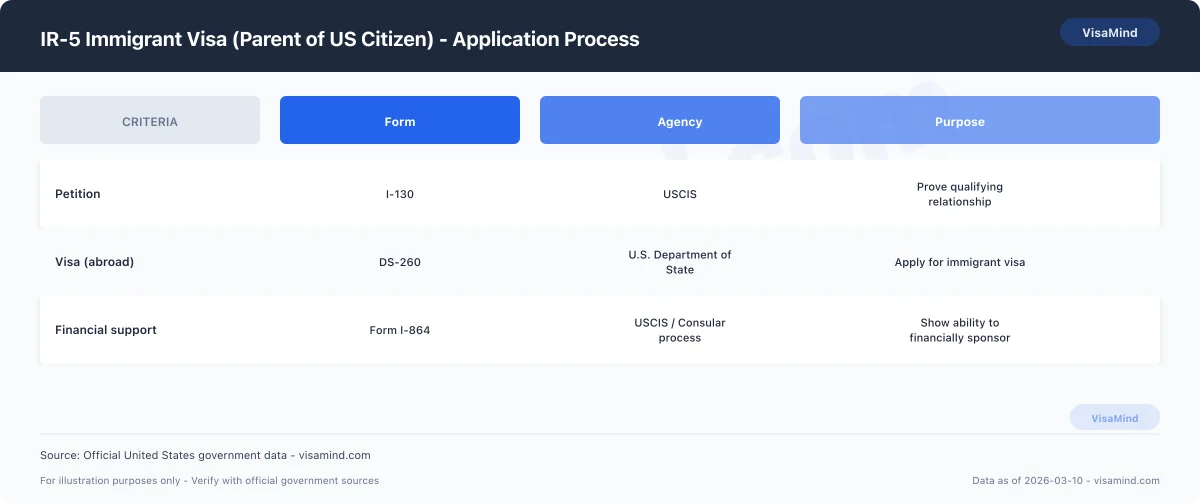
| Stage | Form | Agency | Purpose |
|---|---|---|---|
| Petition | I-130 | USCIS | Prove qualifying relationship |
| Visa (abroad) | DS-260 | U.S. Department of State | Apply for immigrant visa |
| Financial support | Form I-864 | USCIS / Consular process | Show ability to financially sponsor |
You must submit Form I-864, Affidavit of Support, during the visa or adjustment stage to demonstrate you meet financial sponsorship requirements.
Filing locations and online filing
If you live in the United States, file Form I-130 with USCIS. Filing instructions specify the correct mailing address or online filing option.
USCIS allows many petitioners to file Form I-130 online. When filing online, you create a USCIS online account and upload required documentation.
USCIS sends a receipt notice after submission. If you file by mail, send your petition to the address listed in the official Form I-130 instructions.
Filing locations can change, so verify the current address before mailing. Fees change, too—refer to the current fee schedule and payment instructions from USCIS.
Completing and submitting the form
Form I-130 collects detailed information about you, your parent, and your qualifying relationship.
Complete every required section. Don’t leave mandatory fields blank.
Pay attention to Part 4 (Question 61 or 62)—select only one option regarding consular processing or adjustment of status. Accuracy matters for names, dates of birth, and biographical details.
USCIS will reject an unsigned form. Review all answers for consistency before submitting.
Confirm you selected the correct processing option. Include the required filing fee or complete online payment.
Submit Form I-130 to USCIS and keep your receipt notice. The receipt number lets you track your case status.
When to Get Help
#Some IR-5 parent visa cases move without issue, but others stall due to preventable errors, missing documents, or status problems. Early recognition and correction can help avoid delays or rejections from USCIS or the U.S. Department of State.
Red flags and complex situations
Seek help if your case involves prior denials, missing civil documents, or inconsistent information across forms.
Discrepancies between Form I-130, Form DS-260, and supporting records often trigger requests for evidence or processing delays. Incomplete sections—like missing beneficiary information or relationship details—increase the risk of rejection.
Guidance is also needed if you submitted pages from different editions of Form I-130, failed to sign the petition, have documents not in English without certified translations, or feel uncertain about your proof of U.S. citizenship.
Family-based immigration depends on clear proof of the parent-child relationship. Weak or inconsistent documentation can delay approval at both the USCIS petition stage and the consular processing stage.
| Issue | Why It Matters |
|---|---|
| Mixed form editions | USCIS may reject the filing |
| Missing signature | Automatic rejection |
| Incomplete Part 4 | Affects processing decisions |
| No certified translation | Evidence may be disregarded |
If you notice any of these issues after filing, act quickly.
Common pre-filing pitfalls
Many IR-5 problems start before submission. Careless preparation leads to rejection notices and lost time.
Pay close attention to completing every required section of Form I-130 and accurately listing all family members.
Use the current form edition from USCIS and include all required supporting documents. Sign every required page.
At the National Visa Center stage, complete Form DS-261 (Choice of Address and Agent) promptly. Delays here can slow communication about the Form DS-260 immigrant visa application.
Financial sponsorship errors also cause problems. If your Form I-864, Affidavit of Support, is incomplete or inconsistent with your tax records, expect delays.
| Stage | Common Error | Result |
|---|---|---|
| I-130 filing | Missing relationship evidence | Rejection or delay |
| NVC processing | DS-261 not completed | Missed correspondence |
| I-864 review | Incomplete financial data | Processing hold |
Review each form line by line before filing.
Expert tips for tricky cases
Some situations require careful strategy, not just accurate paperwork.
If your parent is in the United States and may qualify to file Form I-485, Application to Register Permanent Residence or Adjust Status, consider whether concurrent filing with Form I-130 makes sense. Confirm eligibility before proceeding.
Your status as a U.S. citizen must be clearly documented. Petition category depends on your status, and incorrect proof can delay adjudication.
For document-heavy cases, provide primary civil documents first. Add secondary evidence if primary documents are unavailable.
Ensure every foreign-language document includes a full English translation and certification. Track communications from USCIS and the U.S. Department of State closely.
Respond to any request for evidence by the stated deadline. When you feel uncertain about eligibility, documentation gaps, or prior filing mistakes, professional guidance can prevent avoidable denials and repeated filings.
Your Rights After Approval
#Approval of the Form I-130 petition by USCIS moves your case into consular processing for the IR-5 parent visa. Your focus shifts to financial sponsorship, required forms, and preparing documents for the U.S. Department of State interview.
Sponsor obligations
When USCIS approves your I-130, you accept a binding financial role as the sponsor. You must show you have sufficient income to support your parent.
By signing Form I-864, Affidavit of Support, you agree to maintain financial support as required. This is a legal commitment.
Your household size directly affects the income requirement. Count yourself, your parent (the intending immigrant), any dependents listed on your tax return, and any other individuals you already sponsor.
If your income alone doesn’t meet the requirement, you may use a household member’s income. That person must sign Form I-864A and provide proof of income.
All information must match your I-130 and civil records. Inconsistent names, dates, or household numbers can delay or jeopardize visa issuance.
Affidavit of support and related forms
You must submit Form I-864 as part of the National Visa Center (NVC) stage, together with the Form DS-260 Immigrant Visa Application and civil documents. The case won’t move forward without it.
Prepare the affidavit and supporting documents before starting DS-260. The NVC reviews them together.
Include your most recent federal tax return, W-2s or equivalent income evidence, and proof of current employment or income.
Use the correct version of the form based on your situation:
| Form | When You Use It | Who Signs |
|---|---|---|
| I-864 | Standard form for most IR-5 cases | Sponsor |
| I-864A | When using a household member’s income | Household member + sponsor |
| I-864EZ | Limited simplified option (check eligibility carefully) | Sponsor |
All entries must be consistent with your petition and supporting records. Errors or mismatched data can lead to delays or refusal under Department of State review.
Practical next steps before interview
Once the NVC accepts your documents and fees, it schedules the immigrant visa interview with a U.S. consulate abroad. The U.S. Department of State controls this stage.
Before the interview, your parent must complete the online DS-260 accurately and fully. A required medical examination with an authorized physician is also necessary.
Collect all required police certificates. Use the exact spelling of names as shown on passports and civil documents across all forms.
Even minor spelling differences can cause processing delays. Gather originals and copies of civil documents early.
Monitor your case status through the NVC and respond promptly to any document requests. Incomplete submissions prevent the interview from being scheduled.
Fees and Processing Times
#You will pay multiple government fees, and you’ll wait through several stages before your parent receives an IR-5 immigrant visa. Processing depends on how USCIS handles the Form I-130 and how the U.S. Department of State schedules consular processing.
Typical processing windows
The IR-5 category falls under “U.S. citizen filing for a spouse, parent, or child under 21.” As of early 2026, USCIS reports I-130 processing times ranging from 17 to 87 months, depending on the service center.
The full process—petition, National Visa Center (NVC) stage, and consular interview—commonly takes about 12 to 18 months or longer. Actual timelines depend on workload and document accuracy.
| Stage | Agency | What Happens | Time Frame (Reported) |
|---|---|---|---|
| I-130 Petition | USCIS | Reviews and approves family relationship | 17–87 months (varies by center) |
| Form DS-260 & Civil Docs | U.S. Department of State (NVC) | Collects fees, affidavit, and documents | Varies by case volume |
| Interview & Visa Issuance | U.S. Department of State | Conducts immigrant visa interview | Depends on consulate capacity |
You can check current case-specific estimates using the USCIS processing times tool and Department of State updates.
Cost-related pitfalls and fee rules
Fees apply at multiple points: when you file Form I-130, when you submit the Form DS-260, and when you submit the Form I-864, Affidavit of Support. Fees change, and you must confirm current amounts using the fee schedule from USCIS and the Department of State.
Avoid these mistakes:
- Wrong fee or outdated form edition → USCIS may reject your I-130.
Check the current fee schedule.
-
Use the edition date listed on the USCIS form page.
-
Submitting Form DS-260 before paying required NVC fees → NVC delays your case.
Pay required fees first.
-
Then submit DS-260 and upload civil documents in the order instructed.
-
Insufficient income on Form I-864 → Request for Evidence (RFE) or refusal.
Meet at least 125% of the federal poverty guidelines using the current I-864P chart.
- Add a household member (Form I-864A) or a joint sponsor if needed.
Include your most recent tax transcript and proof of employment. If you are self-employed, provide business records.
How times vary by category and center
USCIS processing times vary sharply by family-based immigration category and service center. Immediate relative cases like IR-5 generally move faster than preference categories.
The table below shows reported I-130 ranges by category:
| Eligibility Category | Reported Range (Months) |
|---|---|
| U.S. citizen filing for spouse, parent, or child under 21 | 17–87 |
| Permanent resident filing for spouse or child under 21 | 49.5–213.5 |
| U.S. citizen filing for unmarried son/daughter 21+ | 50–198 |
| Permanent resident filing for unmarried son/daughter 21+ | 48–240 |
| U.S. citizen filing for married son/daughter | 47.5–178.5 |
| U.S. citizen filing for brother or sister | 95–240 |
The processing time depends on the service center handling your Form I-130, the family relationship category, whether USCIS issues an RFE, and the workload at the U.S. embassy or consulate handling the DS-260 interview.
Check your specific service center’s estimate directly through USCIS.
Form Contents and What the Form Collects
#The IR-5 process requires detailed personal data and proof of a qualifying parent-child relationship.
USCIS reviews the Form I-130 first. Later forms such as Form DS-260 and Form I-864 collect additional biographical and financial information.
Petitioner and beneficiary biographical data
Form I-130 requests identifying details about you, the U.S. citizen petitioner, and your parent, the beneficiary. You’ll need to provide full legal names, current addresses, marital status, and citizenship information.
USCIS uses this data to confirm your identity and to check that you qualify to file under family-based immigration. Proof of your U.S. citizenship is required.
After your petition is approved, your parent completes Form DS-260 for visa processing through the U.S. Department of State.
Expect to provide:
- Full legal names (no nicknames)
- Current residential addresses
- Marital status
- Citizenship status
- Other standard biographical details
| Form | Who Completes It | What It Collects |
|---|---|---|
| I-130 | U.S. citizen child | Petitioner and parent biographical data |
| DS-260 | Parent | Immigrant visa biographical details |
| I-864 | U.S. citizen child | Financial support information |
Every name and date must match your civil documents exactly.
Relationship and citizenship questions
USCIS requires solid proof that you’re the parent’s U.S. citizen child. The form asks about your relationship and your citizenship status.
You’ll need to submit:
- Proof of your U.S. citizenship
- Documents showing the parent-child relationship
- A marriage certificate if relevant
- A certified court order of legitimation if needed to establish a U.S. citizen father’s paternity
If you’re petitioning for a spouse in another context, you’d include a marriage certificate. For IR-5 parent cases, focus on proving the parent-child connection.
Only properly filed petitions with all required documents will be adjudicated by USCIS.
How to avoid rejected submissions
USCIS rejects incomplete or unsigned forms. Even a missing signature will trigger a rejection.
Before filing, check these points:
-
Sign and date every required section.
-
All names must match supporting documents exactly.
-
Include proof of citizenship and relationship.
Don’t mix up Form I-130 with Form I-140, which is for employment-based petitions and not used for IR-5 cases.
Why Family Visas Get Denied
Most IR-5 parent visa denials result from missing documents, incorrect forms, or inconsistent information. Submitting complete evidence and matching answers across forms helps avoid these problems.
Common reasons for rejection
USCIS rejects or denies family-based petitions when evidence or forms are missing, incorrect, or inconsistent. Even small mistakes can cause setbacks.
Common issues:
- No proof of U.S. citizenship or lawful permanent resident status with Form I-130
- Wrong relationship category selected on the I-130
- Missing required supplements, like Form I-130A if applicable
- Forms left unsigned or undated
- Information on DS-260 that doesn’t match the I-130 or civil documents
Inconsistencies between birth certificates, marriage records, divorce decrees, and the DS-260 often result in denial. Names, dates, and places must match everywhere.
USCIS reviews the I-130 petition. The U.S. Department of State handles the DS-260 and supporting civil documents during consular processing.
What triggers RFEs
A Request for Evidence (RFE) means USCIS wants more documentation before making a decision. RFEs often involve financial sponsorship or missing civil records.
Frequent RFE triggers:
- Incomplete or missing civil documents, such as certified birth or marriage certificates
- Gaps in address or travel history on the DS-260
- Errors in household size calculations on Form I-864
- Income not clearly meeting 125% of the federal poverty guidelines
- Missing signatures from joint sponsors or household members
If Form I-864 doesn’t clearly show enough income, USCIS will ask for clarification or more proof. Incorrectly counting household members is a common error.
Submitting complete, certified documents and checking everything for accuracy before filing helps reduce the risk of an RFE.
How to prevent avoidable delays
Delays often happen when applicants submit incomplete forms or miss required signatures. These details are within your control.
Checklist before filing:
| Step | What to Confirm |
|---|---|
| 1 | Form I-130 is fully completed and signed |
| 2 | Proof of U.S. citizenship is included |
| 3 | All civil documents are certified copies |
| 4 | DS-260 answers match the I-130 exactly |
| 5 | Form I-864 income and household size are calculated correctly |
| 6 | Every required signature is present |
List every address and trip since age 16 on the DS-260. Avoid leaving any gaps.
Review your entire packet as a single file. Consistency across the I-130, DS-260, and I-864 is key to preventing unnecessary delays in IR-5 parent visa processing.
Path to Permanent Residence
#An approved petition and available immigrant visa allow you to move from the IR-5 process to lawful permanent residence. As the parent of a U.S. citizen, you qualify as an immediate relative, so there’s no wait for a visa number.
When a visa leads to a Green Card
You’re eligible to apply for a Green Card once USCIS approves Form I-130 and an immigrant visa is available. For parents of U.S. citizens, visa numbers are always available under the immediate relative category.
This classification means you don’t wait in a quota backlog or track a priority date.
Key eligibility points:
- Approved Form I-130 by USCIS
- Immediate relative classification (parent of a U.S. citizen)
- Immigrant visa availability (immediate for this category)
If your petitioner naturalizes after filing, notify the National Visa Center (NVC) so your case gets updated. This affects how your case moves forward under family-based immigration.
For processing details, refer to USCIS guidance for petitions and the U.S. Department of State for visa issuance.
Adjustment of status vs consular processing
You finish the Green Card process either inside the United States or through a U.S. consulate abroad. The right path depends on where you’re physically located.
| Process | Who Handles It | Where You Apply | Key Form |
|---|---|---|---|
| adjustment of status | USCIS | Inside the U.S. | Check USCIS instructions |
| Consular Processing | U.S. Department of State | Outside the U.S. | Form DS-260 |
If you’re outside the U.S., you’ll submit Form DS-260 through the Department of State. The NVC collects documents before scheduling an interview at a U.S. embassy or consulate.
You must submit Form I-864, Affidavit of Support, from your U.S. citizen child. USCIS reviews the I-864 for sufficiency.
Notifying agencies after status changes
Keep your case updated if anything changes. Delays often happen because of outdated information.
Notify the appropriate agency if:
- The U.S. citizen petitioner naturalizes after filing
- Contact information changes
- You relocate while the case is pending
If your petitioner becomes a U.S. citizen while a petition is pending, inform the National Visa Center so your case reflects immediate relative status. This helps the case move forward without unnecessary waiting.
USCIS manages petition approvals and benefit requests. The U.S. Department of State manages immigrant visa interviews and issuance. Keeping each agency informed helps avoid processing interruptions.
Fees
#| Component | Amount |
|---|---|
| Filing fee (I-130) | $625 online / $675 paper |
| Immigrant visa processing (DS-260)Paid to NVC/consulate after USCIS approval | $325 |
Verify current fees — official United States fee schedule
Fees shown are as of 2026-05-14. Verify on the official United States government website before applying.
Required forms
#Plan your IR-5 Immigrant Visa (Parent of US Citizen) with free United States tools
#Itemized government fees for IR-5 Immigrant Visa (Parent of US Citizen) and other United States categories.
Check United States eligibility
See how your profile scores against IR-5 Immigrant Visa (Parent of US Citizen) and other United States visas.
United States processing times
Typical wait times and stage breakdowns for IR-5 Immigrant Visa (Parent of US Citizen) and related United States visas.
Practice United States interview
Common interview questions and feedback for United States visa applicants.
Verified United States directory
#Browse source-backed, publication-certified records related to this visa route.
Browse source-backed, publication-certified records related to this visa route.