
What the K-2 Child of K-1 Fiancé(e) Visa Covers
#
The K-2 classification allows a child of a K-1 visa Fiancé(e) Visa applicant to seek entry to the United States. It’s linked directly to the K-1 process and follows specific filing and consular steps.
What it is
The K-2 is the visa classification for the child of a K-1 Fiancé(e) Visa applicant. This lets your child apply for a visa based on your K-1 case.
You don’t file a separate family-based immigration petition for the child in this category. The child’s eligibility depends on your K-1 Fiancé(e) Visa process.
For consular processing, your child must complete Form DS-160, the Online Nonimmigrant Visa Application, through the U.S. Department of State. The Department of State conducts the visa interview and decides whether to issue the visa.
Keep in mind:
- Filing the required forms does not guarantee approval.
- U.S. Citizenship and Immigration Services (USCIS) handles petitions and related benefits.
- The Department of State issues the visa abroad.
- U.S. Customs and Border Protection (CBP) determines admission at the port of entry.
This category exists to allow a qualifying child to accompany or follow a parent who holds a K-1 Fiancé(e) Visa.
Who files it
You, as the K-1 Fiancé(e) Visa applicant or petitioner, initiate the main process. Your child doesn’t start a separate immigration case.
The K-2 classification is tied directly to your K-1 case. The child’s eligibility depends on your approved K-1 petition handled by USCIS.
At the visa stage, your child must:
- Submit Form DS-160 to the U.S. Department of State
- Attend a consular interview if required
- Follow the specific instructions for the K-2 category
If you need the correct version of any USCIS form, download it directly from USCIS. Always review the official instructions for your eligibility category before filing.
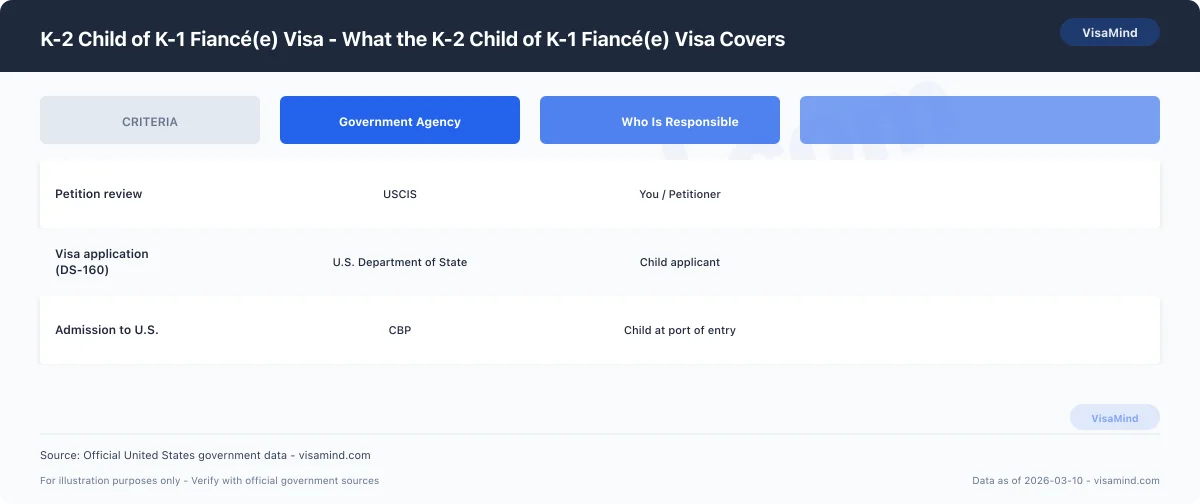
| Stage | Government Agency | Who Is Responsible |
|---|---|---|
| Petition review | USCIS | You / Petitioner |
| Visa application (DS-160) | U.S. Department of State | Child applicant |
| Admission to U.S. | CBP | Child at port of entry |
Where to start
Start with your K-1 Fiancé(e) Visa case. The child’s K-2 classification can’t stand alone.
Follow these steps:
-
Confirm your K-1 process is properly filed with USCIS.
-
Review the official form instructions on the USCIS website.
-
When instructed, complete the child’s Form DS-160 through the U.S. Department of State.
-
Prepare for the consular stage under Department of State procedures.
Before submitting anything, read the most current form instructions on the USCIS website. Requirements can change, and using an outdated form can delay your case.
If you need fee information or filing updates, review the USCIS and U.S. Department of State resources.
Eligibility Requirements
#To qualify for a K-2 visa as the child of a K-1 visa Fiancé(e) Visa applicant, you must meet clear sponsorship, relationship, and age standards. USCIS reviews the petition stage, and the U.S. Department of State handles the visa application and interview process, including the Form DS-160.
Sponsor criteria
Your eligibility depends first on the qualifying sponsor.
A foreign national seeking an immigrant visa must be sponsored by an immediate relative who:
- Is at least 21 years old
- Is a U.S. citizen
USCIS reviews whether the petitioning U.S. citizen meets these minimum standards. If the sponsor doesn’t meet the age or citizenship requirement, the case won’t proceed.
In the K-1 Fiancé(e) Visa context, the U.S. citizen files the underlying petition. The K-2 child’s eligibility flows from that approved petition. The visa is issued by the U.S. Department of State after you submit Form DS-160 and complete consular processing.
You should confirm current filing procedures and document requirements directly through USCIS and the U.S. Department of State before submitting any forms.
Relationship basics
You must qualify as the child of the K-1 Fiancé(e) Visa applicant.
This classification falls within family-based immigration principles. Your eligibility is not independent. It depends on the approved K-1 petition filed on behalf of your parent.
USCIS evaluates whether the claimed parent-child relationship meets immigration standards. You must be properly listed in the petition process to move forward with a K-2 visa application.
At the visa stage, the U.S. Department of State reviews the relationship again during consular processing. You’ll submit Form DS-160 and attend a visa interview if required.
| Requirement Area | What You Must Show | Agency Reviewing |
|---|---|---|
| Qualifying Parent | You are the child of the K-1 applicant | USCIS (petition stage) |
| Proper Inclusion | You are included in the K-1 process | USCIS |
| Visa Eligibility | You qualify for K-2 classification | U.S. Department of State |
If the underlying K-1 petition is denied, you can’t receive a K-2 visa.
Age requirement
Age affects your eligibility.
The sponsor must be at least 21 years old. If the U.S. citizen petitioner doesn’t meet this minimum age, USCIS will not approve the sponsorship.
You must also qualify as a “child” under immigration rules at the time of processing. USCIS evaluates this during the petition stage, and the U.S. Department of State confirms eligibility during visa issuance.
Because age calculations can affect eligibility, check current definitions and policies through USCIS and the U.S. Department of State before applying.
Meeting all three elements—qualified sponsor, valid parent-child relationship, and proper age status—allows you to proceed with K-2 visa processing.
Application Process
#You must complete the online Form DS-160, Online Nonimmigrant Visa Application, for each K-2 child applying with a K-1 visa Fiancé(e) Visa parent. Accuracy, document matching, and proper submission steps help avoid delays at the U.S. Department of State interview stage.
DS-160 steps
You must submit a separate DS-160 for every K-2 child, even if siblings apply together. The form applies to all nonimmigrant visa categories, including K visas connected to family-based immigration.
Follow these steps:
-
Start the DS-160 in the Consular Electronic Application Center (CEAC).
-
Record your application ID number immediately.
-
Complete the form in one session when possible; the system allows limited retrieval time.
-
Answer every security and background question fully.
-
Submit the form electronically.
Make sure every detail matches the child’s passport and supporting records exactly. Even small discrepancies in spelling, dates, or document numbers can delay processing or lead to refusal.
| Requirement | What You Must Do |
|---|---|
| Separate application | File one DS-160 per K-2 child |
| Identity information | Match passport data exactly |
| Security questions | Answer completely and truthfully |
| Petition status | Confirm underlying K-1 Fiancé(e) case details are consistent |
USCIS handles the underlying petition, but the Department of State reviews the DS-160 during consular processing.
After submission
After you submit the DS-160, print the confirmation barcode page immediately. You’ll need this page for the visa interview.
Keep both a printed and digital copy. Many applicants lose access after leaving the CEAC system.
Take these actions promptly:
- Print the DS-160 confirmation page.
- Save the confirmation number.
- Upload the confirmation page if your consulate requires it for appointment booking.
- Double-check that all submitted answers remain consistent with your supporting documents.
The consular officer uses the barcode to retrieve your child’s application at the interview. Missing or incorrect confirmation pages can cause appointment cancellations or administrative delays.
For interview scheduling, document requirements, and visa issuance procedures, consult the U.S. Department of State.
Practical tips
Treat the DS-160 as a legal document. You sign it electronically under penalty of perjury.
Review these eligibility basics before submission:
- The child must qualify as a K-2 derivative of a K-1 Fiancé(e) Visa applicant.
- The information must align with the approved petition filed with USCIS.
- All biographic data must match government-issued documents.
Common errors to avoid:
- Leaving security questions blank.
- Entering nicknames instead of full legal names.
- Using inconsistent dates across forms.
- Failing to save the application ID.
If you need current fee amounts or procedural updates, consult the U.S. Department of State. For petition-related questions, review guidance from U.S. Citizenship and Immigration Services (USCIS).
Required Documents
#You must submit complete forms, clear supporting records, and compliant passport-style photos. Missing signatures, unanswered fields, or improper images can delay a K-2 visa child case connected to a K-1 visa Fiancé(e) Visa under family-based immigration.
Form completion
You must complete every required form fully and accurately before submission. Review each page and confirm that you answered all applicable questions.
For the K-2 visa child, you will complete:
-
Form DS-160, Online Nonimmigrant Visa Application (filed with the U.S. Department of State).
-
Any related forms required by U.S. Citizenship and Immigration Services (USCIS) for the underlying K-1 Fiancé(e) Visa petition.
Follow these rules:
- Answer every question truthfully.
- Do not leave required fields blank.
- Sign and submit where required.
- Use consistent names, dates, and biographical details across all forms.
Inconsistent information between the child’s DS-160 and the K-1 Fiancé(e) Visa petition can cause delays. Review spelling of names, passport numbers, and birth dates carefully before final submission.
If you’re unsure about current filing procedures or submission steps, check the official instructions on the USCIS website or the U.S. Department of State website, depending on which agency handles the form.
Supporting evidence
You must include required evidence with each submitted form. Provide clear, legible copies unless original documents are specifically required.
Common supporting evidence includes:
- The child’s valid passport biographic page
- Proof of the parent’s approved or pending K-1 Fiancé(e) Visa petition
- Civil documents that confirm identity and relationship
Organize documents in a logical order. Label each document so an officer can match it to the correct form.
Use this checklist to review your packet:
| Document Type | Purpose | Key Detail to Confirm |
|---|---|---|
| Passport copy | Confirms identity | Name and date of birth match forms |
| Petition evidence | Connects child to K-1 case | Petition information is consistent |
| Civil records | Confirms relationship | Names match exactly across records |
Incomplete evidence can lead to processing delays. Submit all required items together whenever possible.
Photos
You must provide passport-style photos that meet U.S. government standards. Non-compliant photos frequently cause delays.
Prepare the photos before you begin filing so you can upload or submit them correctly with your forms. The photos must:
- Be recent
- Follow U.S. passport-style formatting requirements
- Clearly show the child’s face
Do not submit casual snapshots or cropped images. Poor lighting, shadows, or incorrect sizing can result in rejection.
If you’re unsure about the current photo specifications, review the photo guidance on the U.S. Department of State website for visa applications and the USCIS website for petition filings.
Fees and Processing Times
#You must pay a visa fee to the U.S. Department of State and plan for several months of processing. Timelines vary by visa category and consular location, and you should confirm current estimates before scheduling travel.
Fees
A K-2 visa applicant pays a nonimmigrant visa application fee (MRV) of $265.
This fee applies to each child seeking a K-2 visa. Payment is due after completing the Form DS-160, Online Nonimmigrant Visa Application, and before the visa interview at the U.S. embassy or consulate.
Key points:
- Amount: $265 per applicant
- Who collects it: U.S. Department of State
- When paid: After submitting DS-160 and before the interview
- Separate from: Any petition filed with U.S. Citizenship and Immigration Services (USCIS) for the K-1 visa Fiancé(e) Visa
The K-2 visa depends on the approved K-1 Fiancé(e) Visa petition, but this visa fee isn’t bundled with USCIS filing fees for the petition.
Processing times by category
Most K-2 applicants can expect a general processing window of 8 to 14 months. Timing depends heavily on the embassy or consulate handling the case.
DS-160 processing times shift by visa category and location. Current ranges (as of February 2026):
| Visa Category (DS-160) | Reported Time Range |
|---|---|
| Visitor (B1/B2) | 0.5 to 23 months |
| Student/Exchange (F, M, J) | 0.5 to 7.5 months |
| Petition-based (H, L, O, P, Q) | 0.5 to 4.5 months |
| Crew and Transit (C, D, C1/D) | 0.5 to 14 months |
K-2 visas are linked to the K-1 Fiancé(e) Visa, which is petition-based. Published ranges don’t guarantee a specific timeline.
Processing typically involves:
-
Petition approval by USCIS for the K-1 parent.
-
Consular processing and visa issuance through the U.S. Department of State.
-
Admission decision by U.S. Customs and Border Protection (CBP) at entry.
Each phase adds time.
Check current times
Verify current processing times before making travel or relocation plans.
Steps to follow:
-
Check your case status with USCIS if the K-1 petition is still pending.
-
Review visa appointment wait times through the U.S. Department of State for your specific embassy or consulate.
-
Confirm local interview availability and document review timelines.
The processing times fluctuate based on staffing, workload, and location. Relying on general estimates is risky if you’re working around deadlines for school, custody, or travel.
Contact the relevant government agency for the most recent updates on your case stage.
Relationship Scrutiny Red Flags
#Consular officers and USCIS officers compare every form and document you submit. Inconsistencies, missing answers, or incorrect selections can mean delays, Requests for Evidence (RFEs), or denial.
Inconsistent application data
Every detail must match across the Form DS-160, your passport, and any earlier submissions tied to the K-1 visa Fiancé(e) Visa and K-2 visa child application.
Officers review:
- Spelling of names (including middle names)
- Dates of birth
- Passport numbers
- Travel history
- Prior U.S. visits
If you start multiple DS-160 sessions, double-check each answer for consistency before submission. Even minor date mismatches can create credibility issues.
| Item Compared | Must Match Exactly | Common Problem |
|---|---|---|
| Passport number | DS-160 vs. passport | Transposed digits |
| Date of birth | DS-160 vs. passport | Different format or typo |
| Travel dates | DS-160 vs. prior entries | Estimated instead of exact dates |
Use the information printed in your passport and official records. Don’t estimate.
USCIS reviews petition details, while the U.S. Department of State reviews visa applications. Both agencies expect your data to align.
Photo and document quality
The Department of State requires a visa photo that meets specific technical standards. If your photo doesn’t comply, the consulate can delay processing.
Common issues:
- Incorrect size or dimensions
- Improper background
- Poor lighting or shadows
- Blurry resolution
A professional service or a validated photo tool that follows Department of State requirements makes this easier. Avoid cropping or editing the image on your own unless you know the exact specs.
Document clarity matters too. Uploading scanned documents with cut-off edges, glare, or unreadable text can lead to authenticity questions or requests for replacements.
You can control this risk. Review every image at full size before submitting to make sure it’s clear and complete.
Wrong category & skipped answers
Select the correct visa category in the DS-160. A K-2 child applies under the classification tied to the approved K-1 Fiancé(e) Visa petition.
Choosing the wrong visa type can result in rejection or cancellation of the interview. Verify the classification before submitting.
Answer every security and background question fully.
Follow these guidelines:
-
Don’t leave blanks.
-
Use “None” or “N/A” where appropriate.
-
Review each page before final submission.
| Issue | Likely Result |
|---|---|
| Wrong visa category | Rejection or rescheduling |
| Skipped security question | Request for Evidence or delay |
| Incomplete background history | Additional scrutiny |
Family-based immigration cases get close review. Incomplete answers can raise reliability concerns.
Complete, accurate responses help reduce delays and protect your child’s K-2 visa process.
Fees
#Total estimated cost: $265
| Component | Amount |
|---|---|
| Application fee (MRV)MRV fee (K fiancé/spouse dependent) | $265 |
Verify current fees — official United States fee schedule
Fees shown are as of 2026-02. Verify on the official United States government website before applying.
Required forms
#Plan your K-2 Child of K-1 Fiancé(e) Visa with free United States tools
#Itemized government fees for K-2 Child of K-1 Fiancé(e) Visa and other United States categories.
Check United States eligibility
See how your profile scores against K-2 Child of K-1 Fiancé(e) Visa and other United States visas.
United States processing times
Typical wait times and stage breakdowns for K-2 Child of K-1 Fiancé(e) Visa and related United States visas.
Practice United States interview
Common interview questions and feedback for United States visa applicants.
Verified United States directory
#Browse source-backed, publication-certified records related to this visa route.
Browse source-backed, publication-certified records related to this visa route.