
What the K-4 Child of K-3 Visa Covers
#The K-4 visa allows certain children of a K-3 visa spouse to enter and stay in the United States temporarily. It’s a part of the family-based immigration process and requires separate visa processing through the U.S. Department of State.
Who qualifies
A child may qualify for a K-4 visa if their parent holds a valid K-3 visa.
Eligibility depends on the relationship to the K-3 visa holder and inclusion in the ongoing family-based immigration case with USCIS. Each child must apply separately for the K-4 visa, even if the parent already received a K-3 visa.
To qualify, the child must meet these basic criteria:
- Child of a K-3 visa holder.
- Parent is married to a U.S. citizen.
- Application for a K-4 nonimmigrant visa through consular processing.
- Completion of the required online visa application (Form DS-160).
The U.S. Department of State reviews the visa application and determines eligibility at the visa interview.
| Requirement | Authority Involved |
|---|---|
| Family relationship review | USCIS (petition stage) |
| Visa application (DS-160) | U.S. Department of State |
| Visa interview and issuance | U.S. Department of State |
What the visa allows
A K-4 visa lets the child enter the United States and live there temporarily with the K-3 parent.
The child may remain in the United States while the parent’s family-based immigration process continues. This visa is intended to keep families together during the period before permanent immigration status is resolved.
The process typically involves these steps:
-
Family-based petition filed with USCIS.
-
Completion of Form DS-160.
-
Visa interview at a U.S. embassy or consulate.
-
If approved, K-4 visa issuance and travel to the United States.
U.S. Customs and Border Protection (CBP) makes the final decision on admission at the U.S. Port of entry.
Temporary nature of stay
The K-4 visa is a nonimmigrant visa, granting only temporary stay in the United States.
Status is tied to the parent’s K-3 classification and the underlying family-based immigration case. It does not grant permanent resident status.
Maintaining valid nonimmigrant status is required while in the United States. If the underlying petition or K-3 status changes, the K-4 status may also be affected.
For current rules on maintaining status or applying for further benefits, refer to USCIS and U.S. Department of State guidance.
Required Documents
#
You’ll need to submit complete forms, proof of relationship to the K-3 visa holder, and identity documents. Missing or inconsistent documents can slow down processing with USCIS or at the visa stage with the U.S. Department of State.
Forms and application data
File the required K-4 application forms with USCIS using the current edition. Outdated versions aren’t accepted.
The form asks for detailed biographical information about the child, such as:
- Full legal name
- Date and place of birth
- Current address
- Parent’s information
- Details about the K-3 visa holder
- U.S. citizen sponsor details
If the child applies for a visa abroad, complete the Form DS-160 Online Nonimmigrant Visa Application as required by the U.S. Department of State. The information must match what you gave USCIS.
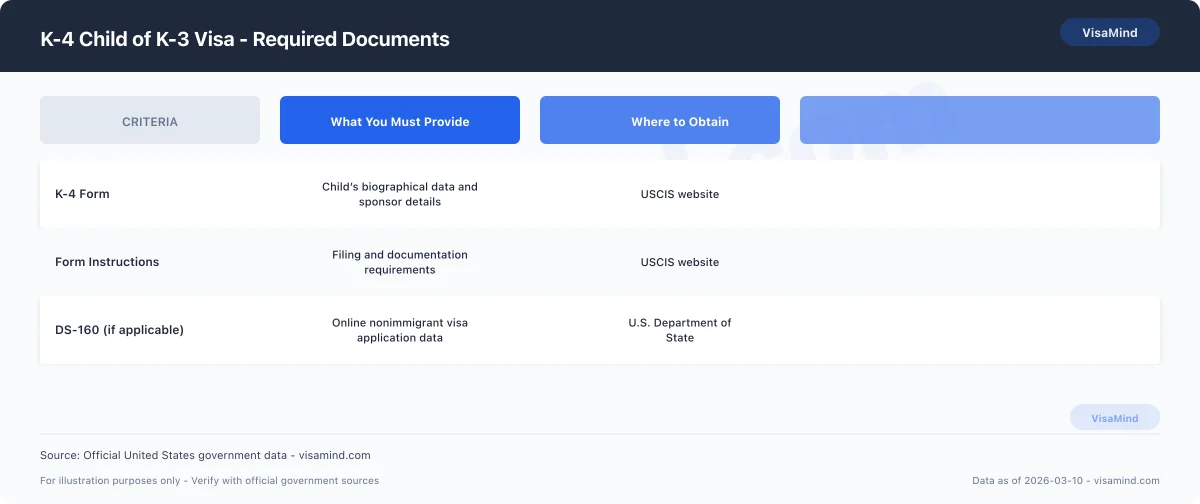
| Document Type | What You Must Provide | Where to Obtain |
|---|---|---|
| K-4 Form | Child’s biographical data and sponsor details | USCIS website |
| Form Instructions | Filing and documentation requirements | USCIS website |
| DS-160 (if applicable) | Online nonimmigrant visa application data | U.S. Department of State |
Double-check all entries before submission. Inconsistent names, dates, or sponsor details can cause processing delays.
Relationship and sponsor evidence
Proof of the child’s relationship to the K-3 visa holder is required. USCIS wants clear evidence of the legal parent‑child relationship.
Submit documents showing:
- Child’s relationship to the K-3 visa holder
- K-3 visa holder’s current status
- Connection to the U.S. citizen sponsor
Documentation must match the information in your forms. All names, dates, and family relationships must be consistent.
Since the K-4 visa is part of family-based immigration, USCIS examines qualifying relationships closely. If there are discrepancies, provide clarification that’s consistent with what has already been filed.
Always check the USCIS form instructions for the current list of acceptable documents. Requirements can change.
Photos and identity documents
Submit passport-style photos that meet official specifications. Non-compliant photos will cause delays or rejections.
Prepare photos before filing so you can include them with your application. Follow the formatting rules in the USCIS form instructions.
Identity documents confirming the child’s details are also required, including:
- Full legal name
- Date of birth
- Nationality
All identity information must match what appears on the USCIS form and the DS-160, if applicable.
| Item | Key Requirement | Common Issue |
|---|---|---|
| Passport-style photos | Must meet official specifications | Incorrect size or background |
| Identity documents | Must match application data exactly | Spelling or date inconsistencies |
Careful document preparation helps avoid unnecessary delays.
The Two-Stage Process
#The K-4 child visa process happens in two phases. First, a petition goes to USCIS. Then, you apply for the visa through the U.S. Department of State using Form DS-160 and attend a consular interview.
Petition filing (USCIS step)
Start with a petition filed with USCIS. The petitioner submits Form I-129F and must indicate that a K-4 visa classification is requested.
Review the form instructions before starting. Complete every section, sign where required, and include all supporting evidence.
Follow these guidelines to reduce the chance of delays:
- Use information that matches the child’s passport.
- Answer all security and background questions.
- Don’t leave blanks; use “None” or “N/A” if needed.
- Review the form for consistency before submitting.
Incomplete answers or inconsistencies can result in a Request for Evidence (RFE) or denial. For filing fees and mailing instructions, refer to the USCIS website.
| Step | Agency | Form | Key Action |
|---|---|---|---|
| Petition filing | USCIS | Form I-129F | Submit completed, signed petition with required evidence |
Consular/DS-160 step
After USCIS processes the petition, the next step is the visa application with the U.S. Department of State. Each K-4 applicant must complete Form DS-160, Online Nonimmigrant Visa Application.
You’ll need to:
-
Complete the DS-160 online in one session if possible.
-
Save your application ID to return within 30 days if needed.
-
Print and keep the DS-160 confirmation barcode page.
Upload or present the DS-160 confirmation page as instructed by the consulate. The consular officer will review this information during the interview.
Common errors at this stage include selecting the wrong visa category, entering inconsistent biographic details, or submitting a non-compliant visa photo. Department of State photo specifications must be followed. Even minor discrepancies between the DS-160 and the passport can delay or prevent visa issuance.
| Step | Agency | Form | Key Action |
|---|---|---|---|
| Visa application | U.S. Department of State | DS-160 | Submit online application and print confirmation page |
Practical tips for submission
Accuracy and consistency matter more than speed. Use the child’s passport as your reference for all names, dates, and document numbers.
Before submitting any form:
- Compare entries against the passport and supporting documents.
- Confirm the correct nonimmigrant visa category.
- Review all security and background responses.
- Check that the visa photo meets Department of State standards.
Save copies of everything you submit, including the DS-160 confirmation page and the signed petition. Organized records help if USCIS issues an RFE or the consulate asks for more documentation.
For procedures, fees, and interview instructions, use the USCIS website for petitions and the U.S. Department of State for visa processing.
From Family Visa to PR
#A K-4 child visa allows temporary entry to the United States, but the goal is lawful permanent residence. The transition from nonimmigrant status to a green card is handled through the family-based immigration process with USCIS and the U.S. Department of State.
Is this an immigrant route?
The K-4 visa is not an immigrant visa. It’s a nonimmigrant classification that lets the child enter the United States while the parent’s family-based immigration case is pending.
Permanent resident status isn’t granted automatically. To become a lawful permanent resident, the child must qualify through a family-based immigration petition filed with USCIS.
The path depends on an approved immigrant petition and visa processing.
| Step | Government Agency | Role |
|---|---|---|
| Immigrant petition | USCIS | Reviews and approves the family-based petition |
| Visa processing (if abroad) | U.S. Department of State | Handles Form DS-160 and visa interview |
| Admission to U.S. | CBP | Decides entry at port of entry |
If processing through a U.S. embassy or consulate, submit Form DS-160 to the U.S. Department of State and attend an interview. If eligible to apply inside the United States, USCIS handles the permanent residence application.
Check eligibility requirements and filing instructions on the USCIS website.
Timing and next steps
The process can take about 12–18 months, depending on case volume and agency workload.
Track your case and respond quickly to any requests for evidence. Delays often result from missed notices or incomplete documents.
Steps to follow:
-
Make sure the family-based immigrant petition has been properly filed.
-
Monitor USCIS case status.
-
Complete required visa processing steps with the U.S. Department of State, including DS-160 if processing abroad.
-
Prepare for the immigrant visa interview or USCIS appointment.
Keep copies of every filing and notice.
If you turn 21 during the process, timing may affect eligibility. Review current age-related protections on the USCIS website to see how they apply.
When to Get Help
#Legal guidance is important if your family structure or application history creates extra risk. Issues with USCIS petitions, the Form DS-160, or consular processing with the U.S. Department of State often require careful documentation and consistent records.
Complex family or sponsor status
Complicated family relationships can delay or disrupt K-4 child visa processing. Scrutiny increases if there are prior marriages, step‑parent relationships, or unclear custody arrangements.
Get help if your case involves:
- Multiple prior marriages for either parent
- Unclear legal custody or consent from the other biological parent
- Adoption or step‑parent relationships
- A pending or previously filed family-based immigration petition with USCIS
- Differences between information in the USCIS petition and the DS-160
Consistency is key. USCIS reviews the petition, and the U.S. Department of State reviews the DS-160 and conducts the visa interview.
| Stage | Government Agency | Why Legal Review Helps |
|---|---|---|
| Petition review | U.S. Citizenship and Immigration Services (USCIS) | Ensures family relationship evidence is complete and consistent |
| Visa application (DS-160) | U.S. Department of State | Prevents conflicting statements before the consular interview |
| port of entry | U.S. Customs and Border Protection (CBP) | Confirms admission eligibility |
If your sponsor’s immigration status has changed or you’ve filed multiple petitions, seek advice before continuing.
Prior denials and evidence problems
A prior visa refusal or petition denial means closer scrutiny for your next application. You must address exactly why the earlier decision went against you, not just send in the same documents again.
Ask for help if you’ve had:
- A K visa denial
- A finding that documents weren’t complete or didn’t match up
- Doubts about the child’s eligibility
- Allegations of misrepresentation on a DS-160
Fixing errors at the source is essential. Sometimes that means updating the underlying USCIS petition or writing a clear explanation for the consular officer with the U.S. Department of State.
If you’re not sure why your case was denied, look over the official notice carefully. Consult the denial letter and agency guidance before you submit anything new.
Fees and Processing Times
#You’ll need to pay a visa application fee and complete Form DS-160 before the interview. processing times depend on the visa category and which U.S. embassy or consulate you’re dealing with.
Visa and application fees
The Machine Readable Visa (MRV) fee is $265 for each K-4 applicant, as of February 2026. The U.S. Department of State collects this fee for consular processing.
You need to submit the Form DS-160, Online Nonimmigrant Visa Application, before your interview. Each child applying for a K-4 visa files a separate DS-160.
| Fee Type | Amount (USD) | Paid To | When Paid |
|---|---|---|---|
| MRV visa application fee | $265 | U.S. Department of State | Before the visa interview |
Questions about extra fees tied to a family-based immigration petition go to USCIS. USCIS handles the underlying petition, while the Department of State manages interviews and visas.
Fees can change. Always check the current amount with the U.S. Department of State before paying.
Typical processing windows
The processing times vary by visa category and location. The Department of State publishes estimated ranges for DS-160 processing.
As of February 2026, reported DS-160 processing windows look like this:
| Visa Category | Reported Processing Range |
|---|---|
| Visitor (B1/B2) | 0.5 to 23 months |
| Student/Exchange (F, M, J) | 0.5 to 7.5 months |
| Petition-based (H, L, O, P, Q) | 0.5 to 4.5 months |
| Crew and Transit (C, D, C1/D) | 0.5 to 14 months |
K-4 falls under family-based immigration, so timing depends on the location. Local demand and staffing directly affect how soon you get an interview.
The processing times aren’t the same everywhere. Check the specific embassy or consulate for your case.
Where to check current times
For updated timelines, use government sources.
Check:
- The U.S. Department of State Visa Bulletin for family-based immigration movement.
- The U.S. Department of State visa processing time information page for consular wait times.
- The USCIS Processing Times page if your case involves a pending petition.
Rely on the agency handling your case for timing, not third-party estimates.
Eligibility Requirements
#You must meet age and relationship standards, and your U.S. citizen stepparent must also qualify. Both the child and the sponsoring citizen have specific roles in this process.
Applicant criteria
To qualify for a K-4 child visa, you must:
- Be unmarried
- Be under 21 years old
- Be the child of someone with a valid K-3 visa
- Be entering the U.S. based on your parent’s marriage to a U.S. citizen
Your eligibility depends on your parent’s K-3 status. If your parent doesn’t qualify for or keep K-3 classification, you can’t get K-4 classification.
You’ll complete the Form DS-160, Online Nonimmigrant Visa Application, for consular processing with the U.S. Department of State. USCIS oversees related family-based immigration filings but does not issue the visa.
Age and marital status requirements are strict. If you marry or turn 21 before the visa is issued, you’re no longer eligible.
Sponsor criteria
Your sponsoring stepparent must:
- Be a U.S. citizen
- Be at least 21 years old
- Be legally married to your K-3 parent
The U.S. citizen is the petitioning sponsor for this family-based immigration category. USCIS manages the underlying petition for K-3 and K-4 classifications.
The sponsor’s age isn’t flexible; under 21, you don’t qualify for K-4 status.
| Requirement Category | Key Standard |
|---|---|
| Child (Applicant) | Unmarried and under 21 |
| Parent | Holds valid K-3 visa |
| U.S. Citizen Sponsor | At least 21 years old |
| Relationship | Valid marriage between sponsor and K-3 parent |
Why Family Visas Get Denied
#USCIS and the U.S. Department of State deny many K-4 visa cases for avoidable reasons. Most denials happen because of missing documents, unsigned forms, or trouble proving the parent qualifies under family-based immigration rules.
Evidence and documentation gaps
You need to submit complete forms and all supporting documents. Leaving out required evidence can lead to refusal or denial.
Common problems:
- No proof of the parent’s valid K-3 visa nonimmigrant visa status
- Forms missing required supporting records
- Incomplete information on the Form DS-160 Online Nonimmigrant Visa Application
If you can’t prove the parent holds K-3 status, the K-4 child visa isn’t possible. The child’s eligibility is tied directly to the parent’s approved K-3 classification.
Check this before filing:
| Required Area | What You Must Confirm |
|---|---|
| Parent status | Evidence of valid K-3 visa |
| Forms | All sections completed |
| Supporting documents | All required records included |
Filing a K-4 application never guarantees approval. Eligibility must be documented clearly and fully.
Form and signature errors
Unsigned or incomplete forms often lead to rejection or denial. USCIS won’t process forms without required signatures.
Review:
- Every signature line on each form
- The accuracy of information on the DS-160
- Consistency between all documents
One missing signature can stop your case. If USCIS rejects a filing for this, it delays your timeline and may mean resubmitting everything.
Check each form against its official instructions before you send it in. Don’t assume a form is complete just because you filled out most of it.
Sponsor or eligibility problems
Eligibility problems come up when the parent doesn’t properly qualify for K-3 status. Since the K-4 visa is tied to the parent, any issue with the parent’s classification affects the child.
You need to confirm:
- The parent holds valid K-3 status
- The child qualifies under the K-4 category within family-based immigration
If USCIS finds the parent doesn’t meet K-3 requirements, the child’s K-4 application will fail. The K-4 category only works if the parent’s case is approved.
Before filing, verify the parent’s immigration status and review eligibility requirements through USCIS and, for visa processing, the U.S. Department of State.
Fees
#Total estimated cost: $265
| Component | Amount |
|---|---|
| Application fee (MRV)MRV fee (K fiancé/spouse dependent) | $265 |
Verify current fees — official United States fee schedule
Fees shown are as of 2026-02. Verify on the official United States government website before applying.
Required forms
#Plan your K-4 Child of K-3 Visa with free United States tools
#Itemized government fees for K-4 Child of K-3 Visa and other United States categories.
Check United States eligibility
See how your profile scores against K-4 Child of K-3 Visa and other United States visas.
United States processing times
Typical wait times and stage breakdowns for K-4 Child of K-3 Visa and related United States visas.
Practice United States interview
Common interview questions and feedback for United States visa applicants.
Verified United States directory
#Browse source-backed, publication-certified records related to this visa route.
Browse source-backed, publication-certified records related to this visa route.