
What the L-2 Dependent Visa Covers
#
The L-2 visa allows certain family members of an L-1 visa holder to live in the United States on a temporary basis. It defines who qualifies, what activities are permitted, and how long you can remain.
Who qualifies
You qualify for L-2 classification only if you are the spouse or child of an L-1 visa holder. The relationship must exist at the time of application and continue during your stay in the United States.
Eligible dependents include:
- Spouses of L-1 nonimmigrants
- Children of L-1 nonimmigrants
This is a temporary, employment-based nonimmigrant status, not a permanent family-based immigration category.
If you apply from outside the United States, you must complete Form DS-160, the Online Nonimmigrant Visa Application, and attend a visa interview through the U.S. Department of State. Visa issuance decisions are made by a U.S. consular officer.
If you are already in the United States and need to request or extend L-2 status, you must follow procedures set by U.S. Citizenship and Immigration Services (USCIS).
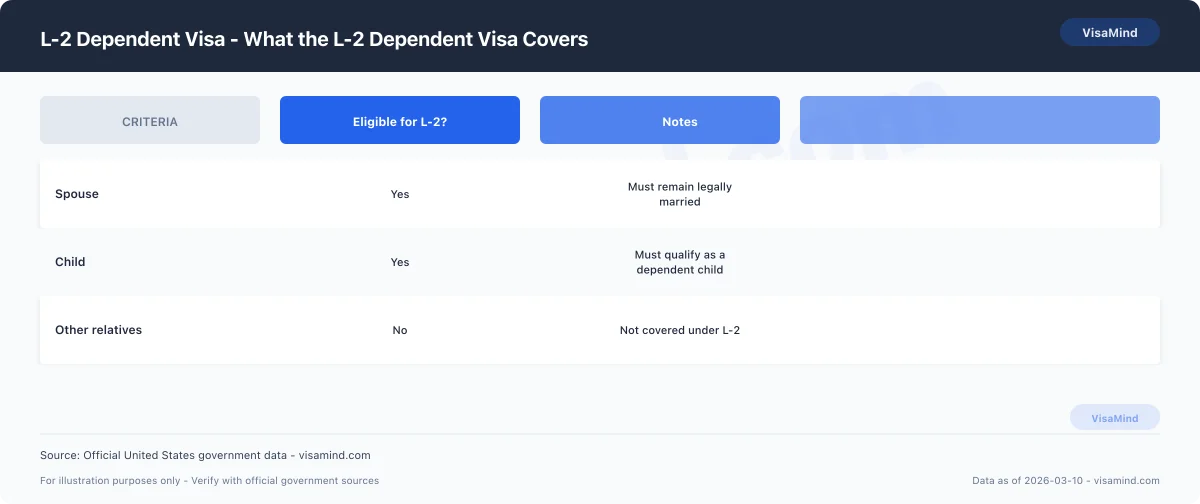
| Relationship to L-1 Holder | Eligible for L-2? | Notes |
|---|---|---|
| Spouse | Yes | Must remain legally married |
| Child | Yes | Must qualify as a dependent child |
| Other relatives | No | Not covered under L-2 |
Purpose and scope
The L-2 visa allows you to accompany or join your L-1 family member in the United States. Your status depends on the principal L-1 worker’s valid nonimmigrant status.
You may use the L-2 visa to:
- Live in the United States with your L-1 spouse or parent
- Remain in the country for the authorized temporary period
The L-2 classification does not convert your stay into permanent residence. It does not serve as a direct immigrant pathway under family-based immigration categories.
If you apply abroad, the U.S. Department of State handles visa processing and interviews. After visa approval, U.S. Customs and Border Protection (CBP) determines whether to admit you at a U.S. Port of entry.
Your stay must align with the terms of the L-1 principal’s status. If the L-1 status ends, your L-2 status ends as well.
Length and limitations
Your L-2 status is temporary. It remains valid only while the L-1 principal maintains valid status.
You cannot hold L-2 status independently. If the L-1 visa holder loses status, departs permanently, or changes to another nonimmigrant category, your L-2 status may also end.
Key limitations include:
- Your stay depends on the L-1 holder’s authorized period
- You must maintain a qualifying relationship
- You must follow all conditions tied to nonimmigrant status
For exact validity periods, extension procedures, and current filing requirements, review guidance from USCIS (for status in the United States) or the U.S. Department of State (for visa issuance abroad).
When to Get Help
#Certain L-2 cases require close coordination between your spouse’s employer, U.S. Citizenship and Immigration Services (USCIS), and the U.S. Department of State. Problems often arise when the underlying L-1 petition, consular paperwork, or employer filings are incomplete or inconsistent.
Complex sponsor situations
You depend on your spouse’s L-1 status. If the employer has not properly filed Form I-129, Petition for a Nonimmigrant Worker, your L-2 application can fail.
You should seek help when:
- The employer has not received approval from USCIS for the L-1 petition.
- The petition details do not match the information you plan to enter on Form DS-160.
- You are unsure whether the petition is still valid at the time of your visa interview.
For H-1b visa and L-1 categories, you should wait until USCIS approves the Form I-129 before completing the DS-160. The consular officer will verify petition status through Department of State systems.
If your spouse previously filed immigrant petitions under family-based immigration or another category, make sure all filings align. Inconsistent information can trigger delays or additional scrutiny at the interview.
Blanket petitions and employer filings
Some employers use approved blanket petitions for L-1 employees. In those cases, you must present documentation tied to that blanket approval during consular processing.
You should get legal guidance if:
- You do not have a copy of the blanket petition approval notice.
- The employer filed multiple petitions and you are unsure which applies to your spouse.
- The employer recently changed structure, ownership, or name.
The employer must file Form I-129 on behalf of the L-1 employee. Approval of that petition does not guarantee your L-2 visa issuance.
| Stage | Government Authority | What Is Verified |
|---|---|---|
| Petition filing | USCIS | Approval of Form I-129 |
| Visa application (DS-160) | U.S. Department of State | Petition status and eligibility |
| Admission to the U.S. | U.S. Customs and Border Protection (CBP) | Valid visa and supporting approval |
If documents are missing or inconsistent, the consular officer may delay or refuse the visa until the record is clarified.
When denials are possible
An L-2 filing does not guarantee approval. You must prove eligibility at the visa interview.
Denial risks increase when:
- The underlying L-1 petition is not approved.
- Information on the DS-160 conflicts with the approved petition.
- Supporting documents do not match the employer’s filing.
The U.S. Department of State controls visa issuance. Even with a valid USCIS approval, the consular officer can refuse the visa if the record does not support eligibility.
If you suspect discrepancies between employer filings and your application, address them before the interview. Review the petition approval notice carefully and confirm all biographical and employment details match your DS-160 exactly.
Path to Permanent Residence
#You may pursue permanent residence while holding L-2 status, but you must file the correct forms with U.S. Citizenship and Immigration Services (USCIS) and, in some cases, complete consular processing through the U.S. Department of State. Processing steps and timelines depend on where and how you apply.
Filing with USCIS
If you apply for permanent residence from inside the United States, you file the required application with U.S. Citizenship and Immigration Services (USCIS).
You must:
- Submit the appropriate form to USCIS based on your eligibility category
- Pay the required filing fees in USD ($) using the current fee schedule
- Follow the official form instructions for the correct mailing address
USCIS reviews your application and supporting documents before making a decision. Always confirm the correct edition of the form and filing location with USCIS before you submit.
If you apply for an immigrant visa through consular processing abroad, you complete Form DS-160, Online Nonimmigrant Visa Application, with the U.S. Department of State. The Department of State manages visa interviews and issuance, while USCIS handles petitions and immigration benefits filed inside the United States.
Processing variation and timelines
processing times depend on:
- The immigration category under which you apply
- Whether you file with USCIS or apply through a U.S. consulate
- The specific office or consular post handling your case
For applicants completing Form DS-160, processing time varies by category and processing location. You must verify current timelines directly with the U.S. Department of State.
USCIS processing times also vary by form type and service center. Check with USCIS for up-to-date case processing estimates before you file.
| Filing Method | Government Agency | Timeframe Source |
|---|---|---|
| Application filed in the U.S. | USCIS | USCIS website |
| DS-160 filed for consular processing | U.S. Department of State | U.S. Department of State |
Typical processing window
For applications involving Form DS-160, you can expect a general processing window of 2–8 weeks, depending on category and location.
This timeframe does not guarantee approval or visa issuance. It reflects the period typically required for processing once the application is properly submitted.
Always confirm current timelines with:
- USCIS for applications filed inside the United States
- U.S. Department of State for visa processing and interviews
The processing times change. Review official government sources before making travel plans or employment decisions.
Conditions and Rights
#Your L-2 status gives you specific rights tied directly to the principal L-1 visa holder’s status. You must follow U.S. Citizenship and Immigration Services (USCIS) rules to maintain lawful status and confirm whether you may work without applying separately for employment authorization.
Work authorization
Certain L dependent spouses are considered employment authorized incident to status. This means you do not need to apply separately for employment authorization before you begin working, as long as you qualify under this rule.
You should confirm your specific classification with USCIS before accepting employment. USCIS determines whether your status requires a separate employment authorization application.
Use this table to understand the distinction:
| Classification Type | Work Authorization Requirement | Where to Confirm |
|---|---|---|
| Certain L dependent spouses | Employment authorized incident to status | USCIS website |
| Other classifications | May require separate employment authorization | USCIS website |
Don’t rely on assumptions. Review your approval documents and compare them with current USCIS guidance to ensure you are authorized to work.
If you applied for your visa abroad, you submitted Form DS-160 through the U.S. Department of State. Visa issuance does not replace USCIS rules about employment eligibility after admission.
Status conditions
Your L-2 status depends on the principal L-1 visa holder maintaining valid status. If the principal loses status, your dependent status is affected.
You must comply with all terms of your admission. U.S. Customs and Border Protection (CBP) determines your admission at the port of entry, and USCIS governs your ongoing status inside the United States.
L-2 is a nonimmigrant classification. It does not grant permanent residence and is separate from Family-based immigration processes handled by USCIS.
You must monitor expiration dates and any conditions listed on your approval notice or admission record. Failure to follow status requirements can affect future immigration benefits.
Where to confirm rights
Verify your rights directly with official government sources. For employment eligibility and status rules, consult USCIS for your specific classification.
For visa application procedures and issuance, rely on the U.S. Department of State. If you apply for a visa abroad, you will complete Form DS-160 and attend a consular interview as required by the Department of State.
Use this checklist:
- Confirm your classification with USCIS.
- Verify whether you are employment authorized incident to status.
- Review your admission record issued by CBP.
- Keep copies of approval notices and visa documents.
You are responsible for ensuring that your work and stay in the United States comply with current USCIS rules.
Renewal and Extension
#You must keep your L-2 status valid by filing on time and submitting complete evidence. The process depends on whether you apply through U.S. Citizenship and Immigration Services (USCIS) or through a U.S. consulate using Form DS-160.
Renewal steps
You extend your L-2 status by filing the required application with USCIS before your current status expires. USCIS must receive a complete, signed submission with supporting documents.
Follow these steps:
- Complete all required sections of the appropriate form.
2. Review your answers for accuracy and consistency.
-
Sign the form where required.
-
Submit the form with supporting evidence to USCIS, following the official form instructions for the correct filing location.
-
Pay the required filing fees. Check with USCIS for current amounts.
If you apply for a new L-2 visa abroad instead of extending status in the United States, you must complete Form DS-160 and follow U.S. Department of State procedures for visa issuance.
| Scenario | Agency | Primary Form |
|---|---|---|
| Extend status inside the U.S. | USCIS | Application submitted to USCIS |
| Renew visa stamp abroad | U.S. Department of State | DS-160 |
Required evidence for extensions
USCIS expects clear documentation supporting your continued eligibility as an L-2 dependent. You must include all required evidence at the time of filing.
Provide:
- Proof of your relationship to the principal L-1 visa holder.
- Evidence that the principal maintains valid L-1 status.
- Copies of your current immigration documents.
- Any additional documentation requested in the form instructions.
Organize your evidence so USCIS can easily verify your eligibility. Missing documents can delay processing or result in denial.
If you pursue long-term options through family-based immigration, that process is separate. An L-2 extension does not replace or convert into a family-based immigrant petition.
Submitting renewals
You must submit a complete and properly signed application package. USCIS will not process an unsigned form.
Before mailing or filing:
- Confirm all required sections are complete.
- Sign where required.
- Include all supporting documents.
- Include correct filing fees. Use the USCIS fee calculator for current amounts.
Follow the form instructions to determine the correct filing method and address. USCIS handles extensions of stay, while the U.S. Department of State handles visa issuance abroad.
Keep copies of everything you submit for your records.
Fees and Processing Times
#You must pay specific government fees and plan for consular wait times before receiving an L-2 visa. Costs are paid to the U.S. Department of State, and processing timelines depend on visa category and local demand.
Application and visa fees
You must pay the Machine Readable Visa (MRV) application fee when you submit Form Form DS-160, Online Nonimmigrant Visa Application.
| Fee Type | Amount (USD) | Paid To | When You Pay |
|---|---|---|---|
| MRV application fee | $205 | U.S. Department of State | Before scheduling your visa interview |
You pay this fee for each L-2 applicant, including children. The fee is non-refundable, even if the consular officer refuses the visa.
If your L-1 spouse or parent already holds valid status in the United States, you may also interact with U.S. Citizenship and Immigration Services (USCIS) for status-related filings inside the country. USCIS filing fees vary. Check the USCIS fee calculator for current amounts before submitting any application.
The U.S. Department of State controls visa interview scheduling and issuance. Customs and Border Protection (CBP) decides admission at the port of entry.
Category-based processing times
L-2 visas fall under the petition-based (H, L, O, P, Q) nonimmigrant category for consular processing. Wait times vary by embassy or consulate.
As of February 2026, reported appointment wait times for DS-160 applications show the following ranges:
| Visa Category | Reported Wait Time Range |
|---|---|
| Petition-based (H, L, O, P, Q) | 0.5 to 4.5 months |
| Visitor (B1/B2) | 0.5 to 23 months |
| Student/Exchange (F, M, J) | 0.5 to 7.5 months |
| Crew and Transit (C, D, C1/D) | 0.5 to 14 months |
Your actual timeline depends on:
- The specific U.S. embassy or consulate
- Local staffing levels
- Seasonal demand
These timeframes reflect interview availability, not visa approval time. Administrative processing after the interview can extend your timeline.
Checking current wait times
Verify wait times directly through the U.S. Department of State before making travel plans. Appointment availability changes frequently.
Follow these steps:
-
Complete and submit Form DS-160.
-
Pay the $205 MRV fee.
-
Access your chosen U.S. embassy or consulate’s appointment system.
-
Review the posted interview wait time for petition-based visas.
Do not rely on general estimates from other visa categories, including family-based immigration cases processed by USCIS. Family-based immigration involves immigrant visas and different processing systems.
If you are applying from within the United States and filing with USCIS, review the USCIS processing time tool for the specific form you submit. USCIS timelines differ from Department of State interview scheduling times.
Application Process
#You must complete the correct online form, submit it through the proper government channel, and ensure every detail matches your official documents. Accuracy and organization determine whether your case moves forward without delay.
Completing the form
Most L-2 visa applicants complete Form DS-160, the Online Nonimmigrant Visa Application, through the Consular Electronic Application Center (CEAC) managed by the U.S. Department of State.
Download the current instructions and review them before you begin. Use only the most recent version available when reviewing related guidance.
Follow these steps carefully:
-
Start the DS-160 and save your application ID immediately.
-
Complete the form in one sitting if possible.
-
Answer every security and background question fully and truthfully.
-
Ensure all entries match your passport and supporting documents exactly.
Inconsistencies between your DS-160 and your passport, marriage certificate, or the L-1 principal’s documents often lead to delays or requests for evidence.
Prepare compliant passport-style photos before starting. Non-compliant photos frequently cause processing delays.
Before leaving the CEAC system, print and save the DS-160 confirmation page. You must include this confirmation with your visa application materials.
Submission steps
The submission process depends on whether you apply abroad through consular processing or seek a related benefit with U.S. Citizenship and Immigration Services (USCIS) inside the United States.
For visa issuance abroad, the U.S. Department of State handles the interview and visa decision. USCIS does not issue visas at consulates.
Your typical submission flow follows this sequence:
-
Complete and submit Form DS-160 online.
-
Print the DS-160 confirmation page.
-
Submit required documents as instructed by the U.S. embassy or consulate.
-
Attend your visa interview, if required.
Use this table to understand agency roles:
| Step | Government Authority | Responsibility |
|---|---|---|
| DS-160 filing | U.S. Department of State | Collects online visa application data |
| Visa interview | U.S. Department of State | Reviews eligibility and issues visa |
| Petition oversight (L-1 principal) | USCIS | Approves underlying L-1 petition |
| Admission at entry | U.S. Customs and Border Protection (CBP) | Determines entry into the U.S. |
If you apply for a related benefit inside the United States, follow the specific form instructions and submit to the address listed there.
Expert tips for faster processing
You reduce delays by focusing on consistency, completeness, and document control.
Use this checklist before submission:
- Confirm your name, date of birth, and passport number match all documents exactly.
- Upload or include the DS-160 confirmation page as required.
- Complete every security and background section without leaving blanks.
- Prepare compliant passport-style photos in advance.
- Save your DS-160 application ID so you can retrieve the form within 30 days if needed.
Incomplete answers often trigger a request for evidence or refusal. Discrepancies between your DS-160 and supporting documents can result in denial.
Treat the L-2 process with the same level of detail you would use in any family-based immigration matter. Careful preparation shortens review time and reduces avoidable setbacks.
Required Documents
#You must prove your identity and your qualifying relationship to the L-1 visa holder. Your documents must clearly match the information you provide to U.S. Citizenship and Immigration Services (USCIS) and on the Form DS-160 submitted to the U.S. Department of State.
Identity and personal details
You must provide complete and accurate personal information for the L-2 visa application. This information must be consistent across all forms and supporting records.
At a minimum, you should prepare documents that confirm:
- Your full legal name
- Your date of birth
- Your place of birth
- Your current citizenship
Ensure that the details you enter on Form DS-160 match your identity documents exactly. Even small differences in spelling or dates can cause delays.
Use the following checklist to organize your identity documents:
| Document Type | What It Must Show | Why It Matters |
|---|---|---|
| Government-issued identity document | Full legal name, date of birth | Confirms your identity |
| Civil birth record | Date and place of birth | Verifies personal background |
| Completed DS-160 confirmation | Submitted personal data | Required for visa processing by the U.S. Department of State |
Relationship evidence
You must prove that you qualify as a dependent of the L-1 visa holder. The L-2 category is based strictly on your family relationship.
Submit clear evidence of your relationship, such as:
- Marriage certificate if you are the spouse of the L-1 visa holder
- Birth certificate if you are the child of the L-1 visa holder
The document must identify both you and the L-1 principal. Names and dates must match the information provided to USCIS and on the DS-160.
This process is not the same as family-based immigration. You are not filing an immigrant petition. You are proving a qualifying family relationship tied directly to the L-1 status.
If your document does not clearly show the relationship, you should obtain an official version that does.
How to present documents
Present documents in a clear and organized format. Disorganized submissions often delay review.
Follow these steps:
-
Place identity documents together.
-
Place relationship evidence in a separate section.
-
Ensure all names and dates are consistent across documents and forms.
-
Bring copies as required by the U.S. Department of State for your visa interview.
Do not submit unrelated records. Only provide documents that establish your identity and your qualifying relationship to the L-1 visa holder.
If you later file any related application with USCIS, submit copies as directed in the form instructions and keep originals for your records.
Eligibility Requirements
#You qualify for an L-2 visa only if you have a qualifying relationship with an approved L-1 principal. Your sponsor must hold valid L-1 status, and you must complete the correct visa application steps through the proper government agency.
Who can sponsor
Your sponsor must be the principal L-1 nonimmigrant worker. The L-2 category does not allow self-petitioning or sponsorship by extended family members.
The sponsor must:
- Hold valid L-1 status in the United States
- Maintain that status at the time you apply for the L-2 visa
- Continue qualifying for L-1 classification under U.S. Citizenship and Immigration Services (USCIS) rules
If your spouse or parent falls out of L-1 status, your eligibility for L-2 status also ends.
L-2 classification is part of a dependent, family-based immigration category tied to employment, not a standalone immigrant petition. USCIS governs the underlying L-1 petition and status. The U.S. Department of State handles visa issuance at U.S. embassies and consulates abroad.
| Requirement | Who Must Meet It | Agency Involved |
|---|---|---|
| Valid L-1 status | L-1 principal | USCIS |
| visa interview and issuance | L-2 applicant | U.S. Department of State |
| Admission at port of entry | L-2 applicant | U.S. Customs and Border Protection (CBP) |
You cannot qualify without an active and valid L-1 principal.
Who can apply
You may apply for an L-2 visa if you are the spouse or unmarried child of an L-1 principal. Children must meet the eligibility rules listed in the official instructions for the L-2 classification.
Eligible applicants include:
- A legally married spouse of an L-1 visa holder
- An unmarried child of an L-1 visa holder
You must apply for the visa directly with the U.S. Department of State if you are outside the United States. This process requires completing Form DS-160, Online Nonimmigrant Visa Application, and attending a visa interview at a U.S. consulate or embassy.
If you are already in the United States in valid status, review USCIS guidance to determine whether you may request L-2 classification through USCIS instead of consular processing.
Each applicant, including children, must complete the required application steps separately.
Review instructions first
Before you begin, read the official instructions for your specific eligibility category. Small errors can delay processing or result in refusal.
Focus on these steps:
-
Identify your correct eligibility category (spouse or child).
-
Complete all required sections of Form DS-160 accurately.
-
Follow the instructions from the U.S. Department of State for visa processing.
Do not skip required fields or submit incomplete information. The Department of State reviews your DS-160 during the visa interview process.
If you plan to request a change or extension of status inside the United States, consult the form instructions and guidance published by U.S. Citizenship and Immigration Services (USCIS) before filing. Requirements vary depending on your current status.
Always rely on the official USCIS and U.S. Department of State instructions for the most current procedural requirements.
Relationship Scrutiny Red Flags
#Consular officers and USCIS focus closely on whether your relationship to the L-1 principal is real and properly documented. Small errors in forms or missing proof often lead to delays, refusals, or requests for additional evidence.
Missing relationship proof
You have to prove your legal relationship to the L-1 visa holder. If you don’t provide clear documentation, the officer may refuse the visa for lack of evidence.
Submit documents that directly establish the relationship. Verbal explanations at the interview won’t be enough.
Commonly reviewed evidence includes:
- Marriage certificate for spouses
- Birth certificate for children
- Documents that clearly list both parties’ names
- English translations, if needed
Officers compare your documents with the information in your Form DS-160 and the L-1 principal’s records. Any mismatch in names, dates, or marital status draws attention.
Applicants sometimes assume the relationship is obvious. It isn’t. You need to document it clearly and consistently.
If your documents have spelling variations or date discrepancies, address them before the interview. Don’t wait for the officer to point them out.
Incomplete applications
Incomplete forms slow processing and can trigger refusals or requests for more evidence. Every required question on the DS-160 must be answered.
Don’t leave blanks. If a question doesn’t apply, enter “None” or “N/A” where permitted.
Security and background questions get particular attention. Skipping or partially answering these usually leads to delays.
Watch for these frequent issues:
| Problem | Likely Outcome | How to Avoid It |
|---|---|---|
| Missing answers on DS-160 | Processing delay or refusal | Review every page before submission |
| Inconsistent information across DS-160 sessions | Refusal | Use identical passport details and travel history |
| Incorrect visa category selected | Refusal | Confirm you selected L-2 before submitting |
Review your completed DS-160 carefully before you sign and submit it. Once submitted, corrections take extra steps and might delay your interview.
Common evidence pitfalls
Even if you submit documents, poor quality can cause problems. Officers expect clear, legible, and compliant materials.
A non-compliant visa photo is a common reason for delay. Follow U.S. Department of State photo specifications exactly. Use a professional service or a validated tool to meet size and background requirements.
Inconsistencies between your passport and DS-160 raise red flags. Pay attention to:
- Exact spelling of your name
- Passport number
- Issue and expiration dates
- Prior travel dates
Don’t guess. Use your passport as the source for all entries.
Errors in visa category selection also lead to refusal. Make sure you picked the correct nonimmigrant visa classification for dependents of L-1 workers before you submit the form.
Protect Your Personal Information
#You share sensitive details throughout the L-2 visa process, including information entered on government forms and in written communications. Limit what you disclose publicly and control how you store and transmit official documents.
What not to share publicly
Don’t post personal information from your immigration forms or feedback on social media, public forums, or comment sections. This includes details you enter on Form DS-160, information connected to U.S. Citizenship and Immigration Services (USCIS) filings, and any data tied to family-based immigration records.
Keep the following private:
- Full legal name as listed on immigration forms
- Date and place of birth
- Passport details
- Case or receipt numbers
- Home address and contact information
- Any personal information included in written feedback about your case
When discussing your experience online, speak in general terms. Avoid repeating the specific data you submitted to USCIS or the U.S. Department of State.
| Safe to Share | Do Not Share |
|---|---|
| General timeline experiences | Receipt numbers |
| Publicly available process steps | Passport numbers |
| Official agency names (USCIS, Department of State) | Personal information from your forms or feedback |
Even small details can identify you when combined with other information.
Keeping documents secure
Store all immigration documents in a secure location. This includes copies of your DS-160 confirmation, USCIS notices, and any records related to family-based immigration benefits.
Use these practices:
-
Keep physical documents in a locked file or cabinet.
-
Save digital copies in password-protected storage.
-
Avoid sending personal information over unsecured public Wi‑Fi.
-
Share documents only with authorized parties involved in your case.
Review any written feedback before submitting it to ensure it doesn’t include unnecessary personal information. Provide only what the agency requests.
Treat every document as sensitive. You decide how widely your personal information circulates.
Fees
#Total estimated cost: $205
| Component | Amount |
|---|---|
| Application fee (MRV)MRV fee (petition-based dependent) | $205 |
Verify current fees — official United States fee schedule
Fees shown are as of 2026-02. Verify on the official United States government website before applying.
Required forms
#Plan your L-2 Dependent Visa with free United States tools
#Itemized government fees for L-2 Dependent Visa and other United States categories.
Check United States eligibility
See how your profile scores against L-2 Dependent Visa and other United States visas.
United States processing times
Typical wait times and stage breakdowns for L-2 Dependent Visa and related United States visas.
Practice United States interview
Common interview questions and feedback for United States visa applicants.
Verified United States directory
#Browse source-backed, publication-certified records related to this visa route.
Browse source-backed, publication-certified records related to this visa route.