
What the TN NAFTA/USMCA Professional Visa Covers
#The TN category allows eligible Canadians and Mexicans to enter the U.S. for temporary, professional-level business activities.
It applies only to prearranged positions in designated fields and supports temporary work authorization.
Who uses this classification
You use the TN classification if you’re a Canadian or Mexican citizen seeking temporary entry for professional business activities in the U.S.
This applies only if:
- You have a prearranged job with a U.S. employer
- The position is in your professional field
- You plan to work temporarily
TN status is not for permanent employment or for those without a confirmed job offer.
| Requirement | TN Visa Standard |
|---|---|
| Citizenship | Canada or Mexico only |
| Job offer | Required before applying |
| Nature of role | Professional-level business activity |
| Duration | Temporary |
Applying from outside the U.S. involves U.S. Department of State procedures, including Form DS-160 for visa processing.
If you’re seeking a change or extension of status inside the U.S., USCIS handles that request.
What it permits
TN status allows you to enter the U.S. temporarily to work in a professional capacity for the specific employer and role described in your application.
You may:
- Perform duties in your approved field
- Work only for the employer listed in your TN request
- Engage in business activities consistent with your job offer
Open-ended employment or work outside the approved role isn’t permitted.
CBP determines admission at the port of entry. USCIS governs status-related benefits inside the U.S., while the Department of State manages visa issuance abroad.
Eligibility Requirements
#To qualify for TN status, you must meet citizenship, profession, and job criteria.
Eligibility depends on your nationality, the listed profession, and a prearranged U.S. job.
Nationality and listed professions
Only citizens of Canada or Mexico qualify for TN status. Permanent residents are not eligible.
Your profession must be on the USMCA list of covered occupations. The U.S. job must match one of those professions.
To meet this standard, you’ll need:
- Proof of Canadian or Mexican citizenship
- A job offer in a USMCA-listed profession
- Evidence the role fits the listed professional category
The U.S. employer’s position must genuinely require a professional in that USMCA occupation.
If the job doesn’t fit a listed profession, TN status isn’t available.
| Requirement | What You Must Show |
|---|---|
| Citizenship | Canadian or Mexican passport |
| Profession | Occupation appears on USMCA list |
| Position | U.S. job matches listed profession |
Job and qualification requirements
You need a prearranged full-time or part-time job with a U.S. employer. Self-employment isn’t allowed.
The position must require a USMCA professional, and you must have the right credentials for the field.
Prepare to provide:
- A job offer or employment agreement
- Proof of your professional qualifications
- Evidence you meet the requirements to practice in that field
If applying through USCIS, submit the appropriate petition and supporting evidence.
If applying at a consulate, complete Form DS-160. The Department of State will determine visa issuance.
Final admission and work authorization are decided at entry to the U.S.
Conditions and Portability
#TN status is tied to a specific U.S. employer and defined professional position.
You must perform the job as arranged. Any change to that arrangement can affect your ability to keep working lawfully.
Employer-specific job requirement
TN status requires a prearranged position with a U.S. employer or entity.
Work is limited to the employer that offered the professional role supporting your TN application.
You can’t accept employment outside the approved arrangement. The job must require a USMCA professional, and your work must match that role.
Key conditions:
- Confirmed job offer from a U.S. employer or entity
- Professional position covered under USMCA
- Work limited to the employer listed in your application
Consular processing involves submitting Form DS-160 to the Department of State. If you file a petition with USCIS, the employer-based request defines your authorized work.
You can’t work for another company unless a separate TN process is completed and approved.
Full-time and part-time employment
TN status allows both full-time and part-time work, provided the job is prearranged and professional.
The number of hours doesn’t determine eligibility. What matters is whether the job qualifies as a USMCA professional role with a U.S. employer.
| Employment Type | Permitted Under TN | Key Requirement |
|---|---|---|
| Full-time | Yes | Prearranged professional position |
| Part-time | Yes | Prearranged professional position |
You must perform the work described in your application, regardless of hours.
USCIS and the Department of State review the position itself, not just the hours, to determine compliance.
If your employment terms change in a material way, you may need updated authorization before continuing work.
The Dual-Track Application
#You can apply for TN status through a petition filed with USCIS or through a visa application with the Department of State.
The right path depends on your citizenship and whether your employer files Form I-129 on your behalf.
| Track | Who Files | Government Agency | Core Form |
|---|---|---|---|
| Employer Petition | U.S. employer | USCIS | Form I-129, Petition for Nonimmigrant Worker |
| Worker Visa Application | TN visa applicant | U.S. Department of State | Form DS-160 |
Employer petition (Form I-129)
A U.S. employer may file Form I-129 with USCIS to request TN classification for you. This option is commonly used for Canadian citizens when the employer handles the petition.
Make sure your employer downloads the current edition of Form I-129 and its instructions directly from USCIS. Outdated forms will be rejected.
Your employer must:
- Complete all required sections of Form I-129
- Sign where required
- Include supporting evidence of your eligibility
- Submit the petition according to official instructions
Keep copies of everything submitted to USCIS. You may need these documents later.
Worker visa steps (DS-160 / consular filing)
If you apply for a TN visa at a U.S. consulate, complete Form DS-160 online. This form is required for all nonimmigrant visa categories.
Submit the form electronically before your visa interview. Information must be accurate and match your supporting documents.
The Department of State manages visa processing and interviews. USCIS doesn’t issue visas.
After visa approval, CBP determines your admission when you arrive in the U.S.
Filing checklist and submission
Use this checklist to avoid issues:
For Form I-129 filings with USCIS:
- Current edition of Form I-129
- Completed and signed form
- All required supporting documentation
- Filing package assembled per official instructions
For DS-160 visa applications:
- Completed online DS-160
- Confirmation of submission
- Supporting documentation consistent with your eligibility
Review form instructions before filing. For current filing requirements, procedures, and any applicable fees, refer to USCIS for petitions and the Department of State for visa processing.
What Documents to Prepare
#You’ll need specific documents for U.S. Customs and Border Protection (CBP) when seeking TN admission.
CBP officers focus on proof of citizenship, your employer’s letter, and evidence you qualify for the role.
Bring organized copies and keep originals accessible.
Documents for admission at port of entry
CBP decides whether to admit you in TN status at the port of entry.
Prepare:
- Proof of Canadian citizenship
- A detailed employer support letter
- Evidence of educational qualifications
- Credential evaluation if your degree requires it
- Any required government fees
Your documents must confirm your professional role, purpose of employment, and intended length of stay.
Use this checklist:
| Document | Purpose |
|---|---|
| Proof of citizenship | Confirms nationality eligibility |
| Employer letter | Explains role, purpose, and duration |
| Education documents | Shows you meet qualification standards |
| Credential evaluation (if applicable) | Verifies foreign degree equivalency |
CBP officers review these materials at the border. Incomplete documentation can delay or prevent admission.
Education and credential evidence
You need to show you meet the educational requirements for the TN profession in your employer’s letter.
Bring diplomas, transcripts, or other formal proof of your qualifications.
If your degree is from outside the U.S., a credentials evaluation may be required. This evaluation should confirm your education matches the required level for the position.
Organize your evidence:
- Copy of diploma
- Academic transcripts
- Credential evaluation (if needed)
Your documents must match the profession described by your employer.
Employer letter and supporting items
The employer letter is central to your TN application.
It must describe the professional capacity in which you’ll work in the U.S.
The letter should state:
- The purpose of your employment
- Your job title and duties
- The length of your stay
Information should be specific and consistent with your qualifications. CBP relies on this letter to confirm your role qualifies as professional employment.
If you later apply for a benefit with USCIS, you’ll need documentation consistent with what you presented at entry.
Keep copies of everything you submit or present.
Prepare for Consulate and Border Steps
#Your process depends on your citizenship and where you’re applying.
Follow Department of State procedures for visa issuance and be ready for inspection by CBP at entry.
When to apply through consulate vs. at the border
Your citizenship determines where you apply for TN classification.
| Citizenship | Visa Required Before Travel | Where You Apply |
|---|---|---|
| Canadian citizen residing outside the U.S. | No | Apply directly at a U.S. port of entry with CBP |
| Mexican citizen residing outside the U.S. | Yes | Apply at a U.S. embassy or consulate |
Canadian citizens don’t need a TN visa from a consulate. They request admission in TN status directly with CBP at the border.
Mexican citizens must first obtain a TN visa from a U.S. embassy or consulate. The Department of State manages interviews and visa issuance.
CBP still decides whether to admit you when you arrive.
If you filed a petition with USCIS, bring your approval documentation to the interview or port of entry.
DS-160 and interview preparation tips
If you need to apply through a consulate, start by completing Form DS-160 online using the Consular Electronic Application Center (CEAC).
Try to fill out the DS-160 in one sitting if you can.
Save your application ID so you can return to it for up to 30 days.
Print and keep the DS-160 confirmation barcode page.
Upload and save the confirmation page before leaving CEAC.
Prepare a compliant passport-style photo before you begin. Non-compliant photos can slow down your case.
Your answers must match your passport and supporting documents exactly. Discrepancies often lead to delays or even refusals.
Answer every security and background question fully. Don’t leave blanks—use “None” or “N/A” if needed.
Bring the DS-160 confirmation page to your interview. The consular officer will check your information before deciding on your TN visa.
Common DS-160 mistakes to avoid
Most issues with DS-160 forms come from inconsistencies or missing information.
Review every answer before you submit.
| Mistake | Result | How to Avoid It |
|---|---|---|
| Inconsistent answers across sessions or mismatch with passport | Refusal or delay | Use exact passport data and confirmed travel details |
| Poor-quality or non-compliant photo | Processing delay | Follow U.S. Department of State photo standards |
| Selecting the wrong visa category | Refusal | Choose the correct nonimmigrant visa classification for TN |
| Skipped security or background questions | Delay or refusal | Answer every question fully; use “None” or “N/A” where needed |
Don’t guess or estimate information like passport numbers or dates.
Review the entire application before submitting.
Fees and Processing Times
#You’ll pay government fees at different stages. Timelines and costs depend on whether you apply through the U.S. Department of State or with U.S. Citizenship and Immigration Services (USCIS).
Application and visa fees
Most TN applicants at a U.S. consulate must pay the Machine Readable Visa (MRV) fee of $185.
You pay this when you submit the Form DS-160 online with the U.S. Department of State.
If your employer files a petition with USCIS, the filing fees are different. USCIS updates its fees periodically—check the current amount using the USCIS fee calculator.
Key payment points:
- $185 MRV fee for DS-160 (consular processing)
- Separate USCIS filing fees if your employer files a petition
- Fees are paid in USD ($)
You must pay the required fee before the Department of State will schedule your interview.
Processing-time ranges and variability
processing times depend on where and how you apply.
For many TN applicants, processing can take anywhere from 2 to 8 weeks, but this varies by case and location.
Applying through a U.S. consulate using the DS-160? Wait times will differ by visa category and post.
As of February 2026, reported ranges include:
| Visa Category (Department of State) | Reported Processing Range |
|---|---|
| Visitor (B1/B2) | 0.5 to 23 months |
| Student/Exchange (F, M, J) | 0.5 to 7.5 months |
| Petition-based (H, L, O, P, Q) | 0.5 to 4.5 months |
| Crew and Transit (C, D, C1/D) | 0.5 to 14 months |
Actual timing depends on the consulate, appointment availability, and your individual case.
What Your Employer Must Do
#Your employer is central to the TN process.
A detailed employment letter is required, and sometimes a petition with U.S. Citizenship and Immigration Services (USCIS).
Employer letter and petition actions
Your employer must provide a signed letter that explains the employment being offered.
This letter is the foundation of your TN application.
The letter should:
- Identify the employer and the offered position
- Describe your job duties in specific terms
- State that the employment is temporary
- Confirm your compensation and work arrangement
- Explain how your qualifications relate to the role
You’ll rely on this letter when applying for a visa through the U.S. Department of State, including Form Form DS-160 if you process through a consulate.
Use the letter to show the work matches the TN professional category you’re applying under.
Keep the description factual and consistent with your credentials.
| Employer Document | Purpose | Used By |
|---|---|---|
| Employment letter | Confirms job offer and work details | Department of State or CBP |
| Supporting company information | Verifies business operations | Reviewing officer |
When employers file Form I-129
Sometimes, your employer must file Form I-129, Petition for a Nonimmigrant Worker, with USCIS.
When filing Form I-129:
-
The employer completes and signs the petition.
-
The employer submits supporting evidence, including the employment letter.
-
USCIS reviews the petition and issues a decision.
Your employer—not you—submits the petition to USCIS. You can’t self-petition for TN classification with Form I-129.
If USCIS approves the petition, you use the approval notice for your next step, depending on whether you apply for a visa or seek admission at a port of entry.
For current filing instructions, forms, and fees in USD ($), your employer should use the USCIS fee calculator.
When Self-Preparation Isn't Enough
#
Some TN applications are straightforward. Others come with risks that make professional guidance a smart move.
If your eligibility, documents, or immigration history raise questions, don’t rely on guesswork.
When to consult an immigration professional
Consult an immigration professional if your situation includes any complicating factor that could affect eligibility or admission.
Common triggers:
- A prior visa denial or refusal by the U.S. Department of State
- A previous petition filed with USCIS that was denied
- Past overstays, status violations, or unauthorized work in the United States
- Criminal charges or arrests, even if dismissed
- Unclear alignment between your job offer and a listed TN profession
You’ll also need guidance if your employer plans to file with USCIS or if you must complete Form DS-160 for consular processing.
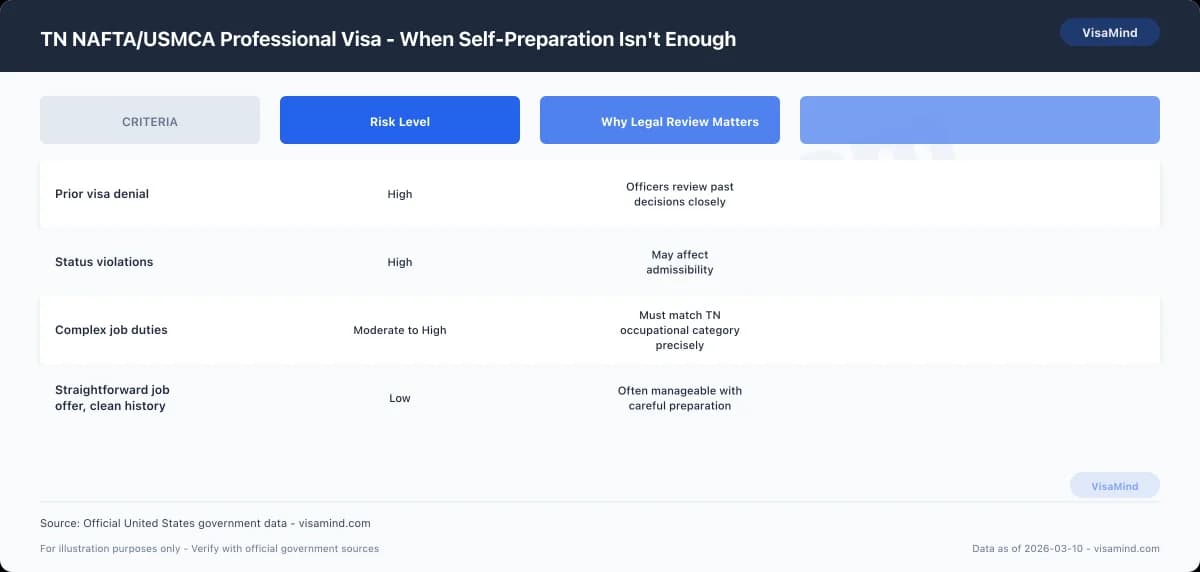
| Situation | Risk Level | Why Legal Review Matters |
|---|---|---|
| Prior visa denial | High | Officers review past decisions closely |
| Status violations | High | May affect admissibility |
| Complex job duties | Moderate to High | Must match TN occupational category precisely |
| Straightforward job offer, clean history | Low | Often manageable with careful preparation |
If your case is higher-risk, professional review reduces avoidable errors.
What specialists can help with
An experienced immigration attorney focuses on eligibility, documentation, and presentation.
They can:
- Analyze whether your position qualifies under a specific TN category
- Review your offer letter to ensure it supports the TN requirements
- Spot inconsistencies that could raise concerns at inspection or interview
- Prepare or review a USCIS petition if your employer files Form I-129
- Guide you through completing Form DS-160 accurately for consular processing
They also help you prepare for questions from U.S. Customs and Border Protection (CBP) at the port of entry or from a consular officer during your interview.
If your ability to work depends on precise classification, job duties, or timing, detailed legal review protects your application from preventable mistakes.
Common Petition Challenges
#Most TN denials are due to missing proof or filing errors.
You need to document your qualifications and follow the right process with USCIS and the U.S. Department of State.
Documentation and credential issues
You must prove citizenship and professional qualifications when you apply.
If you don’t submit clear proof of citizenship, the officer can’t approve your TN classification.
Your employer’s support letter must describe the offered position in detail. It should clearly state:
- The job title
- A summary of duties
- The length of employment
- How the role qualifies under TN rules
- Your qualifications for the position
If the letter omits key facts, USCIS or a consular officer may deny the case.
If your education was completed outside the United States, provide a complete and accurate credentials evaluation when required. An incomplete or inconsistent evaluation creates doubt about eligibility.
Mexican citizens must apply for a TN visa through the U.S. Department of State before seeking admission. This means submitting Form Form DS-160 and attending a visa interview. Arriving without the required visa will prevent admission for TN work.
| Issue | Resulting Problem |
|---|---|
| No proof of citizenship | Ineligibility cannot be verified |
| Weak employer letter | Job does not clearly qualify |
| Incorrect credentials evaluation | Qualifications not established |
| No TN visa (Mexican citizens) | Cannot be admitted for TN work |
Filing a TN request doesn’t guarantee approval. You must prove eligibility with complete and consistent evidence.
Procedural mistakes that cause denials
You have to follow the correct process based on how you apply.
If you file with U.S. Citizenship and Immigration Services (USCIS), submit a complete petition with all required evidence.
Common errors:
-
Submitting incomplete forms.
-
Leaving out required supporting documents.
-
Providing inconsistent information between forms and the employer letter.
If you apply for a visa as a Mexican citizen, you must complete Form DS-160 accurately and make sure it matches your supporting documents. Discrepancies between your DS-160, employer letter, and credentials can lead to refusal.
The offered role and your qualifications must align in every document. Even small inconsistencies can cause delays or denials, since officers rely on the written record.
| Procedural Error | Where It Occurs | Likely Outcome |
|---|---|---|
| Incomplete petition | USCIS filing | Request for evidence or denial |
| Inconsistent job details | USCIS or visa interview | Credibility concerns |
| Incorrect DS-160 entries | U.S. Department of State | Visa refusal |
Accuracy and consistency across every document matter if you want approval for TN work authorization.
Fees
#Total estimated cost: $185
| Component | Amount |
|---|---|
| Application fee (MRV)MRV fee (non-petition, TN/TD NAFTA) | $185 |
Verify current fees — official United States fee schedule
Fees shown are as of 2026-02. Verify on the official United States government website before applying.
Required forms
#Plan your TN NAFTA/USMCA Professional Visa with free United States tools
#Itemized government fees for TN NAFTA/USMCA Professional Visa and other United States categories.
Check United States eligibility
See how your profile scores against TN NAFTA/USMCA Professional Visa and other United States visas.
United States processing times
Typical wait times and stage breakdowns for TN NAFTA/USMCA Professional Visa and related United States visas.
Practice United States interview
Common interview questions and feedback for United States visa applicants.
Verified United States directory
#Browse source-backed, publication-certified records related to this visa route.
Browse source-backed, publication-certified records related to this visa route.
Browse source-backed, publication-certified records related to this visa route.