On this page
- What the C-1 Transit Visa Covers
- What Applicants Get Wrong
- Fees and Processing Times
- Conditions of Stay
- Eligibility Requirements
- When to Consult a Professional
- How to Apply Step by Step
- Document Checklist
- How Your Application Is Assessed
- Fees
- Required forms
- Related visa types
- Related guides
- Related goals
- Next steps
What the C-1 Transit Visa Covers
#The C-1 transit visa allows you to pass through the United States while traveling to another country. Your entry must be brief and tied directly to an immediate and continuous trip abroad.
Who this visa covers
You qualify for a C-1 transit visa if your only purpose for entering the United States is transit to another country.
This visa is for foreign citizens who:
- Have a final destination outside the United States
- Plan a short layover in the United States
- Intend to continue their trip without delay
Your stop must connect directly to onward travel. You can't use this visa for tourism or to remain in the country beyond what's needed for transit.
The U.S. Department of State manages visa applications and interviews. You'll need to complete Form DS-160 and follow Department of State procedures.
U.S. Citizenship and Immigration Services (USCIS) does not issue transit visas. Visa issuance happens through a U.S. embassy or consulate.
What transit entry permits
A C-1 visa permits you to enter the United States solely to continue travel to another country.
It allows:
- Entry for a short layover
- Travel directly connected to your onward international trip
- Presence in the United States only as long as necessary for immediate transit
It does not allow you to:
- Stay for tourism or personal visits
- Change your purpose to a Visitor/Tourist stay
- Remain in the United States beyond your transit period
| Permitted Activities | Not Permitted Activities |
|---|---|
| Short layover en route to another country | Tourism or sightseeing |
| Immediate and continuous travel | Extended stay unrelated to transit |
| Entry solely for transit purposes | Remaining in the U.S. for personal reasons |
U.S. Customs and Border Protection (CBP) determines your admission at the port of entry and confirms that your purpose matches transit only.
What Applicants Get Wrong
#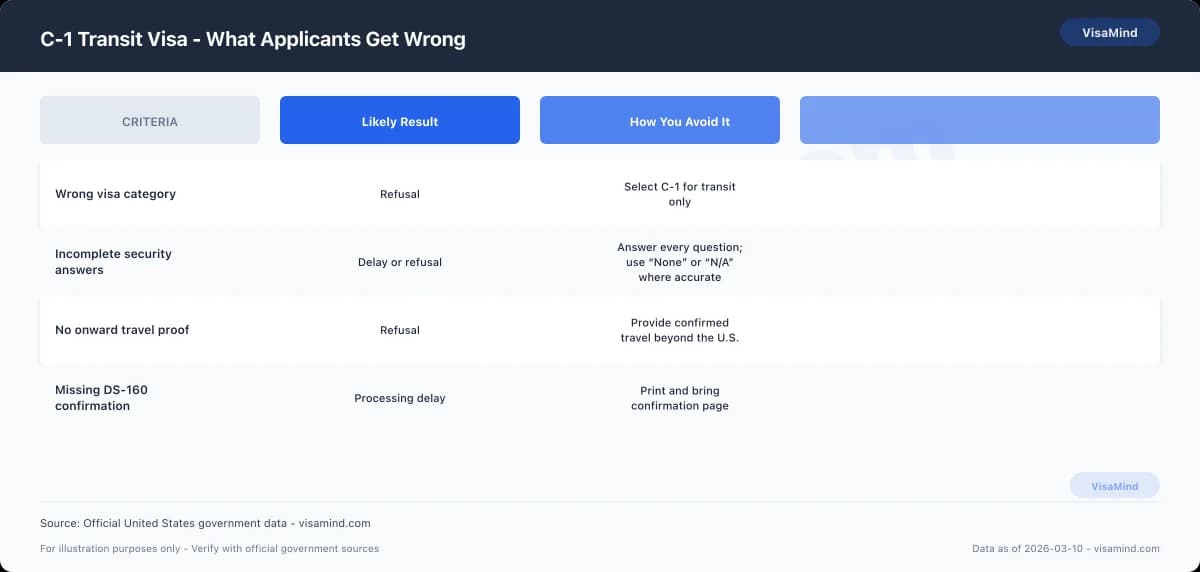
Most C-1 transit visa problems start with the Form DS-160 and basic documentation. Small errors can create delays, interview refusals, or denials by the U.S. Department of State.
Common application errors
Mistakes often happen when applicants rush the DS-160 or treat it like a Visitor/tourist application. The C-1 is only for immediate and continuous transit.
The most frequent errors include:
- Selecting the wrong visa category instead of C-1
- Leaving security or background questions blank
- Entering travel dates that don't match your ticket
- Submitting the DS-160 without printing the confirmation page
- Failing to show proof of onward travel
Inconsistent answers cause problems. If your passport has one spelling of your name and your DS-160 has another, the consular officer may refuse the visa. The same goes for mismatched travel dates.
Review every page before submission. Use your passport details exactly as written and make sure all answers remain consistent.
| Error Type | Likely Result | How You Avoid It |
|---|---|---|
| Wrong visa category | Refusal | Select C-1 for transit only |
| Incomplete security answers | Delay or refusal | Answer every question; use “None” or “N/A” where accurate |
| No onward travel proof | Refusal | Provide confirmed travel beyond the U.S. |
| Missing DS-160 confirmation | Processing delay | Print and bring confirmation page |
Photo and scheduling mistakes
Photo errors slow cases more than people expect. The Department of State applies strict technical standards.
Common problems include:
- Incorrect photo size or format
- Poor lighting or low resolution
- Cropped or edited images
- Uploading a non-compliant digital file
A non-compliant photo can lead to appointment delays or administrative processing. Using a professional service or a validated tool that follows Department of State specifications is recommended.
You also need to schedule and attend your visa interview. Submitting the DS-160 alone doesn't start the process.
If you fail to book the appointment, your case doesn't move forward.
Fees and Processing Times
#You must pay a fixed application fee and plan for consular processing times, which vary by location and visa category. Processing can range from a few weeks to many months, depending on where you apply.
Application fees
The $185 nonimmigrant visa application fee (MRV) applies to a C‑1 transit visa. This covers review of your DS‑160 and your visa interview with the U.S. Department of State.
| Fee Type | Amount (USD) | Paid To | Notes |
|---|---|---|---|
| MRV Application Fee | $185 | U.S. Department of State | Required before scheduling interview |
You pay this fee through the U.S. Department of State’s visa appointment system. USCIS does not process C‑1 visa applications unless a separate petition-based classification applies.
The MRV fee is required whether you apply for a C‑1 transit visa alone or a combined C‑1/D crew visa.
Typical processing windows
Processing time includes two main stages:
-
DS‑160 and interview appointment availability
Visa issuance after your interview
For the Crew and Transit (C, D, C1/D) category, published processing estimates range from about 0.5 months to 14 months as of February
- Actual timing depends on the U.S. embassy or consulate where you apply.
| Visa Category | Estimated Processing Range |
|---|---|
| Crew and Transit (C, D, C1/D) | 0.5–14 months |
| Visitor/Tourist (B1/B2) | 0.5–23 months |
| Student/Exchange (F, M, J) | 0.5–7.5 months |
| Petition-based (H, L, O, P, Q) | 0.5–4.5 months |
After visa approval, many applicants receive their passport with the visa within 2 to 8 weeks, depending on local courier and consular workload.
Processing times change frequently. Always verify current estimates directly with the U.S. Department of State for your specific consulate before making travel plans.
Conditions of Stay
#A C-1 transit visa allows you to pass through the United States while traveling to another country or to join a vessel or aircraft where you will work. Your stay must match the specific transit purpose listed in your visa application and supporting documents.
Eligible transit roles
Travel must be for a direct and immediate transit purpose. The C-1 visa does not authorize you to remain in the United States as a Visitor/Tourist or for long-term employment.
Common eligible situations include:
- Passing through the United States on the way to another country
- Traveling to join a ship or aircraft where you will serve as a crewmember
- Entering temporarily before continuing international travel
If you plan to work aboard a vessel or aircraft, you must show you're joining the specific ship or aircraft listed in your travel documents. Your visa classification must match your actual purpose.
You apply for the visa through the U.S. Department of State by submitting Form DS-160 and attending a consular interview. USCIS does not issue transit visas, but it oversees other immigration benefits if your purpose changes.
| Activity | Permitted on C-1 | Not Permitted |
|---|---|---|
| Immediate transit | ✔ | — |
| Joining ship/aircraft crew | ✔ | — |
| Tourism | — | ✘ |
| Permanent residence | — | ✘ |
Border and biometrics overview
A visa lets you travel to a U.S. port of entry, but it doesn't guarantee admission. U.S. Customs and Border Protection (CBP) decides whether to admit you and for how long.
During visa processing, you must provide biometric information like fingerprints and a photograph. CBP may also collect biometrics when you arrive.
At the border, be prepared to present:
- A valid passport
- Your C-1 visa
- Evidence of onward travel
- Documentation showing you will join a specific ship or aircraft, if applicable
CBP will confirm that you intend to remain only for transit. If your purpose differs from what you stated in your DS-160, officers can refuse admission.
Eligibility Requirements
#You must meet specific documentary and procedural requirements before a consular officer can issue a C-1 transit visa. You also need to follow the correct application steps through the U.S. Department of State and review official guidance from USCIS.
Who can apply
You may apply for a C-1 transit visa if you're seeking to pass through the United States in transit and you qualify under a nonimmigrant visa category processed through Form DS-160.
At minimum, you need:
- A completed Form DS-160 (Online Nonimmigrant Visa Application)
- A passport valid for travel to the United States
- Compliance with the specific instructions for your visa category
All nonimmigrant applicants, including those applying for K visa classifications, must submit Form DS-160.
The U.S. Department of State handles visa interviews and issuance. USCIS provides official forms and category-specific instructions. Download the current C-1 form and review the instructions directly from the USCIS website before you begin.
| Core Requirement | What You Must Do |
|---|---|
| DS-160 | Complete and submit online before your interview |
| Passport | Ensure it is valid for U.S. travel |
| Category instructions | Review current C-1 guidance from USCIS |
Follow official instructions
You must follow the official instructions for your eligibility category before completing any forms. Avoid using outdated versions or third-party summaries.
Take these steps:
-
Download the current C-1 form and instructions from the USCIS website.
-
Review the eligibility requirements for your specific classification.
-
Complete Form DS-160 accurately and in full.
The U.S. Department of State manages consular processing, including the visa interview. Always verify procedural updates directly with the Department of State and USCIS to ensure you use the correct forms and follow the current requirements.
When to Consult a Professional
#Some C-1 transit visa cases are straightforward and require careful form preparation. Others involve prior petitions, status issues, or coordination between USCIS and the U.S. Department of State.
When self-preparation is usually enough
You can usually prepare your own application if your situation is simple and limited to direct transit through the United States.
Self-preparation often works when:
- You're passing through the United States to another country.
- You have no prior U.S. immigration violations.
- You're not changing status inside the United States.
- You don't have a separate petition pending with USCIS.
In these cases, you typically complete Form DS-160 and attend your visa interview with the U.S. Department of State.
Filing with USCIS does not guarantee approval, so accuracy matters. If your travel purpose is clearly transit—not tourism as a Visitor/Tourist (B-2) visa—and your documents match your travel plans, you can often handle the process yourself.
| Situation | Professional Help Usually Needed? |
|---|---|
| Simple airport transit | No |
| Clear travel itinerary | No |
| No prior U.S. issues | No |
| No pending USCIS petition | No |
Situations that benefit from expert help
Consult an immigration attorney if your C-1 transit is linked to another petition or visa classification.
For example, when traveling in connection with an approved Form I-129 petition, petition approval must be in place before completing Form DS-160. The U.S. consulate will check petition status during visa processing.
Professional guidance is also helpful if:
- You previously filed applications with USCIS that were denied.
- You're unsure whether your travel qualifies as transit or falls under a different category.
- You have overlapping classifications, such as employment-based petitions tied to transit travel.
An attorney can review your petition history and confirm proper sequencing between USCIS filings and consular processing. This helps reduce inconsistencies between forms.
| Scenario | Why Legal Review Helps |
|---|---|
| Pending or approved I-129 | Confirms petition status before DS-160 |
| Prior denials | Identifies risks and inconsistencies |
| Mixed visa purposes | Clarifies correct classification |
How to Apply Step by Step
#You apply for a C-1 transit visa by submitting an online application and attending an in-person interview at a U.S. embassy or consulate.
You must complete Form DS-160 accurately and participate in the U.S. Department of State’s interview process.
| Step | What You Do | Authority Involved |
|---|---|---|
| 1 | Complete Form DS-160 online | U.S. Department of State |
| 2 | Schedule and attend visa interview | U.S. Department of State |
Complete the online application
Start with the Online Nonimmigrant Visa Application (Form DS-160). This form collects your biographic information, travel plans, and background details.
Submit the form electronically. Save and print the confirmation page—you’ll need it for your interview.
Follow these steps:
-
Access the DS-160 through the U.S. Department of State’s platform.
-
Answer every question truthfully and completely.
-
Review your entries carefully before submitting.
Save your application ID as soon as you begin. The system lets you retrieve your form for a limited time, but finishing it in one session helps avoid errors or lost data.
If you encounter technical issues or need clarification on the form, refer to the U.S. Department of State’s official guidance.
Interview scheduling and submission
After submitting Form DS-160, schedule a visa interview at a U.S. embassy or consulate.
Bring the required documents to your appointment, including:
- DS-160 confirmation page
- Appointment confirmation
- Any supporting evidence requested by the consulate
Each embassy or consulate may have specific document requirements and procedures. For fee details, refer to the U.S. Department of State’s published fee information.
Attend the interview in person. A consular officer will review your application and decide whether to issue the C-1 transit visa.
Admission to the United States is still subject to inspection by U.S. Customs and Border Protection at the port of entry.
Document Checklist
#You must bring specific documents to your C-1 transit visa interview.
Focus on your passport, Form DS-160 confirmation materials, compliant photos, and paperwork that shows your immediate transit through the United States.
Passport and ID
Your passport is the main document for a C-1 transit visa. It must be valid, in good condition, and match your application details.
Bring:
- Your current passport
- Any prior passport with relevant U.S. visas, if applicable
- A government-issued photo ID, if requested by the consulate
The biographic details in your passport must match those you entered in the Form DS-160, Online Nonimmigrant Visa Application. Mismatched names, birth dates, or passport numbers can delay processing.
If you’ve applied for a Visitor/Tourist visa or another nonimmigrant visa before, confirm that the passport information is consistent across applications. Consular officers rely on your passport to verify identity and eligibility.
Photos and DS-160 confirmation
You need to complete the DS-160 online before scheduling or attending your interview. After submission, print and keep the DS-160 confirmation page with the barcode.
Follow these steps:
-
Complete every required section of the DS-160.
-
Upload a compliant passport-style photo during the application.
-
Electronically sign and submit the form.
-
Print the barcode confirmation page before leaving the CEAC system.
Non-compliant photos can cause delays. Prepare your passport-style photos in advance so you can upload them without interruption.
The photo must meet U.S. visa standards. If you’re unsure about current specifications, refer to the U.S. Department of State’s guidance.
Bring the printed DS-160 confirmation page to your interview. Without the barcode page, the consular officer can’t access your application properly.
| Required Item | Action You Must Take |
|---|---|
| DS-160 form | Complete all sections and sign electronically |
| Photo | Upload during DS-160 process |
| Confirmation page | Print and keep the barcode page |
Supporting evidence and forms
Gather all required documents before your interview.
At minimum, bring:
- Your DS-160 confirmation page
- Your passport
- Any additional documents specifically requested by the U.S. embassy or consulate
Upload or keep copies of key documents as instructed during the application process. Keep both digital and printed versions organized.
If you have questions about additional forms or document requirements, consult the U.S. Department of State’s guidance for consular processing. USCIS does not issue C-1 visas; the Department of State manages visa interviews and issuance.
Complete every required section of your application and make sure all documents are consistent. Missing paperwork or unsigned forms can delay a decision on your transit visa.
How Your Application Is Assessed
#A consular officer from the U.S. Department of State reviews your Form DS-160, supporting documents, and interview responses for accuracy and consistency.
Even small errors can delay or end your application.
What consular officers evaluate
The officer compares every detail in your DS-160 to your passport and supporting records.
Names, birth dates, passport numbers, and travel details must match exactly.
You must answer all security and background questions completely. Leaving sections blank or providing partial answers can result in a request for more evidence or a denial.
Officers also check that your stated purpose aligns with a C-1 transit visa, not a Visitor/tourist classification. Your answers must show you intend to transit through the United States.
They look for internal consistency across documents and statements.
| Document/Item Reviewed | What Officers Check |
|---|---|
| DS-160 form | Complete answers; no skipped security questions |
| Passport | Exact match of biographic details |
| Supporting documents | Consistency with DS-160 information |
| Interview statements | Clear, direct answers that match the written record |
If you previously filed any applications with U.S. Citizenship and Immigration Services (USCIS), make sure the information remains consistent with your current DS-160.
Consequences of inconsistencies
Inconsistent information raises credibility concerns. Officers may pause processing to review discrepancies.
Common issues include:
- Misspelled names or reversed digits in passport numbers
- Different travel dates listed on documents
- Incomplete security disclosures
Even minor differences can lead to refusal if you can’t resolve them.
Failure to answer all background questions fully can trigger a request for more evidence or result in denial. You carry the burden of providing accurate and complete information the first time.
Before submitting the DS-160 and attending your interview, verify that every detail matches your passport and supporting documents.
Fees
#| Component | Amount |
|---|---|
| Application fee (MRV)MRV fee (non-petition) | $185 |
Fees change; always verify on USCIS.
Required forms
#Next steps
#Use Find My Visa to build a sequenced plan with official sources and deadlines.
FAQs
What happens at the port of entry?
A visa doesn't guarantee you'll be allowed in.
U.S. Customs and Border Protection (CBP) officers make the call when you arrive.
You'll need to show evidence that you'll leave the United States on time to continue your travel.
What is the C-1 Transit Visa?
The C-1 Transit Visa is for foreign citizens traveling through the United States en route to another country as part of an immediate and continuous transit (with limited exemption scenarios).
Who can use the C-1 Transit Visa?
A foreign citizen who will have a brief layover in the United States when the only reason for entering is transit qualifies; there is also a category for crewmembers traveling to the U.S. to join a ship or aircraft they will work on.
Do I need a visa to transit the United States?
Generally, a citizen of a foreign country who wishes to enter the United States must first obtain a visa — either a nonimmigrant visa for temporary stay or an immigrant visa for permanent residence; transit requires the appropriate nonimmigrant visa such as the C-1.
What form do I need to apply for a C-1 Transit Visa?
Visa applicants must submit a completed Form DS-160, the Online Nonimmigrant Visa Application; completing the DS-160 is a core part of the application process.
What should I do after completing the DS-160?
After completing the Form DS-160, print and keep the DS-160 barcode/confirmation page and follow the next steps listed by the issuing authority, including scheduling your interview and bringing required documents.
What are common reasons applications are rejected or delayed?
Common mistakes include submitting the Form DS-160 form without printing the confirmation page, missing proof of onward travel, using an incorrect photo format, not scheduling an interview appointment, inconsistent information across DS-160 sessions or with your passport, poor-quality or non-compliant visa photos, selecting the wrong visa category, and incomplete or skipped security/background questions.
How much does the visa application cost?
The Machine Readable Visa (MRV) application fee is $185 (as of 2026-03).
How long does processing usually take?
processing times vary by visa category and location. For crew and transit (C, D, C1/D) the window reported (as of February 2026) is 0.5 to 14 months; processing times vary so verify current times with the issuing authority. A separate processing time note lists 2–8 weeks as a processing time.
What documents should I prepare before my interview?
Gather all required documents before your interview, including a passport valid for travel to the United States, passport-style photos (prepared to the specified format), and the Form DS-160 confirmation/barcode page; complete all required sections, sign, and submit with the required evidence.
Does submitting a C-1 application guarantee approval?
No — filing for a C-1 does not guarantee approval.
Official sources referenced
Last reviewed: 2026-03-10
VisaMind provides informational guidance only and is not a government agency. This is not legal advice. Requirements can change and eligibility depends on your specific facts. If your case is complex or high-stakes, consult a licensed immigration attorney.
Next steps
Every United States visa case depends on your nationality, purpose, and timeline. Get a personalized plan with official sources and deadlines.
Find my visa