What the M-2 Dependent Visa Covers
#The M-2 visa lets certain family members of an M-1 visa vocational student stay in the United States during the student’s program. It defines who qualifies, how long they may remain, and the type of family relationship required.
Who is covered
The M-2 visa covers specific dependents of an M-1 vocational student. You must be the legal spouse or unmarried child of the principal M-1 student to qualify.
Eligible applicants include:
- A husband or wife of an M-1 student
- An unmarried child of an M-1 student
Parents, siblings, fiancés, or extended relatives are not eligible. The category is limited to immediate family members only.
Each dependent must apply for a visa. If you are applying from outside the United States, you submit Form DS-160 to the U.S. Department of State and attend a visa interview at a U.S. embassy or consulate.
The Department of State issues the visa. U.S. Customs and Border Protection (CBP) decides admission at the port of entry.
If you are already in the United States and seeking a related immigration benefit, you must follow procedures listed by U.S. Citizenship and Immigration Services (USCIS).
| Relationship to M-1 Student | Eligible for M-2? |
|---|---|
| Spouse | Yes |
| Unmarried child | Yes |
| Parent | No |
| Sibling | No |
Purpose and duration
The M-2 visa exists to keep your immediate family together while the M-1 student completes a vocational program in the United States. It does not create an independent reason to stay in the country.
Your stay depends on the M-1 student’s status. If the student maintains valid M-1 status, you may remain in M-2 status for the same general period. If the student’s status ends, your M-2 status ends as well.
You cannot use the M-2 visa as a substitute for family-based immigration. It is a temporary, nonimmigrant classification tied directly to the M-1 student’s authorized stay.
Relationship types
Your relationship to the M-1 student must be legally valid and recognized. Informal or unregistered partnerships do not qualify.
You must fall into one of these categories:
- Legally married spouse
- Unmarried child of the M-1 student
A fiancé(e) does not qualify under this category. You must be legally married before applying as a spouse.
A child must remain unmarried to qualify as an M-2 dependent. Once a child no longer meets that definition, eligibility for M-2 status ends.
Each dependent applies separately using Form DS-160 through the U.S. Department of State. Approval depends on proving the qualifying relationship and the principal student’s valid M-1 status.
Required Documents
#
You must prove your family relationship to the M-1 visa student, show the student’s valid status, and submit compliant photos and identity documents. Every detail on your forms, passport, and supporting records needs to match exactly.
Relationship evidence
Clear evidence is required to show you qualify as an eligible family member of the M-1 student. This is the core requirement for an M-2 dependent visa.
Prepare documents such as:
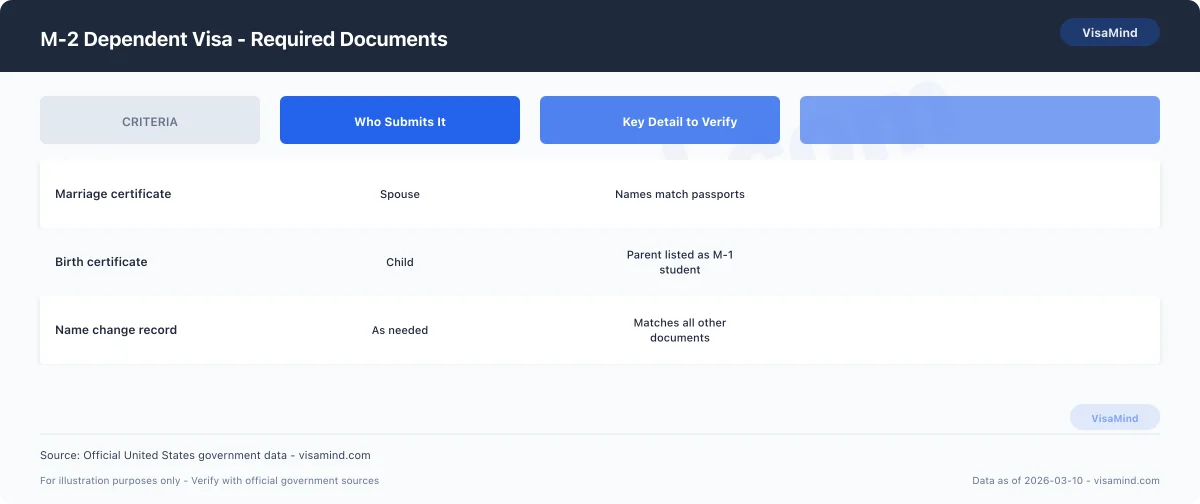
- Marriage certificate (for a spouse)
- Birth certificate listing the M-1 student as a parent (for a child)
- Official records showing any legal name changes
Your documents must show consistent names, dates of birth, and places of birth. If any document contains different spellings or variations, correct the issue before submitting your Form DS-160.
| Document Type | Who Submits It | Key Detail to Verify |
|---|---|---|
| Marriage certificate | Spouse | Names match passports |
| Birth certificate | Child | Parent listed as M-1 student |
| Name change record | As needed | Matches all other documents |
If your documents do not clearly establish the relationship, the U.S. Department of State may delay or refuse the visa.
Primary visa documentation
Your application depends on the M-1 student’s valid status. You must submit documentation that confirms the student holds M-1 classification.
Include:
- Evidence of the student’s current M-1 status
- Identification details that match the student’s passport
- Any documentation used to support the student’s visa classification
All information in your DS-160 must match the student’s records exactly. Even small discrepancies—such as a missing middle name—can cause processing delays.
If you have questions about status documentation, review official guidance from the U.S. Department of State for visa processing or from U.S. Citizenship and Immigration Services (USCIS) for status-related benefits.
Photos and identity matching
You must submit passport-style photos that meet U.S. Department of State specifications. Non-compliant photos are a common cause of delay.
Follow these steps:
-
Review the State Department’s photo requirements before taking your photo.
-
Use a professional service or a validated tool to confirm compliance.
-
Ensure your photo matches your current appearance.
Your passport, DS-160, and all supporting documents must reflect identical biographic information.
Confirm that:
- Your full legal name matches your passport exactly.
- Your date of birth is consistent across all documents.
- Your passport number is entered correctly on the DS-160.
| Item to Match | Where It Must Be Identical |
|---|---|
| Full legal name | Passport, DS-160, civil records |
| Date of birth | Passport, birth certificate, DS-160 |
| Passport number | Passport, DS-160 |
Inconsistent identity information can lead to delays or denial at the visa interview stage.
Fees and Processing Times
#You must pay a fixed visa fee and plan for both interview scheduling and visa issuance time. Processing windows vary by visa category and U.S. embassy or consulate.
Visa and processing fees
You pay a Machine Readable Visa (MRV) fee of $185 when you submit your online Form DS-160 for an M-2 dependent visa. The U.S. Department of State collects this fee for consular processing.
| Fee Type | Amount (USD) | Paid To | When You Pay |
|---|---|---|---|
| MRV application fee | $185 | U.S. Department of State | Before scheduling your visa interview |
This fee applies to each applicant. If you have multiple dependents, each person must pay $185.
The MRV fee covers:
- Processing of your DS-160
- Scheduling of your visa interview
- Adjudication by a consular officer
If you later file an application with U.S. Citizenship and Immigration Services (USCIS), such as a change or extension of status inside the United States, separate USCIS filing fees apply.
Category-specific processing windows
Interview wait times depend on how the U.S. embassy or consulate classifies your visa category. M-2 visas fall under the Student/Exchange (F, M, J) group for scheduling purposes.
As of February 2026, reported processing windows are:
| Visa Category | Approximate Wait Range |
|---|---|
| Visitor (B1/B2) | 0.5 to 23 months |
| Student/Exchange (F, M, J) | 0.5 to 7.5 months |
| Petition-based (H, L, O, P, Q) | 0.5 to 4.5 months |
| Crew and Transit (C, D, C1/D) | 0.5 to 14 months |
These ranges reflect variation by location. A consulate in one country may schedule interviews within weeks, while another may take several months.
After your interview, visa issuance commonly takes 2 to 8 weeks, depending on workload and any required additional review. You should not book nonrefundable travel until you receive your passport with the visa.
Checking current wait times
You need to verify wait times directly with the U.S. Department of State, which manages consular interviews and visa issuance. USCIS does not control overseas visa interview scheduling.
Follow these steps:
-
Select the U.S. embassy or consulate where you will apply.
-
Check the posted interview wait time for the Student/Exchange category.
-
Review any location-specific instructions for M visa applicants.
processing times can change quickly due to staffing, local demand, or security procedures. If you are coordinating your timeline with an M-1 visa student or planning future family-based immigration, align your visa strategy with current consular data.
Application Process
#You must complete the correct online form, prepare supporting documents, and attend a visa interview through the U.S. Department of State. Accuracy and complete answers matter at every stage.
Complete the online form(s)
You must submit Form DS-160, Online Nonimmigrant Visa Application, for each M-2 applicant. This requirement applies to all nonimmigrant visa categories.
Follow these steps:
-
Complete the DS-160 through the Consular Electronic Application Center (CEAC).
-
Answer every security and background question fully.
-
Submit the form electronically.
-
Print and keep the DS-160 confirmation barcode page.
Save your application ID before you begin. The system allows you to retrieve your form for a limited period, but you should complete it in one sitting if possible.
If you file any related application with U.S. Citizenship and Immigration Services (USCIS), review the official form instructions on the USCIS website before submitting.
| Form | Who Completes It | Agency Involved | Key Action |
|---|---|---|---|
| DS-160 | Each M-2 applicant | U.S. Department of State | Submit online and print barcode page |
| USCIS form (if required) | Applicant or petitioner | USCIS | File correct edition with required evidence |
Incomplete answers often lead to delays or requests for additional evidence.
Gather and submit evidence
You must submit all required supporting documents with your application.
Prepare the following:
- DS-160 confirmation barcode page
- Any required USCIS forms, if applicable
- Supporting evidence listed in the official instructions for your eligibility category
- Signed forms where required
Upload the DS-160 confirmation page with your visa application and keep a printed copy for your records.
Organize your documents clearly. Label files correctly if you upload them electronically.
If you have questions about document requirements, check the USCIS website for filing guidance and the U.S. Department of State for visa processing instructions.
Interview and next steps
After you submit the DS-160 and required documents, you must follow the U.S. Department of State’s process for scheduling your visa interview.
Bring:
- Your DS-160 confirmation page
- Any required supporting documents listed in your appointment instructions
- Printed copies of submitted forms, if requested
Answer all questions clearly and consistently with your application. Discrepancies between your DS-160 and interview answers can delay a decision.
If the officer needs more information, you may receive instructions for additional steps. Follow those instructions exactly and submit any requested documents promptly.
Admission to the United States, if a visa is issued, is determined by U.S. Customs and Border Protection at the port of entry.
When to Get Help
#Some M-2 cases require close coordination between petition approval, visa processing, and family status. Seek guidance when your situation involves overlapping filings, prior issues with USCIS, or complications at the consular stage.
Complex petition situations
If your M-2 application relies on an underlying employment petition—like H-1b visa or L-1—that U.S. Citizenship and Immigration Services (USCIS) must approve, it's smart to get legal help.
The principal applicant needs an approved Form I-129 before you finish the Form DS-160. The U.S. Department of State checks the petition’s status during visa processing.
Filing the DS-160 too soon often causes delays or disrupts your case.
You’ll also want guidance if your family situation overlaps with other immigration categories, such as:
- A pending employment-based petition
- A pending or approved family-based immigration petition
- A change of status request with USCIS
- Multiple dependents applying at different times
In these scenarios, timing is everything. An attorney can coordinate filings so your student-dependent status matches the principal applicant’s approved petition and current status.
| Situation | Why Legal Help Matters |
|---|---|
| I-129 not yet approved | Prevents filing DS-160 prematurely |
| Mixed visa categories in one family | Avoids conflicting status issues |
| Concurrent USCIS filings | Ensures consistent information across forms |
Prior denials or RFEs
If USCIS previously denied a related petition or sent a Request for Evidence (RFE), you should get help.
A prior RFE or denial can affect how a consular officer reviews your DS-160 and supporting documents. Inconsistent answers between past filings and your current application tend to raise concerns at the interview.
Legal review helps you:
- Spot discrepancies in prior submissions
- Prepare explanations for consular review
- Align your DS-160 with the approved petition record
If the principal applicant faced delays or scrutiny with USCIS, don’t assume your dependent visa will move forward without issues. Careful preparation can reduce the risk of complications with the U.S. Department of State.
Eligibility Requirements
#You qualify for an M-2 dependent visa only if you have a qualifying relationship to a valid M-1 visa student. Your eligibility also depends on the primary visa holder maintaining proper nonimmigrant status.
Who qualifies to be a dependent
You may apply for M-2 classification if you’re the spouse or unmarried child of someone holding a valid M-1 nonimmigrant student visa.
To qualify, you must meet the following:
- You’re legally married to the M-1 student or
- You’re the unmarried child of the M-1 student
- You intend to accompany or follow to join the M-1 student in the United States
- You apply for a nonimmigrant visa through the U.S. Department of State by submitting Form Form DS-160
Extended family members aren’t eligible. Parents, siblings, and other relatives don’t qualify for M-2 status.
M-2 classification is separate from family-based immigration and doesn’t provide permanent residence or a path to a green card on its own.
| Relationship to M-1 Student | Eligible for M-2? |
|---|---|
| Spouse | Yes |
| Unmarried child | Yes |
| Parent | No |
| Sibling | No |
Primary visa holder requirements
Your eligibility depends on the M-1 student maintaining valid status.
The primary visa holder must:
- Hold a valid M-1 vocational student visa
- Be admitted to pursue full-time vocational or nonacademic study
- Stay in compliance with the terms of M-1 classification
If the M-1 student falls out of status, your M-2 status is directly affected.
U.S. Citizenship and Immigration Services (USCIS) handles immigration benefits inside the United States. The U.S. Department of State issues visas abroad. At entry, U.S. Customs and Border Protection (CBP) determines admission.
You can’t get or keep M-2 status independently of the M-1 student.
Relevant nonimmigrant categories
U.S. student visas fall into specific nonimmigrant categories. The M-2 visa only exists as a dependent classification of the M-1 category.
The broader framework includes:
| Visa Category | Purpose |
|---|---|
| M-1 | Vocational or nonacademic student |
| M-2 | Dependent of M-1 student |
| J | Exchange visitor programs |
If the primary visa holder qualifies under a different student or exchange category, the dependent classification changes accordingly.
When applying for an M-2 visa abroad, you must complete Form DS-160 and attend a consular interview through the U.S. Department of State.
Relationship Scrutiny Red Flags
#U.S. consular officers and U.S. Citizenship and Immigration Services (USCIS) review M-2 cases closely for proof of a real, qualifying relationship to the M-1 visa student. Missing documents, inconsistent answers, or picking the wrong visa category often lead to refusal or a Request for Evidence (RFE).
Common evidence gaps
You must prove your relationship to the M-1 student. Filing for an M-2 visa doesn’t guarantee approval.
Officers expect clear documents showing a valid spousal or parent-child relationship. If you don’t provide them, the case can be refused.
Typical evidence gaps include:
- No proof of marriage to the M-1 student
- No proof of parent-child relationship
- Documents that don’t match the names in your passport
- Failing to bring relationship documents to the visa interview
| Required Proof | Common Problem | Result |
|---|---|---|
| Marriage evidence | Not submitted or inconsistent names | Visa refusal |
| Parent-child evidence | Missing documentation | Visa refusal |
| Identity documents | Do not match passport details | Delays or refusal |
If you’re applying through consular processing, the U.S. Department of State officer reviews this evidence at your visa interview. If USCIS asks for more proof, respond fully and by the stated deadline.
Application inconsistencies
Inconsistent information across Form DS-160 sessions causes credibility concerns. Officers compare your answers with your passport and previous filings.
You need to use exact passport details and correct travel dates every time you complete the DS-
- Even minor differences can trigger questions.
Frequent issues include:
- Different spellings of your name across DS-160 submissions
- Travel dates that don’t match your passport or earlier answers
- Changing biographic information without explanation
Review every answer before you submit the DS-160.
If you leave required fields blank or skip security questions, you risk an RFE or refusal. Enter “None” or “N/A” where appropriate instead of leaving spaces empty.
Background and category errors
Selecting the wrong visa category leads to denial. An M-2 visa is for accompanying or following to join an M-1 vocational student.
You must pick the correct category on the DS-
- Don’t select a visitor category like B-1/B-2 or a student category like F-1 visa unless it matches your real purpose.
| Purpose of Travel | Correct Visa Category | Common Error |
|---|---|---|
| Accompany M-1 student | M-2 | Selecting B-1/B-2 |
| Study as primary student | F-1 or M-1 (as appropriate) | Selecting M-2 |
Answer every background and security question completely. Incomplete answers often cause delays or formal requests for clarification.
Treat the DS-160 as a legal document. Inaccurate category selection or incomplete background responses can undermine your credibility from the start.
Protect Your Personal Information
#You share sensitive data throughout the M-2 dependent visa process, including forms filed with U.S. Citizenship and Immigration Services (USCIS) and the Form DS-160 submitted to the U.S. Department of State. Limit what you disclose publicly and use secure methods when sending documents or feedback.
What not to share publicly
Don’t post personal details from your M-2 application on social media, public forums, or comment sections. This includes anything you entered on Form DS-160 or forms submitted to USCIS.
Avoid sharing:
- Your full legal name with your date of birth
- Passport numbers
- SEVIS-related details linked to the M-1 visa Student
- Receipt numbers from USCIS
- Copies of approval notices
- Information about any family-based immigration filings
Even in online support groups for students and dependents, keep your questions general. Describe your issue without posting identifying numbers or scanned documents.
| Safe to Share | Do Not Share |
|---|---|
| General process questions | Receipt numbers |
| Publicly available form names | Passport biographic pages |
| Official agency names (USCIS, U.S. Department of State) | Complete DS-160 confirmation page |
| Broad timelines from official sources | Personal contact details |
If you provide feedback to agencies, remove unnecessary personal identifiers unless the form specifically asks for them.
Secure submission practices
Submit forms only through official government systems. Use the USCIS website for benefits processing and follow U.S. Department of State instructions for DS-160 and visa interview scheduling.
When sending documents:
-
Use secure internet connections, not public Wi-Fi.
-
Upload documents only through official portals.
-
Mail physical forms to the address listed in the current form instructions.
-
Keep copies of everything you submit.
Store digital files in password-protected folders. Limit access to you and trusted family members directly involved in your case.
If someone helps with your M-2 application, including anything related to a student or family-based immigration case, share only the documents needed for that task. You’re responsible for protecting your personal information throughout the process.
Fees
#| Component | Amount |
|---|---|
| Application fee (MRV)MRV fee (non-petition) | $185 |
Fees change; always verify on USCIS.
Required forms
#Next steps
#Use Find My Visa to build a sequenced plan with official sources and deadlines.
FAQs
Can an M-2 visa lead to family-based immigration?
An M-2 visa is a nonimmigrant category.
If you later pursue family-based immigration, you'll need to look at the separate eligibility rules and filing process set by USCIS.
Each immigration category has its own requirements and procedures. For current forms, filing instructions, and eligibility criteria, refer directly to USCIS resources.
Who is eligible for this dependent visa?
Spouses and children of M-1 visa vocational students may apply to join the principal M-1 visa holder and stay together while the M-1 pursues vocational studies.
What forms do applicants need to submit?
Applicants must complete the Form DS-160 Online Nonimmigrant Visa Application and also complete and submit the M-2 visa application form; after finishing the DS-160 you should print and keep the DS-160 barcode page.
What evidence should I prepare to prove the family relationship?
Prepare details and evidence showing your relationship to the M-1 visa holder, and include valid M-1 visa information for the primary visa holder.
Does submitting the M-2 application guarantee approval?
No. Filing the M-2 application does not guarantee approval; for example, failure to provide proof of the relationship to the M-1 visa holder can lead to denial.
How much does the visa application cost?
The application (MRV) fee is $185 (as of 2026-02).
How long will processing take?
processing times vary by visa category and location. Examples (as of February 2026) include ranges of 0.5 to 23 months for Visitor (B1/B2), 0.5 to 7.5 months for Student/Exchange (F, M, J), 0.5 to 4.5 months for petition-based categories, and 0.5 to 14 months for crew/transit; processing times vary so verify current times. A general processing time reference is 2–8 weeks.
What are common mistakes that cause delays or rejections?
Common problems include inconsistent information across Form DS-160 sessions or with your passport, poor-quality or non-compliant photos, selecting the wrong visa category, and incomplete or skipped security/background questions.
Any tips for completing the DS-160?
Save your application ID and, when possible, complete the form in one sitting (data can be retrieved for 30 days); upload and print the Form DS-160 confirmation page; prepare compliant passport-style photos before starting; and answer all security and background questions fully, ensuring all information matches your passport and supporting documents exactly.
Where can I get the official M-2 form and instructions?
Download the current M-2 form and instructions from the official USCIS website; this is the form used by applicants filing with USCIS.
Official sources referenced
Last reviewed: 2026-03-10
VisaMind provides informational guidance only and is not a government agency. This is not legal advice. Requirements can change and eligibility depends on your specific facts. If your case is complex or high-stakes, consult a licensed immigration attorney.
Next steps
Every United States visa case depends on your nationality, purpose, and timeline. Get a personalized plan with official sources and deadlines.
Find my visa