
Overview
#Refugee resettlement allows you to seek protection in the United States if you face persecution and remain outside the country.
The process requires a referral to the U.S. Refugee Admissions Program (USRAP) and review by U.S. Citizenship and Immigration Services (USCIS).
What this process is
Refugee resettlement is a formal process for people who are outside the United States and cannot return to their home country due to persecution.
You must be considered under the U.S. Refugee Admissions Program (USRAP).
You do not apply directly on your own.
You first need a referral to USRAP before USCIS will review your case.
USCIS conducts eligibility determinations as part of this process.
If you qualify, you may receive humanitarian relief through admission to the United States as a refugee.
Refugee resettlement is different from filing an application inside the United States.
It applies only to individuals who are abroad at the time of consideration.
| Key Feature | Refugee Resettlement |
|---|---|
| Location of applicant | Outside the United States |
| Program | U.S. Refugee Admissions Program (USRAP) |
| Reviewing agency | U.S. Citizenship and Immigration Services (USCIS) |
| Type of protection | Humanitarian relief |
Who it’s for
This process serves individuals who have experienced persecution and remain outside the United States.
You must fall within the categories considered for refugee protection under USRAP.
You may qualify if:
- You are outside the United States.
- You have faced persecution.
- You receive a referral to USRAP for consideration.
Family members may also seek protection in certain situations.
Form Form I-730, Refugee/Asylee Relative Petition, allows qualifying relatives to request follow-to-join benefits through USCIS.
USCIS reviews each case individually.
You must meet the specific eligibility standards applied during the refugee determination process.
How consideration begins
Your case begins with a referral to the U.S. Refugee Admissions Program.
Without a referral, USCIS will not evaluate you for refugee resettlement.
The basic sequence works as follows:
-
You receive a referral to USRAP.
-
You apply through the refugee admissions process.
-
USCIS conducts an eligibility determination outside the United States.
USCIS officers review your information and decide whether you meet refugee criteria.
This determination occurs before you enter the United States.
Your Rights During Processing
#
You have the right to receive clear notices, respond to requests, and seek consideration when urgent needs arise.
USCIS must review your filings, notify you of missing items, and weigh any expedite request based on urgency and merit.
Requests for evidence and photo requirements
USCIS may issue a Request for Evidence (RFE) if your filing lacks required documents or does not meet photo standards.
You have the right to receive written notice that explains what is missing and how to respond.
Common triggers for an RFE include:
- Missing required photographs
- Photos that do not meet USCIS specifications
- Incomplete supporting documentation
If you submit photos that do not meet the stated requirements, USCIS may pause processing and ask you to provide new ones.
This can delay adjudication of related filings, including Form I-765, Application for Employment Authorization, or Form I-730, Refugee/Asylee Relative Petition.
| Issue Identified | What Happens | Your Right |
|---|---|---|
| Missing photo | USCIS sends RFE | Submit corrected photo within deadline |
| Incorrect photo format | USCIS requests new photo | Provide compliant replacement |
| Incomplete evidence | USCIS asks for documents | Respond with requested proof |
You must respond by the deadline listed in the notice.
Failure to respond may result in a denial.
Work authorization and related filings
You may file Form I-765, Application for Employment Authorization, while your refugee-based benefit is pending, if eligible.
USCIS must adjudicate your Form I-765 after reviewing your submission.
If USCIS requires additional evidence to process your Form I-765, it may issue an RFE.
You have the right to respond with the requested documentation before a final decision.
When you file related applications together—such as Form I-730 for qualifying family members and Form I-765 for work authorization—USCIS reviews each benefit separately.
An issue with one form can affect timing but does not automatically determine the outcome of another.
If you seek humanitarian relief connected to your refugee status, USCIS evaluates each request under its own eligibility rules.
Expedite and procedural considerations
You may request expedited processing if you face urgent circumstances.
USCIS does not grant expedite requests automatically.
When reviewing an expedite request, USCIS:
-
Examines the urgency of your situation
-
Reviews the merit of your underlying application
-
Decides whether to move your case ahead of earlier-filed cases
USCIS carefully weighs each request before deciding to adjudicate a case out of order.
Approval of an expedite request does not guarantee approval of the underlying benefit.
If you request expedited handling for Form I-765 or Form I-730, provide clear documentation that supports the urgency.
USCIS retains discretion to approve or deny the request based on the evidence you submit.
Getting Legal Help
#You face strict filing rules and evidence standards in refugee resettlement and related humanitarian relief cases.
Careful timing, complete forms, and organized proof often determine whether U.S. Citizenship and Immigration Services (USCIS) accepts or rejects your case.
When to get expert help
You should seek legal help when primary documents are missing or incomplete.
If you cannot obtain official records, you must address the gap with other credible evidence and explain the absence clearly.
Derivative filings require close attention to deadlines.
If you plan to file Form I-730, Refugee/Asylee Relative Petition, you must submit it within 2 years of your asylum or refugee approval.
This deadline is strict for qualifying relatives abroad.
Consider legal guidance if:
- You lack primary or secondary civil documents.
- You need to prepare affidavits to support missing records.
- You are unsure which supplements apply to your eligibility category.
- You are filing under a humanitarian relief category with detailed instructions.
An attorney can review your timeline, confirm eligibility, and ensure you include every required supplement with the main petition to avoid rejection.
| Situation | Risk Without Help | Why Legal Review Matters |
|---|---|---|
| Missing civil documents | Weak evidence or denial | Proper affidavits and explanation |
| I-730 filed after 2 years | Rejection | Deadline tracking and strategy |
| Omitted supplements | Case rejection | Complete filing package |
Filing tips and common errors
USCIS rejects filings that omit required supplements or supporting forms.
Submit all required supplements together with your main petition.
Review the specific instructions for your eligibility category before you start.
Do not assume requirements are the same across humanitarian relief options.
Common errors include:
- Filing Form I-730 after the 2-year deadline.
- Sending the main form without required supplements.
- Failing to address missing primary evidence.
- Ignoring category-specific instructions.
Follow a clear sequence:
-
Confirm your eligibility category.
-
Read the full USCIS form instructions.
-
Gather required evidence and supplements.
-
Assemble and review the entire package before filing.
If you are unsure about current fees or procedural updates, check directly with USCIS.
Do not rely on outdated versions of forms or prior guidance.
Reviewing instructions and evidence strategy
Start with the official form instructions issued by USCIS.
Each eligibility category lists required evidence and any mandatory supplements.
If primary and secondary documents are unavailable, you must overcome that gap with credible affidavits and a clear explanation.
Organize affidavits logically and tie each one to the missing document.
Focus your evidence strategy on:
- Proving eligibility under your specific humanitarian relief category.
- Demonstrating family relationship for Form I-730, if applicable.
- Explaining any absence of standard records.
Create a checklist based directly on the form instructions.
Match each requirement to a document in your packet.
A structured review reduces rejections and helps USCIS evaluate your case efficiently.
Application Process
#You must first receive a referral before you can apply for refugee resettlement in the United States.
After referral, you complete required forms, attend an interview with U.S. Citizenship and Immigration Services (USCIS), and follow strict submission and signature rules to avoid rejection.
Referral, interviews, and overseas processing
You cannot apply for refugee status on your own.
You must receive a formal referral to the U.S. Refugee Admissions Program.
If you receive a referral, authorized staff will help you prepare your application paperwork.
You will then attend an in-person interview abroad with a USCIS officer.
During the interview, a USCIS officer evaluates whether you qualify for refugee classification.
The officer reviews your statements, documents, and background information before making a decision.
Key steps include:
-
Referral to the U.S. Refugee Admissions Program
-
Application preparation with authorized assistance
-
Interview with a USCIS officer outside the United States
Eligibility determination
If USCIS approves your case, you may move forward with overseas processing coordinated with the U.S. Department of State.
If you are seeking to reunite certain family members after approval, you may later use Form I-730, Refugee/Asylee Relative Petition, as part of humanitarian relief options available under U.S. law.
Forms, signatures, and edition rules
The primary application form for refugee classification is Form I-590, Registration for Classification as Refugee.
You must download the current edition of the form and its instructions directly from USCIS.
Using an outdated edition can result in rejection.
Follow these requirements carefully:
- Complete all required sections.
- Provide accurate and consistent information.
- Sign the form where indicated.
- Submit all required supporting evidence.
Failure to sign the form will result in automatic rejection.
USCIS will not process an unsigned application.
The table below highlights common form issues:
| Issue | Result |
|---|---|
| Missing signature | Immediate rejection |
| Outdated form edition | Rejection |
| Incomplete required fields | Processing delays or rejection |
Always verify the edition date listed by USCIS before submitting your paperwork.
How to submit and what causes rejection or delay
You must follow the submission instructions provided for Form I-590.
Submit your completed and signed form with all required evidence as directed in the official instructions.
Before submission, confirm that you have:
- Used the correct form edition
- Signed every required signature field
- Completed all mandatory sections
- Included all required supporting documents
USCIS may reject or delay your case for procedural errors rather than eligibility issues.
The most common problems include missing signatures, incomplete forms, and outdated editions.
If USCIS rejects your application, you must correct the issue and resubmit according to the official instructions.
Always review the most current guidance from USCIS before filing to reduce avoidable delays.
Eligibility Criteria
#To qualify for refugee resettlement, you must prove persecution tied to a protected ground and meet specific family and documentation rules.
U.S. Citizenship and Immigration Services (USCIS) reviews your status, your claimed harm, and any qualifying relatives you seek to include.
Protected grounds and qualifying harms
You must show that you experienced past persecution or have a well‑founded fear of future persecution based on at least one protected ground:
- Race
- Religion
- Nationality
- Political opinion
- Membership in a particular social group
The harm must connect directly to one of these grounds.
Personal disputes or generalized hardship do not meet this standard unless they relate to a protected category.
You should provide detailed facts about what happened to you or what you reasonably fear will happen.
Include dates, locations, and who caused the harm.
If you served in the military or police, disclose that service fully and explain your role.
USCIS evaluates whether your fear is tied to one of the listed grounds and whether the harm rises to the level of persecution.
| Requirement | What You Must Show |
|---|---|
| Protected ground | Harm linked to race, religion, nationality, political opinion, or social group |
| Past harm or future fear | Specific incidents or credible fear of persecution |
| Military or police history | Full disclosure and explanation of duties |
Who may be included as derivatives
Certain family members can be included in your case, but there are strict limits.
You may include:
- Your spouse
- Your unmarried children under 21
If you're a principal refugee admitted to the United States within the past two years, or a principal asylee granted asylum within the past two years, you may file Form I-730, Refugee/Asylee Relative Petition with USCIS.
This petition allows your qualifying spouse and unmarried children under 21 to join you.
In some situations, an unmarried child over 21 might qualify for following-to-join benefits, but that depends on the facts.
You may also be eligible to file an Affidavit of Relationship for:
- Your spouse
- Your unmarried child under 21
- Your parents
You must show proof of your principal refugee or asylee status when filing Form I-730.
| Relationship | Possible Path |
|---|---|
| Spouse | Form I-730 or Affidavit of Relationship |
| Unmarried child under 21 | Form I-730 or Affidavit of Relationship |
| Parents | Affidavit of Relationship |
| Unmarried child over 21 | Possible following-to-join in limited cases |
Information the adjudicator considers
USCIS reviews your application to confirm eligibility under the refugee definition and to verify family relationships.
You need to provide:
- Proof of your refugee or asylee status in the United States
- Evidence supporting your claimed persecution or fear
- Documentation of your family relationships
The adjudicator checks that your statements are consistent and that the harm is tied to a protected ground.
In derivative cases, USCIS needs to see that the relationship existed as required and meets the age and marital status limits.
If you seek humanitarian relief for family through Form I-730, USCIS checks whether you filed within the two-year period after your admission as a refugee or grant of asylum.
What Happens Next
#After approval and arrival, you receive specific forms of support and may begin the process to bring certain family members.
The next steps depend on your relatives’ location and whether they will process through a U.S. consulate or apply inside the United States.
Arrival support and benefits
When you arrive in the United States as a refugee, you qualify for medical assistance and cash assistance.
These benefits help you meet basic needs while you settle. The type and duration of assistance depend on program rules, which you should confirm through your local resettlement agency or the relevant government office.
Keep records of your refugee approval and identity documents.
You may need them to access benefits or apply for additional humanitarian relief through U.S. Citizenship and Immigration Services (USCIS).
If you plan to file for family members using Form I-730, Refugee/Asylee Relative Petition, keep copies of your approval notice and proof of your status.
USCIS will require evidence that you were granted refugee or asylum status before it approves any derivative case.
Derivative processing paths (consular vs. adjustment)
Your family member’s location determines the next step.
| Location of Derivative | Process Type | Main Form | Government Agency Involved |
|---|---|---|---|
| Outside the U.S. | Consular processing | DS-260 | U.S. Department of State |
| Inside the U.S. | adjustment of status | Form I-485 | USCIS |
If your relative is abroad, they'll complete consular processing. This involves submitting Form DS-260 and attending an immigrant visa interview with the U.S. Department of State.
If your relative is in the United States, they may apply for adjustment of status by filing Form I-485 with USCIS, if eligible.
Proofs to show after principal’s approval
After you receive refugee or asylum approval, you must prove both your status and your relationship to your family member.
Prepare clear copies of:
- Your refugee or asylum approval notice
- Marriage certificate (for a spouse)
- Birth certificate (for a child)
- Any other official document that confirms the claimed relationship
USCIS reviews these documents when you file Form I-130. The agency must see evidence that the relationship exists and that your status was approved.
Organize documents before filing. Missing proof can delay processing or lead to denial.
Processing Times and Costs
#Refugee resettlement cases move through several agencies. Timing depends on the form type and the agency handling your case.
You need to track your case and use official processing tools for updates.
Costs are limited in certain refugee-based filings, including Form I-730.
Typical waits and variability
processing times for refugees under the standard category currently range from 6 to 12 months as of March 2026.
This timeframe can change depending on your eligibility category and the USCIS service center.
USCIS posts case-specific estimates through its online processing times tool. You must select the correct form and service center to get an accurate range.
For Form I-730, Refugee/Asylee Relative Petition, timing also varies.
If your case remains pending beyond the posted range, you may qualify to submit an inquiry.
| Case Type | Current Processing Time (as of March 2026) | Notes |
|---|---|---|
| Refugee (Standard) | 6–12 months | Varies by eligibility category and service center |
| Form I-730 | Varies by service center | Check USCIS processing times tool |
If your petition involves consular processing abroad, the U.S. Department of State manages visa issuance timelines.
USCIS controls petition adjudication only.
How to check status and submit inquiries
Monitor your case directly through USCIS. Use the official case status system and the processing times tool to compare your receipt date with posted timelines.
If your Form I-730 exceeds the normal processing window, you may file an “outside normal processing times” inquiry.
This asks USCIS to review a case that appears delayed.
Follow these steps:
-
Check the posted processing time for Form I-730.
-
Confirm your receipt date falls outside the listed range.
-
Submit an online inquiry through USCIS if eligible.
If your petition is pending with the U.S. Department of State for visa issuance, review status updates through the appropriate consular channel.
USCIS can't provide updates on visa interview scheduling or issuance.
Keep copies of all receipt notices and correspondence. You will need your receipt number to request updates.
Fees and filing cost information
Certain refugee-based filings do not require a filing fee. As of February 2026, the Form I-730 filing fee is $0.
| Form | Filing Fee (USD) | Effective Date |
|---|---|---|
| Form I-730 | $0 | As of February 2026 |
No payment is required when you file Form I-730 with USCIS.
Other humanitarian relief filings may have different fee structures.
You must review the official USCIS fee schedule or fee calculator for up-to-date amounts. Fee rules can change, and USCIS will reject filings that include incorrect payments.
Credibility and Procedural Risks
#USCIS will not approve a refugee resettlement case or related humanitarian relief request just because you filed it.
You must prove eligibility with complete, consistent, and well-documented evidence, especially for petitions like Form I-730.
Why applications are denied or rejected
USCIS may reject or deny your case if you leave out required documents or if your evidence doesn't match what's in your forms.
Common rejection or denial reasons include:
- Missing civil documents that prove identity or family relationships
- Submitting Form I-730 without required supporting evidence
- Providing information that conflicts with birth, marriage, or other civil records
- Leaving required fields incomplete on USCIS forms
A rejection usually results from filing errors or missing required items.
A denial can occur when USCIS reviews the merits and finds that the evidence does not establish eligibility.
| Issue | How It Affects Your Case |
|---|---|
| Missing required document | Case may be rejected and returned |
| Inconsistent biographical data | Credibility concerns; possible denial |
| No proof of relationship (I-730) | Failure to establish eligibility |
You carry the burden of proof. USCIS will not correct omissions for you.
Common evidentiary pitfalls
The most frequent problem is failure to prove the claimed relationship in a Form I-730 Refugee/Asylee Relative Petition.
If you don't submit clear documentary proof, USCIS cannot confirm eligibility.
You must ensure that:
- Names, dates of birth, and places of birth match across all documents
- Translations, if required, are complete and consistent
- Civil documents correspond exactly to the information listed on your forms
Even small discrepancies can raise credibility concerns.
If your marriage certificate lists a different spelling than your petition, USCIS may question whether the relationship qualifies.
Another common error is submitting partial documentation. Providing some but not all required records can delay review or result in rejection.
| Pitfall | Risk Created |
|---|---|
| Inconsistent spellings | Questions about identity |
| Missing relationship evidence | Inability to approve I-730 |
| Incomplete submission | Processing delays or rejection |
You must review the USCIS form instructions carefully before filing.
How to avoid procedural problems
You reduce risk by treating your filing as a legal submission, not just an application packet.
Accuracy and completeness matter.
Take these steps before you file:
-
Read the official USCIS form instructions for your specific benefit.
-
Match every form answer to the exact wording on your civil documents.
-
Include all required supporting evidence listed in the instructions.
-
Confirm that you signed every required form.
For Form I-730 and other humanitarian relief filings, verify that your proof of relationship is clear and complete.
If a required document is unavailable, follow the instructions on the USCIS website for acceptable alternatives.
| Preventive Step | Why It Matters |
|---|---|
| Document checklist review | Prevents rejection for missing items |
| Data consistency check | Protects credibility |
| Complete evidence submission | Supports approval on the merits |
USCIS decides cases based on what you submit. If the record is incomplete or inconsistent, your case faces avoidable risk.
Prepare Your Documents
#Organize clear proof of your identity and your qualifying family relationships before you file.
U.S. Citizenship and Immigration Services (USCIS) will review these records closely with your Form I-730 for refugee or asylee family reunification under humanitarian relief.
Identity and biographical documents
Provide complete biographical details for yourself and each family member you petition for on Form I-730.
Make sure names, dates of birth, and places of birth match across all documents.
Include:
- A passport-style photograph or a recently taken clear photograph of each family member you are petitioning for
- Accurate biographical information for each beneficiary
If any document shows a different name, submit evidence of legal name changes so USCIS can connect the records.
Inconsistent spelling or missing middle names often cause delays.
Use the table below to confirm consistency:
| Document | Must Show | Match to I-730? |
|---|---|---|
| Birth certificate | Full legal name, parent names | Yes |
| Marriage certificate | Names of both spouses | Yes |
| Photograph | Current likeness | Yes |
Review every entry before filing. Small errors create requests for additional evidence.
Family and relationship proofs
You must prove that each person qualifies as your spouse or child under the Form I-730 process.
For a child, submit:
- Child’s birth certificate showing the child’s name and your name
- If applicable, a marriage certificate between you and the child’s natural parent
- Evidence of legal name changes if names differ
If you are the father and the child’s parents were not married at birth, provide proof the child was legitimated by civil authorities or evidence that a bona fide parent-child relationship exists or existed.
For a spouse, submit a marriage certificate showing a valid marriage.
Your documents must clearly connect you to the beneficiary. If the relationship is not obvious from the primary record, include additional supporting proof.
Photos, secondary evidence, and checklist items
Submit a passport-style or clear recent photograph for each family member listed in your Form I-730 package.
Photos must be current and identifiable.
If a primary document is unavailable, provide secondary evidence.
Examples include:
- Religious institution records
- School records
- Census records
Secondary evidence should confirm names, dates, and family relationships.
Use this checklist before mailing your package to USCIS:
-
Completed Form I-730 with accurate biographical information
-
Required photographs for each beneficiary
-
Birth certificates showing parent-child relationships
-
Marriage certificates where required
-
Proof of legal name changes, if applicable
-
Any necessary secondary evidence
If you are unsure about document requirements or formatting, review the official Form I-730 instructions on the USCIS website.
Fees
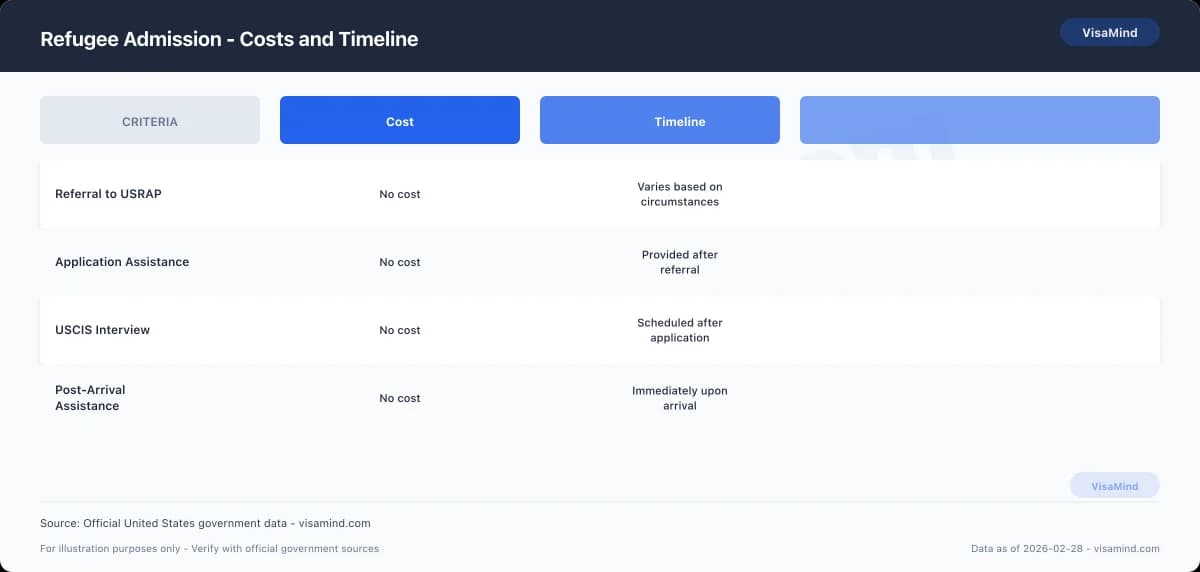
#| Component | Amount |
|---|---|
| Application feeNo fee for refugee admission | $0 |
Fees change; always verify on USCIS.
Required forms
#Next steps
#Use Find My Visa to build a sequenced plan with official sources and deadlines.
FAQs
What is the Refugee Admission form used for?
The form is used to apply to the U.S. Refugee Admissions Program for individuals outside the United States who have faced persecution; it is a form used by applicants filing with USCIS.
Do I need a referral to be considered for admission?
Yes. You must receive a referral to the U.S. Refugee Admissions Program (USRAP) for consideration.
Where and how is eligibility determined?
Eligibility determinations are conducted outside the U.S.; if you receive a referral, a USCIS officer will interview you abroad to determine eligibility for refugee resettlement.
What grounds can qualify someone for refugee consideration?
Eligibility requires demonstrating persecution or fear of persecution because of race, religion, nationality, political opinion, or membership in a particular social group; your history of persecution or fear of it is relevant.
Can I include family members on my application?
You may include your spouse and unmarried children under 21 in your application. In some cases you may file an Affidavit of Relationship for your spouse, unmarried children under 21, or parents. Also, principals admitted within the past two years (or asylees granted within two years) may use Form I-730 to request that spouse and unmarried children under 21 join them.
What documents and photos will I need to prepare?
Typical required items include passport-style photographs for each family member, birth certificates showing the child’s and parent’s names, marriage certificates where relevant, evidence of legal name changes if names don’t match, and secondary evidence (religious or school records, census) or affidavits if primary/secondary evidence are missing. Gather and submit proofs of status and family relationships and follow the checklist for Form I-730 where applicable.
Is there a fee to file?
The application fee is $0 (as of 2026-02).
How long does the process typically take?
Standard processing time is generally 6 to 12 months (as of March 2026). processing times vary by eligibility category and service center; USCIS posts processing times and you may submit an 'outside of normal processing times' inquiry for pending Form I-730.
What common mistakes lead to delays or rejection?
Common problems include failing to sign the form, using an incorrect or outdated form edition, missing or incorrect evidence (including photos), and other procedural or credibility issues — filing does not guarantee approval.
Official sources referenced
Last reviewed: 2026-03-10
VisaMind provides informational guidance only and is not a government agency. This is not legal advice. Requirements can change and eligibility depends on your specific facts. If your case is complex or high-stakes, consult a licensed immigration attorney.
Next steps
Every United States visa case depends on your nationality, purpose, and timeline. Get a personalized plan with official sources and deadlines.
Get my Refugee Admission plan