On this page
Overview
#A VAWA self-petition gives you the ability to apply for lawful permanent residence without the abuser’s involvement.
You file directly with U.S. Citizenship and Immigration Services (USCIS) using Form I-360 under specific family-based immigration categories.
What this covers
The VAWA self-petition allows you to seek immigration status on your own if a qualifying U.S. citizen or lawful permanent resident (LPR) family member subjected you to battery or extreme cruelty.
You don’t need the abuser’s knowledge, consent, or signature.
You start the process by filing Form I-360, Petition for Amerasian, Widow(er), or Special Immigrant, with USCIS.
Your case proceeds within the family-based immigration system, but without requiring the abusive relative to sponsor you.
Key features include:
- Self-petitioning without the abuser’s participation
- Protection of your privacy and safety during the process
- Review and adjudication by USCIS under humanitarian provisions
Who the law helps
VAWA immigration protections apply to certain victims of abuse by U.S. citizen or LPR relatives.
The focus is on your relationship to the abuser and the abuse you experienced.
You may qualify if:
- You are a victim of battery or extreme cruelty
- The abuser is a U.S. citizen or lawful permanent resident
- The abuser is a qualifying family member
The law also recognizes survivors of domestic violence, dating violence, sexual assault, and stalking in related housing protections.
Eligibility for those housing protections does not require you to be married to, related to, or living with the perpetrator.
In the immigration context, you must meet specific statutory criteria.
USCIS reviews your Form I-360 and supporting evidence to determine eligibility.
Application Process
#You start by preparing and filing Form I-360 with U.S. Citizenship and Immigration Services (USCIS).
You’ll submit Form I-485 when eligible to adjust status.
Accuracy, complete documentation, proper signatures, and a safe mailing address are essential to protect your case and privacy.
Filing the I-360 and related forms
You file Form I-360 with USCIS to request classification under VAWA.
Complete every section and sign the form before mailing it.
Attach evidence that supports your eligibility.
This typically includes proof of your relationship to the abuser and documentation of abuse.
Core items to include:
- Completed and signed Form I-360
- Supporting evidence of the relationship
- Supporting evidence of abuse
- Any category-specific documents required in the form instructions
Organize your evidence clearly.
Use labeled tabs or a cover sheet so USCIS can review your submission efficiently.
If you plan to seek permanent residence, keep your Form I-797, Notice of Action (receipt or approval notice).
You will need it when filing Form I-485, unless you submit both forms together.
Submitting I-485 and filing tips
You file Form I-485, Application to Register Permanent Residence or Adjust Status, to apply for lawful permanent residence.
You may file it together with Form I-360 or after USCIS approves your petition.
Include required supporting documents and photographs.
Adjustment package checklist:
- Completed and signed Form I-485
- Two passport-style photographs
- Form I-797 for your Form I-360 (if not filing concurrently)
- Form I-693, Report of Medical Examination and Vaccination Record, if required
- Supporting documentation requested in the I-485 instructions
The table below shows when to include certain documents:
| Situation | Include Form I-797? | File I-485 Now? |
|---|---|---|
| Filing I-360 and I-485 together | No | Yes |
| Filing after I-360 approval | Yes | Yes |
Mailing, signatures and notifications
Mail your forms to the address listed in the current USCIS form instructions.
USCIS updates filing locations, so confirm the correct address before sending your package.
Sign every form in ink where required.
USCIS will reject unsigned forms.
If you need confidentiality, list a safe mailing address in the mailing address field on your forms.
USCIS will send notices to that address.
To receive electronic confirmation that USCIS accepted your package, include Form G-1145, E-Notification of Application/Petition Acceptance, clipped to the front of your filing.
After acceptance, USCIS will issue a Form I-797 receipt notice for each form filed.
After Approval
#
An approved Form I-360 confirms your eligibility under VAWA.
You must still secure permanent resident status.
Your next steps depend on visa availability and your specific circumstances.
Adjustment and status outcomes
You cannot receive a Green Card under VAWA until U.S. Citizenship and Immigration Services (USCIS) approves your Form I-360.
If you qualify as an immediate relative of the abusive U.S. citizen, an immigrant visa is always available.
You may file Form I-485, Application to Register Permanent Residence or Adjust Status, at any time.
If you already filed Form I-485 and later submit a VAWA self-petition, notify USCIS that:
-
You filed a Form I-360, or
-
You will file it within 30 days.
USCIS will then adjudicate your pending Form I-485 based on the approved VAWA petition.
If you are outside the United States, the U.S. Department of State handles immigrant visa processing and issuance.
U.S. Customs and Border Protection (CBP) determines your admission at the port of entry.
| Step | Government Agency | What It Does |
|---|---|---|
| Form I-360 approval | USCIS | Confirms VAWA eligibility |
| Form I-485 adjudication | USCIS | Decides adjustment of status |
| Immigrant visa interview | U.S. Department of State | Issues visa abroad |
| Admission to U.S. | CBP | Grants entry as permanent resident |
Eligibility exceptions and special situations
You may still qualify for VAWA-based adjustment even if your marriage ended or had legal defects tied to abuse.
USCIS recognizes the following situations:
- You believed your marriage was valid, but it was invalid solely because your abusive spouse committed bigamy.
- Your abusive spouse died within 2 years before you filed Form I-360.
- Your spouse lost or gave up U.S. citizenship or lawful permanent resident status due to a domestic violence incident.
- You divorced your abusive spouse within 2 years before filing, and the divorce connects to battery or extreme cruelty.
| Situation | Key Requirement |
|---|---|
| Bigamous marriage | You had a good-faith belief the marriage was legal |
| Spouse’s death | Death occurred within 2 years of filing |
| Loss of status | Loss tied to domestic violence incident |
| Divorce | Filed within 2 years and abuse-related |
These exceptions allow you to pursue family-based immigration benefits independently through your approved Form I-360.
Getting Legal Help
#Legal help can protect your eligibility, prevent missed deadlines, and ensure you file the correct classification under Form I-360.
Many errors in VAWA self-petitions involve timing, category selection, or incomplete evidence submitted to U.S. Citizenship and Immigration Services (USCIS).
When to get help
You should seek legal help before filing Form I-360, Petition for Amerasian, Widow(er), or Special Immigrant, if your case involves abuse, remarriage issues, or a pending Form I-485.
An attorney can help you:
- Confirm you qualify under the correct VAWA self-petitioner category
- Prepare evidence that meets USCIS standards
- Determine whether you can file or convert a pending Form I-485, Application to Register Permanent Residence or Adjust Status
- Avoid filing under the wrong family-based immigration category
If you are a widow(er) of a U.S. citizen or a VAWA self-petitioning spouse or parent, category selection matters.
Filing under the wrong classification can delay or derail your case.
Review the official Form I-360 instructions and the USCIS Policy Manual for specific requirements.
If your immigration history includes prior petitions, remarriage, or removal proceedings, don’t rely on guesswork.
Special categories & policy references
Form I-360 covers several classifications beyond VAWA.
Each has different requirements and supporting evidence.
| Classification | Key Requirement |
|---|---|
| Widow(er) of a U.S. citizen (a)(4) | Must qualify as surviving spouse |
| VAWA spouse (b)(2) | Abused by U.S. citizen or lawful permanent resident spouse |
| VAWA parent (b)(4) | Abused by U.S. citizen son or daughter age 21 or older |
| Special Immigrant Juvenile (SIJ) | Must file before 21st birthday |
| Special Immigrant Religious Worker | Employer attestation required |
If you file as a Special Immigrant Juvenile, you must submit Form I-360 before turning 21.
Missing that deadline ends SIJ eligibility.
Some Afghan special immigrant cases are processed through the U.S. Department of State rather than USCIS classification alone.
Confirm which agency controls your process in those situations.
USCIS policy guidance, including updates in the USCIS Policy Manual, controls how officers review I-360 petitions.
Legal counsel can align your filing with current policy standards.
Deadlines and timing risks
Timing errors create serious problems in VAWA-based cases.
You risk denial if you:
- Fail to file Form I-485 within the required timeframe after requesting conversion of a pending adjustment application
- Do not submit proof that you filed a VAWA self-petition when requesting to convert a pending Form I-485
- Miss the SIJ filing deadline before age 21
Section 204(l) of the Immigration and Nationality Act may allow approval of certain petitions even after remarriage, but this protection does not apply automatically.
You must document eligibility clearly.
Track every filing date.
Keep copies of receipt notices from USCIS.
If you plan to adjust status through family-based immigration after I-360 approval, confirm that your Form I-485 remains valid and timely.
When deadlines approach, act immediately.
USCIS does not excuse late filings simply because you misunderstood the rules.
Who Qualifies for Protection
#You may qualify if you have a specific family relationship with a U.S. citizen or lawful permanent resident and experienced battery or extreme cruelty.
You must also meet admissibility rules and file the correct forms with USCIS, including Form I-360 and, if eligible, Form I-485.
Qualifying relationships
VAWA protection applies only to certain family relationships.
You must show a direct connection to a U.S. citizen or lawful permanent resident (LPR) who abused you.
You may file Form I-360 as a self-petitioner if you are:
- The spouse or former spouse of a U.S. citizen
- The spouse or former spouse of a lawful permanent resident
- The child of a U.S. citizen or lawful permanent resident who abused you
- The parent of a U.S. citizen son or daughter who abused you
USCIS treats these cases as part of family-based immigration, but you file on your own without the abuser’s participation or consent.
Your relationship must be real and legally valid.
You must prove the abuser’s U.S. citizenship or lawful permanent resident status and your qualifying relationship to that person.
| Your Relationship to Abuser | Abuser’s Status Must Be |
|---|---|
| Spouse or former spouse | U.S. citizen or LPR |
| Child | U.S. citizen or LPR |
| Parent | U.S. citizen (son/daughter) |
If you do not fit into one of these categories, you cannot qualify under VAWA.
Abuse and other eligibility requirements
You must show that the qualifying relative subjected you to battery or extreme cruelty.
Physical violence is not required if you can prove extreme cruelty.
USCIS requires evidence that:
- The abuse was committed by the qualifying U.S. citizen or LPR
- You have the required family relationship
- You meet the filing requirements for Form I-360
You may still qualify even if you are living in a shelter, transitional housing, or permanent housing funded by a federal assistance program.
Receiving this type of assistance does not disqualify you.
You must properly file Form I-360, Petition for Amerasian, Widow(er), or Special Immigrant, with USCIS.
If you are eligible to apply for permanent residence, you must also:
- Be physically present in the United States when filing Form I-485
- Properly file Form I-485, Application to Register Permanent Residence or Adjust Status
USCIS reviews both the relationship and the abuse carefully.
Clear documentation strengthens your case.
Admissibility considerations
Approval of your Form I-360 by USCIS doesn’t guarantee you qualify for adjustment of status. You must be admissible under U.S. immigration law or eligible for a waiver.
Most inadmissibility grounds still apply to VAWA self-petitioners. There are two key exceptions:
- Public charge under INA 212(a)(4)
- Entry without inspection under INA 212(a)(6)(A)
You also need to show that none of the general bars to adjustment of status apply when you file Form I-485.
| Issue | Applies to VAWA Self-Petitioners? |
|---|---|
| Public charge | No |
| Entry without inspection | No |
| Other inadmissibility grounds | Yes, unless waived |
If you’re inadmissible for another reason, you’ll need to qualify for a waiver or other relief. USCIS will not approve your green card unless those issues are resolved.
Your Rights During Processing
#While USCIS reviews your Form I-360, you can seek work authorization and protect your ability to remain in the United States. You’ll need to file the right forms at the right time and follow travel restrictions if you’re also pursuing adjustment of status.
Work authorization
You can request employment authorization while your VAWA self-petition is pending. File Form I-765, Application for Employment Authorization for this purpose.
USCIS processes work permits separately from Form I-130. Filing both together often helps prevent delays.
Best practice:
- File Form I-360 (VAWA self-petition)
- File Form I-765 (work permit request) at the same time
If USCIS approves your Form I-765, you’ll receive an Employment Authorization Document (EAD). This card lets you work legally in the U.S. while your VAWA case is pending.
Travel and staying in the U.S.
You may stay in the United States while your Form I-360 is pending, provided you don’t violate other immigration rules. Many VAWA applicants also file Form I-485, Application to Register Permanent Residence or Adjust Status.
If you have a pending Form I-485, don’t leave the U.S. without first receiving an approved advance parole document. Leaving without advance parole leads USCIS to treat your Form I-485 as abandoned.
Use this guide:
| Situation | Travel Outside the U.S. |
|---|---|
| I-360 pending only | Review risks carefully; check USCIS guidance |
| I-485 pending, no advance parole | Do not leave |
| I-485 pending, advance parole approved | Travel may be permitted |
Avoiding pitfalls while pending
Small filing errors can delay your case for months. A common mistake is forgetting to include Form I-765 when seeking work authorization.
Reduce delays by:
- Filing Form I-360 and Form I-765 together
- Using the most recent USCIS form editions
- Following USCIS instructions exactly
Don’t expect USCIS to issue a work permit automatically. You have to request it.
Track your case status through USCIS and respond promptly to any notices. If USCIS asks for more evidence, submit it within the deadline listed on the notice.
Processing Times and Costs
#You’ll need to pay specific USCIS filing fees and prepare for long processing times when filing a VAWA self-petition. The timeline depends on the Form I-360 eligibility category and the service center handling your case.
USCIS fees
When you file Form I-360 as a VAWA self-petitioner, USCIS charges these standard fees:
| Fee Type | Amount (USD) |
|---|---|
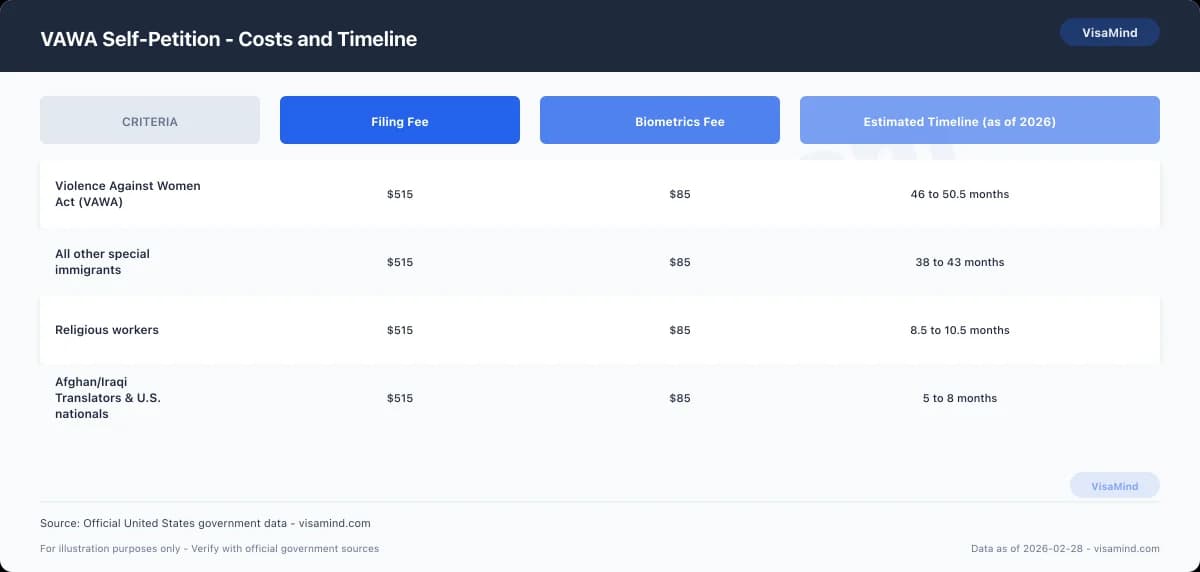
| Form I-360 filing fee | $515 |
| Biometrics services fee | $85 |
You pay these fees to USCIS when you file, unless you qualify for a fee waiver.
If you also file other family-based immigration forms, such as Form I-485, those forms have separate fees. Review each form’s instructions so you include the correct payment and avoid rejection.
I-360 processing timelines
USCIS processing times for Form I-360 vary. As of January 2026, VAWA-based I-360 petitions show estimated processing times of 46 to 50.5 months.
For comparison, other I-360 categories have different timeframes:
| I-360 Category | Estimated Processing Time |
|---|---|
| Violence Against Women Act (VAWA) | 46 to 50.5 months |
| All other special immigrants | 38 to 43 months |
| Religious workers | 8.5 to 10.5 months |
| Afghan or Iraqi translators and certain U.S. government workers | 5 to 8 months |
These ranges are posted estimates and may shift due to case volume and staffing. Individual cases sometimes fall outside the posted range.
How processing varies by category
Processing times depend on the eligibility category you select on Form I-130. Each category is tracked separately, even though the same form is used for all.
VAWA self-petitions currently show longer timelines than most other special immigrant classifications. Religious worker and certain Afghan or Iraqi national categories move much faster.
Which service center handles your case also matters. Two applicants in the same VAWA category may see different estimates if their cases go to different USCIS offices.
You should:
- Select the correct I-360 eligibility category.
- Monitor your case status through your USCIS account.
- Check the USCIS processing times tool regularly for updates.
Credibility and Procedural Risks
#USCIS reviews your Form I-360 for consistency, proof of eligibility, and required documentation. Missing evidence, incorrect classification, or weak abuse documentation can lead to rejection or a Request for Evidence (RFE).
Common reasons for denial or RFE
USCIS may deny or reject your VAWA self-petition if you don’t prove the qualifying relationship to the abuser. You must submit civil documents that match the information listed on your Form I-360.
Insufficient evidence of abuse often leads to an RFE. USCIS expects detailed, credible documentation.
Frequent issues include:
- Missing proof of the qualifying family relationship
- Filing under the wrong classification (for example, selecting the wrong category on Form I-360)
- Limited or weak evidence of abuse
- Not submitting Form I-693 when required
- Omitting required supporting documents listed in the form instructions
| Issue | Likely Outcome | How to Prevent It |
|---|---|---|
| No proof of relationship | Rejection or denial | Submit marriage, birth, or other civil records that match your petition |
| Weak abuse evidence | RFE | Provide affidavits, police reports, medical records, or counseling records |
| Wrong classification | Rejection | Confirm you selected the correct I-360 category before filing |
| Missing required forms | Rejection | Review the USCIS form instructions line by line |
VAWA doesn’t guarantee approval. USCIS must find your evidence credible and complete.
Identity and documentation problems
USCIS checks your identity documents against the information in your petition. Inconsistent names, missing pages, or incomplete identification can stop processing.
Submit clear, legible copies of your identification documents. Make sure all dates, spellings, and biographical details match across:
- Form I-360
- Civil records
- Identity documents
- Any supporting affidavits
If your documents contain variations in spelling or different names, ensure your evidence consistently reflects the same identity details. Discrepancies without explanation can delay your case or result in rejection.
Failure to include required documentation—such as proof of the qualifying relationship or required medical documentation when applicable—creates avoidable procedural risk. USCIS evaluates family-based immigration petitions using the documents you provide.
How to reduce procedural risk
Prepare your filing as if USCIS will verify every fact. Organize your submission clearly and follow the official I-360 instructions exactly.
Take these steps before filing:
-
Confirm you selected the correct Form I-360 category.
-
Match every factual statement to a supporting document.
-
Include detailed affidavits describing the abuse.
-
Attach corroborating records such as police, medical, or counseling documents when available.
-
Review the USCIS instructions to confirm whether Form I-693 is required in your case.
Create a simple internal checklist and verify each item before mailing your petition.
| Preventive Action | Purpose |
|---|---|
| Cross-check forms against civil records | Avoid inconsistencies |
| Provide detailed abuse evidence | Strengthen credibility |
| Follow USCIS filing instructions precisely | Prevent rejection |
| Review required forms before submission | Avoid missing documentation |
What Documents to Gather
#You must submit clear evidence with Form I-360 to show your qualifying relationship, the abuse, and your identity. USCIS decides VAWA self-petitions based on documents, not statements alone.
Organize your records before filing to avoid delays.
Proof of relationship
You must prove your legal relationship to the abusive U.S. citizen or lawful permanent resident. USCIS will not approve your I-360 without this evidence.
Provide copies of official civil documents, such as:
- Marriage certificate showing you married the abuser
- Birth certificate if you are filing as a child
- Adoption decree, if applicable
- Evidence connecting a marriage termination to domestic violence, if the marriage ended
If you file as a derivative or related applicant, include documents that show your relationship to the principal applicant.
Use legible copies. If a document contains identifying details, make sure names and dates match the information listed on your Form I-360.
| Situation | Key Document Examples |
|---|---|
| Spouse of abuser | Marriage certificate |
| Child of abuser | Birth certificate |
| Adopted child | Adoption decree |
| Marriage ended due to abuse | Proof linking termination to domestic violence |
Proof of abuse and supporting records
You must provide evidence that abuse occurred. USCIS reviews written statements and supporting documentation together.
Include:
- A detailed personal statement describing the abuse
- Any supporting records that confirm your account
- Information about the abuser’s immigration status
Your statement should explain what happened, when it happened, and how it affected you. Keep the description factual and consistent with the rest of your application.
If you have documents that support your claim, submit copies. Make sure your name and other identifying details match your Form I-360.
Identity, medical and criminal records
You must prove your identity and disclose your background.
Include:
- Two passport-style photographs
- A copy of a government-issued photo ID
- Your birth certificate
- Information about your current immigration status and history with the U.S. government
If required, submit Form I-693, Report of Immigration Medical Examination and Vaccination Record.
If you have ever been arrested, charged, or convicted, provide certified copies of court records or police certificates. USCIS expects full disclosure. Missing records can delay or negatively affect your petition.
Protecting Your Case
#Strong documentation, correct form selection, and careful filing protect your VAWA self-petition. You must prove the relationship, the abuse, and your eligibility under the correct Form I-360 category while avoiding preventable errors.
Gathering strong evidence
USCIS decides your Form I-360 based on the record you submit. Document both the qualifying relationship and the abuse or extreme cruelty.
Focus on two core areas:
| What You Must Prove | Examples of Evidence |
|---|---|
| Valid relationship to the abuser | Marriage documents and records showing the relationship |
| Abuse or extreme cruelty | Police reports, medical records, counseling records, sworn affidavits |
Include detailed affidavits that describe specific incidents. State dates, locations, and what happened.
If you experienced domestic violence, dating violence, sexual assault, or stalking, document each event clearly. Medical records and police reports carry weight, but personal declarations and statements from witnesses also support your case.
Organize your evidence in chronological order. Label each exhibit so USCIS can follow your timeline.
Expert tips for filing
Form I-360 covers several categories, including VAWA self-petitioners, widow(er)s, Amerasians, and Special Immigrant Juveniles. Select the correct classification on the form.
Use the proper supplement for your category. Don’t submit supplements intended for Special Immigrant Juvenile or widow(er) cases if you are filing under VAWA.
You may file Form I-360 and Form I-485 at the same time if you’re eligible. There’s no need to wait for I-360 approval before filing the I-485.
Before filing:
-
Confirm you selected the correct I-360 category.
-
Review the USCIS form instructions for the current edition and filing address.
-
Check the USCIS fee calculator for the correct filing fees.
Family-based immigration rules still apply to classification and eligibility, even though you file without the abuser’s participation.
Avoiding avoidable mistakes
Many denials happen because of incomplete evidence or picking the wrong form. Take time to check your packet before sending it off.
Common errors include:
- Submitting minimal details about the abuse.
- Failing to document the legal relationship.
- Using the wrong I-360 classification.
- Omitting required signatures.
Your affidavit should go beyond isolated incidents. Explain patterns of behavior and how the abuse affected you during the marriage.
Don’t expect USCIS to request missing documents. Submit everything they need the first time.
If you're unsure about eligibility, required evidence, or fees, confirm with U.S. Citizenship and Immigration Services (USCIS).
Fees
#| Component | Amount |
|---|---|
| Filing fee (I-360)$0 if filing as a VAWA self-petitioner, Special Immigrant Juvenile, or certain other categories. | $515 |
| BiometricsBiometrics: $85 (as of 2026-02). Verify the current fee on the official schedule before filing. | $85 |
Fees change; always verify on USCIS.
Next steps
#Use Find My Visa to build a sequenced plan with official sources and deadlines.
FAQs
What happens after USCIS approves Form I-360?
Once USCIS approves Form I-360, you might have a path forward in the family-based immigration process.
Your next steps hinge on your particular situation.
If you're eligible and already in the United States, you can apply for adjustment of status with USCIS.
If you're outside the country, you'll need to go through immigrant visa processing with the U.S. Department of State.
- Process Stage: I-360 Petition Review. Government Agency: USCIS
- Process Stage: Adjustment of Status. Government Agency: USCIS
- Process Stage: Immigrant visa interview & Issuance. Government Agency: U.S. Department of State
What does the VAWA self-petition allow me to do?
The VAWA self-petition lets eligible victims of battery or extreme cruelty by certain U.S. family members apply for lawful permanent residence, and it provides a way to self-petition without the abuser's knowledge. It is specifically designed for individuals abused by U.S. citizen or lawful permanent resident relatives.
Who can file a VAWA self-petition?
People who were abused by a U.S. citizen or lawful permanent resident relative may be eligible, including those abused by a spouse, former spouse, parent, son or daughter (as applicable). Applicants must demonstrate a qualifying relationship with the abusive U.S. citizen or LPR relative.
Do I need to be physically in the United States to file for adjustment of status?
Yes — VAWA self-petitioners must be physically present in the United States at the time of filing Form I-485. You may file Form I-485 concurrently or after eligibility conditions are met.
Do I need an approved Form I-360 before getting a green card?
To qualify for a Green Card under a VAWA self-petition, you must have an approved Form I-360; however, VAWA self-petitioners can file Form I-360 and Form I-485 concurrently (no need to wait for I-360 approval).
What types of evidence should I submit to support a VAWA petition?
You should submit evidence of your relationship to the abusive family member and proof of abuse. Strong VAWA evidence can include affidavits, police reports, medical records, counseling records and other documentation detailing incidents of battery or extreme cruelty.
Can I work while my VAWA petition is pending?
Yes — experts recommend filing Form I-765 (work authorization) with Form I-360 so you can request work authorization while the VAWA petition is pending; failing to file the I-765 can delay work authorization.
What are the fees and how long does the I-360 take?
The Form I-360 filing fee is $515 (as of 2026-02) and the biometrics services fee is $85 (as of 2026-02). processing times vary by category and service center — for example, VAWA I-360 processing was listed as about 46 to 50.5 months (as of January 2026); processing times differ by eligibility category.
What are common reasons a VAWA case is denied or delayed?
Common procedural problems include failure to provide required evidence of relationship or abuse, missing or incorrect identity documents, not submitting required medical forms when applicable, and filing the wrong petition type or classification. Filing a VAWA petition does not guarantee approval.
Can my immediate relatives get visas based on my VAWA petition?
Immediate relatives of VAWA self-petitioners are considered to have visas available and may file Form I-485 at any time, where applicable.
Where can I find more guidance or policy info?
USCIS policy references (including material moved from the Adjudicator’s Field Manual into the USCIS Policy Manual) and official guidance for special classifications (SIJ, widow(er), Amerasian, religious worker) and country-specific visa processes are available; consult the form instructions and specified webpages for further details and deadlines for special categories.
Official sources referenced
Last reviewed: 2026-03-10
VisaMind provides informational guidance only and is not a government agency. This is not legal advice. Requirements can change and eligibility depends on your specific facts. If your case is complex or high-stakes, consult a licensed immigration attorney.
Next steps
Every United States visa case depends on your nationality, purpose, and timeline. Get a personalized plan with official sources and deadlines.
Get my VAWA Self-Petition plan