
Extension Eligibility Overview
#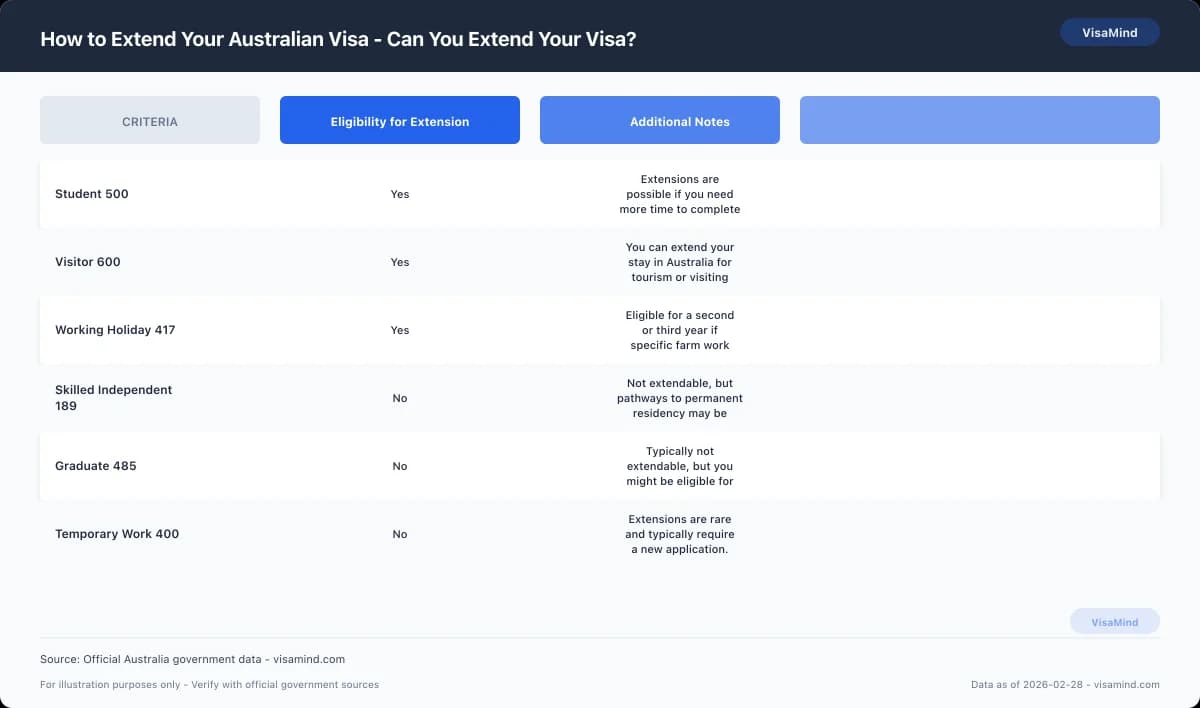
In Australia, certain visa types can be extended, allowing you to prolong your stay without leaving the country. Understanding which visas are eligible for extension is necessary to planning your future in Australia.
Visa Types Eligible for Extension
Several commonly held visas in Australia have options for extension. These options allow individuals to remain in Australia for longer periods if they meet specific criteria.
| Visa Type | Extension Possibility | Key Considerations |
|---|---|---|
| Visitor Visa (subclass 600) | Yes | Must apply while in Australia |
| Student Visa (subclass 500) | Yes | Must meet academic progress requirements |
| Temporary Skill Shortage Visa (subclass 482) | Yes | Employer sponsorship required |
| Temporary Graduate Visa (subclass 485) | Yes | Limited to certain post-study work rights |
| Training Visa (subclass 407) | Yes | Requires ongoing training opportunity |
Tip: Check specific conditions and requirements for each visa type on the Department of Home Affairs website.
Visas Not Eligible for Extension Some
Australian visas cannot be extended, meaning the holder must leave Australia at the end of their permitted stay or apply for a different visa.
| Visa Type | Extension Possibility | Alternative Options |
|---|---|---|
| Electronic Travel Authority (ETA) (subclass 601) | No | Apply for a different visa if eligible |
| eVisitor (subclass 651) | No | Explore other visa options |
| Working Holiday Visa (subclass 417) | No | Consider a second or third working holiday if eligible |
| Work and Holiday Visa (subclass 462) | No | Check eligibility for a second year extension |
| Transit Visa (subclass 771) | No | No extension available |
Common Misunderstandings About Extensions
A common misunderstanding is that all visas can be extended under the same conditions. Each visa type has distinct eligibility criteria and application processes. - Not all visas allow in-country extensions. - Extensions may require different documentation than the initial application. - Visa extensions are not guaranteed; meeting criteria is essential.
Warning: Failing to extend your visa before it expires can result in unlawful status in Australia. Always verify deadlines and requirements on the Home Affairs website.
Visa-by-Visa Extension Rules
#In Australia, extending your visa involves specific procedures that vary by visa category. The Department of Home Affairs manages the extension process, and it's essential to understand the rules for your particular visa type.
Tourist Visa Extension Guidelines
If this condition applies, you must leave and apply for a new visa from outside Australia. - Check your visa for conditions such as 'No Further Stay'.
- Ensure you have adequate funds for your extended stay. - Consider applying for a different visa if an extension is not possible.
Student Visa Extension Procedures
Students on a Student Visa (subclass 500) needing more time to complete their studies must apply for a new visa before their current one expires. Ensure your Confirmation of Enrolment (CoE) is valid for the duration of your extended study period.
-
Obtain a new CoE from your educational institution.
-
Lodge your application through your Immi Account.
-
Check the Student Visa (subclass 500) for updated requirements.
Warning: Ensure your application is submitted before your current visa expires to avoid breaching visa conditions.
Work Visa Extension Options
For work visas like the Temporary Skill Shortage Visa (subclass 482)
extension options depend on your visa terms and employer sponsorship. Extensions typically require employer support and valid sponsorship.
| Visa Type | Extension Possibility | Employer Requirement |
|---|---|---|
| Temporary Skill Shortage (subclass 482) | Possible with conditions | Yes, sponsorship needed |
| Temporary Graduate (subclass 485) | No extension, but can transition to other visas | No |
Tip: Check the Temporary Skill Shortage Visa (subclass 482) page for further details.
Family Visa Extension Criteria
Family visas, such as the Partner Visa (subclass 820/801)
generally do not have extensions. However, transitioning to a permanent visa is often possible if eligibility criteria are met. - Meet all current visa conditions. - Provide evidence of ongoing relationship for Partner Visas. - Consider applying for permanent residency if eligible.
Important: Review the Partner Visa (subclass 820 801) for specific application processes.
What It Costs and How Long It Takes
#Australia generally does not add time to an existing temporary visa as a simple extension. To stay longer, you usually apply for a new visa and pay the charge that applies to that subclass on the date of lodgement. Eligibility, onshore application restrictions, a possible subsequent temporary application charge, and bridging-visa consequences depend on your current visa and history.
A Student Visa holder who needs more time to finish a course generally applies for a new Student Visa (subclass 500). The standard primary charge is A$2,500 for most applications lodged from 1 July 2026, but concessions and additional-applicant charges can apply.
Use the official pricing estimator and live processing-time guide. Priority handling is governed by Home Affairs policy and is not a paid expedited service available on demand.
The Risks of Staying Past Your Visa
#Australia takes visa overstays seriously, with penalties that can significantly impact your future travel plans. If you overstay your visa, you may face legal and financial consequences, including restrictions on your ability to return to Australia. Understanding these risks is vital for anyone planning to extend their stay in Australia. Make informed decisions to maintain your legal status by being aware of potential penalties and their implications.
Penalties for Overstaying in Australia -
You may incur a re-entry ban of up to three years. - Overstaying can result in detention by the Australian Border Force. - Fines and removal from Australia are possible outcomes.
Important: The Department of Home Affairs enforces these penalties strictly to ensure compliance with immigration laws.
Impact on Future Visa Applications
Overstaying your visa can severely affect your eligibility for future visas. The Department of Home Affairs considers visa compliance history during application assessments. - Future visa applications may be denied. - Previous overstays can affect your credibility as an applicant. - You may face additional scrutiny in future applications.
Warning: An overstay record can hinder your ability to obtain visas not only for Australia but potentially for other countries.
Legal and Financial Consequences
Overstaying can lead to legal proceedings, potentially resulting in deportation. Legal fees and fines can accumulate, adding financial stress to the situation.
| Consequence | Description |
|---|---|
| Legal Proceedings | May include detention and deportation. |
| Fines | Monetary penalties for violating visa conditions. |
| Travel Restrictions | Barred from re-entering Australia for a specified period. |
Tip: Consider contacting Visa Refusal Reasons for guidance on avoiding common pitfalls in future applications.
The Extension Application Process
#In 2026, the Department of Home Affairs reported a significant increase in online visa extension applications, indicating a shift towards digital solutions for extending Australian visas. If you're considering extending your stay in Australia, understanding the process can help ensure a smooth application experience.Whether you choose to apply online or in person, careful preparation is key.
Online vs In-Person Applications The Department of Home
Affairs offers both online and in-person methods for lodging your visa extension application. The online process is facilitated through the ImmiAccount portal, which allows you to manage your application digitally. - Online Applications: Convenient for those with internet access, allowing you to upload necessary documents and track your application status. - In-Person Applications: Suitable for those who prefer face-to-face assistance or have limited internet access. Applications can be lodged at designated Australian Visa Application Centres.
Tip: Applying online via ImmiAccount can significantly reduce processing times compared to in-person submissions.
Step-by-Step Application Guide
-
Create or log into your ImmiAccount. This is essential for accessing online application services.
-
Select the appropriate visa extension option for your current visa type, such as the Tss Visa (subclass 482).
-
Gather required documents as per the guidelines on the Department of Home Affairs website.
-
Complete the application form with accurate personal details and upload necessary documents.
-
Pay the application fee, which varies depending on your visa type. Ensure you check the latest fee structure on the official website.
-
Submit your application and await confirmation, which will be sent to your registered email.
Important: Ensure your documents are up-to-date and meet all specified requirements to avoid delays in processing.
Key Steps for Successful Application
A successful visa extension application relies on thorough preparation and timely submission. It's key to start the process well before your current visa expires to avoid any compliance issues. - Verify the specific extension requirements for your visa category on the Department of Home Affairs website. - Double-check your application for completeness and accuracy before submission. - Keep track of your application status regularly through ImmiAccount.
Warning: Overstaying your visa can lead to serious legal consequences, including potential bans from re-entering Australia. Always initiate your extension process in advance.
What to Submit with Your Extension
#Extending your Australian visa requires submitting specific documents to the Department of Home Affairs. Different visa types may have unique requirements, but several documents are essential for most visa extensions.
Essential Documents for Visa Extension -
Valid passport: Ensure your passport is valid for the duration of your extended stay. - Current visa details: Provide evidence of your current visa and its expiration date. - Proof of continued purpose: Documents supporting the reason for your extended stay, such as a letter of enrollment for students or employment contract for workers.
Important: Check the Department of Home Affairs website for visa-specific document requirements to avoid processing delays.
Proof of Financial Means
Demonstrating your ability to support yourself during your stay is necessary. This involves providing evidence of your financial means. - Bank statements: Recent statements showing sufficient funds to cover your stay. - Sponsorship details: If someone else is supporting you, provide their financial documents and a letter of support. - Scholarship or financial aid: Proof of financial aid if you are a student receiving such support.
Tip: Ensure all financial documents are recent and clearly show account balances or support amounts.
Additional Supporting Documents
Depending on your visa type, additional documents may be required to support your application. - Health insurance: Proof of adequate health insurance coverage for the duration of your stay. - Character documents: Police clearance certificates if required. - Relationship evidence: If applying as a dependent or partner, provide marriage or birth certificates.
Warning: Failing to provide required additional documents can lead to application delays or refusals.
What Else Can You Do?
#In 2026, over 600,000 people lodged applications for different visa types in Australia. If you're considering extending your stay, there are several pathways you might explore to suit your needs. The Department of Home Affairs offers various options for those looking to extend their visas or switch to a different visa category. Understanding these can help you make informed decisions about your immigration journey.
Switching to Different Visa Types
Switching to a different visa type can be a viable option if your current visa does not meet your needs anymore.| Current Visa | Potential New Visa | Purpose | | Visitor 600 | Student 500 | Pursue education | | Student 500 | Graduate 485 | Stay post-study | | Temporary Skill Shortage 482 | Skilled Work Regional 491 | Work in regional areas |
Tip: Consider your long-term goals when choosing a new visa type.
Benefits of Leaving and Re-entering
Leaving and re-entering Australia can sometimes reset the clock on your visa, offering additional time to stay. This can be particularly useful if your current visa is close to expiring. - Opportunity to revisit entry conditions
- Potential to apply for a new visa on re-entry
- Chance to explore visa options not available onshore
Important: Before leaving, ensure that your visa allows for re-entry into Australia. Some visas may only permit a single entry.
-
Log in to your Immi Account to check eligibility.
-
Gather necessary documents as per the Department of Home Affairs requirements.
-
Lodge your application online for the new visa type.
Warning: Changing status within Australia can be complex. Ensure you meet all the criteria for the new visa to avoid potential refusals.