On this page
- Is This Program for You?
- Eligibility Criteria
- Step-by-Step Application
- Supporting Documents Checklist
- Timeline and Processing
- Where Applicants Go Wrong
- How It Compares to Alternatives
- Fees and Financial Requirements
- What You Can and Cannot Do
- Real-World Examples
- Visa options for this goal
- Guides for Australia
- Other goals for Australia
Is This Program for You?
#The Business and Investment Visa for Australia offers a pathway for skilled workers to permanently live and work in Australia, provided they secure a nomination from an Australian employer. Managed by the Department of Home Affairs, this visa is ideal for individuals who meet specific criteria essential for both the applicant and the employer.
Who Should Consider This Program?
This visa program is particularly suitable for individuals with the right set of skills and qualifications, as determined by Australian standards. If you have a background in a skilled occupation and can demonstrate relevant experience, you may be eligible to apply. The current list of eligible skilled occupations is detailed in the legislative instrument associated with this visa category and can be accessed through the Department of Home Affairs.
Basic Eligibility Requirements
To qualify for the Business and Investment Visa, you must meet the following fundamental criteria:
-
Skills and Qualifications: You must possess the necessary skills and qualifications for your nominated occupation. Evidence of this will be required during the application process.
-
Employer Nomination: An Australian employer must nominate you. This is a crucial step in the application process, as it demonstrates that your skills are needed in Australia.
-
Health and Character: You must satisfy Australia’s health and character requirements. This includes undergoing health examinations and providing police certificates from countries where you have lived.
Important: Ensure your skills assessment is completed by the relevant skills assessment authority for your nominated occupation. Failure to do so could delay or jeopardize your application.
Why Choose This Visa?
Choosing the Business and Investment Visa offers several advantages, including the opportunity to live and work in Australia permanently. This visa also allows you to apply for Australian citizenship, provided you meet the residency and other requirements. It’s an excellent option for those looking to establish themselves in Australia on a long-term basis.
For more comprehensive guidance on the application process and necessary documents, you can refer to our Documents Checklist and How To Apply guides. Additionally, comparing this visa with others, such as the Skilled Independent 189 and Skilled Nominated 190, might help you understand which pathway best suits your circumstances.
Eligibility Criteria
#The Business and Investment Visa for Australia offers individuals the opportunity to live and work in the country permanently, provided they meet specific eligibility criteria set by the Department of Home Affairs. Understanding these criteria is crucial for a successful application.
Basic Eligibility Requirements
-
Skills and Qualifications: You must possess the necessary skills for the job you are applying for. This often involves a skills assessment by a relevant Australian authority to confirm your qualifications align with Australian standards.
-
Employer Nomination: An Australian employer must nominate you for the visa. This nomination is a critical component of the application process and must be obtained before lodging your application.
-
Health and Character: Applicants must meet health and character requirements. This includes undergoing medical examinations and providing police clearance certificates from countries where you have lived for a certain period.
Points Threshold and Age Limit
Certain visas under the Business and Investment category require you to meet a points threshold:
-
Points System: Points are awarded based on factors such as age, English language proficiency, work experience, education, and other criteria. The specific points requirement varies by visa subclass, so it’s important to verify on the official Home Affairs website for the most current thresholds.
-
Age Limit: While there is no strict age limit for some business visas, others may have age restrictions, particularly those that fall under the points-tested categories. Typically, applicants must be under 55 years old, unless specific exemptions are applicable.
English Language Proficiency
- Language Requirements: Demonstrating proficiency in English is often required. You may need to provide results from an approved English language test, such as IELTS, PTE Academic, or TOEFL iBT, unless you are exempt.
Tip: Ensure you check the specific English language requirements for your visa subclass, as these can differ.
Financial Capacity and Investment Experience
-
Financial Requirements: Certain visas may require you to demonstrate financial capacity to establish or invest in a business in Australia. This could include evidence of business assets, investment funds, or previous business ownership.
-
Investment Experience: Prior experience in managing or owning a business may be necessary. This experience must often be substantiated with documentation of your involvement and success in business operations.
For further details on the specific requirements for various business and investment visas, you may explore related visa options like the Business Innovation and Investment (Provisional) Visa (subclass 188) or the Global Talent Visa (subclass 858).
In summary, meeting the eligibility criteria for a Business and Investment Visa for Australia involves a combination of skills, employer nomination, health and character assessments, and possibly satisfying certain points and language benchmarks. Always refer to the latest information from the Department of Home Affairs to ensure compliance with current requirements.
Step-by-Step Application
#Create an ImmiAccount
To begin your application for a Business and Investment Visa for Australia, you need to create an ImmiAccount on the Department of Home Affairs website. This account will allow you to lodge your application online and track its progress. Ensure that you have a valid email address to set up your account.
Prepare Your Documents
Gather all necessary documents before lodging your application. This includes evidence of your skills and qualifications, nomination details from an Australian employer, and relevant health and character documents. It's crucial to refer to the Documents Checklist to ensure you have everything required.
Tip: Double-check the expiry dates of your documents to avoid delays in your application process.
Lodge Your Application
Once your ImmiAccount is set up and your documents are ready, you can proceed to lodge your application through the portal. Follow the online instructions carefully to ensure all information is entered correctly. The application portal will guide you through the necessary steps specific to your visa subclass.
Pay the Application Fee
After lodging your application, you will need to pay the visa application fee. The fee amount varies depending on the visa subclass and your individual circumstances. Make sure to verify the current fee on the official Department of Home Affairs website.
Track Your Application
After submitting your application, you can track its status through your ImmiAccount. Regularly check for any updates or additional requests from the Department of Home Affairs. This step is crucial to ensure you respond promptly if further information is needed.
Attend Health and Character Checks
As part of the application process, you may be required to undergo health and character checks. These checks ensure you meet Australia's health and character requirements. You will receive instructions on how to complete these checks if they apply to your situation.
Important: Failing to complete health and character checks promptly can lead to delays in your application processing.
For a detailed explanation on how to apply, refer to the How To Apply guide. If you have any questions about your eligibility or the application process, consider reviewing the Employer Nomination 186 page for more specific information.
Supporting Documents Checklist
#To successfully apply for a Business and Investment Visa for Australia, it's critical to prepare and submit the correct supporting documents. This section outlines the necessary documents, required certifications, and guidelines on translations and supporting evidence.
General Document Requirements
- Identity Documents: Include a valid passport, national identity card, and any previous visas.
- Photographs: Recent passport-sized photographs adhering to the Australian government’s specifications.
- Proof of Change of Name: If applicable, provide documents such as marriage certificates or legal name change certificates.
Skills and Qualifications
- Evidence of Skills: Gather evidence of your qualifications and skills relevant to the job. This may include educational certificates, professional licenses, or accreditations.
- Skills Assessment: If your occupation requires it, ensure you obtain a skills assessment from the relevant Australian assessing authority.
- Work Experience: Provide references and employment records that verify your work experience in the relevant field.
Employer Nomination
- Nomination Details: Include a copy of the nomination from your Australian employer. This document should detail the position offered and the terms of employment.
- Employer Statement: A statement from your employer explaining why your skills are essential for the position and how they meet the requirements of the role.
Health and Character Requirements
- Health Documents: Submit medical examinations and health checks as required by the Department of Home Affairs.
- Character Documents: Provide police clearance certificates from every country you have lived in for more than 12 months in the past 10 years.
Translations and Certifications
- Certified Translations: All documents not in English must be translated by a certified translator. Ensure the translations are complete and legible.
- Document Certification: Copies of original documents must be certified by an authorized official, such as a notary public or a justice of the peace.
Important: Incomplete or incorrect documentation can delay processing times. Ensure all documents are current and meet the specified requirements.
For more guidance on the documentation process, refer to the Documents Checklist and consult the How To Apply guide. If your application involves a visa under the Employer Nomination 186, ensure you comply with specific requirements for this subclass.
Timeline and Processing
#The Department of Home Affairs manages the processing of Business and Investment Visa applications for Australia, and the timeline can vary significantly depending on several factors.
Expected Processing Times
As of 2023, the processing times for business and investment visas can range from several months to over a year. The specific duration depends on the visa subclass you are applying for and the completeness of your application. It's crucial to check the Processing Times regularly on the official website, as they can change based on demand and policy updates.
Factors Affecting Processing Speed
Several elements can influence how quickly your application is processed:
- Completeness and Accuracy: Submitting all required documents accurately can prevent delays. Missing information or incorrect documentation can lead to requests for further information, which will extend processing times.
- Nomination by an Employer: If your visa requires employer nomination, delays in receiving this nomination can impact your application timeline.
- Health and Character Checks: Delays in obtaining health clearances or character certificates can also affect processing speed.
Expedited Options
In certain situations, you might be eligible for expedited processing:
- Priority Processing: Some applications may be eligible for priority processing if they fall under specific categories outlined by Ministerial Direction. Consult the Department of Home Affairs for more details on eligibility.
- Employer Nomination Scheme: Applications under the Employer Nomination Scheme (ENS) are often given higher priority.
Tip: Always apply through the IMMIACCOUNT Portal to track your application status and receive notifications faster.
What to Do If Your Situation Changes
If your circumstances change while your application is being processed—such as moving to a new address or changes in employment—it's important to update your information with Home Affairs promptly. This ensures that any correspondence or additional requests can reach you without delay.
For more information on related visa options, consider exploring the Skilled Independent 189 or the Employer Nomination 186 visas to understand other pathways available.
Where Applicants Go Wrong
#Important: Many applications are refused due to incomplete documentation or failing to meet nomination requirements. Ensure all required documents are prepared and submitted correctly.
Common Documentation Errors
-
Incomplete Evidence of Skills and Qualifications: Applicants often fail to provide sufficient evidence of their skills and qualifications. It's crucial to gather all relevant documents, such as diplomas, certificates, and employment references, that clearly demonstrate your capabilities.
-
Missing Health and Character Documents: Not submitting the necessary health and character documents is a frequent mistake. Ensure that you complete all health examinations and provide police certificates from every country you've lived in for 12 months or more over the past 10 years.
Tip: Use the Documents Checklist to verify that you have all required documents before lodging your application.
Nomination Pitfalls
-
Failure to Secure a Nomination: A common stumbling block is not obtaining a nomination from an eligible Australian employer. This is a critical requirement, and your application will be refused without it. Engage in early discussions with potential employers to ensure they understand the nomination process.
-
Incorrect Nomination Details: In some cases, nominations are submitted with incorrect details or do not align with the applicant's qualifications. Double-check that your employer's nomination accurately reflects your skills and the job requirements.
Understanding Eligibility Requirements
-
Not Meeting Basic Eligibility Criteria: Applicants often overlook the importance of reviewing the eligibility criteria for the visa subclass they are applying for. Make sure you meet the basic criteria such as necessary skills, employer nomination, and health and character requirements.
-
Confusion About Skilled Occupation Lists: Ensure your occupation is listed on the Skilled Occupation List relevant to your visa subclass. Misunderstanding which list applies can lead to an unsuccessful application.
Application Process Mistakes
-
Delayed Submission of Applications: Timing is critical. Delays in submitting your application can lead to changes in eligibility criteria or occupation lists, impacting your chances of success.
-
Ignoring Processing Times: Applicants often underestimate the time required for processing. Check the Processing Times for your visa category and plan accordingly to manage expectations.
By avoiding these common pitfalls and ensuring thorough preparation, you can increase the likelihood of a successful application for a Business and Investment Visa in Australia.
How It Compares to Alternatives
#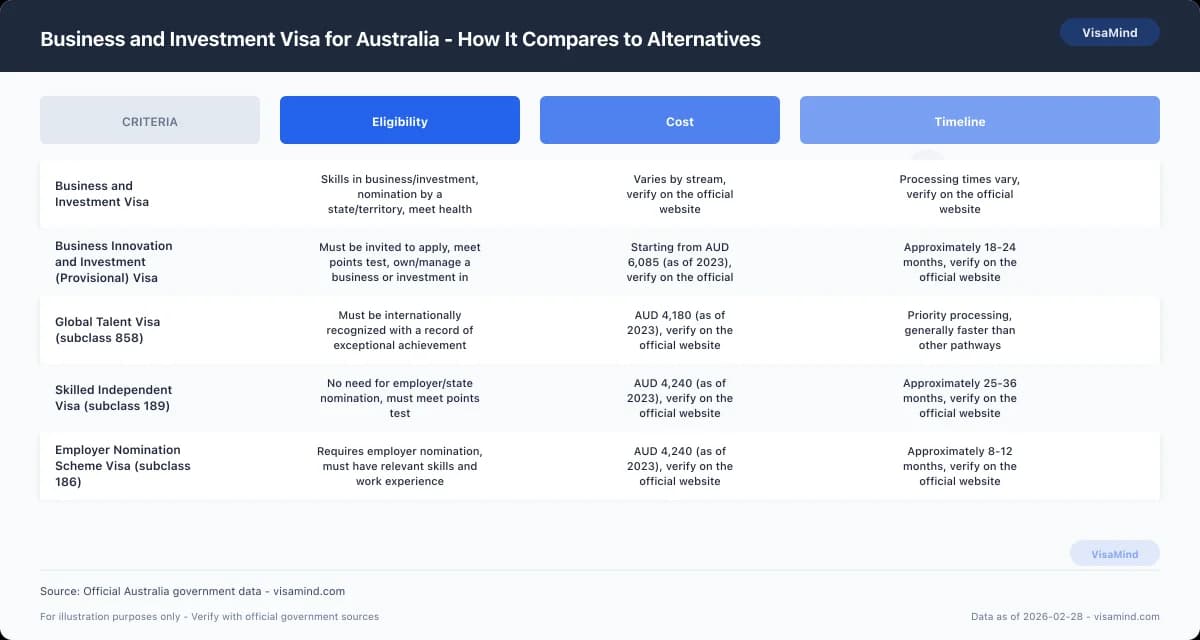
When considering the Business and Investment Visa for Australia, it's important to understand how it compares to other visa options available through the Department of Home Affairs. Each visa type has distinct eligibility requirements and benefits tailored to different applicant profiles. Below is a comparison between the Business and Investment Visa, the Business Innovation and Investment (Provisional) Visa (subclass 188), and the Global Talent Visa (subclass 858).
| Visa Type | Eligibility | Cost | Timeline | Key Features |
|---|---|---|---|---|
| Business and Investment Visa | Must be nominated by an Australian employer, have necessary job skills, and meet health and character requirements | Varies (verify on official website) | Priority processing under Ministerial Direction No | Permanent residency, employer sponsorship required |
| Business Innovation and Investment (Provisional) Visa (subclass 188) | Requires business ownership or investment experience, and meeting certain financial thresholds | AUD $5,375 (as of 2023, verify on official website) | Processing times vary, typically 18-24 months | Provisional visa leading to permanent residency, no employer nomination needed |
| Global Talent Visa (subclass 858) | Demonstrate internationally recognized talent or outstanding achievements in a target sector | AUD $4,110 (as of 2023, verify on official website) | Priority processing, typically within 3 months | No employer nomination required, direct pathway to permanent residency |
What Sets the Business and Investment Visa Apart?
The Business and Investment Visa is unique in that it requires a nomination from an Australian employer. This makes it ideal for individuals who have secured a job offer and wish to live and work in Australia permanently. Unlike the Skilled Independent Visa (subclass 189), which allows for independent application based on skills, the Business and Investment Visa hinges on employer sponsorship.
How Does the Business Innovation and Investment (Provisional) Visa Compare?
For those looking to establish or invest in a business in Australia, the Business Innovation and Investment (Provisional) Visa (subclass 188) is an attractive option. It doesn't require employer nomination but does require a substantial financial investment. This visa serves as a stepping stone to permanent residency through the Business Innovation and Investment (Permanent) Visa (subclass 888).
Is the Global Talent Visa Right for You?
The Global Talent Visa (subclass 858) targets highly skilled individuals in sectors such as fintech, medtech, and space. It offers a fast-tracked pathway to permanent residency without the need for an employer nomination. If you have a recognized talent and can demonstrate exceptional achievements, this visa might be the most streamlined route to settling in Australia permanently.
Tip: When choosing a visa type, consider your career goals, eligibility, and whether you have an employer willing to sponsor you. Each visa has distinct advantages depending on your personal and professional circumstances.
For further information, it is advisable to consult the official Department of Home Affairs website to verify details and ensure you meet all requirements before lodging an application.
Fees and Financial Requirements
#It is essential to understand the financial commitments involved. The Department of Home Affairs manages these visas and provides a structured fee schedule.
| Visa Type | Application Fee (AUD) | Additional Applicant Fee (Adult) | Additional Applicant Fee (Child) |
|---|---|---|---|
| Business Innovation and Investment (Provisional) Visa (subclass 188) | $6,085 | $3,045 | $1,520 |
| Global Talent Visa (subclass 858) | $4,180 | $2,090 | $1,045 |
Important: These fees are subject to change. Always verify the latest costs on the official Department of Home Affairs website.
Financial Requirements
For those applying for the Business Innovation and Investment Visa, there are specific financial requirements that must be met:
- Investment Minimums: Depending on the stream, you may need to demonstrate significant business or investment activity in Australia. For example, the Business Innovation stream requires a total net business and personal asset value of at least AUD 1.25 million.
- Salary Thresholds: If nominated by an employer under the Employer Nomination Scheme (ENS), you must meet the market salary rate for the position.
Financial Proof and Documentation
To support your application, you will need to provide evidence of your financial standing. This typically includes:
- Proof of available funds
- Evidence of business or investment activities
- Financial statements audited by a qualified accountant
Tip: Ensure all financial documents are professionally translated into English, if necessary, to avoid delays in processing.
Timelines and Payment Process
The timelines for processing financial assessments can vary. It is advisable to:
- Gather your documents early to avoid last-minute complications.
- Lodge your application promptly, as processing times can fluctuate based on demand.
For more detailed information on processing times, refer to the Processing Times guide.
By understanding these financial requirements and preparing the necessary documentation, you can streamline your application process for a Business and Investment Visa in Australia.
What You Can and Cannot Do
#The Business and Investment Visa for Australia provides a pathway to live and work permanently in Australia. Here's what you can do if you hold this visa:
- Work Rights: You can work in your field of expertise, contributing to Australia's economy. Being nominated by an Australian employer is a critical component, ensuring your skills are in demand locally.
- Travel: Enjoy the flexibility to travel in and out of Australia as often as you wish. This facilitates business operations and personal travel needs.
- Family Members: You may include eligible family members in your application. Your spouse or partner, along with dependent children, can join you and also enjoy similar rights to live, work, and study in Australia.
Tip: Ensure your family members meet health and character requirements to avoid delays in processing their applications.
What You Cannot Do
While the Business and Investment Visa offers numerous benefits, there are also restrictions to be aware of:
- Change Employers Easily: Your visa is closely tied to your employer nomination. Changing employers could impact your visa status and may require additional procedures or approvals.
- Permanent Residency Conditions: Although this visa provides a pathway to permanent residency, you must maintain compliance with all conditions attached to your visa, such as residing in Australia for a certain period.
- Immediate Citizenship: This visa does not grant immediate citizenship. You must meet residency and other criteria before applying for Australian citizenship. More information can be found in Australian Citizenship.
Key Restrictions to Consider
| Aspect | Details |
|---|---|
| Employer Nomination | Must remain with the nominating employer unless visa conditions change. |
| Travel Limitations | Regular travel permitted, but must adhere to residency requirements for citizenship eligibility. |
| Family Applications | Family members must meet eligibility criteria and be included at the time of application. |
Important: Failure to comply with visa conditions, such as not maintaining the employment relationship, could lead to visa cancellation. Always consult with the Department of Home Affairs or a registered migration agent if your circumstances change.
Real-World Examples
#"I was concerned about how my freelance income would be perceived when applying for a Business and Investment Visa in Australia. My earnings fluctuate, and I worried this might suggest instability. To address this, I meticulously gathered a year's worth of bank statements, tax returns, and client contracts to demonstrate a consistent income stream. I also prepared a detailed business plan outlining future projects and potential earnings. This demonstrated my ability to sustain myself financially in Australia. The visa was approved, and the case officer even commented positively on the thoroughness of my documentation."
"Another worry I had was that my investment funds originated from multiple family members, raising questions about proof of ownership and legitimacy. To tackle this, I worked closely with a financial advisor to compile a detailed paper trail. This included notarized affidavits from family members, bank transfer receipts, and a certified letter from our family lawyer confirming the gifts. By clearly documenting the origin and transfer of funds, I was able to satisfy the Department of Home Affairs about the legitimacy of my investment capital. The visa application was successful, and the process helped me understand the importance of transparency in financial documentation."
"Lastly, I was anxious about whether my small business, which employs only a handful of people, would be seen as a legitimate operation worthy of a Business and Investment Visa. I focused on showcasing the business's potential for growth and contribution to the Australian economy. This involved preparing a comprehensive business plan, highlighting past successes, projected growth, and how the business aligns with Australia's economic priorities. I also included testimonials from clients and suppliers to corroborate the business's reputation. The visa was granted, and the feedback indicated that the strategic presentation of my business's economic contributions was crucial to my application's success."
FAQs
Can I switch from the Global Talent Visa to the Business and Investment Visa for Australia?
What documents must I submit for the Business and Investment Visa for Australia?
What is the difference between the Business Innovation and Investment Visa and the Employer Nomination Scheme Visa in Australia?
Can I apply for Australian citizenship with a Business and Investment Visa?
What are common mistakes when applying for the Business and Investment Visa for Australia?
Can I combine the Business and Investment Visa with a Skilled Work Regional Visa in Australia?
What are the financial requirements for the Business and Investment Visa for Australia?
VisaMind provides informational guidance only and is not a government agency. This is not legal advice. Requirements can change and eligibility depends on your specific facts. If your case is complex or high-stakes, consult a licensed immigration attorney.
Next steps
Requirements vary by nationality, purpose, timeline, and case details. Use Find My Visa to get a personalized checklist for Australia with official sources and deadlines.
Find my visa