Eligible Family Members
#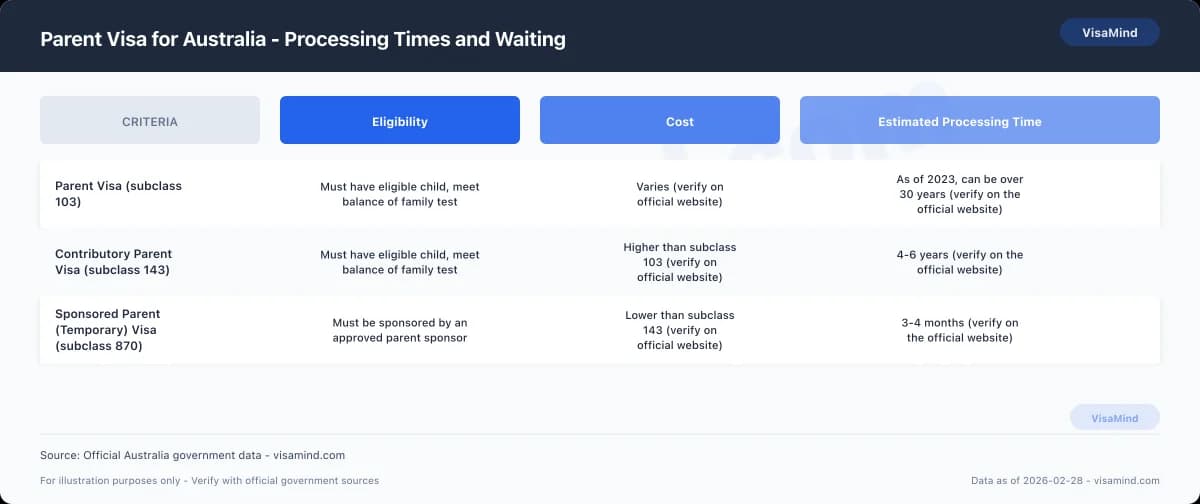
The Parent Visa (subclass 103) provides a pathway for parents to join their children in Australia as permanent residents. To be eligible, you must have an eligible child who is a settled Australian citizen, permanent resident, or eligible New Zealand citizen. The eligibility also extends to other family members under specific conditions.
Eligible Relationships
| Relationship Type | Eligibility Requirements |
|---|---|
| Spouse/De Facto Partner | Must be in a genuine and continuing relationship with the sponsor. |
| Children | Must be dependent on the applicant and meet age requirements or be in full-time education. |
| Parents | Must be the parent of an eligible child who is a settled Australian citizen, permanent resident, or eligible New Zealand citizen. |
| Other Dependents | Must demonstrate financial dependency on the applicant. |
Key Eligibility Criteria
To apply for the Parent Visa (subclass 103), you must meet several key eligibility criteria:
- Sponsorship: You need an eligible sponsor, typically your child. If your child is under 18, an eligible relative or community organisation can sponsor you.
- Balance of Family Test: At least half of your children must be residing in Australia, or more children must live in Australia than any other single country.
- Health and Character Requirements: All applicants must pass health and character checks.
Considerations for Retirees
If you are applying as a retiree, some criteria differ:
- No Need for a Sponsor: You don't require a sponsor if you held an Investor Retirement (subclass 405) visa or Retirement (subclass 410) on 8 May 2018.
- Exemption from Balance of Family Test: You are not required to meet this test.
- Health Insurance: Proof of adequate health insurance is necessary.
Important: Ensure you and all family members included in the application meet the health and character requirements. Missing documentation can lead to delays.
Related Visas
You might also consider other visa options depending on your circumstances, such as the Contributory Parent Visa (subclass 143) for faster processing, although it involves a higher fee, or the Sponsored Parent (Temporary) Visa (subclass 870) if you're looking for a temporary stay.
For further details on the application process, see the How To Apply guide and ensure you have all necessary documents ready as per the Documents Checklist.
Relationship or Family Evidence
#Demonstrating your relationship or family ties is crucial. The Department of Home Affairs requires specific types of evidence to establish your connection to your eligible child, who must be a settled Australian citizen, permanent resident, or eligible New Zealand citizen. Below is a detailed list of acceptable forms of relationship and family evidence.
Official Documents
- Marriage Certificates: If you are married, provide a certified copy of your marriage certificate to prove your relationship with your spouse.
- Birth Certificates: These documents are essential to establish your relationship with your children or step-children.
- Adoption Papers: If applicable, provide legal documentation of adoption to confirm the relationship with your child.
Cohabitation and Shared Life
- Joint Lease or Property Ownership Documents: Evidence of shared living arrangements, such as a joint lease or property ownership, can support claims of a family relationship.
- Utility Bills: Bills in both names, such as electricity or water, can show cohabitation and a shared household.
Financial Interdependence
- Joint Bank Account Statements: These statements serve as proof of financial interdependence, indicating shared financial responsibilities.
- Shared Financial Commitments: This may include joint loans, mortgages, or shared investments.
Personal Evidence
- Photographs: A collection of photographs depicting family gatherings, holidays, or other significant events can illustrate the family bond.
- Communications: Emails, letters, or text message records can be submitted to demonstrate regular and ongoing communication between family members.
Important: Ensure all documents are certified copies, where necessary, and translated into English if they are in another language. Failure to provide certified translations can lead to application delays.
Additional Considerations
When preparing your application, remember that the balance of family test is a requirement for the Parent Visa (subclass 103). This test mandates that at least half of your children live in Australia, or more of your children reside in Australia than in any other country. This test underscores the importance of providing accurate and comprehensive relationship documentation.
For more detailed information on document preparation, consider reviewing the Documents Checklist. Additionally, if you are considering other visa options for parents, the Contributory Parent Visa (subclass 143) might be an alternative worth exploring.
Tip: Keep multiple copies of all submitted documents and maintain a record of all communications with the Department of Home Affairs to facilitate any future inquiries or follow-ups.
Financial Requirements
#Financial requirements play a critical role. These requirements ensure that you, as an applicant, have adequate financial support, either through personal means or via a sponsor. This section outlines the key financial aspects you need to understand.
Sponsor Income Thresholds
To sponsor a parent, the sponsor must meet specific income thresholds. These thresholds ensure that the sponsor can financially support the parent if necessary. The income threshold varies depending on the number of family members the sponsor supports, including those they have previously sponsored. As of 2023, these requirements are subject to change, so it is essential to verify them on the official website.
| Visa Type | Income Requirement |
|---|---|
| Parent Visa (subclass 103) | Minimum taxable income requirement based on family size |
Important: The income requirement is assessed based on the sponsor's taxable income over the past two years. Ensure that your sponsor's income documentation is up-to-date and accurate.
Savings Requirements
Applicants themselves are not typically required to prove specific savings amounts, but having sufficient personal funds can be beneficial. Financial stability can demonstrate your ability to support yourself in Australia, potentially easing the application process.
Assurance of Support
An Assurance of Support (AoS) is a legal commitment by a person or organisation to provide financial support to the visa holder. This is often required for Parent Visas to ensure public funds will not be needed. The assurer must provide a financial bond, which is held for a specified period.
| Visa Type | Assurance of Support Bond Amount | Bond Period |
|---|---|---|
| Parent Visa (subclass 103) | AUD 10,000 for the main applicant (as of 2023) | 10 years |
Tip: Ensure your assurer understands their obligations. The bond is refundable, but only after the bond period if no claims are made against it.
Maintenance Funds
While not always a formal requirement, demonstrating access to maintenance funds can strengthen your application by showing you can cover living expenses in Australia. This includes everyday costs such as housing, food, and healthcare, especially considering the comprehensive healthcare requirements for visa applicants.
For more details on visa types and financial requirements, refer to the Parent Visa (subclass 103) and Contributory Parent Visa (subclass 143) pages. Additionally, you can explore the Financial Requirements guide for broader insights into financial criteria for different visa categories.
Understanding these financial requirements is crucial for ensuring a successful application process. Make sure to regularly check the Department of Home Affairs website for the most current information.
Step-by-Step Family Visa
#Check Your Eligibility
Before starting the application process for a Parent Visa (subclass 103), ensure that you meet the eligibility requirements. You must have a child who is a settled Australian citizen, permanent resident, or eligible New Zealand citizen. Additionally, you must pass the balance of family test. It's essential that you confirm all eligibility criteria, including health and character requirements, and ensure you have not applied for or hold a Sponsored Parent (Temporary) (subclass 870) visa.
Gather Required Documents
Collect all necessary documentation to support your application. This includes:
- Valid passports for you and any family members included in the application
- Proof of relationship to your child
- Sponsor documents from your eligible child (or an eligible relative/community organisation if your child is under 18)
- Evidence of meeting the balance of family test
- Assurance of support documents, unless applying as a retiree
- Certified copies of original documents and police certificates
Make sure all documents are up-to-date and certified where necessary. For a comprehensive list, refer to the Documents Checklist.
Lodge Your Application
Once your documents are prepared, you can lodge your application through your Immi Account. If you don't have an account, you'll need to create one. Import your application by entering your application ID, date of birth, and identity document number. Attach all supporting documents to your application in your Immi Account.
Tip: By applying online through the Immi Account, you avoid potential mail delays and receive a receipt number immediately.
Attend Required Appointments
After submitting your application, you may be required to attend an interview or provide biometrics. The Department of Home Affairs will notify you if an interview is necessary. It's important to attend all scheduled appointments promptly and provide any additional documents requested.
Await Application Outcome
Once all steps are completed, wait for a decision from Home Affairs. Processing times may vary, so it's advisable to regularly check the status of your application through your Immi Account. If your application is successful, you will receive information on the next steps to finalize your visa.
Important: Ensure that all information provided is accurate and complete to avoid processing delays. Missing or incorrect information can significantly lengthen the application process.
For more information on the Parent Visa (subclass 103) and related options, explore details about the Contributory Parent Visa (subclass 143) and other family visas.
Current Wait Times
#It's important to be aware of the current wait times and factors that can influence the processing speed. This section will help you understand the timelines associated with different visa subclasses and priority categories.
Current Processing Timelines
The wait time for processing a Parent Visa can vary significantly depending on the visa subclass and other influencing factors. Below is a comparison of the typical timelines for various parent visa options.
| Visa Type | Description | Estimated Processing Time |
|---|---|---|
| Parent Visa (subclass 103) | Permanent visa for parents of settled Australian residents. | Approximately 30 years |
| Contributory Parent Visa (subclass 143) | Offers a faster pathway with a higher fee. | 5 to 7 years |
| Sponsored Parent (Temporary) Visa (subclass 870) | Temporary visa that allows parents to stay in Australia for up to 10 years. | 6 months to 1 year |
Tip: Consider the Contributory Parent Visa if you are seeking a faster processing time, though it comes with higher fees.
Factors Affecting Processing Speed
Several factors can impact the processing speed of your Parent Visa application:
- Priority Categories: Applications are processed based on priority categories, with contributory visas generally receiving higher priority over non-contributory options.
- Complete Documentation: Ensuring that all required documents, such as identity and sponsorship papers, are correctly submitted can prevent unnecessary delays.
- Assurance of Support: Required for most parent visas, an assurance of support involves a financial commitment from a sponsor and can affect the timeline if not promptly arranged.
Important: Not providing all required documents or accurate information can lead to significant delays in processing your application.
Managing Expectations
Given the extended processing times for some parent visas, planning ahead is crucial. Make sure to keep track of your application's status through your Immi Account and stay informed about any changes in processing times by checking the Processing Times Guide. This proactive approach can help in managing expectations and preparing for the eventual migration to Australia.
In conclusion, understanding the current wait times and factors influencing the speed of processing is vital for applicants considering a Parent Visa to Australia. By choosing the appropriate visa subclass and ensuring all documentation is in order, you can better navigate this complex process.
What Goes Wrong
#Navigating the Parent Visa process for Australia can be challenging, and several issues can potentially hinder your application. Below are some common problems applicants face:
Insufficient Evidence
- Lack of Documentation: Not providing all required documents can lead to processing delays. Ensure you have valid passports, proof of identity, and certified copies of original documents.
- Balance of Family Test: Failing to meet the balance of family test, which requires at least half of your children to be living in Australia, can result in application denial.
Tip: Review the Documents Checklist to ensure you haven't missed any critical items.
Sham Marriage Concerns
- Proof of Genuine Relationship: If your application involves a spouse, you must provide substantial evidence of a genuine and ongoing relationship. This may include joint financial commitments, shared accommodation, and other relationship evidence.
Financial Shortfalls
- Assurance of Support: Failure to secure an assurance of support can be a significant obstacle. This is a financial commitment by your sponsor to cover your potential welfare costs in Australia.
- Sponsor Requirements: Your sponsor must meet specific financial criteria to support you. If these requirements are not met, your application may be at risk.
For more details on financial obligations, visit our Financial Requirements guide.
Medical and Character Issues
- Health Requirements: All applicants must meet health criteria. Failing to provide required medical examinations or having a medical condition that may pose a public health threat could result in rejection.
- Character Requirements: Applicants over 18 must demonstrate good character by providing police certificates. A history of criminal activity can lead to application refusal.
Important: Always ensure that your police certificates are current and certified copies are submitted to avoid unnecessary delays.
If you encounter any of these issues, it is crucial to address them promptly to improve your chances of a successful outcome. For more guidance, refer to our Visa Refusal Reasons page.
Rights While Waiting
#When you apply for a Parent Visa in Australia, your rights and obligations during the waiting period can significantly impact your stay. Understanding the implications of bridging visas, work rights, and travel restrictions is crucial.
Work Rights and Bridging Visas
While waiting for your Parent Visa application to be processed, you will typically be granted a Bridging Visa, which allows you to remain lawfully in Australia until a decision is made. The specific conditions of your Bridging Visa, including work rights, depend on the type of Bridging Visa you receive:
-
Bridging Visa A (BVA): Generally granted if you applied for the Parent Visa while in Australia. This visa does not automatically allow you to work. If you wish to work, you may need to apply for work rights separately through the Department of Home Affairs.
-
Bridging Visa C (BVC): Usually issued if you applied for the Parent Visa after your previous visa expired. Like the BVA, this visa does not inherently include work rights, and you would need to apply for them.
-
Bridging Visa B (BVB): Allows you to leave and return to Australia while your application is being processed. If you plan to travel, ensure you hold a BVB before departing.
Important: Always check the conditions of your Bridging Visa, as they dictate your work rights and travel permissions. For the most current information, consult the Parent Visa 103 page.
Travel Restrictions
Travel restrictions while on a Bridging Visa can vary. If you are on a Bridging Visa A or C, you are generally not allowed to travel outside Australia without first obtaining a Bridging Visa B. Failing to secure a BVB before departing can result in the cancellation of your bridging visa, potentially affecting your Parent Visa application.
Implied Status While Application is Pending
Holding a Bridging Visa grants you an implied lawful status in Australia while your Parent Visa application is under consideration. This means you can stay in Australia legally, but you must adhere to the specific conditions of your Bridging Visa.
Ensure you maintain your valid status by abiding by all conditions, and keep an eye on any correspondence from the Department of Home Affairs regarding your application status. To streamline your application process, consider creating an Immi Account to manage and track your application online through the IMMIACCOUNT-PORTAL.
Tip: Keeping your contact details up-to-date in your Immi Account ensures you receive all official communications promptly.
What Happens After Approval
#After your Parent Visa (subclass 103) application is approved by the Department of Home Affairs, you'll gain the benefits of Australian permanent residency. This status allows you to reside in Australia indefinitely, offering you an opportunity to be closer to your family and enjoy a range of resident privileges.
Permanent Residency Benefits
Upon approval, you become a permanent resident of Australia, which grants you several rights and privileges:
- Live and Work: You can live, work, and study anywhere in Australia.
- Healthcare Access: You are eligible for Medicare, Australia's public health care system.
- Sponsorship Opportunities: Permanent residency allows you to sponsor eligible relatives for their own permanent residency.
- Travel Flexibility: You can travel to and from Australia freely. However, to maintain your permanent resident status, you must meet certain residency requirements.
Can You Apply for Citizenship?
After living in Australia for an extended period, you may become eligible to apply for Australian citizenship. To apply, you’ll need to meet the general residence requirement, which typically involves living in Australia on a valid visa for four years immediately before applying, including at least 12 months as a permanent resident. Most applicants must also pass a citizenship test to demonstrate their understanding of Australian values and responsibilities.
Tip: If you're considering citizenship, explore more about the Australian Citizenship process to ensure you meet all criteria and understand the benefits.
Residency Requirements and Travel Restrictions
While you have the freedom to travel, it is important to adhere to residency requirements to maintain your permanent resident status:
- Travel Facility: Your initial permanent visa includes a five-year travel facility, allowing you to leave and re-enter Australia as a permanent resident. After this period, you'll need to apply for a Resident Return Visa if you plan to travel internationally.
- Residency Obligation: Spending significant time outside Australia without a valid Resident Return Visa may jeopardize your permanent resident status.
For those looking for more information on maintaining residency status, consider checking the requirements for the Resident Return Visa.
Restrictions for New Permanent Residents
Initially, there are some restrictions for new permanent residents:
- Social Security: Access to certain social security payments may be limited for the first two years as a permanent resident.
- Sponsorship Limitations: While you can sponsor relatives, they must meet their own eligibility requirements, and processing times can vary significantly.
Important: Always verify the latest requirements and conditions on the official website to stay informed about any changes that may affect your status or benefits.
Understanding these aspects of your new status will help you make the most of your life in Australia and ensure that you continue to meet the necessary requirements for permanent residency and potential citizenship.
The Long-Term Outlook
#The journey from arriving in Australia on a Parent Visa (subclass 103) to obtaining permanent residency and eventually citizenship involves a series of steps and timeframes that prospective applicants should be aware of.
From Visa to Permanent Residency
Once you are granted a Parent Visa (subclass 103), you immediately become a permanent resident of Australia. This status comes with several benefits, such as the ability to live, work, and study in Australia indefinitely, as well as access to Medicare, Australia's public health care scheme. As a permanent resident, you can also consider applying for a Resident Return Visa (subclass 155) if you wish to travel outside Australia and maintain your residency status.
Pathway to Citizenship
Becoming an Australian citizen provides additional rights and responsibilities, including the right to vote and the ability to apply for an Australian passport. To be eligible for citizenship, you must meet certain residence requirements:
- General Residence Requirement: You need to have lived in Australia on a valid visa for four years immediately before applying for citizenship.
- Permanent Residency Requirement: You must have been a permanent resident for at least 12 months within this four-year period.
During the citizenship application process, most applicants aged 18 to 59 will need to pass a citizenship test that assesses your knowledge of Australia and the responsibilities and privileges of citizenship. Children under 16 are exempt from the residence requirement but must hold permanent residency.
Important Considerations
Important: Ensure you maintain your permanent residency status until you receive your Australian citizenship certificate. Any lapse could affect your eligibility.
Tip: Staying engaged with local community activities and learning about Australian culture can help you prepare for the citizenship test and integrate into Australian society.
For more detailed information on the citizenship process, visit the Australian Citizenship page. Additionally, for those interested in exploring other visa options, such as the Skilled Independent Visa (subclass 189), it's beneficial to understand the different pathways to permanent residency in Australia.
Family Immigration Stories
#When I first considered applying for the Parent Visa to join my daughter in Australia, I was worried about the balance of family test. My daughter is my only child living in Australia, and I have another child living in Canada. I was concerned that this might affect my eligibility. To address this, I gathered thorough documentation proving that my daughter was settled in Australia and provided evidence of my family ties, which demonstrated that more of my family members were in Australia than any other single country. This careful preparation helped ease my initial worries, and my application was eventually approved, allowing me to join my daughter permanently.
Overcoming Document Challenges
The process of gathering all necessary documents felt overwhelming at first. I was particularly anxious about meeting the assurance of support requirement, as it was a significant part of the application. My son, who was my sponsor, meticulously prepared his financial documents to demonstrate he could meet this requirement. We ensured we had all the certified copies ready, and I double-checked that my passport was valid. Despite the initial stress, our thorough preparation paid off, and the Department of Home Affairs accepted our application without any delays, leading to a successful outcome.
Addressing Health Concerns
As I prepared my application, I was particularly concerned about the health requirements. I had a history of minor health issues, and I worried they might impact my eligibility. To address this, I consulted my doctor and gathered all necessary medical reports to present a clear picture of my health status. This proactive approach ensured that my health assessments were completed smoothly, without any issues arising during the application process. Ultimately, this diligence allowed me to meet the health requirements successfully, proving that careful preparation can alleviate even the most daunting concerns.
FAQs
What is the balance of family test for the Parent Visa for Australia?
What documents are required for the Parent Visa (subclass 103) application in Australia?
Can I apply for the Parent Visa for Australia if I have applied for another visa?
How can I prove my relationship for the Parent Visa for Australia?
What happens after my Parent Visa for Australia is approved?
Are there any exemptions for retirees applying for the Parent Visa for Australia?
How does the Department of Home Affairs assess character for the Parent Visa for Australia?
VisaMind provides informational guidance only and is not a government agency. This is not legal advice. Requirements can change and eligibility depends on your specific facts. If your case is complex or high-stakes, consult a licensed immigration attorney.
Next steps
Requirements vary by nationality, purpose, timeline, and case details. Use Find My Visa to get a personalized checklist for Australia with official sources and deadlines.
Find my visa