
On this page
About This Diplomatic Visa (Brazil diplomatic visa)
#
This visa is for diplomatic passport holders traveling to Brazil on official duty. It uses a Federal Police form and fits into Brazil’s official visa classifications.
Who it's for
You’re eligible if you hold a diplomatic passport and will enter Brazil to perform official government duties. Your travel must be directly tied to your diplomatic role, not for private or commercial purposes.
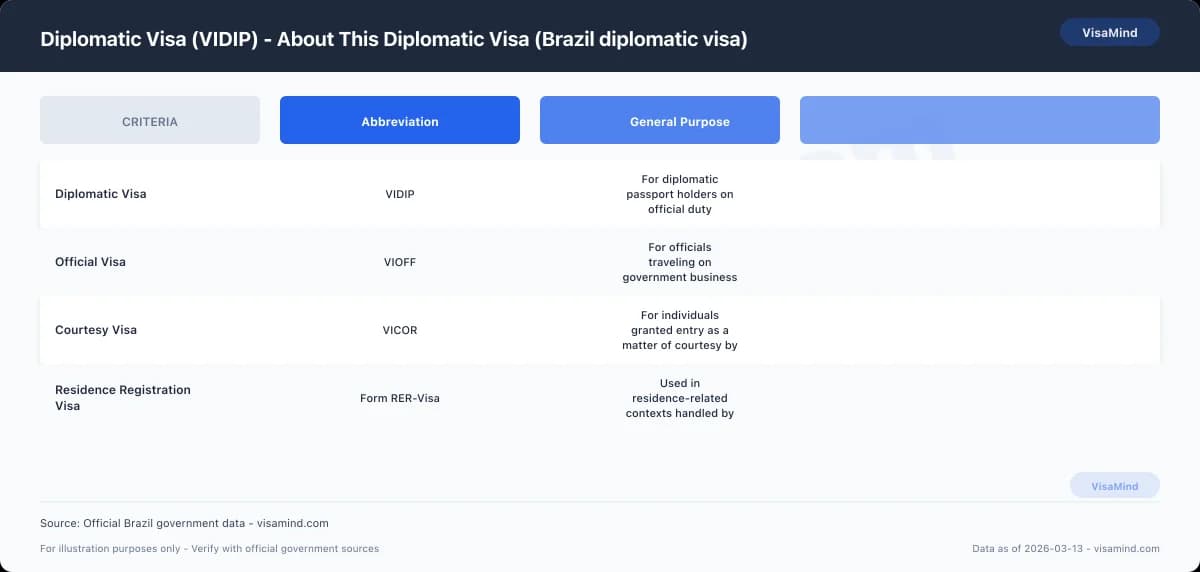
This is the Diplomatic Visa (VIDIP), distinct from other official categories:
| Visa Category | Abbreviation | General Purpose |
|---|---|---|
| Diplomatic Visa | VIDIP | For diplomatic passport holders on official duty |
| Official Visa | VIOFF | For officials traveling on government business who do not hold diplomatic status |
| Courtesy Visa | VICOR | For individuals granted entry as a matter of courtesy by the Brazilian government |
| Residence Registration Visa | Form RER-Visa | Used in residence-related contexts handled by the Federal Police |
Your passport type and assignment must match the diplomatic classification. If you hold an official but non-diplomatic passport, you may need the Official Visa (VIOFF) instead.
Brazilian consulates issue visas abroad. Once you arrive, the Federal Police (Polícia Federal – PF) handles immigration registration inside Brazil.
What the form is
The form is called Diplomatic Visa (VIDIP). It’s an official document used in Federal Police procedures.
You use this form to request a diplomatic visa under the VIDIP classification. It identifies you as a diplomatic passport holder traveling on official duty and puts your application in the right visa framework.
The form ties your status to Brazil’s internal immigration controls managed by the Polícia Federal (PF). While consulates handle visa issuance abroad, PF manages immigration matters once you’re in Brazil.
Use the VIDIP form only if you meet the diplomatic criteria. Filing under the wrong category—like VIOFF or VICOR—can slow things down or require correction through the proper authority.
Accreditation and Arrival
#You need to complete immigration registration with the Federal Police (Polícia Federal – PF) after entering Brazil with an Official Visa (VIOFF), Courtesy Visa (VICOR), or RER‑Visa. This step formalizes your presence and links your visa status to the national immigration system.
Registering with authorities
You register directly with the Federal Police (PF) inside Brazil. PF manages immigration records and processes filings related to your stay.
Applicants must complete the required registration form for immigration processing. Download the current VIDIP form and its instructions from the Federal Police website.
Prepare your documents carefully before filing. Follow the official instructions that come with the VIDIP form, and fill out all fields accurately.
| Visa Type | Registration Authority in Brazil | Form Source |
|---|---|---|
| Official Visa (VIOFF) | Federal Police (PF) | Federal Police website |
| Courtesy Visa (VICOR) | Federal Police (PF) | Federal Police website |
| RER‑Visa | Federal Police (PF) | Federal Police website |
Brazilian consulates issue visas abroad. PF controls immigration registration after arrival.
Where to file on arrival
You file your registration in person with the Federal Police (PF) in Brazil. PF offices handle immigration services for foreign nationals holding diplomatic and related visas.
Download the current VIDIP form before visiting PF and review their official instructions. Complete the form as directed and bring the required documentation listed in the guidance.
Use the Federal Police website to confirm:
- The correct VIDIP form version
- Filing instructions
- Office procedures and any updated requirements
PF determines the process for VIOFF, VICOR, and RER‑Visa holders once you arrive in Brazil.
Conditions and Restrictions
#You need to complete every required part of the diplomatic visa application and submit it with the proper supporting documents. Incomplete forms, missing signatures, or absent evidence can prevent issuance of an Official Visa (VIOFF), Courtesy Visa (VICOR), or Form RER-Visa.
Brazilian consulates issue visas abroad. The Federal Police (Polícia Federal – PF) manages immigration registration inside Brazil.
Completing the application
Fill out all mandatory fields in the application form without leaving blanks. Provide accurate personal, diplomatic, and mission-related details as they appear in your official documents.
Sign the application where required.
Follow this sequence:
-
Complete all required sections of the form.
-
Review entries for accuracy and consistency.
-
Sign the form in the designated area.
-
Prepare the required supporting evidence.
If you apply for a VIOFF, VICOR, or RER-Visa, make sure the visa category matches the purpose of your assignment. Incorrect classification can delay processing or require a new application.
| Requirement | What You Must Do |
|---|---|
| All fields completed | Do not leave mandatory sections blank |
| Signature | Sign where indicated |
| Visa category | Select the correct diplomatic classification |
| Accuracy | Ensure all details match supporting documents |
Submitting supporting evidence
Submit the application with all required supporting documents. The form alone is not enough.
Supporting evidence must confirm your diplomatic, official, or courtesy status. The consulate reviews these documents before issuing the visa.
Prepare your file carefully:
- Include all required evidence at submission.
- Make sure documents are consistent with your form.
- Verify your visa category (VIOFF, VICOR, or RER-Visa) matches the documentation.
If you enter Brazil with a diplomatic visa, you must comply with registration requirements handled by the Federal Police (PF). Missing or inconsistent documentation can interrupt your status or delay recognition of your diplomatic stay.
How the Embassy Applies (VIDIP visa)
#Brazilian consulates issue the VIDIP visa abroad, based on formal diplomatic communication from your sending authority. Coordinate with your mission or organization before filing.
Note Verbale requirements
You cannot apply for a VIDIP visa on your own.
A Note Verbale (Verbal Note) from one of the following must go with the application:
- The local Ministry of Foreign Affairs (Chancellery)
- A foreign Diplomatic Mission
- An International Organization
The Note Verbale requests the VIDIP visa on your behalf and confirms your diplomatic or official status. Without it, the consulate will not process your application.
Your Note Verbale should state:
- Your full name
- Your position or function
- The visa category requested (such as Official Visa (VIOFF) or Courtesy Visa (VICOR), if needed)
- The purpose of your assignment
Review the eligibility requirements before submission. They may differ depending on whether you seek VIDIP or a related status such as Form RER-Visa.
Protocol steps before filing
Complete your internal diplomatic coordination before approaching the Brazilian consulate.
Follow these steps:
-
Confirm your eligibility category with your mission or organization.
-
Make sure the correct visa classification is identified (VIDIP, VIOFF, or VICOR, as needed).
-
Obtain the signed and sealed Note Verbale.
-
Submit the visa request through the Brazilian consulate with jurisdiction over your location.
Brazilian consulates issue the visa abroad. After arrival in Brazil, the Federal Police (Polícia Federal – PF) handles immigration registration if registration applies to your status.
| Stage | Responsible Authority |
|---|---|
| Visa issuance abroad | Brazilian Consulate |
| Immigration registration in Brazil | Federal Police (PF) |
Don’t file before your diplomatic documentation is complete. The consulate needs formal communication from your sending authority to validate your request.
Eligibility and Protocol
#You must present a properly completed application and basic identity items to request a Brazilian diplomatic visa. Brazilian consulates issue the visa abroad, and the Federal Police (Polícia Federal – PF) manages immigration matters inside Brazil.
Required applicant items
You qualify to apply when you can submit all required application materials in complete form. Incomplete filings delay processing or cause refusal.
At minimum, provide:
- A fully completed electronic visa application form
- A recent passport-style photograph
- Your signature on the application, where required
Your information must match your passport exactly. Discrepancies in name, date of birth, or signature can cause rejection.
Brazil recognizes several official categories. The visa class must match your status.
| Visa Category | Purpose | Issued By |
|---|---|---|
| Diplomatic Visa (VIDIP) | Diplomatic status | Brazilian consulate abroad |
| Official Visa (VIOFF) | Official government travel | Brazilian consulate abroad |
| Courtesy Visa (VICOR) | Courtesy status | Brazilian consulate abroad |
| Form RER-Visa | Specific regulated category | Brazilian consulate abroad |
Make sure the selected category reflects your official designation before submitting the form.
Document checklist
Get your documents in order before starting the electronic form. Missing items interrupt submission.
Checklist:
- ✅ Completed electronic visa application form
- ✅ Passport photo meeting standard identification format
- ✅ Applicant signature where indicated
The photograph should be clear and recent. Blurred or outdated images might not be accepted.
After visa issuance and arrival in Brazil, the Federal Police (PF) handles immigration registration. The consulate does not manage in-country registration.
If you’re unsure which category—VIDIP, VIOFF, VICOR, or RER-Visa—applies to you, verify your official status before filing. Submitting under the wrong classification can delay your case.
Check Fees and Cost Details
#Brazil sets diplomatic and related visa fees by visa type and nationality. Confirm the exact amount with the Brazilian consulate that will issue your visa, and complete any required registration with the Federal Police (Polícia Federal – PF) after arrival if needed.
Fee table overview
Application fees vary by visa classification and citizenship. Some diplomatic-related categories currently show no application charge.
| Visa Type | Eligible Nationalities (as listed) | Stay Reference | Fee (BRL) |
|---|---|---|---|
| Official Visa (VIOFF) | United Kingdom (if stay exceeds 180 days) | More than 180 days | R$215 |
| Official Visa (VIOFF) | All other listed countries | Up to 180 days (where applicable) | R$100 |
| VITEM VI (Work During Vacation) | New Zealand, France | Up to 180 days | R$100 |
| VITEM XII (Artistic or Sport Activity under contract) | As applicable | — | Check consulate |
| Diplomatic-related category (as of 2026‑03) | As applicable | — | R$0 |
Some categories are not open to U.S. citizens or certain other nationalities at this time.
If you need to register your stay in Brazil, PF manages immigration records inside Brazil. Brazilian consulates issue the visa abroad.
Country-specific fee notes
Your nationality affects what you pay. The same visa type may have different fees depending on your passport.
For example:
- United Kingdom citizens may pay R$215 for stays over 180 days under the listed category.
- New Zealand and French citizens applying under VITEM VI pay R$100.
- Other listed nationalities often pay R$100, where eligible.
- Some nationalities, including U.S. citizens in certain categories, cannot apply at this time.
Official Visa (VIOFF), Courtesy Visa (VICOR), and RER‑Visa classifications may follow different fee rules depending on reciprocity and diplomatic status. Confirm the exact amount with the Brazilian consulate responsible for your jurisdiction before you submit your application.
Expect Processing Times
#Plan for a defined processing window. Brazilian diplomatic visas, including Official Visa (VIOFF), Courtesy Visa (VICOR), and related categories, follow a standard timeframe for consular review.
Typical turnaround
Brazilian diplomatic visa applications are usually processed within up to 10 business days.
This timeline covers diplomatic-type requests submitted through the appropriate Brazilian consulate.
It includes:
- Official Visa (VIOFF)
- Courtesy Visa (VICOR)
- Diplomatic visa requests, often called Form RER-Visa
- Other diplomatic entries under VIDIP processing
Only business days count here. Weekends and local holidays at the consulate are excluded from the 10-day period.
| Visa Category | Standard Processing Time |
|---|---|
| VIOFF | Up to 10 business days |
| VICOR | Up to 10 business days |
| RER-Visa | Up to 10 business days |
If your assignment has a fixed start date, submit your application early enough to allow for the full 10-business-day window.
Processing time context
The processing period refers to how long the Brazilian consulate needs to review and decide your visa application abroad.
Brazilian consulates handle diplomatic visas outside Brazil.
After you enter Brazil, the Federal Police (Polícia Federal – PF) manages immigration registration and any required in-country formalities.
PF procedures are separate from consular visa issuance and aren't included in the 10-business-day consular processing window.
Other timing factors to consider:
-
Time spent gathering required diplomatic documentation.
-
Internal approval steps within your sending government or organization.
-
Possible scheduling delays for submission.
If timing is tight, confirm procedural details directly with the Brazilian consulate for your jurisdiction and coordinate with your sponsoring authority.
When to Get Help
#Seek guidance if your diplomatic visa case involves uncertainty or unusual eligibility factors.
Approval isn't guaranteed, even after submission, so early review helps avoid delays or refusals.
If approval is uncertain
Submitting a diplomatic visa request, including through VIDIP, doesn't guarantee approval.
If your role, status, or documentation doesn't clearly fit the requested category—like Official Visa (VIOFF) or Courtesy Visa (VICOR)—get professional advice before or right after filing.
Uncertainty often comes up when:
- Your diplomatic or official status isn't clearly defined in your documents
- Your assignment in Brazil doesn't match the title listed in your request
- You're unsure whether your case fits VIOFF, VICOR, or another category like Form RER-Visa
- The Brazilian consulate raises questions during processing
An experienced advisor can review your documentation before the consulate or the Federal Police (Polícia Federal) (PF) gets involved with post‑arrival registration.
| Situation | Why Help Matters |
|---|---|
| Unclear visa category | Prevents filing under the wrong classification |
| Inconsistent documents | Reduces risk of refusal |
| Prior concerns raised by a consulate | Allows you to correct issues quickly |
Addressing issues early protects your official assignment and helps avoid disruption to your entry plans.
Complex eligibility issues
Get help if your eligibility involves overlapping roles, mixed diplomatic and non-diplomatic functions, or unclear institutional recognition.
Brazil uses specific classifications, and choosing the wrong visa type can affect how you register with the PF after arrival.
Complex cases might include:
- Dual roles involving both governmental and non-governmental duties
- Dependents whose status depends on your diplomatic classification
- Changes in assignment after you submit your request
- Uncertainty about whether an Official Visa (VIOFF) or Courtesy Visa (VICOR) applies
In these situations, a detailed eligibility review makes sure your application reflects your actual function in Brazil.
Approval is discretionary, and how you present your role and documentation can influence the outcome.
Fees
#| Component | Amount |
|---|---|
| Application feeNo charge for diplomatic visas for all countries on the consular fee schedule | $0 |
Fees change; always verify on PF.
Required forms
#Next steps
#Use Find My Visa to build a sequenced plan with official sources and deadlines.
FAQs
Where do you apply for the visa?
You apply at a Brazilian consulate in your country of residence.
The consulate reviews your documentation and issues the appropriate visa category.
Are there fees for diplomatic or official visas?
Fee requirements vary based on visa type and your nationality.
Contact the Brazilian consulate processing your application for details on current fees in BRL (R$) and payment instructions.
What is the VIDIP?
VIDIP is the official Polícia Federal form titled "Diplomatic Visa (VIDIP)" and is used in the context of diplomatic passport holders on official duty.
Who is the Diplomatic Visa intended for?
It is for diplomatic passport holders traveling to Brazil on official duty.
Where can I download the VIDIP form and instructions?
Download the current VIDIP form and instructions from the official Polícia Federal (Federal Police) website.
What documents are required to apply for VIDIP?
Required items include a completed electronic visa application form, a passport photo, and the applicant's signature; a Verbal Note from the local Chancellery, foreign Diplomatic Mission, or International Organization must also be submitted.
Is a Verbal Note required for VIDIP applications?
Yes. A Verbal Note from the local Chancellery, foreign Diplomatic Mission, or International Organization must be submitted for VIDIP applications.
How long does a VIDIP application usually take to process?
Typical processing time for VIDIP is up to 10 business days.
Is there an application fee for the VIDIP?
Application fee: $0 (as of 2026-03).
Does filing a VIDIP guarantee approval?
No. Filing the VIDIP does not guarantee approval.
Where is the VIDIP form filed?
This form is used by applicants filing with Polícia Federal (Federal Police).
Are there country-specific or conditional fees noted?
Yes. The fee table lists visa type, country of citizenship, and fee; there are conditional country-specific fee lines shown (for example lines referencing 180-day stays and varying fees for countries such as the United Kingdom, New Zealand, France, and the USA).
Official sources referenced
Last reviewed: 2026-03-13
VisaMind provides informational guidance only and is not a government agency. This is not legal advice. Requirements can change and eligibility depends on your specific facts. If your case is complex or high-stakes, consult a licensed immigration attorney.
Next steps
Every Brazil visa case depends on your nationality, purpose, and timeline. Get a personalized plan with official sources and deadlines.
Get my Diplomatic Visa (VIDIP) plan