
Is This Guide for You?
#The Family Sponsorship Guide is central to Canada's immigration pathways, allowing Canadian citizens and permanent residents to sponsor specific family members to become permanent residents of Canada. This process, managed by Immigration, Refugees and Citizenship Canada (IRCC), enables sponsored individuals to live, study, and work in Canada.
Identifying Eligible Family
Members Understanding which relatives you can sponsor is essential. The guide provides detailed instructions for sponsoring various family members, including spouses, partners, children, parents, and grandparents. Each category has specific eligibility requirements and processes.
Tip: For more detailed information on specific sponsorship types, explore options like Spousal Sponsorship and Parent and Grandparent Sponsorship.
When to Use
This Guide is intended for those who wish to sponsor their family members to become permanent residents of Canada. It is suitable if you meet the criteria to sponsor a family member and are ready to begin the application process.
Important: Ensure you have a clear understanding of the specific category under which you wish to sponsor a family member, as processes and requirements vary.
Eligibility and Requirements
#Each year, thousands of Canadians successfully sponsor their family members to become permanent residents. This process allows sponsored family members to live, study, and work in Canada, enriching the lives of both the sponsors and the newcomers. To successfully sponsor a family member, it is essential to understand the eligibility criteria and requirements set by Immigration, Refugees and Citizenship Canada (IRCC). This section outlines who qualifies for family sponsorship, financial obligations, and the necessary proof of relationship documentation.
Sponsorship Eligibility Criteria
Important:
Canadian citizens living abroad can sponsor family members, but they must plan to return to Canada once the application is approved.
Tip: For detailed information on specific family member sponsorships, refer to Spousal Sponsorship and Parent and Grandparent Sponsorship.
Income and Financial
Obligations Financial stability is key when sponsoring a family member. IRCC requires sponsors to demonstrate sufficient income to support both themselves and their sponsored family members.
- You must provide proof of income to show you can meet the minimum necessary income level (MNI) for the size of your family unit.
- Income requirements vary depending on how many family members you are supporting.
- You may need to provide Notice of Assessment from the Canada Revenue Agency as proof of income.
Warning: Failure to meet the financial requirements can result in the refusal of your sponsorship application.
Proof of Relationship Documentation
To prove your relationship with the family member you wish to sponsor, you must submit specific documents as evidence. These documents demonstrate the legitimacy of the relationship to IRCC.
- Birth certificates for sponsoring children.
- Marriage certificate for sponsoring a spouse.
- Adoption papers if applicable.
- Proof of cohabitation, such as joint leases or utility bills, for common-law partners.
Tip: Ensure that all documents are translated into English or French, if originally in a different language, to avoid delays in processing.
Fees, Timeline, and What to Expect
#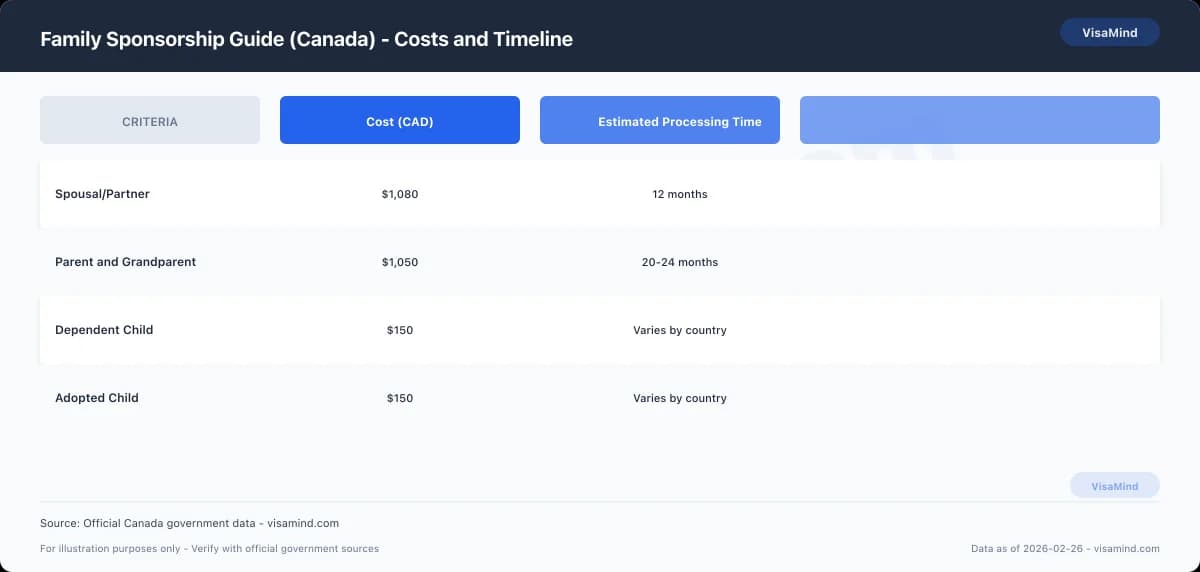
The fees and processing times can vary depending on the type of family member you are sponsoring.
Sponsorship Processing Fees
The fees for family sponsorship in Canada depend on the relationship between you and the person you are sponsoring. Typically, sponsoring a spouse, partner, or child incurs a different cost than sponsoring parents or grandparents.
What Experienced Applicants Recommend
#Each year, numerous Canadians successfully sponsor their family members to become permanent residents through the Family Sponsorship Guide. However, the process requires careful attention to detail and thorough preparation to avoid common pitfalls.
Preparing Comprehensive
Documentation Compiling a complete set of documents is necessary when sponsoring family members to Canada. Missing or incorrect documentation can lead to delays or rejections.
- Ensure you gather strong evidence of your relationship to the sponsored family member, such as marriage certificates or birth certificates. Link to related visas: Spousal Sponsorship
- Include personal information, such as telephone numbers, emails, and Social Insurance Numbers (SIN) where applicable.
- Prepare financial documents to demonstrate your ability to support the family member financially if required.
Warning: Failure to provide adequate evidence of your relationship can result in application delays or rejection.
Tip: Check the official IRCC website regularly for any updates on document requirements and processing times.
Maintaining Open
Communication Maintaining clear and open communication with both the IRCC and your sponsored family member is essential throughout the process.
- Regularly check your email and IRCC portal for any updates or requests for additional information.
- Ensure your family member is aware of all necessary steps and timelines, so they can provide their documentation promptly.
- Keep copies of all correspondence to avoid misunderstandings.
Tip: Consider setting reminders for important deadlines and follow-up dates to stay on track with your application.
Utilizing Online Resources Effectively
The IRCC provides a wealth of resources online that can help guide you through the application process.
- Utilize the Visa Application Steps guide to understand each phase of the application.
- Explore the Spousal Open Work Permit Guide if your family member is eligible for work permits.
- Review the Express Entry Document Checklist to ensure all required documents are in order.
Important: Online resources can provide clarity on complex topics, but always verify information with official IRCC channels to ensure accuracy.
Overview
#Canada's Family Sponsorship program allows Canadian citizens and permanent residents to sponsor eligible family members for permanent residency. This initiative supports family reunification, enabling loved ones to live, study, and work in the country. The program covers various family relationships, including spouses, partners, dependent children, parents, and even grandparents. Understanding the steps and requirements involved in sponsoring family members is essential for a successful application.
Understanding Family Sponsorship Family
Sponsorship in Canada is a pathway that allows Canadian citizens and permanent residents to bring their family members to live with them permanently. The program is managed by Immigration, Refugees and Citizenship Canada (IRCC) and offers a way for families to reunite under Canada's immigration framework.
- Spouses or common-law partners
- Dependent children
- Parents and grandparents
Important: You must prove your relationship to the family member you wish to sponsor, which is a critical part of the application process. For detailed guidance, you can explore related programs like Spousal Sponsorship and Parent and Grandparent Sponsorship.
Key Benefits of Sponsorship
The Family Sponsorship program offers several benefits. It facilitates family reunification, allowing families to thrive together in Canada. Sponsored family members gain permanent resident status, which provides them with the right to live, work, and study in Canada.
- Access to Canada's public healthcare system
- Educational opportunities for children
- Work opportunities for adults
Tip: Sponsoring family members can also enhance their financial stability and improve their quality of life through better opportunities available in Canada. The Family Sponsorship Guide is used to sponsor family members to become permanent residents in Canada, allowing them to live, study Ensure you meet eligibility criteria as a sponsor. Gather necessary documents, such as proof of relationship and financial capability. Submit the sponsorship application and wait for IRCC's processing.
Warning: Providing inaccurate or incomplete information can lead to application delays or refusals. Ensure all submitted documents meet IRCC's requirements. For more comprehensive guidelines on the requirements and process, consult the Visa Application Steps.
Step-by-Step Process
#This section guides you through the process of sponsoring family members, including spouses, children, parents, and grandparents, to live, study, and work in Canada. Understanding the step-by-step process is essential for a successful application. The Family Sponsorship Guide provides instructions based on IRCC’s official guidance, ensuring you comply with all necessary requirements. Determine your eligibility to sponsor a family member based on IRCC guidelines. Gather all necessary documents, such as proof of relationship and personal information. Access IRCC's resources to understand the application process for your specific family member category.
Important: Ensure you have comprehensive evidence of your relationship to the family member you wish to sponsor, as this is a critical part of the application.
Tip: Visit the Visa Application Steps guide for detailed application instructions and tips.
Submitting Required Documents Submitting the correct documents is vital.
This includes evidence of your relationship and other personal details like financial information and medical records.
- Proof of relationship (marriage certificate, birth certificate, etc.)
- Personal information (telephone, email, SIN)
- Financial documents (tax returns, pay stubs)
- Medical and police certificates if required
Warning: Failure to provide complete documentation can lead to application delays or rejection.
Tip: Check the Medicals And Police Certificates guide to understand the health and security requirements.
Monitoring Application
Status After submitting your application, monitoring its status is required. You can do this through the IRCC's online portal. Log into your IRCC account to check for updates. Respond promptly to any requests for additional information or documents from IRCC. Keep track of your application's progress and expected processing times.
Tip: Refer to the Processing Times Explained guide for insights into how long each step might take.
Real-World Examples
#Family sponsorship is a key pathway for many individuals seeking to reunite with loved ones in Canada. Each year, thousands process to bring family members to live, study, and work in Canada. Understanding real-world experiences can provide valuable insights into the sponsorship journey, highlighting both successes and challenges faced by applicants.
Successful Spouse Sponsorship Story
John, a Canadian citizen, successfully sponsored his spouse, Maria, from Brazil. The process began by gathering all necessary documents, such as evidence of their marriage and personal information as outlined by IRCC. John ensured that each document was translated into English by a certified translator, which is a required step for non-English documents. Throughout the application, John frequently checked the IRCC website for any updates or changes in requirements. After a thorough review by IRCC, Maria received her permanent residency approval, allowing her to join John in Canada.
Important: Always verify the latest requirements on the official IRCC website to avoid missing any updates.
Navigating Extended Processing
Delays Navigating processing delays can be stressful for applicants. Amira, living in Toronto, faced extended processing times when sponsoring her parents from Egypt. Despite having submitted all the required documents promptly, the wait was longer than expected. Amira reached out to IRCC through their online portal to inquire about her application status. She also joined online forums and community groups for support from others experiencing similar delays. Eventually, after several months, her application moved forward, and her parents were granted permanent residency.
Tip: Engage with community support groups and stay informed through official IRCC updates to manage expectations during delays.
Overcoming Financial Requirement
Challenges Facing financial challenges can be a significant hurdle in family sponsorship. Liam, a permanent resident in Vancouver, wanted to sponsor his brother but was concerned about meeting the financial requirements set by IRCC. By reviewing the Proof Of Funds guidelines, Liam adjusted his financial plan to ensure he met the income threshold. He sought advice from a financial advisor to consolidate his assets and income documentation. This preparation helped Liam successfully demonstrate his ability to support his brother.
Important: Ensure your financial documentation is accurate and up-to-date before submitting your application.