
Who Should Read This
#Canada offers multiple pathways to obtain Permanent Residency (PR), with guidance provided by Immigration, Refugees and Citizenship Canada (IRCC). Understanding these pathways is required for anyone considering a long-term stay in Canada, as they outline the various eligibility requirements and procedures involved.
Prospective Skilled Workers and Families
Prospective skilled workers and their families are among the primary candidates for Canada's PR pathways. The IRCC offers several programs designed to attract individuals with valuable skills needed in the Canadian labor market. These programs include the Express Entry system and the Provincial Nominee Program (PNP), among others.
- Express Entry: For skilled workers
- Provincial Nominee Program (PNP): For individuals nominated by a province or territory
- Family Sponsorship: For family members of Canadian citizens or PR holders
Tip: Consider the Express Entry Guide and PNP Guide for detailed steps on applying through these programs.
When to Consider Canadian PR
Considering Canadian PR might be timely if you have a job offer in Canada, have completed studies in the country, or are looking to reunite with family members already residing in Canada. It is also beneficial for those seeking long-term stability and benefits that come with PR status, such as access to healthcare and social services.
Important: The timing of your application can significantly impact your eligibility and processing times. Ensure your documents and qualifications are up-to-date before applying. Explore more about transitioning from a Post-Graduation Work Permit (PGWP) to PR through our PGWP To PR Roadmap.
Key Metrics for Eligibility Check
Before applying for Canadian PR, it's essential to evaluate your eligibility based on key metrics. Factors such as age, work experience, education, and language proficiency play a necessary role in the assessment process.
- Age: Younger applicants may score higher
- Work Experience: Relevant work experience can boost your score
- Education: Higher education levels may enhance eligibility
- Language Proficiency: Proficiency in English and/or French is essential For a comprehensive assessment, consider using the Express Entry Document Checklist to ensure you have all necessary documents prepared.
Who Qualifies
#Canada offers numerous pathways for Permanent Residency (PR), tailored to various skills and backgrounds. Understanding these pathways and the eligibility criteria is required for a successful application.
Essential Criteria for PR Eligibility
Permanent Residency in Canada requires meeting specific eligibility criteria. Applicants must prove their intent to live in Canada and demonstrate sufficient settlement funds.
- Proof of funds to support yourself and family after arrival.
- No criminal record and a clean bill of health.
- Intent to reside outside Quebec (unless applying through Quebec programs).
Tip: Ensure all documents submitted are up-to-date and translated into English or French if originally in another language.
Education and Work Experience Standards
Educational and work experience are key factors in Canadian PR applications. These elements contribute to your overall score in pathways like Express Entry.
- Educational credentials must be assessed by an approved organization.
- Work experience should be in a skilled occupation as per the National Occupational Classification (NOC).
- Experience must be full-time or an equivalent amount in part-time.
- Each immigration program counts skilled work experience differently: the Canadian Experience Class is built around work performed in Canada, the Federal Skilled Worker Program also recognises qualifying foreign work experience, and employer-driven routes such as the Atlantic Immigration Program tie your eligibility to a designated employer.
Important: Ensure your Educational Credential Assessment (ECA) is issued by a recognized organization to avoid delays.
Language Proficiency and Assessment Tests
Language proficiency is a critical component of the Canadian PR application process. You must demonstrate ability in either English or French through approved tests.
- Approved language tests include IELTS and CELPIP (for English), and TEF Canada or TCF Canada (for French).
- Test results must still be valid on the day you apply; confirm the current validity period on the official IRCC language testing page.
- Minimum language requirements vary by program; ensure you meet the specific level required for your chosen pathway.
Tip: Consider taking language improvement courses if your initial test scores fall below the required level.
Costs and Timeline
#The application fees vary depending on the immigration pathway you choose, and processing times can be lengthy. Fees are generally payable in Canadian dollars (CAD) and cover various steps in the application process. It's important to budget for these expenses and be aware of potential hidden costs.
Application Fees and Hidden Costs
Application fees vary by immigration program, and IRCC updates them periodically, so confirm the current amounts on the official IRCC fees page before you budget. Common fees include the processing fee, the right of permanent residence fee, and the biometrics fee.
Expected Processing Times
Processing times for PR applications vary significantly depending on the specific immigration program and where your application is processed, and IRCC revises them regularly. Check the current estimate for your program with the official IRCC processing times tool rather than relying on a fixed figure.
Budgeting for Application Expenses
When budgeting for your PR application, consider not only the fees but also additional costs such as document translation, medical exams, and police certificates.
Most economic immigration programs also expect you to show settlement funds — money that is never paid to IRCC but must be available and documented at the time you apply. Our PR settlement funds guide explains how proof of funds is evidenced. Applicants who already hold valid authorization to work in Canada, or who have a qualifying job offer, may be exempt from the settlement-funds requirement under some pathways, so confirm the rule that applies to your specific immigration program rather than assuming it applies to everyone.
Common Mistakes
#One frequent issue is not providing all necessary documents. This leads to delays and potential rejections.
- Failing to include proof of language proficiency.
- Not submitting police clearance certificates or the immigration medical exam.
- Missing employment reference letters, or reference letters that do not state the duties and hours needed to prove skilled work experience.
- Ignoring a biometrics request after submitting.
Tip: Always verify document requirements on the official IRCC website before applying.
Important: Gather all required documents before starting your application to avoid last-minute issues. For more information on document requirements, consult the Express Entry Document Checklist.
Misunderstanding Points System
The points-based system can be complex, and misunderstanding it may affect your eligibility score.
- Misinterpreting how job offers impact your score.
- Overestimating points for education or work experience.
- Ignoring additional points for Canadian education.
Warning: Meeting the minimum points does not guarantee approval. Other factors are also considered. Exploring the Express Entry system can help you better understand how to maximize your score.
Ignoring Language Requirements
Language proficiency is a critical component in most immigration pathways. Ignoring it can jeopardize your application.
- Not taking the language test early enough.
- Choosing an unrecognized language test.
- Scoring below the required benchmark.
Tip: Use resources like the Study Permit Guide to find recognized language tests and preparation tips. Ensure you take an approved test such as IELTS or CELPIP, and plan your preparation accordingly.
Tips and Best Practices
#Canada receives thousands of applications for Permanent Residency (PR) each year. Understanding the pathways available and the application process is key for success.
Maximizing CRS Score Effectively
Enhance your language proficiency by taking official language tests such as IELTS for English or TEF for French.
- Gain additional work experience in a skilled occupation to increase your points.
- Consider applying through a Provincial Nominee Program (PNP) for additional points.
- Track category-based selection rounds. IRCC periodically invites Express Entry candidates whose work experience falls in a targeted occupation category, or who have strong French, separately from the general draws — which can matter more than a few extra CRS points. Check which categories are currently active on the official IRCC category-based selection page.
Tip: Keeping your profile updated with new qualifications or job offers can improve your Comprehensive Ranking System (CRS) score.
Warning: Meeting the minimum CRS score does not guarantee an invitation to apply for PR.
Organizing Your Documents
Before you submit, prepare your supporting documents so your application is complete.
-
Gather essential documents such as identification, proof of work experience, and language test results.
-
Organize documents in chronological order and ensure they are up-to-date.
-
Scan and save all documents as clear, legible copies in a secure digital format.
Important: Check the official IRCC website for a detailed list of required documents specific to your chosen immigration pathway.
Tip: Using a document checklist can help ensure no important papers are missed. Consider the Express Entry Document Checklist.
Staying Updated with Policy Changes
Immigration policy in Canada can change frequently, affecting eligibility and requirements.
- Regularly visit the IRCC website for the latest updates.
- Subscribe to updates from immigration news platforms or relevant forums.
- Join online communities or social media groups focused on Canadian immigration for real-time discussions.
Tip: Consider following the Express Entry Guide for specific policy updates related to Express Entry applications.
The Big Picture — RNIP closed in 2024; current RCIP and FCIP are community pilots
#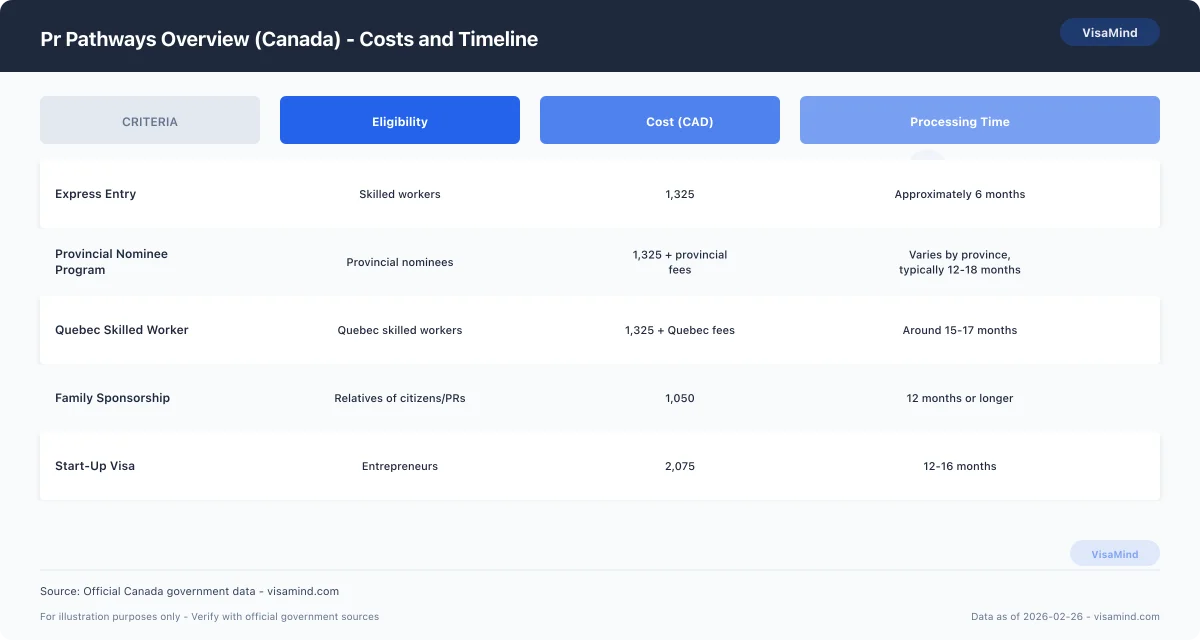
Pathways are structured to accommodate a wide range of applicants, from skilled workers to family members of Canadian citizens. Each pathway has distinct criteria, focusing on factors like work experience, education, and language proficiency.
- Express Entry: A system for skilled workers that manages applications for three federal immigration programs — the Federal Skilled Worker Program, the Federal Skilled Trades Program, and the Canadian Experience Class. Alongside general rounds, IRCC runs category-based selection draws that invite candidates with work experience in targeted occupations or strong French-language ability, so the same Express Entry profile can be reached through more than one kind of round.
- Family Sponsorship: Allows Canadian citizens and permanent residents to sponsor relatives, including a spouse or partner and parents or grandparents.
- Provincial Nominee Programs (PNP): Provinces nominate individuals based on local labor market needs. If you are weighing this against the federal route, our Express Entry vs PNP comparison sets out how the two immigration programs differ in practice.
- Quebec-selected immigration: Quebec runs its own immigration program for candidates who intend to settle in the province, including the Quebec Skilled Worker Program. Quebec assesses economic applicants under its own selection rules rather than the federal Comprehensive Ranking System — see our Quebec immigration overview for how that pathway to permanent residence works.
- Regional and community immigration: The Atlantic Immigration Program, the Rural and Northern Immigration Pilot, and Francophone community immigration tie permanent residence to an employer or a designated community in a particular region.
- Caregiver and sector-specific pathways: Routes such as caregiver immigration open permanent residence to workers in occupations Canada has trouble filling.
- Business and entrepreneur immigration: Options such as the Start-up Visa Program and the Self-Employed Persons Program for those planning to build a business and work in Canada.
- Humanitarian and refugee routes: Protected persons and applicants approved on humanitarian and compassionate grounds can also become a permanent resident outside the economic streams.
These pathways are not mutually exclusive, and most applicants qualify — or nearly qualify — under more than one. A skilled worker can sit in the Express Entry pool while also pursuing a provincial nomination, and someone already working in Canada on a valid permit may be able to keep working on a bridging open work permit while their application is assessed. The practical question is rarely which immigration program is objectively best, but which one your work experience, language ability, education, and regional or family ties actually fit.
Tip: Consider using the Express Entry Guide to understand how your skills may align with Canadian immigration requirements.
Key Features of PR Programs
Permanent residency programs in Canada offer several benefits, including the right to live and work anywhere in the country and access to healthcare. However, each program has specific eligibility criteria and application processes.
- Comprehensive Ranking System (CRS) scores for Express Entry
- Points-based systems for provincial programs
- Family relationship documentation for sponsorship
Important: Meeting basic eligibility criteria does not ensure approval. Check the Visa Application Steps for detailed guidance.
Overview of Provincial Nominee Programs
Provincial Nominee Programs (PNPs) allow individual provinces and territories to nominate individuals who wish to immigrate to Canada and are interested in settling in a particular province. Each province has its own unique program, targeting specific skills and sectors.
| Province | Program Focus | Application Process |
|---|---|---|
| Ontario | Tech and business professionals | Online application through Ontario Immigrant Nominee Program (OINP) |
| British Columbia | Tech and healthcare workers | BC PNP Tech Pilot |
| Alberta | Trades and agriculture | Alberta Immigrant Nominee Program (AINP) |
Tip: Explore the PNP Guide for more detailed information on provincial programs and their specific requirements.
The Process from Start to Finish
#Every route to permanent residence follows broadly the same arc, even though the forms, portals, and decision-makers differ by immigration program. You confirm which pathway you qualify for, gather the evidence that proves it, submit a profile or application, respond to whatever IRCC asks for, and — once approved — land in Canada as a permanent resident.
Choosing Your Immigration Program and Confirming Eligibility
Start by matching your profile to one program rather than applying to everything at once. A skilled worker with foreign work experience usually looks first at Express Entry; someone with a job offer or an in-demand occupation in a particular province looks at the Provincial Nominee Program; someone with a Canadian spouse, partner, or close relative looks at family sponsorship. Confirm the criteria for the pathway you pick on the official IRCC immigrate to Canada page before you spend money on language tests or credential assessments.
Tip: Use the Express Entry tool to calculate your Comprehensive Ranking System (CRS) score and evaluate your eligibility.
Completing the Express Entry Profile
Once you confirm eligibility, the next step is completing an Express Entry profile. This profile is essential for those applying through economic programs like the Federal Skilled Worker Program or the Canadian Experience Class.
-
Create an IRCC account and fill out your Express Entry profile online.
-
Provide detailed information about your skills, work experience, education, and language ability.
-
Submit your profile and receive a CRS score, which determines your rank in the Express Entry pool.
Important: Ensure all information in your Express Entry profile is accurate. Incorrect details can lead to application rejection.
Post-Submission Follow-up and Next Steps
After submitting your profile, it's important to monitor your application status and be ready for the next steps. If you receive an Invitation to Apply (ITA), you must respond promptly.
-
Receive an ITA if you rank high enough in the Express Entry pool.
-
Gather and submit all required documents, including police certificates and your immigration medical exam.
-
Give your biometrics if IRCC asks for them — an unanswered biometrics request leaves the application incomplete.
-
Pay the processing fee, which varies depending on the program, using CAD.
Tip: Check the Processing Times Explained guide to understand how long each step might take.
Warning: Receiving an ITA does not guarantee PR approval. You must still meet all requirements and provide complete documentation.
Landing and Becoming a Permanent Resident
Approval is not the final step. When IRCC approves your application it issues a Confirmation of Permanent Residence (COPR), plus a permanent resident visa if you hold a passport that requires one. You actually become a permanent resident when you complete the landing formalities — either with a border services officer when you arrive at a port of entry, or, if you are already inside Canada, through a virtual landing appointment. Your permanent resident card is produced after landing and mailed to a Canadian address; it is the document you use to prove your status when you return from travel.
It is worth being clear about what the status does and does not give you. A permanent resident may live, study, and work in Canada anywhere in the country and for any employer without holding a work permit, and can access most social benefits. But permanent residence is not unconditional: you must meet an ongoing physical-presence obligation to keep the status, you cannot vote or hold most public offices, and you remain a foreign national until you become a Canadian citizen. Confirm the current landing procedure and the residency obligation that applies to you on the official IRCC website rather than relying on a summary.
What Other Applicants Experienced
#Every year, thousands of people apply through various Permanent Residency (PR) pathways to make Canada their home. These pathways are managed by Immigration, Refugees and Citizenship Canada (IRCC), providing opportunities for family reunification, skilled professionals, and provincial nominees.
Success Story: Family Reunification
A family from India sought to reunite with their son who was a permanent resident in Canada. They applied through the Parent and Grandparent Sponsorship program, which is one of the key pathways for family reunification. The family diligently collected all necessary documents, including proof of their son's financial ability to support them. They followed the guidelines provided by IRCC and submitted their application. After a thorough review process, the family was granted PR status, allowing them to join their son in Canada. This showcases the potential for successful family reunification through IRCC's structured processes.
Tip: Ensure all financial proof and supporting documents are up-to-date and accurate when applying for family sponsorship.
Challenges Faced by IT Professionals
An IT professional from Brazil faced challenges when applying for PR through the Express Entry system. Despite having a strong background and high language proficiency scores, they struggled due to the high competition in the tech sector. To improve their chances, they sought additional points through a Provincial Nominee Program (PNP), which targets specific skills in demand within Canadian provinces. By aligning their application with provincial needs, they successfully increased their Comprehensive Ranking System (CRS) score.
Important: Consider leveraging both federal and provincial pathways to increase your chances of obtaining PR status in Canada.
Navigating Provincial Nominee Programs
A registered nurse from the Philippines was already working in Canada on an employer-specific work permit, but her Express Entry ranking was not competitive against the wider pool. Instead of waiting for a federal draw, she applied to the healthcare stream of the Provincial Nominee Program run by the province where she worked, using her Canadian work experience and her employer's confirmation of continued employment as evidence. The provincial nomination lifted her score enough to receive an Invitation to Apply, and she was later granted permanent residence. Her route is a common one for applicants whose occupation is in demand regionally even when it is not competitive nationally — the same immigration program can look very different depending on which province is assessing you.
Tip: Research provinces that have specific demands for your profession to enhance your PR application through PNP.