
Who Should Read This
#Caregivers interested in immigrating to Canada have multiple pathways available, although some specific programs have recently closed to new applicants. The Home Child Care Provider Pilot and Home Support Worker Pilot no longer accept new submissions, reflecting the dynamic nature of Canada's immigration landscape. Immigration, Refugees and Citizenship Canada (IRCC) continues to manage the application process for those seeking temporary or permanent residence through caregiver programs. Understanding the nuances of these pathways is essential for prospective caregivers aiming to work and live in Canada.
Intended Audience for Canadian Immigration
This guide is specifically tailored for caregivers who are considering immigration to Canada either as temporary workers or with the goal of becoming permanent residents. With the closure of some programs, such as the Live-in Caregiver Program to new applicants unless they have a work permit based on an older labour market impact assessment, navigating these pathways requires up-to-date information.
Tip: Ensure you have the necessary proof of work experience as a caregiver, which is a critical requirement for many application processes.
Ideal Situations to Use This Guide
is useful at various stages of the immigration process. Whether you are preparing to gather documents for your application or seeking to understand the eligibility criteria, this resource provides clarity on the available options for caregivers.
- Preparing for an application under caregiver categories
- Understanding eligibility requirements for caregiver pathways
- Identifying which caregiver programs are currently open for applications
Important: As some caregiver programs are closed, it's vital to verify current eligibility and program status before proceeding.
The Process from Start to Finish
#Canada's Immigration, Refugees and Citizenship Canada (IRCC) manages the immigration process for caregivers, offering pathways to either work temporarily or apply for permanent residence. Understanding the step-by-step process can help ensure your application is handled efficiently. The 'Imp Guide (Canada)' outlines the pathways and requirements for immigrating to Canada, based on official guidance from IRCC. This guide focuses on the process from initial application to finalizing permanent residency for caregivers.
-
Start by gathering all required documents as listed on the official IRCC website.
-
Create a Permanent Residence Portal account or sign in to an existing account. Ensure you have proof of work experience ready to upload as part of your application.
-
Check the official IRCC website to confirm all current requirements and program eligibility.
Tip: Frequently check the IRCC website for any updates or changes in application requirements.
Navigating Canadian Immigration Interviews
At some point in the application process, you may be required to attend an interview. The purpose of this interview is to verify the information in your application and assess your eligibility.
-
Prepare for the interview by reviewing your application and supporting documents thoroughly.
-
Practice answering potential questions about your work experience and reasons for immigrating. Attend your interview at the scheduled time and location provided by IRCC.
Important: Being honest and consistent with the information provided during your interview is key for your application’s success.
Finalizing Your Permanent Residency
Once all the required steps are complete, you will receive a decision on your application. If approved, you'll be granted permanent residency.
-
Receive your Confirmation of Permanent Residence (COPR) from IRCC.
-
Prepare to move to Canada by arranging travel and settlement plans. Upon arrival in Canada, present your COPR to the border officer to finalize your residency status.
Tip: Explore the Caregiver and Permanent Residence programs for more details on what to expect after receiving your residency.
Common Mistakes
#Every year, thousands of applications are submitted to Immigration, Refugees and Citizenship Canada (IRCC), and many face delays or rejections due to common mistakes. Understanding these pitfalls can significantly enhance your chances of success.
Avoiding Incomplete
Documentation is a major reason for delays in the immigration process. IRCC requires a comprehensive set of documents tailored to your specific application category. - Missing work experience proof: Ensure you provide detailed evidence of your work history, especially if applying as a caregiver. Refer to IRCC's guidelines for acceptable documents. - Old or expired documents: Double-check that all submitted documents are current and valid. - Lack of translations: If any documents are not in English or French, include a certified translation.
Tip: Always use the checklist provided by IRCC for your application type to confirm you've included all necessary documents.
Common Errors in Form
Submissions can lead to application rejection or processing delays. It's key to carefully fill out all required fields. - Incorrect personal details: Ensure your name, birth date, and other personal information match your official documents. - Omitting mandatory fields: Pay special attention to mandatory sections; leaving them blank can invalidate your application. - Confusing pilot programs: Be aware that some programs, like the Home Child Care Provider Pilot, are closed. Applying to ineligible programs is a common mistake.
Important: Create a Permanent Residence Portal account or sign in to track your application status and updates.
Missteps in Proof of Funds
Proof of funds is a critical requirement for many immigration applications. Missteps here can lead to application denials. - Insufficient funds: Ensure your financial documents meet the required thresholds for your specific application. - Inconsistent financial statements: Provide consistent and recent bank statements showing the required balance. - Ignoring currency fluctuations: Remember that all funds should be calculated in CAD (CA$) to avoid discrepancies.
Tip: For detailed guidance on proving financial capability, refer to our Proof Of Funds guide.
Who Qualifies
#Canada's immigration system considers various factors to determine eligibility for different visa programs. Being well-prepared with the necessary qualifications and understanding specific requirements can enhance your chances of success. While meeting the requirements is essential, it's important to remember that eligibility does not guarantee approval. Ensure you are applying to an open program to avoid application pitfalls.
Basic Eligibility Criteria for Canada
Have a valid passport and travel documents.
- Be in good health and willing to undergo a medical examination if required.
- Have no criminal record and be willing to provide a police certificate.
- Demonstrate sufficient funds to support yourself and any accompanying family members during your stay in Canada.
Tip: Create a Permanent Residence Portal account or sign in to stay updated on your application status and requirements.
Important: Ensure all required documents are gathered before starting your application process to avoid delays.
Understanding Language Proficiency Needs
Language proficiency is a critical component of Canada's immigration eligibility requirements. English and French are the official languages, and you may need to demonstrate proficiency in one or both, depending on the program.
- Take an approved language test like IELTS or CELPIP for English.
- For French, consider tests like TEF or TCF.
- Achieve the minimum language score required by your specific immigration program.
Tip: Consider taking language courses to improve your scores if needed. The Express Entry Guide offers insights into language requirements for skilled immigrants.
Work Experience and Qualification Standards
Your work experience and educational qualifications play a significant role in determining your eligibility for Canadian immigration programs. Different programs have varying criteria for these factors.
- Have relevant work experience that matches the National Occupational Classification (NOC) codes.
- Ensure your educational credentials are assessed by a recognized agency.
- Check the specific requirements of the program you are applying to, such as those under the Federal Skilled Worker program.
Warning: Applying to a closed program can result in rejection. Always check the current status and eligibility criteria of the program you are interested in.
The Big Picture
#Canadian immigration system is built on policies that support economic growth, family reunification, and humanitarian commitments. It emphasizes transparency and fairness, aiming to attract skilled workers while offering protection to refugees.
- Economic Immigration: Programs like Express Entry aim to fill labor shortages.
- Family Sponsorship: Allows Canadian citizens and permanent residents to bring family members to Canada.
- Refugee Protection: Offers asylum to those fleeing persecution and conflict.
Important: Simply meeting the requirements of a program does not guarantee approval. Each application is assessed on its merits.
Key Pathways to Permanent Residency
There are several key pathways to obtaining permanent residency in Canada. Each pathway caters to different types of applicants, from skilled workers to family members of Canadian residents.
| Pathway | Description |
|---|---|
| Express Entry | For skilled workers through a points-based system. |
| Provincial Nominee Program (PNP) | Allows provinces to nominate individuals based on local economic needs. |
| Family Sponsorship | Enables family reunification by sponsoring relatives. |
| Start-Up Visa | For entrepreneurs with a business idea supported by a Canadian investor. |
| Atlantic Immigration Program (AIP) | Targets skilled workers willing to settle in Atlantic Canada. |
Tip: Check the PR Pathways Overview to understand which program suits your profile best.
Immigration System Structure and Goals
The structure of Canada's immigration system is designed to meet the country's economic, demographic, and social objectives. It aims to enhance the country's labor market while maintaining humanitarian values.
- Economic Growth: Attracting skilled workers to fill labor market gaps.
- Demographic Goals: Addressing an aging population with young skilled immigrants.
- Social Objectives: Facilitating family reunification and offering refugee protection.
Warning: Be cautious of applying to programs that may have closed recently, as the availability of immigration programs can change.
Costs and Timeline
#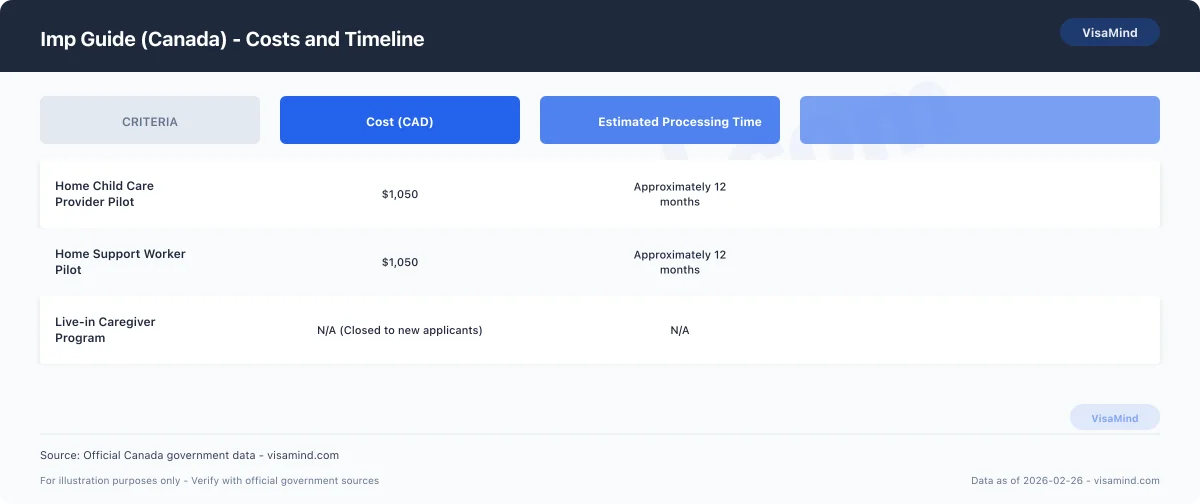
Immigrating to Canada as a caregiver involves various costs and timelines that must be considered. Understanding these elements is essential for planning your journey effectively.
Application Fees Breakdown
Application fees for immigrating to Canada can vary based on the type of application you are submitting. These fees are set by Immigration, Refugees and Citizenship Canada (IRCC).
Expected Processing Timeframes
Processing times for caregiver immigration applications can vary significantly depending on the type of application and the volume of applications received by IRCC.
Tip: Check the Processing Times Explained guide regularly to stay updated on current processing times.
Budgeting for Immigration Expenses
When budgeting for your immigration to Canada, it is important to consider all potential expenses beyond just application fees. These can include costs for medical exams, police certificates, and travel expenses.
Tip: Plan for unexpected expenses by keeping a financial buffer. For more details on work opportunities, visit the Caregiver Work page.
Tips and Best Practices
#Canada's Comprehensive Ranking System (CRS) is a pivotal component for those applying through the Express Entry system. Understanding how to enhance your CRS score can significantly improve your chances of receiving an invitation to apply for permanent residence. Document preparation and communication with immigration officers are critical steps in the immigration process. Properly organizing your documents and knowing how to effectively communicate can streamline your journey to Canada.
Maximizing Your CRS Score
Boosting your CRS score can be achieved by strategically enhancing different factors that the system evaluates. This score determines your ranking in the Express Entry pool.
- Improve your language proficiency scores in English or French.
- Gain additional work experience in Canada.
- Pursue further education or obtain a Canadian degree.
- Secure a valid job offer from a Canadian employer.
- Obtain a provincial nomination through programs like the Provincial Nominee Program.
Tip: Consider taking additional language tests or seeking employment opportunities in Canada to enhance your score.
Effective Document Preparation Tips
Effective preparation of your documents is necessary for a successful application. Ensuring that you have all the required documents ready can prevent delays and issues.
- Ensure all documents are current and translated into English or French, if necessary.
- Organize your documents in the order specified by the IRCC guidelines.
- Verify that your proof of work experience as a caregiver is comprehensive and accurate, as required by the Caregiver programs.
Important: Always check the IRCC website for the most current document requirements and guidelines.
Communicating with Immigration Officers
Maintaining clear and professional communication with immigration officers can positively impact your application. This involves understanding the appropriate channels and etiquette.
-
Use the Permanent Residence Portal for submitting inquiries and tracking your application.
-
Respond promptly to any requests for additional information or documents from IRCC. Be concise and factual in your communications, avoiding unnecessary details.
Warning: Avoid contacting immigration officers too frequently or for issues that can be resolved through the official IRCC channels.
What Other Applicants Experienced
#A caregiver successfully transitioned to permanent residency through the Home Child Care Provider Pilot before it closed to new applications. They diligently gathered all required documentation, including proof of work experience, and submitted their application through the Permanent Residence Portal. This proactive approach ensured a smooth transition to permanent residency. Another applicant, after working temporarily as a caregiver, applied for permanent residency using the Live-in Caregiver Program. They had received a work permit based on a labour market impact assessment submitted before December 2014. Their detailed documentation and adherence to the program's requirements played a key role in their application's success.
Challenges Faced by Newcomers
often face challenges, such as understanding which caregiver programs remain open for applications. Many mistakenly apply to closed programs like the Home Support Worker Pilot, leading to unnecessary delays and frustration.
Warning: Applying to a closed program can result in wasted time and effort. Always verify the program's current status on the IRCC website. Some applicants struggle with gathering comprehensive proof of work experience, a critical requirement for caregiver pathways. This documentation is essential for demonstrating eligibility and ensuring the application meets all IRCC standards.
Lessons from Failed Applications
A caregiver's application was denied due to the misconception that meeting all listed requirements guarantees approval. They overlooked the importance of demonstrating how their experience and qualifications fit the specific needs of Canada's caregiver programs.
Important: Meeting requirements does not ensure approval. Tailor your application to highlight how your experience aligns with Canada's immigration needs. Another applicant faced rejection due to incomplete documentation. They failed to provide adequate proof of their caregiving experience, resulting in a missed opportunity to secure a work permit. This underscores the importance of thoroughly checking document completeness before application submission.