
CETA work permit Canada: Overview
#The CETA work permit lets certain EU professionals work in Canada temporarily under a trade agreement. You apply through IRCC, and your eligibility depends on your role and the type of service you provide.
Purpose and scope
The CETA Professional Work Permit supports temporary entry for specific professionals covered by CETA. It’s handled under the International Mobility Program and processed by IRCC.
This pathway covers:
- Contractual service suppliers
- Independent professionals
IRCC assesses applications under exemption codes like R204(a) – T47 and T43, depending on your category. You must fit within one of the professional roles defined in the agreement.
This is a temporary authorization, not a route to permanent residence.
| Feature | CETA Professional Work Permit |
|---|---|
| Legal basis | International trade agreement (CETA) |
| Type | Temporary work authorization |
| Administered by | Immigration, Refugees and Citizenship Canada (IRCC) |
| Category examples | Contractual service suppliers, independent professionals |
You need to submit your application to IRCC using Form IMM 1295 if applying from outside Canada.
If you require a visa, you must obtain a Temporary Resident Visa (Visitor Visa) first. If you’re visa-exempt, you may need an Electronic Travel Authorization (eTA) before traveling.
Who it serves
This permit is for skilled professionals from EU countries who meet CETA criteria and have a qualifying arrangement in Canada. Your services must fall under a role covered by the agreement.
You usually qualify if you are:
- A contractual service supplier with a service contract in Canada
- An independent professional with a direct contract to provide services
- A citizen of an eligible EU country
- Applying for temporary entry only
This pathway isn’t for open employment or general job offers outside the agreement’s scope.
Your authorization is tied to the specific services described in your application. In practice, this is an Employer-Specific Work Permit, so you can only perform the approved professional activities.
At the border, the Canada Border Services Agency (CBSA) checks your admissibility. IRCC decides on your permit application.
Related pathways
You may need to combine this permit with other temporary entry documents, depending on your nationality.
| Stage | Possible Document |
|---|---|
| Before travel | Temporary Resident Visa or Electronic Travel Authorization (eTA) |
| Work authorization | CETA Professional Work Permit |
| After temporary work | Employer-Specific Work Permit or Express Entry (Federal Skilled Worker) |
After working in Canada, some applicants pursue permanent residence through Express Entry (Federal Skilled Worker) if they meet the criteria.
If you don’t qualify under CETA, other trade-based options like the CPTPP Professional Work Permit or the Intra-Company Transferee Work Permit may be available, depending on your situation.
Each route has its own eligibility and documentation requirements. Apply under the category that matches your professional role and contract.
How to Apply
#You apply for a CETA work permit through IRCC. Use the correct form, ensure your job offer details are exact, and submit a complete application with supporting documents and biometrics.
Download forms & instructions
Start by downloading the correct application package from IRCC for your category. Most applicants use Form IMM 1295 (Application for Work Permit Made Outside Canada).
If you qualify as a CETA professional, intra-company transferee, or another eligible category, review the specific instructions before filling out the form. Don’t use instructions for other programs like the CPTPP Professional Work Permit or the Intra-Company Transferee Work Permit unless those apply to you.
Confirm your work permit type:
| Category | Permit Type |
|---|---|
| CETA Professional | Employer-Specific Work Permit |
| Intra-Company Transferee | Employer-Specific Work Permit |
Prepare the required documents, including:
- Copy of your signed contract with the Canadian service recipient
- Details of your professional qualifications
- Proof of your current immigration status (if applying from inside Canada)
Processing only begins once IRCC has a complete application.
Complete and submit
Fill out IMM 1295 completely and accurately. Missing or inconsistent information can delay your application.
You need to enter:
- The correct exemption code
- The appropriate NOC code from the International Mobility Program (IMP) offer of employment
- Your intended occupation and exact job title
- The province and city listed in your job offer
Your job title and duties must match the IMP offer of employment. IRCC checks this closely.
You’ll also need to provide:
- Biographical and identity details
- Your reason for seeking work authorization
- Information about your professional qualifications
- Details of the Canadian employer and contract
Submit your application through the right channel:
1. Outside Canada and the United States:
Apply through a Canadian embassy, high commission, or consulate.
2. Inside Canada:
Apply if you meet the conditions under section R199 of the Immigration and Refugee Protection Regulations.
If you’re visa-exempt, you may also need an Electronic Travel Authorization (eTA).
Biometrics & where to apply
Most applicants must provide biometrics. IRCC will send instructions after you submit your application, if required.
You must give biometrics at an authorized collection point. Processing won’t move forward until you complete this step.
Where you apply depends on your location:
| Your Location | Where You Apply |
|---|---|
| Outside Canada or U.S. | Canadian embassy, high commission, or consulate |
| Inside Canada (eligible under R199) | Apply from within Canada |
IRCC starts processing when it receives your complete application. Processing ends when a decision is made.
CBSA officers assess admissibility when you arrive in Canada. Keep copies of your approval and supporting documents when you travel.
What Can Go Wrong
#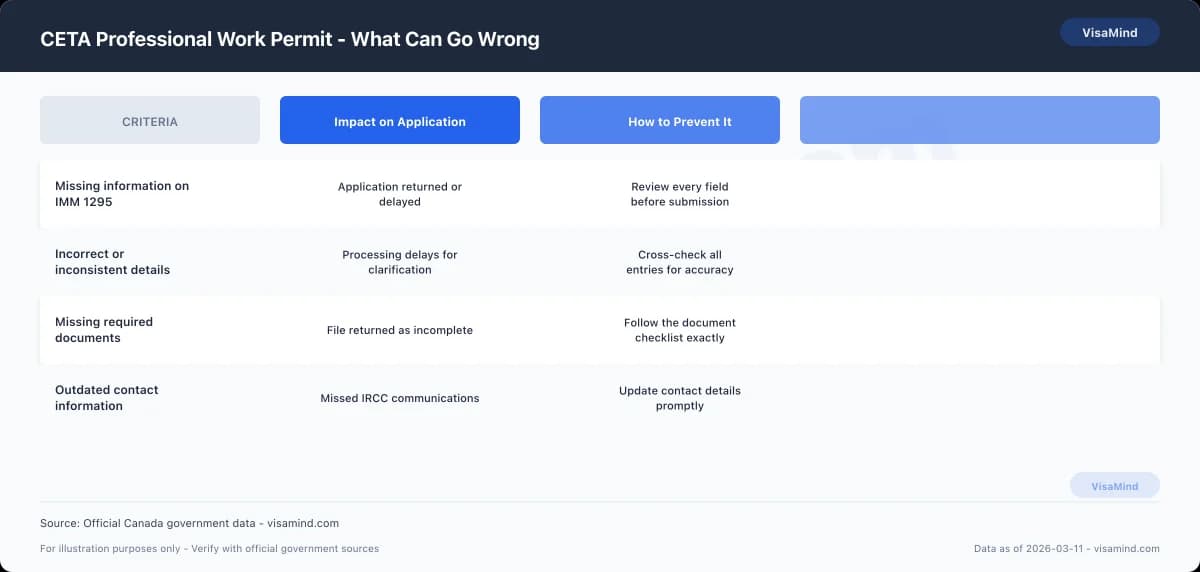
Most problems with a CETA work permit application come from avoidable errors. IRCC may delay, return, or refuse your file if you submit incomplete forms, incorrect information, or don’t keep your contact details up to date.
Incomplete applications
IRCC may delay or return your application if it’s incomplete. This includes missing answers, unsigned declarations, or missing documents required for your category, such as an Employer-Specific Work Permit, Intra-Company Transferee Work Permit, or other CETA stream.
You need to complete Form IMM 1295 carefully and check every field for accuracy. Even small omissions can cause delays.
Follow the document checklist closely. If you apply as a CETA professional and leave out required materials, IRCC may return your file without processing.
Before you submit, check that you have:
- Completed every field in IMM 1295
- Uploaded all required supporting documents
- Signed all declarations where needed
- Submitted accurate employment details
Incomplete filings are a common cause of delay.
Delays and returns
IRCC may return your application if they can’t contact you. Outdated email addresses, mailing addresses, or phone numbers can cause unnecessary delays.
If IRCC asks for clarification and you miss the message, your application can stall or close. You’re responsible for keeping your contact information current during processing.
Delays also happen when officers need to request corrections due to inconsistencies. Discrepancies between your employment information and what appears in your work permit category can slow things down.
If you need an Electronic Travel Authorization to travel, unresolved permit issues may affect your plans. Double-check all information before submitting to reduce the risk of administrative returns.
Common procedural mistakes
Most delays come from preventable filing errors. Incorrect or inconsistent information is the main problem.
Review your application for consistency. Make sure job titles, employer names, and category selections match across all documents.
Here’s a table of frequent mistakes and how to avoid them:
| Mistake | Impact on Application | How to Prevent It |
|---|---|---|
| Missing information on IMM 1295 | Application returned or delayed | Review every field before submission |
| Incorrect or inconsistent details | Processing delays for clarification | Cross-check all entries for accuracy |
| Missing required documents | File returned as incomplete | Follow the document checklist exactly |
| Outdated contact information | Missed IRCC communications | Update contact details promptly |
Submitting a CETA-based application, even if it’s similar to a CPTPP Professional Work Permit or Intra-Company Transferee Work Permit, doesn’t guarantee approval. Accuracy and completeness are what IRCC looks for.
When to Consult a Professional
#You can prepare a CETA work permit application yourself, but errors often lead to refusals. Legal help is useful when eligibility is unclear, documents are complex, or you’ve already been refused.
When expert help is useful
Consult a professional if you’re unsure whether you qualify under R200 or the exemption under R204(a). IRCC officers assess both when reviewing a CETA-based Employer-Specific Work Permit.
Eligibility issues often come up when:
- Your job offer doesn’t clearly match the CETA category.
- Your documents don’t fully explain your role.
- You previously applied under another category, like the Intra-Company Transferee Work Permit or CPTPP Professional Work Permit, and were refused.
- A family member may not meet admissibility or eligibility requirements.
- You’re unsure how to complete Form IMM 1295.
- You need clarity on whether an Electronic Travel Authorization is needed before travel.
A professional reviews your documents against IRCC’s instructions and checks that you include all required evidence. Missing documents or unclear job descriptions are a common reason for refusals.
If your case involves prior refusals, status issues, or inconsistent information in earlier applications, get advice. Small discrepancies can affect credibility.
Complex refusals and decision records
If IRCC refuses your work permit, professional advice is recommended. An officer must record clear reasons explaining why the requirements weren’t met.
The decision record should outline:
- The specific requirement not met under R200.
- How the officer assessed the exemption under R204(a), if that applies.
- The facts and documents considered.
- The reasoning connecting those facts to the refusal.
A refusal that only says the officer was “not satisfied” isn’t detailed. Review the written decision to understand the logic.
An immigration professional can analyze the refusal against your evidence and identify whether the issue is missing documents, legal interpretation, or credibility. This helps you decide if you should reapply with stronger documentation or take other steps with IRCC.
Early legal review helps reduce the risk of repeated refusals and inconsistent records in your immigration history.
Are You Eligible?
#You need to meet strict nationality, experience, and profession-specific criteria to qualify under CETA. IRCC will check your citizenship, your background, and whether your occupation appears in the relevant annex before issuing an Employer-Specific Work Permit.
Nationality & basic eligibility
You must be a citizen of a European Union member state to apply under CETA as a contractual service supplier or independent professional. Permanent residents of EU countries don’t qualify unless they also have EU citizenship.
Apply for an Employer-Specific Work Permit through IRCC. Your application usually includes Form Form IMM 1295 and proof of citizenship.
Prepare clear documentation:
- Valid passport confirming EU citizenship
- Proof you fall under a CETA category (contractual service supplier or independent professional)
- Supporting documents showing your qualifications meet Canadian requirements
Depending on your nationality, you may also need an Electronic Travel Authorization (eTA) to travel to Canada. Work permit approval and entry to Canada are separate. IRCC issues the permit, and the Canada Border Services Agency (CBSA) checks admissibility at the port of entry.
Experience and education requirements
Your experience threshold depends on your category. IRCC applies different standards to contractual service suppliers and independent professionals.
| Category | Minimum Experience | Employment Relationship |
|---|---|---|
| Contractual Service Supplier | 3 years professional experience | Must have worked for the EU enterprise for at least 1 year before applying |
| Independent Professional | 6 years professional experience | Self-employed, no Canadian employer-employee relationship |
You must also have:
- A university degree or equivalent qualification
- Any professional credentials required by the province or territory where you’ll work
Some engineering and scientific technologist roles may qualify without a university degree if listed under the applicable annex.
Your education and experience must directly relate to the services you’ll provide in Canada.
Lists, annexes and employer attestations
Your profession must appear in Annex 10‑E to qualify as a contractual service supplier or independent professional. If your occupation isn’t listed, this CETA category won’t apply.
Certain professionals, like some technologists, may qualify under Annex 10‑C instead. Each annex tightly defines which occupations are eligible.
You’ll need to provide:
- Proof your occupation appears in the relevant annex
- Documentation confirming your qualifications
- Evidence of professional experience that matches annex requirements
Your Canadian client or employer must issue a letter confirming your qualifications meet Canadian standards for the work you’ll do. This letter is essential for your Employer-Specific Work Permit application.
CETA eligibility isn’t interchangeable with other routes such as the Intra-Company Transferee Work Permit or the CPTPP Professional Work Permit. You have to apply under the category that matches your citizenship, occupation, and work arrangement.
At the Border
#Arrive ready to prove that your job, location, and personal details match what Immigration, Refugees and Citizenship Canada (IRCC) approved. The Canada Border Services Agency (CBSA) officer will compare your documents to your application and check that you meet your CETA work permit’s conditions.
Documents to carry
Carry original or clear copies of all documents supporting your approved application. CBSA officers expect to see information consistent with what you submitted to IRCC.
Bring:
- Your passport and, if required, your Electronic Travel Authorization
- A copy of your approved Work Permit (Employer-Specific) application
- Your completed Form IMM 1295 form (if required for your category)
- Proof of pre-arranged employment
- A copy of the service contract
- Details of any dependants included in your application
- Supporting documents you submitted (residence records, financial or work-related documents, if relevant)
If you’re applying under a category like Intra-Company Transferee Work Permit or CPTPP Professional Work Permit, bring documents confirming your role and employment arrangement.
Keep everything organized. Officers will review your paperwork quickly and expect clarity.
What officers will check
CBSA decides if you can enter Canada. IRCC approves the application, but CBSA confirms admissibility at the port of entry.
Officers check:
- Your identity matches your passport and application
- Your occupation matches the declared role
- Your job fits the National Occupational Classification (NOC) guidance
- You’ve got enough evidence of pre-arranged employment
- Your service contract reflects the terms in your application
- Your dependants’ details match what IRCC received
They’ll also review personal details like contact info and work history for consistency.
You need to satisfy the officer that you meet eligibility requirements for entry under your approved category.
Matching your application to arrival details
Your entry details must match your approved employment information exactly. Even small discrepancies can cause delays at the border.
Officers compare key elements:
| Item Reviewed | Must Match |
|---|---|
| Province and city of destination | Address listed in the employment offer |
| Occupation | NOC-aligned job description in your application |
| Employer | Name listed in the IMP offer |
| Work location | Employment address on file with IRCC |
| Dependants | Names and details included in the application |
If you hold an Employer-Specific Work Permit, you can’t change employers or job locations at entry.
Make sure the province and city you state on arrival match the employer’s offer. Your job title and duties should reflect what you declared in IMM 1295 and supporting documents.
Consistency across all records allows CBSA to issue your work permit without unnecessary issues.
How Long It Lasts
#Your CETA work permit allows temporary work in Canada for a specific, limited period. How long you can stay depends on your approved service contract, compliance with Canadian law, and your passport’s validity.
Maximum period of authorized work
Under CETA, you can supply services for no more than 12 months.
IRCC issues the Work Permit (Employer-Specific) based on your approved service contract’s duration, but never beyond 12 months. This applies whether you use Form IMM 1295 or another eligible category, like the CPTPP Professional Work Permit or Intra-Company Transferee Work Permit.
You’re not authorized for open-ended employment. Your permit is tied to:
- The specific employer
- The defined service
- The approved time period (max 12 months)
If you’re authorized for less than 12 months, you must stop working on the expiry date unless IRCC approves a new application.
| Key Rule | What It Means for You |
|---|---|
| Maximum duration | 12 months |
| Type of work | Temporary service supply only |
| Work permit type | Employer-specific |
| Extension beyond 12 months | Not permitted under this category |
CBSA checks admissibility at entry, but IRCC sets the validity period.
Contract and legal compliance
Your service contract must comply with Canadian federal, provincial, and territorial laws.
IRCC won’t authorize work that conflicts with legal requirements. This includes compliance with employment standards and any other Canadian regulations tied to your service.
Your contract must:
- Reflect a temporary service arrangement
- Respect Canadian legal requirements
- Match the details in your application
If your contract ends early or violates Canadian law, your authorization may become invalid. Your right to work depends on the contract’s continued legality and validity.
If the contract falls out of compliance, your work authorization ends with it.
Passport validity requirement
You must hold a valid passport or travel document for the entire period of your authorized stay.
IRCC can’t issue a work permit beyond your passport’s expiry date. If your passport expires in eight months, your work authorization can’t exceed that date, even if your contract runs longer (up to the 12-month maximum).
Before applying, check:
- Your passport stays valid for your full intended work period
- Your travel document has no restrictions affecting entry
- You meet entry requirements, including an Electronic Travel Authorization if needed
Your passport’s validity limits how long you can remain and work in Canada. Renew it before applying if it doesn’t cover your full intended period.
Red Flags at Entry
#Border officers and IRCC assess whether your documents match CETA requirements and your Work Permit (Employer-Specific) terms. Errors in contracts, credentials, biometrics, or application details can lead to refusal at the port of entry or processing delays.
Missing or unsigned service contract
You must carry a signed service contract between the EU service provider and the Canadian client. An unsigned draft or missing signature raises doubts about the legitimacy of the engagement.
The contract should match the role and duration stated in your application. If you request entry for more than 12 months, officers may question compliance with CETA’s time limits.
Common issues include:
- No signatures from both parties
- Contract dates that exceed 12 months
- Job title that doesn’t align with the duties described under the NOC
- Duties that differ from what you listed on Form IMM 1295
| Document Issue | Why It Matters at Entry |
|---|---|
| Unsigned contract | Officer may doubt the genuineness of the service |
| Duration over 12 months | May conflict with CETA limits |
| Mismatched job title | Suggests incorrect NOC classification |
| Different duties than application | Signals inconsistency or misrepresentation |
CBSA officers review your documents at the port of entry. If the contract doesn’t support the exact role described in your Employer-Specific Work Permit application, you risk refusal.
Insufficient experience or qualifications
You must prove that you meet the professional experience required for the specific CETA category. If you can’t demonstrate your background clearly, officers may conclude you don’t qualify.
Bring documentation that supports your credentials, such as:
- Proof of relevant professional experience
- Evidence that your background matches the declared occupation
- Documents that align with the duties listed in your application
Your job title must accurately reflect what you’ll actually do in Canada. If your duties resemble a different occupation than the one declared, officers may question whether you applied under the correct category, or whether another route like the Intra-Company Transferee Work Permit or CPTPP Professional Work Permit would have been more appropriate.
Inconsistencies between your résumé, contract, and IMM 1295 create credibility issues. Officers focus on whether your qualifications directly support the services described in your contract.
Biometrics, LMIA and application-number issues
Incomplete application requirements often cause delays or refusals before or at entry. You must complete biometrics if required and make sure IRCC has valid records before you travel.
Frequent problems include:
- Failure to provide required biometrics
- Missing or invalid LMIA-exempt number
- Entering an incorrect LMIA number when one is required
- Presenting without a valid application number linked to your approval
| Issue | Consequence |
|---|---|
| Biometrics not completed | Processing delay or refusal |
| Invalid LMIA/LMIA-exempt number | Application may be rejected |
| Incorrect application number | Officer cannot verify approval |
Your Work Permit (Employer-Specific) must link to the correct LMIA or LMIA-exempt number in IRCC’s system. If the number doesn’t validate, CBSA cannot issue your permit at entry.
If you need an Electronic Travel Authorization, ensure it’s approved before you board your flight. Airlines check travel authorization before departure, and CBSA confirms admissibility on arrival.
Is the CETA professional right for you?
#You qualify under the CETA professional category when your European training and experience meet a Canadian employer’s expectations. Your success depends on how clearly you document your qualifications and how precisely your job offer defines your role in Canada.
How European qualifications map to Canada
CETA recognizes that education systems differ between the European Union and Canada. If the credential structure isn’t identical, the Canadian requirement is considered met when your European education satisfies your Canadian employer.
Your employer plays a central role in this assessment. IRCC relies on the employer’s evaluation of whether your background supports the duties listed in your job offer.
Compare your credentials using this table:
| Factor | What Matters for CETA |
|---|---|
| Degree level | Whether your EU degree aligns with the job requirements in Canada |
| Field of study | Direct relevance to the offered position |
| Professional certifications | Certifications obtained in your field |
| Experience | Years of practical work supporting the role |
Describe the work you’ll perform in Canada in clear, technical terms. Vague job descriptions weaken your application.
If you previously considered the Intra-Company Transferee Work Permit or the CPTPP Professional Work Permit, check that CETA fits your nationality and employment structure before applying for an Employer-Specific Work Permit through IRCC.
Types of evidence that support eligibility
You must prove both your professional qualifications and the legitimacy of the job offer. IRCC reviews the totality of your documentation.
Prepare the following:
- Reference letters detailing your duties and length of employment
- Letter of support from the Canadian company
- Detailed job description outlining required training and responsibilities
- Proof of degrees or certifications in the field
- Evidence of years of experience
- Publications or awards, if relevant
- Clear description of the work to be performed in Canada
Your documents should connect directly to the offered position. For example, your reference letters should mirror the duties listed in the employer’s support letter.
When you apply, you submit your forms, including Form IMM 1295, to IRCC. If you’re visa‑exempt, you may also need an Electronic Travel Authorization before traveling to Canada.
Who typically uses this stream
The CETA professional stream is for EU citizens with a concrete job offer from a Canadian employer and specialized training tied to that role.
This stream fits professionals whose qualifications clearly align with a defined position. It’s not for those seeking open-ended work authorization or general job exploration.
You may benefit from CETA if:
- Your education directly supports the job offered in Canada
- A Canadian employer confirms your qualifications are sufficient
- Your role requires professional-level training
- You can document your experience in detail
Unlike broader work permit categories, CETA professionals apply for an Employer-Specific Work Permit, meaning you work only for the employer named in your approval.
Before applying, check whether your circumstances would fit better under another category, like the Intra-Company Transferee Work Permit, especially if you’re transferring within the same company.
What will it cost?
#You’ll pay a government filing fee and, in most cases, a biometrics fee. Processing times depend on your country and category, and some groups may qualify for reduced or capped fees.
Application and biometrics fees
You must pay the Work Permit (Employer-Specific) application fee when you submit Form IMM 1295 to Immigration, Refugees and Citizenship Canada (IRCC).
| Fee type | Amount (CAD) | Who pays |
|---|---|---|
| Work permit (including extensions) – per person | CA$155 | Each applicant |
| Biometrics services fee | CA$85 | Each applicant required to give biometrics |
If IRCC instructs you to provide biometrics, you’ll pay the CA$85 fee in addition to the CA$155 work permit fee. Most applicants applying from outside Canada must complete biometrics.
Family members applying at the same time and place may qualify for a maximum total fee of CA$500 for work permit applications. Children must meet the definition of dependants to count toward this cap.
If you also need an Electronic Travel Authorization, pay that separate fee directly through IRCC’s system.
Processing times & location notes
IRCC lists current processing times by category and country. For a CETA Professional work permit under standard processing, the range is 2 to 5 months as of March 2026.
The processing time starts when IRCC receives your complete application and ends at their decision. Incomplete or non‑routine files usually take longer.
Applying from outside Canada or the United States? Add 3 to 4 months for mailing.
Location affects outcomes. Processing times shift depending on:
- The country where you apply
- The specific CETA category
- Application volume at that visa office
Compare with other options such as the Intra-Company Transferee Work Permit or the CPTPP Professional Work Permit if you’re eligible.
Special fee rules and group exceptions
Special fee rules sometimes apply.
Maximum group fee (CA$500) applies if:
- You’re a group of three or more performing artists and their staff
- Everyone applies together, at the same place
- Required exams for all members are valid at the same time
Each applicant still files a full application. The cap doesn’t apply if the group submits separately.
For families, the CA$500 cap applies only when:
- All family members apply at the same time
- All apply at the same location
- Children qualify as dependants
If these conditions aren’t met, IRCC charges the standard CA$155 per person, plus biometrics if needed.
Fees
#| Component | Amount |
|---|---|
| Filing fee (IMM-1295)Work permit (outside Canada). | CA$155 (approx $113 USD) |
| BiometricsBiometrics: CA$85 (approx $62 USD) (as of 2026-02). Verify the current fee on the official schedule before filing. | CA$85 (approx $62 USD) |
Fees change; always verify on IRCC.
Required forms
#Plan your CETA Professional Work Permit with free Canada tools
#Itemized government fees for CETA Professional Work Permit and other Canada categories.
See how your profile scores against CETA Professional Work Permit and other Canada visas.
Typical wait times and stage breakdowns for CETA Professional Work Permit and related Canada visas.
Common interview questions and feedback for Canada visa applicants.