
CPTPP work permit Canada: Overview
#The CPTPP Professional Work Permit allows nationals of CPTPP member countries—including the United Kingdom, whose accession enters into force between Canada and the UK on September 1, 2026—to work in Canada in a defined professional capacity.
You apply through Immigration, Refugees and Citizenship Canada (IRCC) under the International Mobility Program, and your eligibility depends on your nationality and the nature of your professional engagement.
What it is
The CPTPP is currently in force between Canada and 10 other economies—Australia, Brunei, Chile, Japan, Malaysia, Mexico, New Zealand, Peru, Singapore, and Vietnam—and the United Kingdom will join as the first new accession member when the agreement enters into force between Canada and the UK on September 1, 2026.
IRCC processes this permit under R204(a) – exemption code T52 within the International Mobility Program.
It’s classified as a Work Permit (Employer-Specific), so your authorization is tied to a specific employer and role.
You must submit the required application forms, including Form IMM 1295, and provide:
- Biographical information
- Details about your Canadian employer
- Evidence of your professional credentials
Most applicants first need a Temporary Resident Visa (Visitor Visa) or an Electronic Travel Authorization (eTA) before entering Canada, depending on nationality.
Some applicants later pursue permanent residence through programs such as Express Entry (Federal Skilled Worker) after working in Canada.
Who it's for
You qualify only if you’re a national of a CPTPP member country and intend to work in Canada in a capacity that meets the definition of a CPTPP professional.
You must demonstrate that:
- You hold citizenship of a CPTPP country
- You’ll work in a professional or technical occupation covered by the agreement
- Your role in Canada matches your professional background
IRCC officers review your education, credentials, and the nature of your job offer to confirm that your work aligns with the agreement.
This pathway differs from other international agreements, such as the CETA Professional Work Permit, and from categories like the Intra-Company Transferee Work Permit.
Each has its own eligibility criteria and legal basis.
If you don’t meet the CPTPP professional definition, you must consider a different work permit category.
Key features
The CPTPP Professional Work Permit has several defining characteristics:
| Feature | Details |
|---|---|
| Legal basis | R204(a), exemption code T52 |
| Program | International Mobility Program |
| Type | Employer-Specific Work Permit |
| Processing authority | IRCC |
| Border authority | Canada Border Services Agency (CBSA) determines admissibility at entry |
Your permit is temporary and tied to the employer and position listed in your application.
You cannot change employers without authorization.
You must submit form IMM 1295 and supporting documentation to prove your identity, nationality, and qualifications.
IRCC assesses eligibility.
The CBSA decides whether you may enter Canada when you arrive at the port of entry.
Official sources: https://www.canada.ca/en/global-affairs/news/2026/07/minister-sidhu-announces-canadas-ratification-of-the-united-kingdoms-cptpp-accession-protocol.html · https://international.canada.ca/en/global-affairs/consultations/trade/2024-06-03-cptpp-general-review/report
When to Get Professional Help (CPTPP professional)
#Some CPTPP professional applications are routine and document-driven.
Others involve legal interpretation, prior refusals, or complex corporate structures that justify experienced review before you submit to IRCC.
When the employer can handle it
You may not need a representative if your case is straightforward and your employer has handled Employer-Specific Work Permit applications before.
This usually applies when:
- Your job clearly fits the CPTPP professional category.
- Your employer has prepared similar applications under CPTPP, the CETA Professional Work Permit, or the Intra-Company Transferee Work Permit.
- You can complete Form IMM 1295 accurately and gather all required documents.
- No Quebec-specific documents are missing, if Quebec processing applies.
Your employer must follow IRCC’s official instructions and include every required document.
Incomplete forms, missing attachments, or unanswered fields often cause delays or returned applications.
Before filing, confirm:
| Item | Verified |
|---|---|
| All fields in IMM 1295 completed | ✅ |
| Required supporting documents included | ✅ |
| Quebec documents (if applicable) included | ✅ |
| Information consistent across all forms | ✅ |
If each item is accurate and documented, you can often proceed without professional assistance.
Complex situations
You should consider professional help if your eligibility under R204(a) isn’t obvious or requires interpretation.
This includes situations where:
- Your job title doesn’t clearly match the CPTPP professional list.
- Your role overlaps with another category such as the Intra-Company Transferee Work Permit.
- Your employment structure is unusual or involves multiple entities.
- You previously held another status in Canada that may affect your application.
IRCC officers assess whether you meet all requirements under R200 and the applicable exemption.
If your case requires detailed explanation, legal submissions can clarify how your position qualifies.
Professional review helps ensure your documentation directly supports the regulatory criteria.
Refusals & responding to requests
You should seek help immediately if IRCC refuses your application or sends a request for additional information.
Officers must record clear reasons for refusal.
A refusal often means the officer was not satisfied that you met the CPTPP exemption or other R200 requirements.
Common problems include:
- Failing to respond on time to an IRCC request
- Submitting incomplete or inconsistent information
- Omitting required documents
- Filing a non-routine application without clear supporting evidence
A CPTPP professional application does not guarantee approval.
If IRCC questions your eligibility, your response must directly address the officer’s concerns with specific documents and explanations.
Do not submit a rushed or partial response.
A structured, complete reply reduces the risk of another refusal.
Fees and Processing Times
#You pay government fees directly to Immigration, Refugees and Citizenship Canada (IRCC) when you submit your CPTPP work permit application.
Most applicants pay a base work permit fee plus biometrics, and some may qualify for capped group rates.
Application fees
IRCC charges a standard fee for a Work Permit (Employer-Specific) or an extension.
| Fee type | Amount (CAD) | Notes |
|---|---|---|
| Work permit (including extensions) – per person | CA$155 | Applies to initial applications and renewals |
| Form IMM 1295 filing fee | CA$155 | Submitted with your online or paper application |
You must submit Form IMM 1295 and pay the required fee at the time of filing.
IRCC will not process your application without payment.
These fees apply whether you apply under CPTPP categories, a CETA Professional Work Permit, or an Intra-Company Transferee Work Permit, unless IRCC states otherwise.
The processing times vary by location and volume.
IRCC publishes updated timelines on its official website.
Check your country-specific estimate before you apply.
Group & special fees
IRCC sets specific caps for certain group applications.
| Category | Maximum total fee (CAD) | Key condition |
|---|---|---|
| Performing artists and staff (3 or more) | CA$500 | Must apply together at the same time and place |
To qualify for the CA$500 group cap, you must meet all of the following:
- You are a group of three or more performing artists and their staff
- Everyone applies at the same time and same location
- Required exams for all applicants remain valid at the same time
If one member does not qualify, IRCC may refuse the group cap and charge individual fees instead.
Family members do not automatically qualify for a group maximum.
To receive a capped rate, dependants must apply together and meet IRCC’s definition of eligible dependants.
Biometrics & related costs
Most applicants must pay a biometrics services fee in addition to the work permit fee.
| Service | Amount (CAD) |
|---|---|
| Biometrics fee – per person | CA$85 |
You pay this fee when you submit your application.
After payment, IRCC issues instructions for you to provide fingerprints and a photo at an authorized collection point.
Each person pays separately unless IRCC confirms a family maximum applies.
If you do not provide biometrics when required, IRCC will not finalize your application.
IRCC does not publish fixed processing times in the fee schedule.
Review current timelines on the IRCC website before filing so you can plan your travel and employment start date.
How long will my application take?
#Most CPTPP Professional work permit applications take 2 to 5 months under standard processing.
Your timeline depends on where you apply, whether your file is complete, and how IRCC calculates processing times.
Standard processing
As of March 2026, the posted processing time for a CPTPP Professional application under standard processing is 2 to 5 months.
IRCC commits to processing most complete applications within the published timeframe.
This estimate applies to properly submitted applications, including the required forms such as Form IMM 1295 for a Work Permit (Employer-Specific).
| Application type | Current standard processing time |
|---|---|
| CPTPP Professional | 2 to 5 months |
The processing times vary by category and location.
A CPTPP Professional application may move at a different pace than a CETA Professional Work Permit or an Intra-Company Transferee Work Permit, even though all fall under international trade agreements.
You must check the current posted time directly through IRCC before you apply, as times change regularly.
Location & special cases
Where you apply affects how long you wait.
If you apply outside Canada or the United States, add 3 to 4 months to account for mailing and related delays.
This additional time sits on top of the standard 2 to 5 month processing window.
| Situation | Additional time to consider |
|---|---|
| Applying outside Canada and the U.S. | Add 3 to 4 months |
| High global application volumes | Possible delays |
IRCC may also face higher-than-expected application volumes in a given year.
When more people apply than Canada plans to admit, processing can slow.
In some regions experiencing instability, IRCC may not provide reliable processing estimates.
In those cases, you should expect uncertainty in timelines.
How processing time is calculated
IRCC calculates processing time from the day it receives your complete application to the day it makes a decision.
The clock does not start when you begin filling out IMM 1295.
It starts only after IRCC confirms receipt of a complete submission.
IRCC publishes estimates based on:
-
The month and year you apply
-
The number of applications in the system
-
How long similar cases recently took to finalize
The posted timeframe reflects how long IRCC expects it would take to process an application received today.
It remains an estimate, not a guarantee.
If your file is incomplete, IRCC may delay processing or refuse the application, which extends your timeline beyond the standard range.
Extending Your Work Visa
#You can extend a CPTPP work permit if you continue to meet the same eligibility criteria and maintain valid employment in Canada.
You must submit a complete application to Immigration, Refugees and Citizenship Canada (IRCC) before your current status expires.
Eligibility to extend
You must still qualify under the same CPTPP category that supported your original approval.
This may include a CPTPP Professional Work Permit, an Intra-Company Transferee Work Permit, or another eligible category such as a CETA Professional Work Permit if applicable to your situation.
You remain eligible to extend only if you:
- Continue working in the approved occupation
- Have a valid job offer from your Canadian employer
- Meet the professional credential requirements for your category
- Comply with the conditions of your current Employer-Specific Work Permit
If your employer changes, your job duties change significantly, or your professional credentials are no longer valid, you may not qualify for a simple extension.
In those cases, you may need a new work permit application rather than an extension.
IRCC assesses whether you still meet the specific CPTPP eligibility category you originally used.
You must review the official instructions for your category before applying.
| Requirement | Must Still Be Valid for Extension |
|---|---|
| Job offer | Yes |
| Professional credentials | Yes |
| CPTPP eligibility category | Yes |
| Work permit conditions | Yes |
Filing for an extension
You must submit a new application to IRCC before your current permit expires.
Filing early helps you avoid gaps in status.
Follow these steps:
-
Download the current CPTPP Professional Work Permit application and instructions from the official IRCC website.
-
Complete all required sections accurately.
-
Sign the form where required.
-
Include updated job offer documentation and proof of professional qualifications.
-
Submit the application with all required supporting evidence.
If you are applying under the Professional category, you may need to complete Form IMM 1295 where required by IRCC.
Review the form instructions carefully to avoid errors that can delay processing.
Incomplete applications can lead to refusal.
You must ensure every section is complete and consistent with your previous approval.
Fees and timing for extensions
You must pay the applicable work permit extension fee in CAD (CA$) at the time you submit your application. IRCC sets and updates these amounts.
For current extension fees, accepted payment methods, and estimated processing times, refer to IRCC’s published figures.
The processing times fluctuate depending on application volume and completeness. IRCC updates timelines regularly.
Submit your extension before your current work permit expires. If you apply on time and meet requirements, you may remain in Canada under the same conditions while IRCC processes your application.
Changing Employers
#If you want to change employers under a CPTPP work permit, consider whether your current authorization allows flexibility or requires a new employer-specific approval. Your options depend on the type of activity you plan to perform and whether you will enter the Canadian labour market.
Portability & business visitor option
Some CPTPP professionals and technicians may qualify as business visitors under section R186(a) if they do not enter the Canadian labour market. This is only possible when your activities involve soliciting business, consulting, providing advice, or meeting clients.
You cannot receive direct employment in Canada under this category. If you plan to work for a Canadian employer in a paid role, you need a valid Employer-Specific Work Permit instead.
The distinction is important when switching roles.
| Situation | Work Permit Required? | Labour Market Entry |
|---|---|---|
| Consulting or advising without Canadian employment | No (R186(a) business visitor) | No |
| Accepting paid employment with a Canadian employer | Yes | Yes |
IRCC assesses whether you meet the business visitor criteria. If your new role involves employment in Canada, you must apply before starting work.
If you previously held a CETA Professional Work Permit or an Intra-Company Transferee Work Permit, review whether your new activities still fit within permitted duties. If not, you need a new authorization.
Employer-specific job offer rules
When you change employers and will work in Canada, you must obtain a new job offer tied to the new employer. Provide a valid offer of employment, details of the employment offer, proof of your professional credentials, and evidence that the job is qualified under CPTPP.
Your work authorization will be tied to that employer. You cannot begin working for the new company until IRCC issues approval.
The core requirements are as follows:
| Requirement | Who Provides It |
|---|---|
| Job offer details | Canadian employer |
| Professional credentials | You |
| Application form (e.g., Form IMM 1295, if required) | You |
CBSA determines admissibility at the border. IRCC processes your work permit application.
Submitting offers through the portal
Your new employer must submit the offer of employment through the Employer Portal before you apply. The process generally involves three steps:
-
Employer submits the offer in the Employer Portal.
-
Employer provides you with the offer details.
-
You submit your work permit application to IRCC, including required forms such as IMM 1295, if applicable.
You must include complete and accurate employment information. Missing details can delay processing.
Do not rely on your previous authorization. Each employer-specific role requires its own properly submitted offer and IRCC approval before you start work.
Path to Permanent Residence
#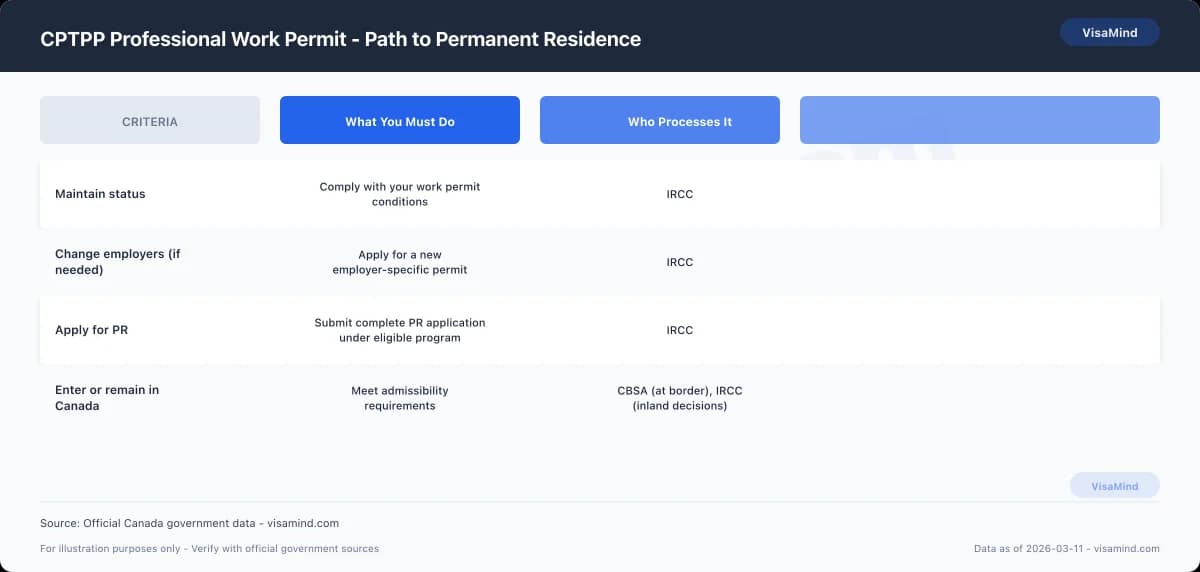
A CPTPP work permit does not provide permanent residence by itself. You must qualify under a separate immigration program and apply to Immigration, Refugees and Citizenship Canada (IRCC).
Common next steps
Most CPTPP applicants hold an Employer-Specific Work Permit. This means you work for one named employer in Canada, which can help you build qualifying Canadian work experience.
Keep detailed records of your job title and duties, hours worked, pay statements, tax documents, and employment dates.
IRCC assesses permanent residence applications based on your actual work performed in Canada, not just your job offer.
If you later change employers, you must apply for a new work permit and receive approval before starting the new job. Submitting Form IMM 1295 (Application for Work Permit Made Outside Canada) or the appropriate in-Canada application is part of that process.
Some applicants transition from other temporary categories, such as the CETA Professional Work Permit or an Intra-Company Transferee Work Permit, into permanent residence streams once they meet eligibility criteria.
You remain a temporary resident until IRCC approves your permanent residence application. Your work permit conditions continue to apply during this period.
| Step | What You Must Do | Who Processes It |
|---|---|---|
| Maintain status | Comply with your work permit conditions | IRCC |
| Change employers (if needed) | Apply for a new employer-specific permit | IRCC |
| Apply for PR | Submit complete PR application under eligible program | IRCC |
| Enter or remain in Canada | Meet admissibility requirements | CBSA (at border), IRCC (inland decisions) |
Links to PR pathways
Your eligibility for permanent residence depends on the specific program you qualify under. A CPTPP work permit does not automatically place you into any PR category.
Common pathways may include programs that assess skilled work experience in Canada, education credentials, language ability, valid job offers, and employer support.
IRCC sets the eligibility rules, required documents, and application forms for each permanent residence program. You must review the criteria for the program you intend to apply under and confirm you meet all requirements before submitting.
If your work permit is close to expiring, you must also plan how to maintain valid temporary status while IRCC processes your PR application. That may require extending your current Employer-Specific Work Permit or applying for a different authorized status, depending on your situation.
The Dual-Track Application
#You and your Canadian employer each complete a separate but connected process. The employer submits the job offer through IRCC’s system, and you file your Work Permit (Employer-Specific) application with supporting proof.
Both tracks must align on job details, qualifications, and eligibility under the CPTPP category.
Employer petition & offer
Your employer starts the process by submitting an offer of employment through IRCC’s Employer Portal. This step creates the official job offer record that supports your CPTPP application.
The offer must clearly describe your job title and duties, the Canadian work location, the length of employment, and details that match your professional qualifications.
IRCC reviews this information when assessing your eligibility for an Employer-Specific Work Permit. The job description must correspond to your training and experience, especially if you apply under a professional category similar to the CETA Professional Work Permit or an Intra-Company Transferee Work Permit.
Your employer does not file your personal work permit application. Inconsistencies between the portal submission and your documents can lead to refusal.
| Employer Responsibility | Key Requirement |
|---|---|
| Submit offer in Employer Portal | Accurate job and company details |
| Define duties and role | Must match your qualifications |
| Confirm employment terms | Consistent with CPTPP category |
Accuracy at this stage directly affects your application outcome.
Worker application & documents
You must prove that you meet CPTPP eligibility and that the job offer qualifies. IRCC expects complete, organized evidence.
Prepare the following:
- Proof of citizenship or permanent residence in a CPTPP country
- Copy of the Canadian job offer
- Educational credentials (degrees, diplomas, certifications)
- Professional qualification documents
- Reference letters confirming relevant work experience
- Detailed job descriptions from past roles
- Biographical and contact information
- Any additional residence or identity documents requested
You must satisfy the officer that you qualify for entry based on your credentials and the specific job in Canada. If you apply as a professional, your academic and occupational background must directly relate to the offered position.
Incomplete or vague documentation weakens your case.
Submitting the form
Review the instructions for your exact eligibility category before completing anything.
Most applicants use Form IMM 1295 to apply for a work permit from outside Canada. Complete every required field accurately and consistently with the employer’s portal submission.
Follow this sequence:
-
Review eligibility and instructions.
-
Complete the application form in full.
-
Attach all required supporting documents.
-
Sign where required.
-
Submit the application with the required evidence through the method specified by IRCC.
If you leave sections blank or submit inconsistent information, IRCC may refuse your application. CBSA will later assess admissibility at the border, but IRCC decides whether to issue the work permit.
Dependents
#Your spouse, common-law partner, and dependent children can apply with you or after you receive your CPTPP work permit. IRCC assesses each family member separately, even when you submit the applications together.
Family applications & fees
You may include your family members in the same submission as your Work Permit (Employer-Specific), CETA Professional Work Permit, or Intra-Company Transferee Work Permit. Each person must complete the required forms and pay the applicable fees in CAD (CA$).
If you apply together, ensure all required documents and medical exams remain valid at the same time. IRCC can delay or refuse processing if documents expire before review.
Key points for family applications:
- Each applicant submits their own forms (for example, you complete Form IMM 1295 for your work permit).
- Each person pays separate processing fees.
- All medical exams, if required, must be valid at the time of submission and decision.
- You must apply at the same time and through the same location if you want coordinated processing.
For current fee amounts, refer to the IRCC fee schedule and fee calculator.
| Item | Principal Applicant | Spouse/Partner | Dependent Child |
|---|---|---|---|
| Separate application required | Yes | Yes | Yes |
| Separate fees (CA$) | Yes | Yes | Yes |
| Medical exam validity must align | Yes | Yes | Yes |
Processing for minors & dependants
IRCC may not offer the same processing options if you apply for a minor (under 18) who lives outside Canada. Confirm eligibility before submitting the child’s application.
A minor’s application must meet the same completeness standards as an adult file. Missing forms or expired documents can delay the entire family’s case.
For dependent children:
- Submit a complete application package.
- Ensure medical results, if required, remain valid.
- File the application at the same time and place as the principal applicant when possible.
- Pay the required processing fees in CA$.
IRCC processes each dependent individually, even when you file together. CBSA officers will still assess admissibility at the port of entry after IRCC approves the permit.
Eligibility Requirements
#To qualify, you must hold the right nationality, meet strict occupation and education standards, and satisfy any country‑specific limits. IRCC will assess whether your job offer and credentials fit within the CPTPP professional category before issuing an Employer-Specific Work Permit.
Nationality & admissibility
You must be a citizen of a CPTPP member country or an Australian permanent resident to apply under this stream. Your passport must confirm your nationality at the time of application.
You must also seek entry to Canada as a CPTPP professional. This means you need a valid job offer in Canada that fits the professional category.
IRCC processes the work permit application. The Canada Border Services Agency (CBSA) assesses your admissibility when you enter Canada.
You must:
- Apply for an Employer-Specific Work Permit
- Submit the required forms, including Form IMM 1295
- Show that you meet the professional category rules
- Be admissible to Canada under immigration law
If you do not meet admissibility standards, CBSA can refuse entry even if IRCC approved your permit.
Occupation & education rules
Your job offer must be in a TEER 0 or TEER 1 occupation. Lower‑skilled roles do not qualify under the CPTPP professional category.
You must also meet minimum education standards. In most cases, you need a post‑secondary degree of at least four years.
Key requirements include:
- A confirmed job offer in a TEER 0 or 1 occupation
- A degree of four or more years (unless a country-specific rule applies)
- Proof your credentials match the position offered
Japanese technicians must hold at least a Japanese associate’s degree. Australian professionals must show a bachelor’s degree equivalent and provide a letter from the Canadian employer confirming that their qualifications are acceptable in Canada.
IRCC will compare your education and the job duties to confirm eligibility before issuing the permit.
Country-specific rules
Some CPTPP countries face occupation limits or additional documentation rules. You must check how your nationality affects your eligibility.
| Country | Key Restrictions or Requirements |
|---|---|
| Australia | Bachelor’s degree equivalent + employer letter confirming acceptability |
| Brunei | Limited to highly specialized and core energy sector services |
| Chile | All TEER 0 and 1 occupations except health, education, and cultural roles |
| Japan | Technicians require at least an associate’s degree |
| Malaysia | TEER 0 and 1 professionals only; no technician category |
| Mexico | TEER 0 and 1 occupations except specific excluded categories |
For example, if you are a Chilean national, you cannot qualify under this stream for health or education occupations, even if they fall under TEER 0 or 1.
If your country limits certain professions, IRCC will refuse the application if your job falls outside the permitted scope. You must align your job offer, education, and nationality to qualify under the CPTPP professional category.
What Your Employer Must Do
#Your employer has to take certain steps before you can apply for a CPTPP Work Permit (Employer-Specific).
They must submit your job offer through the IRCC system and provide accurate employment details matching your qualifications and application, including Form Form IMM 1295.
Submit the offer & portal steps
Your employer needs to submit an offer of employment through the IRCC Employer Portal before you send in your work permit application.
This creates the official job offer record that links to your file.
You’ll need the offer details when you’re filling out IMM 1295 and any other required forms.
The process looks like this:
-
Create or access an Employer Portal account.
-
Enter your job offer information.
-
Submit the offer electronically to IRCC.
Employers must complete this step for CPTPP categories such as professionals or intra-company transferees.
The process resembles the steps for other employer-specific programs, including the CETA Professional Work Permit and the Intra-Company Transferee Work Permit.
All require a formal employer submission before IRCC can assess eligibility.
If the employer doesn’t submit the offer properly, IRCC can’t issue your employer-specific work permit.
| Employer Action | Why It Matters |
|---|---|
| Submit offer in Employer Portal | Creates official job record with IRCC |
| Enter accurate job information | Ensures consistency with your work permit application |
| Complete submission before you apply | Allows IRCC to process your file |
Provide job details & compliance
Your employer must give clear and complete details about your position in Canada.
These details have to align with your qualifications and the CPTPP category you’re applying under.
IRCC will compare the job offer information with your education, professional background, and supporting documents.
Your employer should include:
- Your job title and duties
- The location of employment in Canada
- The terms of employment
- Information showing that the role matches your professional qualifications
You need to submit enough documentary evidence to convince an IRCC officer that you meet the entry requirements.
Your employer’s information should support that evidence.
Inconsistent or incomplete job details can delay processing or lead to refusal.
Accuracy between the Employer Portal submission, your IMM 1295, and your supporting documents matters.
Common Petition Challenges
#Most refusals and delays under the CPTPP work permit happen because of incomplete documentation, ineligible occupations, or local processing errors.
You need to match your application exactly to IRCC requirements and the specific CPTPP category you select.
Missing documents & common mistakes
IRCC often returns or delays applications missing key evidence.
A CPTPP application has to be complete when you submit it, especially for an Employer-Specific Work Permit.
Common document issues:
- No proof of citizenship or permanent residence from an eligible CPTPP country
- No pre-arranged employment offer
- Incomplete or unsigned Form IMM 1295
- Missing or insufficient proof of work experience
- Incomplete professional documentation
If you apply under a category similar to a CETA Professional Work Permit or an Intra-Company Transferee Work Permit, you still need to meet CPTPP-specific documentary standards.
Filing under the CPTPP Professional category doesn’t guarantee approval.
Use this checklist before submission:
| Document Area | What You Must Provide |
|---|---|
| Status proof | Evidence of citizenship or permanent residence in an eligible CPTPP country |
| Job offer | Clear pre-arranged employment documentation |
| Work history | Documentary proof that matches the claimed occupation |
| Forms | Fully completed IMM 1295 and supporting forms |
IRCC may return incomplete applications without processing.
That means you’d have to refile and start over.
Occupation & qualification mismatches
You must apply under an occupation permitted for your country under the CPTPP.
Applying under a role not authorized for your nationality leads to refusal.
Your qualifications must line up with the occupation listed in your employment offer.
IRCC checks whether your documented work experience supports the role you claim.
Problems come up when:
- Your work history doesn’t clearly relate to the job title
- Your documents don’t show the required experience
- You rely on a broad job description without proof
If your employer offers a position outside CPTPP-authorized categories, IRCC won’t approve the application.
An employer-specific offer alone isn’t enough.
Your background needs to directly support the role.
Quebec & other local processing issues
If you’ll work in Quebec, you must meet additional provincial documentation requirements.
Missing Quebec-specific documents can delay or derail processing.
IRCC assesses the federal work permit, while local requirements may apply separately.
Failing to submit required Quebec documents creates processing gaps.
Common local issues include:
- Not including required Quebec processing documents
- Submitting federal documents but omitting provincial requirements
- Providing incomplete professional documentation for regulated roles
You must verify both federal CPTPP criteria and Quebec-specific requirements before filing.
A complete federal package does not fix missing provincial documentation.
Fees
#| Component | Amount |
|---|---|
| Filing fee (IMM-1295)Work permit (outside Canada). | CA$155 (approx $113 USD) |
| BiometricsBiometrics: CA$85 (approx $62 USD) (as of 2026-02). Verify the current fee on the official schedule before filing. | CA$85 (approx $62 USD) |
Fees change; always verify on IRCC.
Required forms
#Plan your CPTPP Professional Work Permit with free Canada tools
#Itemized government fees for CPTPP Professional Work Permit and other Canada categories.
See how your profile scores against CPTPP Professional Work Permit and other Canada visas.
Typical wait times and stage breakdowns for CPTPP Professional Work Permit and related Canada visas.
Common interview questions and feedback for Canada visa applicants.