
On this page
- What an Open Work Permit Allows — Canada open work permit
- How to Apply — open work permit Canada
- Gather your documents
- Who Qualifies
- Conditions and Limitations
- Path to Permanent Residence
- When to Get Help
- Fees and Processing Times
- Eligibility Pitfalls
- Fees
- Required forms
- Related visa types
- Related guides
- Related goals
- Next steps
What an Open Work Permit Allows — Canada open work permit
#
An open work permit gives you broad access to the Canadian labour market. You’re not tied to one named employer.
You still have to follow the conditions set by IRCC. The flexibility is there, but it isn’t unlimited.
What the permit covers
Open work permits allow you to work in Canada without first securing a job from a single employer. Unlike a Work Permit (Employer-Specific), you’re not restricted to one company, position, or location.
You can work for more than one employer. Changing employers doesn’t require a new permit.
You can also look for a job after arriving, instead of before. This is helpful for applicants eligible for a Spousal Open Work Permit.
It’s a way to gain Canadian work experience that may later support permanent residence, including through the Canadian Experience Class (CEC) or Express Entry (Federal Skilled Worker).
You apply using the right IRCC forms, such as Form IMM 1295, when needed. IRCC issues the permit with specific validity dates and conditions.
| Feature | Open Work Permit | Work Permit (Employer-Specific) |
|---|---|---|
| Job offer required before applying | No | Yes |
| Employer listed on permit | No | Yes |
| Ability to change employers | Yes | No (new permit required) |
| Location restrictions | Not employer-based | Based on employer/job details |
Limitations at a glance
Open work permits don’t remove all conditions. IRCC may add restrictions directly on your permit.
You must comply with the validity period on the permit. Some permits have occupation limits or other conditions.
All Canadian immigration and admissibility rules still apply. The permit doesn’t guarantee entry into Canada.
CBSA determines admissibility at the port of entry. If IRCC includes specific restrictions, you must follow them.
You’re also responsible for keeping valid temporary resident status while working.
| Limitation Type | What It Means for You |
|---|---|
| Time limit | You can only work until the expiry date on your permit. |
| Conditions | You must respect any restrictions printed on the document. |
| Status requirement | You must maintain valid status in Canada. |
| Entry control | CBSA decides final admission at the border. |
Who uses this permit
Open work permits are typically used when flexibility matters more than having a job lined up. This is common for people who don’t want to be tied to a single employer.
Common users include eligible spouses applying for a Spousal Open Work Permit, applicants who qualify under IRCC public policies, and those planning to gain Canadian work experience before applying under Canadian Experience Class (CEC) or Express Entry (Federal Skilled Worker).
If you want to explore different employers or industries before making a long-term commitment, this permit can help you build qualifying work history for future immigration programs.
You have to submit the correct application to IRCC, including required forms like IMM 1295 when it applies. IRCC reviews your eligibility before issuing the permit with set conditions and dates.
How to Apply — open work permit Canada
#You need to use the correct IRCC form, fill in all required fields, validate it to generate barcodes, and send it with all supporting documents. Accuracy and completeness matter for IRCC to process your open work permit without unnecessary delays.
Before you start
Download the current open work permit application package from Immigration, Refugees and Citizenship Canada (IRCC). Use the version that’s available when you apply.
Check your eligibility category first. Your requirements will differ if you’re applying for a Spousal Open Work Permit, an open work permit linked to permanent residence (like through Canadian Experience Class or Express Entry), or another IRCC-approved category.
If you’re applying from outside Canada, you’ll need to complete Application for a Work Permit Made Outside of Canada (Form IMM 1295).
Review the official instruction guide and gather all the required documents. Missing documents can slow things down or lead to refusals.
Use this checklist before starting:
| Task | Why it matters |
|---|---|
| Download the latest form | IRCC rejects outdated versions |
| Read category-specific instructions | Requirements vary by eligibility stream |
| Gather supporting evidence | IRCC assesses eligibility based on documents |
| Ensure each applicant completes their own form | Work permits are issued individually |
Each applicant must submit a separate application.
Filling and validating the form
Complete IMM 1295 on your computer. Don’t leave required fields blank.
Give accurate information about your identity, immigration history, and intended work in Canada. If a question doesn’t apply to you, follow the form instructions.
After finishing the form, click the Validate button. This creates barcode pages.
Barcodes help IRCC upload your information to their system. If you don’t see a barcode page, the form isn’t complete.
Steps to validate:
-
Fill in all required fields.
-
Click “Validate.”
-
Make sure barcode pages appear.
-
Save the validated form.
If you’re applying on paper, print the validated form and sign where required. Unsigned forms are returned.
Submitting your application
Send your completed application with all required documents. If you apply on paper, put the barcode page on top.
Include the validated IMM 1295 form, all required supporting evidence for your eligibility category, any additional documents listed in the IRCC instruction guide, and your signature if it’s a paper application.
IRCC only processes complete applications. Missing documents or an unvalidated form can mean your application is returned or refused.
Before you send it, check this list:
| Requirement | Confirmed |
|---|---|
| Correct eligibility category selected | ☐ |
| Latest form version used | ☐ |
| Form validated and barcode generated | ☐ |
| All required documents attached | ☐ |
| Form signed (if paper application) | ☐ |
Submit your application exactly as IRCC instructs for your location and category.
Gather your documents
#You must provide clear, complete documents that match what’s on your application forms. IRCC checks your identity, status, and supporting records against the information you give on forms like Form IMM 1295.
Identity & personal details
Start with your core identity documents. Your full legal name must match your passport or travel document.
Prepare these:
- Valid passport or travel document
- Full legal name (no abbreviations or nicknames)
- Preferred language of service: English or French
- Current marital status
- Details of any past marriages or common‑law partnerships
If you’re married, add a copy of your marriage licence or marriage certificate. This is especially important for a Spousal Open Work Permit, where your relationship status matters for eligibility.
If you’ve applied under Canadian Experience Class or Express Entry before, keep your personal details consistent across all records submitted to IRCC.
| Document | Required for most applicants | Notes |
|---|---|---|
| Passport | Yes | Must reflect your full legal name |
| Marriage certificate | If married | Submit a clear copy |
| Marital history details | If applicable | Include past marriages or partnerships |
Inconsistent names, dates, or relationship details can slow down processing.
Conditional and supporting documents
You need to prove legal status in the country where you apply if you’re not a citizen there.
Include proof of legal status (such as residence authorization), accurate contact details (mailing address and Post Office Box if you have one), and current telephone and email address.
Make sure all personal information—employment, financial, medical, or work history—matches what you declare on IMM 1295 and any related forms.
If IRCC asks for extra residence or supporting records, send them in full. Partial submissions often lead to delays or more document requests.
Medical & residency evidence
Some applicants need to provide medical or residency-related documents. If required, everyone included in the application must have valid results at the same time.
Check validity periods. If one person’s medical or supporting document expires before another’s, IRCC may not finalize the application.
If you submit extra residence documentation, make sure it clearly shows your legal stay and matches what you listed in your application.
Keep copies of everything. IRCC checks eligibility, and CBSA determines admissibility at the port of entry—both rely on accurate documentation.
Who Qualifies
#You qualify for a Canada open work permit only if you fall into a specific category recognized by IRCC. Most applicants qualify because of a family relationship, recent Canadian education, or participation in a defined group situation.
Common eligible categories
IRCC gives open work permits to people who don’t need a work permit tied to one employer. Your eligibility depends on your status or relationship.
You may qualify if you are a spouse or common-law partner of a skilled worker and eligible for a Spousal Open Work Permit, a graduate of a Canadian institution, or an applicant transitioning toward permanent residence through programs such as Canadian Experience Class or Express Entry (Federal Skilled Worker).
If you apply from outside Canada, you usually submit Form IMM 1295 as part of your application.
| Situation | Type of Work Authorization |
|---|---|
| Spouse of skilled worker | Spousal Open Work Permit |
| Canadian graduate | Open work permit |
| PR pathway applicant (CEC or Express Entry – Federal Skilled Worker) | Open work permit (if eligible under IRCC rules) |
Eligibility depends on meeting the conditions for your category. If you get a Work Permit (Employer-Specific) instead, you can only work for the named employer.
Special cases and group situations
Some people qualify as part of a defined group.
For example, a group of three or more performing artists and their essential staff may qualify together under special work permit rules. To access the group work permit fee, your group must include at least three performers and supporting personnel.
You must apply as a coordinated group and meet IRCC’s criteria for performing artists.
| Group Type | Key Requirement |
|---|---|
| Performing artists and staff | Minimum of 3 people to qualify as a group |
Each member must still meet admissibility requirements. IRCC reviews your application, and CBSA determines admissibility at the port of entry.
Conditions and Limitations
#An open work permit gives you flexibility, but it doesn’t remove legal requirements or guarantee immigration status. You still have to meet IRCC standards, and you’re subject to admissibility decisions by CBSA.
Approval is not guaranteed
Submitting an open work permit application doesn’t secure approval. IRCC reviews your file and decides if you meet the specific eligibility rules for your category, such as a Spousal Open Work Permit or another qualifying stream.
You must complete the required forms accurately, including Form IMM 1295, and provide all supporting documents IRCC asks for. Incomplete or inconsistent information can lead to refusal.
IRCC looks at factors like whether you qualify for the specific open permit category, whether you complied with prior Canadian immigration conditions, and whether you’re still admissible to Canada.
An open work permit is different from an Employer-Specific Work Permit. The flexibility to work for most employers doesn’t lower the approval standard.
Holding or applying for programs like Canadian Experience Class or Express Entry doesn’t guarantee approval of a work permit. Each application stands on its own merits.
| Factor | What It Means for You |
|---|---|
| Complete application | You must properly submit IMM 1295 and all required documents |
| Eligibility category | You must qualify under a recognized open work permit stream |
| Admissibility | CBSA can still assess your entry or stay in Canada |
What the permit does not promise
An open work permit doesn't give you permanent residence. It only lets you work in Canada under the specific conditions printed on your permit.
It doesn't automatically qualify you for Canadian Experience Class (CEC) or Express Entry (Federal Skilled Worker). You still have to meet those program requirements and file a full application through the right system.
It also does not:
- Guarantee renewal or extension
- Protect you from status expiry
- Override specific work restrictions printed on your permit
- Ensure re-entry to Canada if you travel abroad
If you apply for a Spousal Open Work Permit, your eligibility depends on your spouse or partner's status. If their status changes, yours may be affected.
You must keep following all immigration conditions. Breaking permit terms can impact future applications, including any for permanent residence.
Path to Permanent Residence
#An open work permit lets you build Canadian work experience that can support a permanent residence application. Your options depend on how you first entered Canada and which economic program you pursue through Immigration, Refugees and Citizenship Canada (IRCC).
Typical prior pathways
Most people reach permanent residence after first holding temporary status that lets them work legally in Canada.
Common starting points:
- Spousal Open Work Permit
- Work Permit (Employer-Specific)
- Open work permit under a temporary public policy
- Initial work permit application using Form IMM 1295
Your prior status affects how you document your experience and eligibility. An employer-specific permit ties you to one employer, while a spousal open work permit is more flexible.
The table below outlines how these permits usually connect to permanent residence options:
| Temporary Status | Work Flexibility | PR Programs Commonly Considered |
|---|---|---|
| Spousal Open Work Permit | Most employers | Canadian Experience Class (CEC), Express Entry (Federal Skilled Worker) |
| Work Permit (Employer-Specific) | One named employer | Canadian Experience Class (CEC), Express Entry (Federal Skilled Worker) |
| Other Open Work Permit | Most employers | Canadian Experience Class (CEC), Express Entry (Federal Skilled Worker) |
You need to keep valid temporary status as you prepare your permanent residence application.
Common next steps toward PR
After gaining enough Canadian work experience, many applicants use Express Entry, which manages programs like:
- Canadian Experience Class (CEC)
- Express Entry (Federal Skilled Worker)
You must meet the specific eligibility criteria set by IRCC for your chosen program.
The usual sequence is:
-
Confirm you meet eligibility for CEC or the Federal Skilled Worker Program.
-
Create an Express Entry profile with accurate work history and status details.
-
Submit a complete permanent residence application if you get an invitation.
IRCC will review your qualifications and documents. The Canada Border Services Agency (CBSA) checks admissibility when you enter or finalize landing as a permanent resident.
Keep records of all your work permits, including any IMM 1295 submissions and approval letters. You'll need them to prove authorized employment.
When to Get Help
#Small filing mistakes can lead to rejection or long delays. If your situation doesn't fit a standard open work permit profile, consider getting advice.
Errors that may need professional help
Submitting incomplete or poorly prepared forms to Immigration, Refugees and Citizenship Canada (IRCC) increases your risk of refusal. Many issues come up with how you complete and submit Form IMM 1295.
Common problem areas:
- Not validating IMM 1295 to create the barcode page
- Leaving required fields blank
- Missing signature on a paper application
- Uploading files that are unreadable or in the wrong format
- Not including proof of legal status in your country of application (if not a citizen)
These mistakes often result in your application being returned or delayed.
| Error Type | Likely Outcome |
|---|---|
| Missing signature | Application rejected |
| No barcode page after validation | Processing delay or return |
| Incomplete fields | Application considered incomplete |
| No proof of legal status | Request for additional documents or refusal |
If IRCC has already returned your application, or you're unsure how to fix a technical issue, a licensed professional can review your package before you resubmit.
Complex filing situations
If your open work permit is linked to another immigration process, errors in one file can affect another.
For example, you might hold a Work Permit (Employer-Specific) and want to switch to an open permit. Or you may apply for a Spousal Open Work Permit while your spouse applies under the Canadian Experience Class (CEC) or Express Entry (Federal Skilled Worker).
These overlapping applications can lead to inconsistent information.
Situations needing careful coordination:
-
Applying for an open work permit while another temporary status remains valid
-
Submitting a work permit alongside a permanent residence file
-
Updating personal details across multiple active IRCC applications
In these cases, all dates, status documents, and personal details must match across every form, including IMM
- Having a professional review can help avoid contradictions that cause delays or document requests.
Fees and Processing Times
#You pay a standard government fee and, in most cases, a biometrics fee. Processing times depend on when IRCC gets your complete application, where you apply, and the type of open work permit you want.
Fees and biometrics
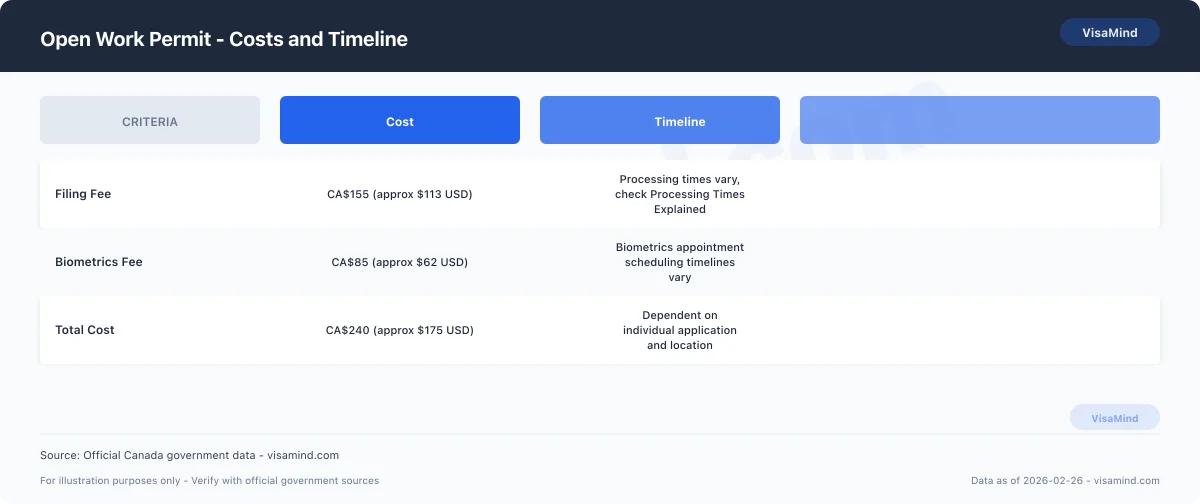
IRCC charges CA$155 per person for a Work Permit (including extensions). This covers most open work permit applications with Form IMM 1295.
A biometrics fee of CA$85 per person applies if biometrics are required.
| Fee Type | Amount (CAD) | Who Pays |
|---|---|---|
| Work Permit (including extensions) | CA$155 | Each applicant |
| Biometrics | CA$85 | Each applicant required to give biometrics |
If applying as a family, you may qualify for a maximum total of CA$500 in work permit fees if:
- All family members apply together
- All applications are submitted at the same place
- Your children qualify as dependants
A Spousal Open Work Permit uses the same base fee structure. Check current amounts with IRCC before paying, as fees can change.
How processing times are calculated
As of March 2026, standard processing for an open work permit is 2 to 5 months depending on the stream. Use IRCC’s processing time tool for current estimates.
Processing time starts from the day IRCC receives your complete application to the day they make a decision. If your application is incomplete, the clock doesn't start until you fix the problem.
Processing times are estimates based on applications submitted in a given month and year. IRCC updates these regularly.
If you apply from outside Canada and the United States, add 3 to 4 months for mailing time. Non-routine cases can take longer.
High application volumes, especially those linked to permanent residence programs like the Canadian Experience Class (CEC) or Express Entry (Federal Skilled Worker), can slow things down.
Location and category variations
Processing times vary by location and permit category. An open work permit processed inside Canada may move faster or slower than one submitted abroad.
IRCC posts different timelines depending on:
- Your country of residence
- Whether you apply inside or outside Canada
- The specific open work permit category
A Spousal Open Work Permit may be processed through a different stream than an employer-based application. An Employer-Specific Work Permit also has its own processing channel.
| Factor | Impact on Time |
|---|---|
| Country of application | Different visa offices have different workloads |
| Application completeness | Incomplete files delay review |
| Category (Open vs Employer-Specific) | Separate processing streams |
| Volume of applications | Higher demand increases wait times |
Always check IRCC’s posted processing time for your exact category and location before applying.
Eligibility Pitfalls
#You can meet most requirements and still get refused if you apply at the wrong time or can't prove eligibility. IRCC refuses open work permits when you or your family member don't clearly qualify under the specific category you select.
Common timing and eligibility traps
You must qualify under a defined pathway, such as a Spousal Open Work Permit or a transition from an Employer-Specific Work Permit. If your underlying status doesn't support an open permit, IRCC will refuse the application.
Some applicants assume that applying under programs like Canadian Experience Class (CEC) or Express Entry (Federal Skilled Worker) automatically makes them eligible for an open work permit. It doesn't. Each program has its own criteria, and you must meet the open work permit rules on their own.
Watch for these issues:
- Your current status has expired or will expire before IRCC reviews your file.
- Your family member’s status doesn't support your application.
- You select the wrong work permit category in Form IMM 1295.
- You rely on future eligibility instead of current status.
| Situation | Risk |
|---|---|
| Status expiring | Loss of eligibility at time of decision |
| Wrong category selected | Refusal for applying under incorrect stream |
| Ineligible family member | Dependent application refused |
Missing evidence that leads to refusal
IRCC makes decisions based on documents, not intentions. If you don't prove eligibility, officers must refuse the application.
You need to show:
- You meet the requirements of the specific open work permit category.
- Your spouse or partner holds valid status, if applying for a Spousal Open Work Permit.
- You completed and signed IMM 1295 properly.
- All required supporting documents match your forms.
Inconsistencies between your forms and supporting records can raise credibility concerns. Missing signatures, incomplete employment details, or unclear status documents often lead to refusal.
| Missing Item | Likely Outcome |
|---|---|
| Proof of valid status | Application refused |
| Incomplete IMM 1295 | Returned or refused |
| No evidence of relationship (spousal cases) | Ineligibility finding |
Submit a complete and consistent package to IRCC. If your eligibility depends on a family member, confirm their status before you apply.
Fees
#| Component | Amount |
|---|---|
| Filing fee (IMM-1295)Work permit (outside Canada). | CA$155 (approx $113 USD) |
| BiometricsBiometrics: CA$85 (approx $62 USD) (as of 2026-02). Verify the current fee on the official schedule before filing. | CA$85 (approx $62 USD) |
Fees change; always verify on IRCC.
Next steps
#Use Find My Visa to build a sequenced plan with official sources and deadlines.
FAQs
What are the key steps to submitting the application?
Download the form, complete all mandatory fields, validate the form to generate a barcode page (if completed on a computer), sign if applying on paper, and submit the application with the barcode page on top.
What common mistakes cause delays or rejections?
Common mistakes include failing to validate the form to generate the barcode page, omitting mandatory fields, uploading or printing the form incorrectly, not signing the form if submitted on paper, and submitting incomplete or incorrect information.
What fees do I need to pay to apply?
The filing fee (IMM-1295) is CA$155 per person and the biometrics services fee is CA$85. Notes on maximum family or group fees are published (for example maximum group fee conditions and family timing rules).
How long does it typically take to process an open work permit?
Processing time for open work permits under 'Standard' is generally 2 to 5 months (stream-dependent); if you apply from outside Canada or the U.S., add 3 to 4 months to account for mailing time.
Do processing times differ by category or location?
Yes. Processing times vary by category and processing location; check the issuing authority's processing times (note some processing time pages require a browser with JavaScript enabled).
Can this permit lead to permanent residence in Canada?
Yes. Common next steps after this permit include applying under Canadian Experience Class (CEC), Express Entry (Federal Skilled Worker), or a Provincial Nominee Program (PNP); the permit typically follows pathways such as Study Permit, Employer-Specific Work Permit, or Spousal/Partner Sponsorship.
What conditional supporting documents might I need to include?
You may need to include a copy of your marriage licence or certificate if married, proof of legal status in the country where you are applying if you are not a citizen, and ensure any required exams for every person are valid at the same time.
Official sources referenced
Last reviewed: 2026-03-11
VisaMind provides informational guidance only and is not a government agency. This is not legal advice. Requirements can change and eligibility depends on your specific facts. If your case is complex or high-stakes, consult a licensed immigration attorney.
Next steps
Every Canada visa case depends on your nationality, purpose, and timeline. Get a personalized plan with official sources and deadlines.
Start my Open Work Permit plan