
On this page
- Overview — Canada parent sponsorship
- Required Documents
- How to Apply
- Fees and Processing Times
- When to expect a decision
- Renewal and Extension
- Conditions and Rights
- Path to Permanent Residence
- Eligibility Requirements
- Relationship Scrutiny Red Flags
- When to Consult a Professional — sponsor parents Canada
- Fees
- Required forms
- Related visa types
- Related guides
- Related goals
- Next steps
Overview — Canada parent sponsorship
#Canada’s parent sponsorship process lets you seek permanent resident status for your parents or grandparents through a formal family sponsorship stream.
You apply through IRCC using specific forms and procedures, and approval isn’t guaranteed.
What this program does
The Parents and Grandparents Program allows you to sponsor your parents or grandparents to become permanent residents of Canada.
If IRCC approves your application, they receive permanent resident status, not just temporary entry.
You submit an application package to IRCC that includes required forms.
Key forms often include:
- Form IMM 1344 (Application to Sponsor)
- Form IMM 0008 (Generic Application Form for Permanent Residence)
- Form IMM 5669 (Schedule A – Background/Declaration)
- Form IMM 5768 (Financial Evaluation, when required)
You file these forms together as part of a combined sponsorship and permanent residence process.
IRCC checks both your eligibility as a sponsor and your parents’ or grandparents’ admissibility.
Filing an application does not guarantee approval.
For temporary stays, some families consider the Super Visa (Parents and Grandparents) instead.
That option does not grant permanent residence.
| Program | Status Granted | Purpose |
|---|---|---|
| Parents and Grandparents Program | Permanent residence | Long-term settlement |
| Super Visa (Parents and Grandparents) | Temporary status | Extended visits |
Who runs it
Immigration, Refugees and Citizenship Canada (IRCC) manages the parent and grandparent sponsorship process.
You submit your application directly to IRCC.
IRCC reviews:
-
Your eligibility as a sponsor.
-
The permanent residence application of your parent or grandparent.
-
The required forms and supporting documents.
IRCC also processes other family-based programs, such as Spousal/Partner Sponsorship, but each program has separate criteria and forms.
You must use the correct forms for the Parents and Grandparents Program.
CBSA is responsible for border enforcement and admissibility decisions at ports of entry, not for processing sponsorship applications.
Quick notes
Before you apply, keep these points in mind:
- Submit complete and accurate forms.
- Sign all required declarations.
- Include all required supporting documents.
- Follow IRCC’s current instructions exactly.
Incomplete or incorrect forms can delay processing or lead to refusal.
Always check you’re using the latest version of each form, including IMM 1344, IMM 0008, IMM 5669, and IMM 5768.
Parent sponsorship is not the same as the Super Visa or Spousal/Partner Sponsorship, which have separate processes and criteria.
For current fees in CA$, application guides, and official checklists, refer to IRCC.
Required Documents
#You must submit the correct IRCC forms and supporting records in the exact order required.
Accuracy and organization help prevent delays and returned applications.
Document checklist (IMM 5771)
Download the 2025 Document Checklist for Parents and Grandparents (IMM 5771) and complete it on your computer using Acrobat Reader.
This checklist controls your entire submission.
Use it to confirm that you included each required form and supporting document.
Check every box as you gather items.
Key forms typically listed include:
- Form IMM 1344 – Application to Sponsor
- Form IMM 5768 – Financial Evaluation
- Form IMM 0008 – Generic Application Form for Canada
- Form IMM 5669 – Schedule A – Background/Declaration
You must also provide personal information where requested, such as:
- Telephone and email details
- Social Insurance Number (SIN)
- Financial information
- Employment history
- Medical information, if required
Place the completed IMM 5771 on top of your paper package before mailing.
If you apply online, upload the completed checklist with your forms.
Always use the version specific to the Parents and Grandparents Program, not forms for Spousal/Partner Sponsorship or the Super Visa (Parents and Grandparents).
How to organize your package
IRCC expects your documents in the exact order listed on IMM 5771.
Do not rearrange the sequence.
Follow this process:
-
Complete all required forms electronically, where possible.
-
Validate forms that require validation.
-
Print and sign where required.
-
Arrange documents in checklist order.
-
Place the signed checklist on top.
Use a simple stack format.
Avoid binders, folders, or decorative covers unless IRCC specifically asks for them.
| Order in Package | Document Type |
|---|---|
| 1 | Completed IMM 5771 checklist |
| 2 | Sponsorship forms (e.g., IMM 1344, IMM 5768) |
| 3 | Principal applicant forms (e.g., IMM 0008, IMM 5669) |
| 4 | Supporting financial and identity documents |
| 5 | Any additional documents requested |
If you apply online, upload documents in clearly labeled files that match the checklist categories.
Extra and supporting evidence
IMM 5771 may request additional documents depending on your situation.
You must review each item carefully.
Examples of extra documents include:
- Proof of residence
- Additional financial records
- Documents supporting personal history details
Provide documents only if the checklist asks for them.
Do not submit unrelated materials.
If IRCC requests further evidence after submission, respond within the deadline stated in your request letter.
Submit exactly what the letter asks for and organize it clearly.
If you’re unsure about a document requirement under the Parents and Grandparents Program, confirm instructions directly through IRCC before sending your package.
How to Apply
#You must receive an invitation before you can submit a full application under the Parents and Grandparents Program.
The process requires careful form selection, complete documentation, and strict compliance with IRCC instructions.
Interest to sponsor and intake notes
IRCC does not accept new sponsorship applications without an invitation to apply.
For the 2025 intake, invitations were issued to potential sponsors who submitted an interest to sponsor form in 2020 and were selected.
You can only apply if IRCC invited you.
Without an invitation, IRCC will not process your package.
Key points for this intake:
| Requirement | What You Must Have |
|---|---|
| Prior submission | Interest to sponsor form submitted in 2020 |
| Current step | Invitation to apply from IRCC |
| Program | Parents and Grandparents Program |
If you were not invited, you cannot submit a sponsorship application under this program.
You may instead review the Super Visa (Parents and Grandparents) as a temporary option while waiting for a future intake.
This process is separate from Spousal/Partner Sponsorship.
Each program has its own forms and eligibility rules.
Downloading forms & instructions
Download the current parent and grandparent sponsorship application package from IRCC.
Always use the most recent version of every form.
Before you complete anything, read the instruction guide that applies to your eligibility category.
The guide explains:
- Who must complete each form
- Which supporting documents you must include
- Where and how to submit the application
- How to pay required fees (see the IRCC fee calculator for current CA$ amounts)
Common forms in this category may include:
| Form Number | Purpose |
|---|---|
| Form IMM 1344 | Application to Sponsor |
| Form IMM 0008 | Generic Application Form for Permanent Residence |
| Form IMM 5669 | Schedule A – Background/Declaration |
| Form IMM 5768 | Financial Evaluation for Parents and Grandparents Sponsorship |
Use only the forms listed in your official document checklist.
Submitting outdated forms can result in delays or rejection.
Completing and submitting the package
Complete every required section of each form.
Do not leave questions blank unless the instructions tell you to do so.
Follow this sequence:
-
Fill out all required forms.
-
Validate forms that require electronic validation.
-
Print and sign where signatures are required.
-
Gather all supporting documents listed in your checklist.
-
Pay the required fees and include proof of payment.
-
Submit the complete package as instructed by IRCC.
You must include all required evidence at the time of submission.
Missing signatures, incomplete financial information on IMM 5768, or absent background details on IMM 5669 can cause IRCC to return your application.
Review the entire package against the official document checklist before you submit it.
Accuracy and completeness determine whether IRCC accepts your application for processing.
Fees and Processing Times
#You must pay government fees to IRCC when you submit your Parents and Grandparents Program application.
Costs include sponsorship, permanent residence processing, and biometrics.
Processing times typically range from 12 to 24 months, depending on the program stream and location.
Sponsorship & application fees
You pay separate fees for the sponsor and the parent or grandparent you are sponsoring.
IRCC will not process your application without full payment.
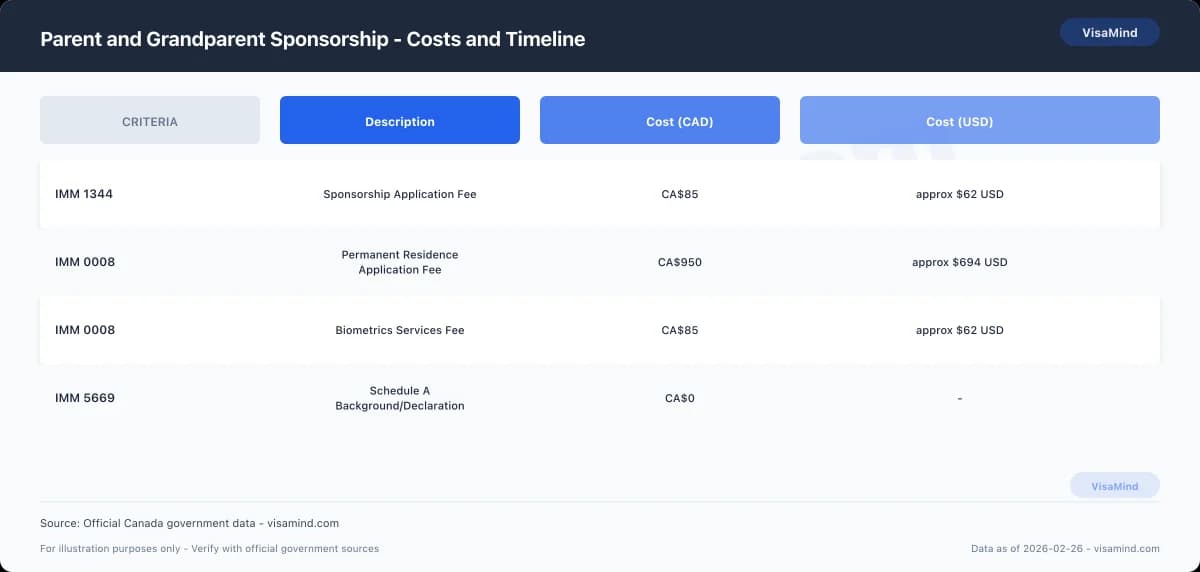
| Fee Type | Form | Amount (CAD) |
|---|---|---|
| Sponsorship filing fee | Form IMM 1344 | CA$85 |
| Permanent residence processing fee | Form IMM 0008 | CA$1,525 |
The CA$85 fee applies when you submit Form IMM 1344 as the sponsor.
This confirms your intent to sponsor under the Parents and Grandparents Program.
The CA$1,525 fee applies to the principal applicant’s permanent residence application filed with Form IMM 0008.
Supporting forms such as Form IMM 5669 and Form IMM 5768 are part of the package but do not carry separate listed fees in this program.
Fees differ from programs like Spousal/Partner Sponsorship or the Super Visa (Parents and Grandparents).
Always confirm current amounts through IRCC before you file, as fees can change.
Biometrics and other charges
Most parent and grandparent applicants must provide biometrics.
IRCC charges a CA$85 biometrics fee per person.
| Service | Amount (CAD) |
|---|---|
| Biometrics | CA$85 |
You pay this fee after IRCC issues a biometrics instruction letter, unless you prepaid it with your application.
IRCC will not finalize permanent residence without completed biometrics.
Other costs may apply depending on your case.
These can include medical examinations or document collection expenses, but IRCC sets and updates official government fees.
Check IRCC’s fee schedule before submitting payment to avoid delays.
Standard processing window
Standard processing for parent and grandparent sponsorship currently ranges from 12 to 24 months.
This timeframe reflects typical cases under the Parents and Grandparents Program as of March 2026.
Processing time begins once IRCC receives a complete application, including Forms IMM 1344, IMM 0008, IMM 5669, and IMM 5768, with correct fees paid.
Missing documents or unpaid fees will delay intake.
Timelines vary by category and by the office handling your file.
Some applications move faster; others take longer due to background checks or file volume.
Always verify current processing times directly through IRCC before you apply.
Processing estimates change based on application inventory and operational capacity.
When to expect a decision
#IRCC measures processing time from the day it receives your complete application to the day it makes a decision.
Timelines depend on application volume, your location, and whether your case requires routine or non‑routine review.
How processing times are calculated
IRCC starts the clock the day it receives your complete application package.
The clock stops when it makes a final decision on your permanent residence under the Parents and Grandparents Program.
If you submit an incomplete package—such as missing Form IMM 1344, Form IMM 0008, Form IMM 5669, or Form IMM 5768—IRCC will not treat it as complete.
That delays the start of processing.
IRCC publishes estimated times based on:
- The month and year you applied
- The type of application (for example, permanent residence)
- Current inventory levels
These estimates reflect how long IRCC expects to process an application received today.
| Processing Time Starts | Processing Time Ends |
|---|---|
| Date IRCC receives your complete application | Date IRCC makes a decision |
If more people apply than Canada can admit in a given year, processing may take longer.
Location, mailing and special cases
Your location affects the timeline.
If you live outside Canada or the United States, add 3 to 4 months for mailing and document transfer. This is separate from IRCC’s published processing time.
| Applicant Location | What to Add |
|---|---|
| Inside Canada | No additional mailing time |
| Outside Canada and the U.S. | Add 3–4 months |
Special situations can also affect timelines.
For example, applications involving minors (under 18) who live outside Canada or the U.S. can take longer.
Files transferred between offices or regional disruptions that prevent IRCC from providing accurate estimates may also delay things.
If your parents hold a Super Visa (Parents and Grandparents) while waiting, that status does not shorten permanent residence processing.
It only allows temporary stay.
Processing times for Spousal/Partner Sponsorship are calculated separately and do not apply to parent sponsorship cases.
Non-routine reviews and exceptions
IRCC processes most complete applications within its posted service standard.
Non‑routine files take longer.
A non‑routine review may occur if information in IMM 5669 (Schedule A) requires closer examination.
Financial details in IMM 5768 might need further assessment.
Missing or unclear documents can trigger extra review.
Background or admissibility checks sometimes require extended attention.
IRCC will continue processing until it reaches a decision.
There is no fixed timeline for non‑routine cases.
If your file moves out of routine processing, expect additional review time beyond the standard estimate.
IRCC does not shorten processing for urgent requests unless it formally accepts the case as urgent under its internal criteria.
Renewal and Extension
#You may need to renew a work permit or extend temporary status while your Canada parent sponsorship application moves through IRCC.
Pay close attention to fee structure, group filing rules, and the validity of required exams to avoid delays or refusals.
Work permit fees and group notes
If you apply for a work permit or extend one during processing under the Parents and Grandparents Program, IRCC charges a fee per person.
| Application type | Fee (CAD) |
|---|---|
| Work permit (including extension) – per person | CA$155 |
You pay this amount for each applicant.
A maximum CA$500 group fee may apply if all family members apply at the same time and place and your children qualify as dependants.
This group cap does not apply automatically.
You must meet every condition exactly as required by IRCC.
A separate maximum group fee may apply to a group of three or more performing artists and their staff who apply together at the same time and location.
If this does not describe your situation, you pay the standard per‑person fee.
For current totals or combined payments with permanent residence forms such as Form IMM 1344, Form IMM 0008, Form IMM 5669, or Form IMM 5768, refer to the IRCC fee tool.
Applying at the same time and place
If you want to qualify for a maximum group fee, you must coordinate carefully.
You must submit all applications together and apply at the same location.
Each child must meet the definition of a dependant.
If one family member applies later or from a different place, IRCC will not apply the group cap.
Each person will pay the standard individual fee.
This timing issue often arises when families combine a Super Visa (Parents and Grandparents) application with a work permit extension or when sponsorship under the Parents and Grandparents Program proceeds while temporary status remains active.
Spousal/Partner Sponsorship rules differ and follow separate program requirements.
Do not assume that group fee rules transfer between programs.
Timing and exam validity
IRCC requires that exams for every person in a qualifying group remain valid at the same time.
If one person’s exam expires before another’s, you may lose eligibility for a group fee cap.
That can increase your total cost.
To avoid this problem:
-
Check each applicant’s exam validity date.
-
Align renewal or extension filings so all exams remain valid together.
-
Confirm validity before you submit payment.
You control the timing.
Track your dates closely, especially if you filed permanent residence forms such as IMM 0008 and are maintaining temporary status while IRCC processes your application.
Conditions and Rights
#
You must meet strict legal and procedural requirements under the Parents and Grandparents Program.
IRCC assesses both the sponsor and the applicant, and you carry ongoing obligations even after approval.
Approval is not guaranteed
Submitting a complete application under the Parents and Grandparents Program does not secure permanent residence for your parents or grandparents.
IRCC reviews eligibility, admissibility, and the accuracy of every form and document before making a decision.
You must file required forms correctly, including:
- Form IMM 1344 (Application to Sponsor, Sponsorship Agreement and Undertaking)
- Form IMM 0008 (Generic Application Form for Canada)
- Form IMM 5669 (Schedule A – Background/Declaration)
- Form IMM 5768 (Financial Evaluation)
Errors, omissions, or inconsistencies can lead to refusal.
IRCC may also refuse an application if the applicant does not meet admissibility standards.
If IRCC refuses the sponsorship, you cannot convert that application into another category.
Some families consider the Super Visa (Parents and Grandparents) as a temporary option, but it is a separate process with different requirements.
Spousal/Partner Sponsorship follows different legal criteria and does not apply to parents or grandparents.
Sponsor & applicant responsibilities
You sign a binding undertaking when you submit IMM 1344.
This document creates legal obligations between you, the sponsored person, and the Government of Canada.
As a sponsor, you must provide complete and truthful information, submit all required forms and supporting documents, meet program requirements set by IRCC, and honor the sponsorship undertaking after approval.
The applicant must complete required forms such as IMM 0008 and IMM 5669 accurately, disclose personal history and background information fully, and respond to IRCC requests within given deadlines.
IRCC processes the application.
The Canada Border Services Agency (CBSA) determines admissibility at the port of entry.
You remain responsible for the accuracy of the application even if you use a representative.
Misrepresentation can result in refusal and future immigration consequences.
Admissibility and eligibility reminders
IRCC evaluates two separate issues: your eligibility as a sponsor and your parent’s or grandparent’s admissibility and eligibility as an applicant.
You must qualify under the Parents and Grandparents Program rules and submit the required financial and sponsorship forms, including IMM 5768.
If you do not meet program criteria, IRCC will refuse the application.
Your parent or grandparent must also be admissible to Canada.
CBSA has authority over admissibility decisions at the border.
| Assessment Area | Who Reviews It | Who Must Qualify |
|---|---|---|
| Sponsor eligibility | IRCC | You (the sponsor) |
| Application completeness | IRCC | You and the applicant |
| Admissibility to Canada | IRCC (processing) / CBSA (entry) | Parent or grandparent |
If you want a temporary stay instead of permanent residence, the Super Visa (Parents and Grandparents) remains a separate pathway with its own standards.
Path to Permanent Residence
#You can bring your parents or grandparents to Canada as permanent residents through structured programs managed by Immigration, Refugees and Citizenship Canada (IRCC).
Each route has different eligibility rules, forms, and long‑term outcomes.
Typical pathways
The main route is the Parents and Grandparents Program (PGP).
Through this program, you sponsor your parent or grandparent for permanent residence.
You must submit required forms and supporting documents, including:
- Form IMM 1344 – Application to Sponsor
- Form IMM 5768 – Financial Evaluation
- Form IMM 0008 – Generic Application Form for Canada (completed by your parent or grandparent)
- Form IMM 5669 – Schedule A: Background/Declaration
IRCC assesses your eligibility as a sponsor, your income against program requirements, and the applicant’s admissibility (medical, criminal, and security checks).
If IRCC approves the application, your parent or grandparent becomes a permanent resident.
| Pathway | Status Granted | Who Applies | Key Authority |
|---|---|---|---|
| Parents and Grandparents Program | Permanent residence | Sponsor + parent/grandparent | IRCC |
| Super Visa (Parents and Grandparents) | Temporary resident status | Parent/grandparent | IRCC |
Super Visa and related routes
The Super Visa (Parents and Grandparents) allows long-term visits but does not grant permanent residence.
It serves families who cannot apply under the PGP or are waiting for an invitation.
Your parent or grandparent applies directly to IRCC for the Super Visa.
You must provide evidence that you meet income requirements and commit to supporting them during their stay.
Super Visa holders remain temporary residents.
They must maintain valid status and comply with entry requirements enforced by the Canada Border Services Agency (CBSA) at the border.
If your parent is married or in a common-law relationship, their spouse may apply at the same time.
This is not the same as Spousal/Partner Sponsorship, which applies to sponsoring your own spouse or partner for permanent residence.
Next steps after sponsorship
After IRCC approves you as a sponsor, the permanent residence application continues under the applicant’s file.
Your parent or grandparent must complete biometrics if required and undergo a medical examination.
Police certificates and background information are also necessary.
IRCC will request additional documents if needed.
You must respond within the deadlines provided in your online account or correspondence.
Before approval, IRCC confirms admissibility.
CBSA makes the final admissibility decision at the port of entry if landing occurs in Canada.
For current forms, document checklists, and fee amounts in CAD (CA$), use IRCC’s official instructions and fee calculator.
Eligibility Requirements
#To sponsor your parents or grandparents under the Parents and Grandparents Program, you and your family members must meet strict criteria set by Immigration, Refugees and Citizenship Canada (IRCC).
IRCC reviews both the sponsor’s qualifications and the applicants’ admissibility before approving permanent residence.
Who can be sponsored
You can sponsor your parents and grandparents through the Parents and Grandparents Program.
This includes biological or legally recognized parents and grandparents.
IRCC requires each sponsored person to submit a complete permanent residence application package.
Key forms typically include:
- Form IMM 0008 – Generic Application Form for Canada
- Form IMM 5669 – Schedule A – Background/Declaration
- Additional supporting documents listed on the official document checklist
If any required document or checklist item is missing, IRCC may consider the application incomplete and return it without processing.
If your parents or grandparents do not qualify or you are not selected under the Parents and Grandparents Program, you may consider the Super Visa (Parents and Grandparents) for long-term temporary stays.
That option does not grant permanent residence.
This program is separate from Spousal/Partner Sponsorship, which applies to spouses, common-law partners, or conjugal partners—not parents or grandparents.
| Program | Who You Can Sponsor | Status Granted |
|---|---|---|
| Parents and Grandparents Program | Parents, grandparents | Permanent residence |
| Super Visa (Parents and Grandparents) | Parents, grandparents | Temporary resident status |
| Spousal/Partner Sponsorship | Spouse or partner | Permanent residence |
Sponsor minimum requirements
You must meet IRCC’s sponsor eligibility rules before your parents’ or grandparents’ applications will proceed.
At minimum, you must submit a complete sponsorship application package and include required forms such as Form IMM 1344 (Application to Sponsor).
Provide financial information, typically through Form IMM 5768.
Include the full document checklist and all supporting evidence.
Failure to include a completed checklist or required forms can lead IRCC to return your application.
IRCC assesses whether you meet program requirements at the time of application.
If you do not satisfy sponsorship criteria, IRCC will refuse the sponsorship portion, even if your parents or grandparents meet other requirements.
Admissibility limits
Even if you qualify as a sponsor, your parents or grandparents must be admissible to Canada.
IRCC evaluates each applicant based on the information provided in forms such as:
- IMM 0008
- IMM 5669
Incomplete background declarations or missing documentation can delay processing or result in refusal.
Admissibility is also enforced at the border by the Canada Border Services Agency (CBSA).
If CBSA determines a person is not admissible when seeking entry, they can deny entry even if an application is in process.
You must ensure that every form is accurate, complete, and consistent across the application package.
IRCC can refuse applications that contain omissions, inconsistencies, or missing required documents.
Relationship Scrutiny Red Flags
#IRCC closely reviews your proof of relationship in a Canada parent sponsorship application.
Most delays and refusals stem from missing details, inconsistent answers, or incomplete forms rather than complex legal issues.
Common evidence gaps
IRCC expects every required form and supporting document to be complete and consistent across the entire package.
You create risk when information on Form IMM 1344, Form IMM 0008, Form IMM 5669, or Form IMM 5768 does not match.
Even small discrepancies in names, dates of birth, marital history, or address history can trigger closer review.
Frequent gaps include:
- Blank fields left unanswered
- Missing signatures or dates
- Incomplete personal history on IMM 5669
- Financial sections on IMM 5768 that are partially filled
- Supporting documents listed in the checklist but not included
If you previously applied under the Parents and Grandparents Program, for a Super Visa (Parents and Grandparents), or through Spousal/Partner Sponsorship, inconsistencies between past and current applications can raise questions.
| Issue | How IRCC Views It | Likely Result |
|---|---|---|
| Missing required form | Application incomplete | Processing delay or return |
| Conflicting personal history | Credibility concern | Additional review |
| Unanswered questions | Incomplete disclosure | Delay or procedural fairness letter |
Accuracy across all documents matters more than volume of paperwork.
Preventing delays
You prevent most delays by reviewing every field before submission.
Follow these steps:
-
Complete every question on each form, even if the answer is “not applicable” where permitted.
-
Cross‑check dates, names, and addresses across all forms.
-
Confirm that each required document listed in the IRCC instruction guide appears in your package.
-
Ensure all signatures and dates are present and current.
Do not rely on memory alone.
Compare entries on IMM 1344, IMM 0008, IMM 5669, and IMM 5768 side by side.
If you previously submitted information to IRCC under another category, review that file to maintain consistency.
IRCC keeps records and compares applications.
What commonly causes denials
Denials often follow unresolved concerns about credibility or eligibility.
IRCC may refuse your application if:
- You provide inconsistent or contradictory information.
- You omit required documents after being given an opportunity to provide them.
- Key sections of required forms remain incomplete.
Failure to fully disclose personal history on IMM 5669 can seriously affect credibility.
Financial sections left incomplete on IMM 5768 can also undermine your eligibility assessment.
IRCC assesses the entire record, not isolated documents.
When forms conflict or required evidence is missing, officers may determine that you did not meet the program requirements.
When to Consult a Professional — sponsor parents Canada
#You must submit complete and accurate forms to Immigration, Refugees and Citizenship Canada (IRCC).
Errors, missing documents, or inconsistencies often lead to delays or refusals.
A qualified professional can review your forms, confirm that you follow the official instructions, and ensure you include all required documents before submission.
Complex or unusual cases
You should consult a professional if your situation does not fit a straightforward Parents and Grandparents Program application.
Complex cases often involve prior immigration history, overlapping applications such as a Super Visa (Parents and Grandparents), or confusion between programs like Spousal/Partner Sponsorship and parent sponsorship.
Each program uses different forms and requirements.
A professional reviews key forms for accuracy and consistency, including:
| Form | Purpose in Parent Sponsorship Context |
|---|---|
| Form IMM 1344 | Sponsorship application and undertaking |
| Form IMM 0008 | Generic permanent residence application |
| Form IMM 5669 | Background and personal history details |
| Form IMM 5768 | Financial evaluation for sponsors |
You must ensure that the information across all forms matches exactly.
Dates, addresses, employment history, and family details must align.
If you feel unsure about eligibility or how programs interact, seek guidance before submitting anything to IRCC.
Prior denials or refusals
A previous refusal increases the need for careful review.
If IRCC has refused a past application—whether for permanent residence or a Super Visa—you must understand the written reasons before reapplying.
Submitting the same documents without correcting the issue will likely lead to another refusal.
A professional can help you:
-
Review the refusal letter.
-
Identify missing or inconsistent information.
-
Confirm that all required documents listed in the official instructions are included.
-
Correct errors in forms such as IMM 0008 or IMM 5669.
You must address the specific concerns raised by IRCC.
Do not assume that adding more documents solves the problem unless those documents directly respond to the refusal reasons.
Genuineness and documentation doubts
Parent sponsorship requires clear proof of your relationship and eligibility.
If you have concerns about incomplete records, name discrepancies, or inconsistent personal history, consult a professional before filing.
Even small inconsistencies across forms like IMM 1344 and IMM 5669 can raise credibility concerns.
Focus on:
- Matching all biographical details across every form
- Following the official IRCC document checklist
- Including every required supporting document listed in the instructions
- Ensuring translations and copies meet IRCC requirements
You bear the responsibility to submit a complete application.
Careful review before submission reduces the risk of return or refusal under the Parents and Grandparents Program.
Fees
#| Component | Amount |
|---|---|
| Filing fee (IMM-1344)Sponsorship application. Plus $545 principal + $575 RPRF for spouse/partner. | CA$85 (approx $62 USD) |
| Filing fee (IMM-0008)Includes processing fee ($950) + Right of Permanent Residence Fee ($575). Spouse: $1,525. Dependent child: $260. | CA$1,525 (approx $1,113 USD) |
| BiometricsBiometrics: CA$85 (approx $62 USD) (as of 2026-02). Verify the current fee on the official schedule before filing. | CA$85 (approx $62 USD) |
Fees change; always verify on IRCC.
Next steps
#Use Find My Visa to build a sequenced plan with official sources and deadlines.
FAQs
How should I organize and submit supporting documents?
Organize documents in the order shown in the checklist, place the completed checklist on top of a paper application before mailing it, or upload the completed checklist if applying online.
What are the main fees I should expect?
Key fees include the filing fee for IMM-1344 (CA$85), the filing fee for IMM-0008 (CA$1,525), and biometrics (CA$85) — amounts shown are approximate as of February 2026.
What is the typical processing time?
Processing time for parent-grandparent-sponsorship under the standard category is estimated at 12 to 24 months (as of March 2026); processing times vary by category and location, so verify with the issuing authority.
When does processing time start?
Processing time starts the day the issuing authority receives your complete application and ends when they make a decision on it.
Do I need to consider extra mailing time if I live outside Canada or the U.S.?
Yes. For applications outside Canada and the United States, add 3 to 4 months to account for mailing time.
What are common causes of delays and how can I avoid them?
Common mistakes that delay applications include incomplete or incorrect information; avoid these by double-checking all fields and including every required document per the official instructions.
Official sources referenced
Last reviewed: 2026-03-11
VisaMind provides informational guidance only and is not a government agency. This is not legal advice. Requirements can change and eligibility depends on your specific facts. If your case is complex or high-stakes, consult a licensed immigration attorney.
Next steps
Every Canada visa case depends on your nationality, purpose, and timeline. Get a personalized plan with official sources and deadlines.
Get my Parent and Grandparent Sponsorship plan