
Canada PGWP: Overview
#
The Post-Graduation Work Permit (PGWP) allows you to gain Canadian work experience after completing an eligible program of study.
You must graduate from a PGWP-eligible institution and meet all requirements set by Immigration, Refugees and Citizenship Canada (IRCC).
You apply for a PGWP after finishing your program and while holding valid status.
In most cases, you must have held a valid Study Permit during your studies.
Key Features
| Feature | Details |
|---|---|
| Permit Type | Open Work Permit (not employer-specific) |
| Issuing Authority | IRCC |
| Eligibility Basis | Completion of a program at a PGWP-eligible institution |
| Application Form | Form IMM 5710 |
| Supporting Evidence | Proof of program completion |
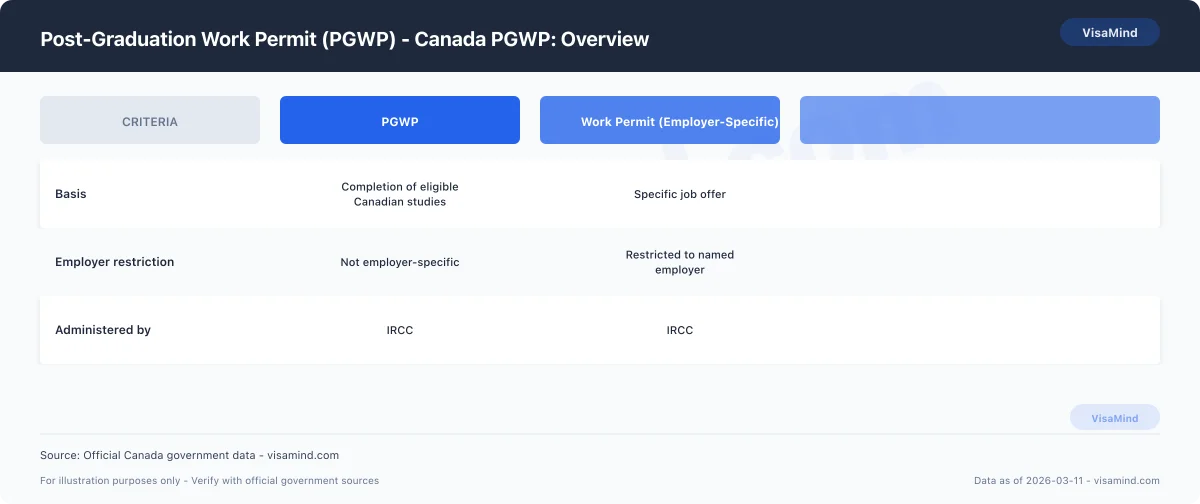
Unlike an employer-specific work permit, the PGWP does not tie you to one employer.
This flexibility helps you gain work experience that may support future immigration pathways such as the Canadian Experience Class (CEC) or programs managed under Express Entry (Federal Skilled Worker).
Basic Eligibility Requirements
To qualify, you must:
- Complete a program at a PGWP-eligible institution
- Meet all eligibility criteria at the time of application
- Hold valid documents when required
- Provide an official letter from your school confirming program completion (required for certain Quebec institutions)
- Submit a complete and signed IMM 5710 with supporting documents
If you complete an accelerated program, you may receive a PGWP valid for the full length of the original program.
Download the most current forms and instructions directly from IRCC before you apply.
Step-By-Step Application (Post-Graduation Work Permit)
#You must apply for your Post-Graduation Work Permit (PGWP) within 180 days of receiving confirmation that you completed your program.
Submit your application to Immigration, Refugees and Citizenship Canada (IRCC) before that deadline.
If you miss the 180-day window, IRCC can refuse your application.
Application Steps
-
Confirm you received official proof of program completion.
-
Complete Form IMM 5710 accurately.
-
Gather all required supporting documents, including any additional residence documents that apply to your situation.
-
Review special case instructions if your circumstances differ from standard eligibility.
-
Submit your application package to IRCC and include the completed document checklist on top if mailing.
Failure to include required documents can delay processing or lead to refusal.
Key Documents Checklist
- Completed IMM 5710
- Proof of program completion
- Copy of your Study Permit
- Any additional residence or status documents required for your case
- Completed document checklist (if submitting by mail)
| Requirement | What You Must Do |
|---|---|
| Application deadline | Apply within 180 days of program completion |
| Form | Submit IMM 5710 |
| Authority | Apply through IRCC |
| Supporting documents | Include all required and case-specific documents |
Do not confuse the PGWP with an employer-specific Work Permit.
Many graduates later use Canadian work experience to pursue permanent residence through programs such as the Canadian Experience Class (CEC) or Express Entry (Federal Skilled Worker).
Fees and Processing Times
#IRCC manages the Post-Graduation Work Permit application process.
You must submit Form Form IMM 5710 and pay the required fees when you apply.
Government Fees
| Fee Type | Amount (CAD) | Who Pays |
|---|---|---|
| Work Permit (including extensions) | CA$155 | Per person |
| Biometrics services fee | CA$85 | Per person (if required) |
You must pay the work permit fee for your PGWP application.
Biometrics fees apply if IRCC instructs you to provide fingerprints and a photo.
IRCC may offer a maximum CA$500 family fee in limited situations.
All family members must apply together, at the same place, and dependent children must qualify under IRCC rules.
Processing Times
The standard processing time for a Post-Graduation Work Permit is 2 to 5 months as of March 2026.
The processing times vary by category and location.
Your processing time:
-
Starts the day IRCC receives your complete application.
-
Ends when IRCC makes a decision.
If you apply from outside Canada or the United States, add 3 to 4 months for mailing time.
Non‑routine applications may take longer.
The processing times can also increase if application volumes exceed annual immigration targets.
If you later pursue permanent residence through the Canadian Experience Class (CEC) or Express Entry (Federal Skilled Worker), IRCC calculates those processing times separately from your PGWP.
When Self-Preparation Isn't Enough
#You must prove that you maintained full-time student status during every semester of your program.
If you cannot document this clearly, your Post-Graduation Work Permit application can face problems with Immigration, Refugees and Citizenship Canada (IRCC).
IRCC expects consistent records that match your Study Permit conditions.
Missing semesters, unclear transcripts, or gaps in enrollment raise concerns.
| Issue | Why It Matters |
|---|---|
| No proof of full-time status | IRCC may question your eligibility for a Post-Graduation Work Permit |
| Study Permit expired before you applied | You may lose status if you did not apply to restore it |
| Incomplete Form IMM 5710 | Processing delays or refusal |
You also risk refusal if you apply after your Study Permit expires without first applying to restore your status.
IRCC does not overlook expired status.
This becomes more serious if you plan to rely on your Post-Graduation Work Permit to gain experience for the Canadian Experience Class (CEC) or Express Entry (Federal Skilled Worker).
A refusal can interrupt that strategy.
You should consider professional help if:
- You are unsure whether every semester qualifies as full-time.
- Your Study Permit expired before submission.
- You previously held a Work Permit (Employer-Specific) and changed status.
- You are uncertain how to complete IMM 5710 correctly.
Errors at this stage affect more than your Post-Graduation Work Permit.
They can disrupt your long-term immigration plans.
From OWP to PR
#You typically move to a Post-Graduation Work Permit after completing your studies under a valid Study Permit.
This open work authorization lets you gain Canadian work experience.
To apply, you submit your application to Immigration, Refugees and Citizenship Canada (IRCC) using Form IMM 5710.
You must include proof that you completed your program at a designated learning institution.
Basic application elements
- Completed IMM 5710
- Proof of program completion
- Valid status in Canada at the time of application
Once you gain qualifying work experience, you can pursue permanent residence.
Permanent Residence Pathways After PGWP
| Pathway | How It Connects to PGWP |
|---|---|
| Canadian Experience Class (CEC) | Uses Canadian work experience gained on your Post-Graduation Work Permit |
| Express Entry (Federal Skilled Worker) | May apply if you meet program criteria |
| Provincial Nominee Program (PNP) | Province may nominate you based on work and residence |
You apply for these programs through IRCC.
Each pathway has its own eligibility rules and selection process.
If your situation changes, you may also consider a Work Permit (Employer-Specific).
This type of permit ties you to one employer instead of allowing open employment.
Your path usually follows this order:
-
Study Permit
-
Post-Graduation Work Permit
-
Permanent residence program (CEC, Express Entry, or PNP)
What You Can and Cannot Do
#You can apply for a Post-Graduation Work Permit if your Study Permit was valid at some point within the 180 days after you graduated and before you submitted your application to Immigration, Refugees and Citizenship Canada (IRCC).
If your study permit did not hold valid status at any time during that 180‑day window, you do not meet this requirement.
You must gather the required documents and complete the applicable forms before submission.
Download the official checklist, save it, and mark each item as you prepare your package.
| You Can Do | You Cannot Do |
|---|---|
| Apply if your study permit was valid at some point within 180 days after graduation | Apply if your study permit was never valid during that 180‑day period |
| Download and save the official document checklist | Submit an application without completing required forms |
| Check off each required item as you prepare your documents | Ignore missing documents or incomplete sections |
Follow a clear process:
-
Confirm your study permit was valid within the required 180‑day period.
-
Download and save the official checklist and forms.
-
Complete each form fully and gather all required documents.
-
Submit your application to IRCC.
If you later pursue programs such as the Canadian Experience Class (CEC) or Express Entry (Federal Skilled Worker), you must meet their separate requirements.
A Work Permit (Employer-Specific) follows different rules than a Post‑Graduation Work Permit.
Who Qualifies
#To qualify for a Post-Graduation Work Permit, you must meet specific requirements set by Immigration, Refugees and Citizenship Canada (IRCC).
You qualify only if you:
- Completed a program at a PGWP-eligible designated learning institution
- Finished a program that lasted at least 8 months
- Apply within 180 days of receiving confirmation that you completed your program
Your eligibility depends on meeting all of these conditions.
| Requirement | What You Must Show |
|---|---|
| Institution | School must be PGWP-eligible |
| Program Length | Minimum 8 months |
| Application Deadline | Within 180 days of completion confirmation |
| Application Authority | Submit to IRCC |
You must have held a valid Study Permit during your studies.
IRCC assesses your application after you apply, and approval is not automatic.
Filing a PGWP application does not guarantee that IRCC will issue a Work Permit.
In some cases, you or a family member may not qualify.
You submit your application to IRCC using the required form, such as Form IMM 5710, if you apply from inside Canada.
A Post-Graduation Work Permit is different from an Employer-Specific Work Permit.
It may also support future immigration pathways such as the Canadian Experience Class (CEC) or programs under Express Entry (Federal Skilled Worker), but eligibility for those programs follows separate rules set by IRCC.
Common Rejection Reasons
#IRCC often refuses a Post-Graduation Work Permit application because you submit incomplete or incorrect information.
Even small errors on Form IMM 5710 can delay or derail your case.
You must review the instructions that apply to your specific eligibility category before you apply.
Many applicants assume the same rules apply to every situation, including transitions from a Study Permit or another Work Permit (Employer-Specific).
The most frequent issues include:
- Missing required documents
- Leaving fields blank on IMM 5710
- Entering inconsistent personal details
- Submitting forms that do not match your eligibility category
Incomplete applications create delays and may lead to refusal.
| Issue | How It Affects Your Application |
|---|---|
| Missing documents | IRCC cannot assess eligibility |
| Incorrect form entries | Processing delays or refusal |
| Wrong eligibility category | Application assessed under incorrect criteria |
| Inconsistent information | Credibility concerns |
Errors at the Post-Graduation Work Permit stage can also affect long-term plans.
If you later apply through Canadian Experience Class (CEC) or Express Entry (Federal Skilled Worker), IRCC will review your prior records.
You protect your application by checking every field, confirming all required documents, and following the correct eligibility instructions.
Accuracy matters at every step.
Fees
#| Component | Amount |
|---|---|
| Filing fee (IMM-5710)Work permit extension/change conditions (in Canada). | CA$155 (approx $113 USD) |
| BiometricsBiometrics: CA$85 (approx $62 USD) (as of 2026-02). Verify the current fee on the official schedule before filing. | CA$85 (approx $62 USD) |
Fees change; always verify on IRCC.
Required forms
#Plan your Post-Graduation Work Permit (PGWP) with free Canada tools
#Itemized government fees for Post-Graduation Work Permit (PGWP) and other Canada categories.
See how your profile scores against Post-Graduation Work Permit (PGWP) and other Canada visas.
Typical wait times and stage breakdowns for Post-Graduation Work Permit (PGWP) and related Canada visas.
Common interview questions and feedback for Canada visa applicants.