
On this page
- Canada spousal sponsorship — Overview
- Fees and Processing Times
- The Two-Stage Process
- What to Submit
- Evidence Checklist
- Conditions and Rights
- Renewal and Extension
- Path to Permanent Residence
- When to Get Help
- Eligibility Requirements (sponsor spouse Canada)
- Relationship Scrutiny Red Flags
- Fees
- Required forms
- Related visa types
- Related guides
- Related goals
- Next steps
Canada spousal sponsorship — Overview
#Canada spousal sponsorship allows you to sponsor your spouse, common-law partner, or conjugal partner for permanent residence through IRCC. You must document your relationship and submit a full application package with the required forms and supporting evidence.
What this pathway covers
This pathway is for Canadian citizens or permanent residents who want to sponsor their partner for permanent residence. It’s central to Canada’s family reunification efforts.
You must show the relationship is genuine and meet IRCC’s eligibility requirements. The application typically includes:
- Form IMM 1344 (Application to Sponsor, Sponsorship Agreement and Undertaking)
- Form IMM 0008 (Generic Application Form for Canada)
- Form IMM 5669 (Schedule A – Background/Declaration)
- Form IMM 5406 (Additional Family Information)
- Form IMM 5532 (Relationship Information and Sponsorship Evaluation)
Your partner might have previously held temporary status, such as a Temporary Resident Visa (Visitor Visa), Study Permit, or employer-specific Work Permit. Sponsorship moves them from temporary status toward permanent residence.
| Key Element | Details |
|---|---|
| Authority | Immigration, Refugees and Citizenship Canada (IRCC) |
| Applicant | Spouse, common-law partner, or conjugal partner |
| Sponsor | Canadian citizen or permanent resident |
| Outcome | Permanent residence |
| Processing time | 12–24 months (verify with IRCC) |
Where it fits in family reunification
Spousal sponsorship is a mainstay of Canada’s family class programs. It’s distinct from Parent and Grandparent Sponsorship, which covers a different family relationship and has separate criteria.
If your parents or grandparents want to visit Canada temporarily, they might look at the Super Visa (Parents and Grandparents). That visa doesn’t lead to permanent residence.
Spousal sponsorship is specifically for partners and, if approved, leads directly to permanent residence. Prior temporary status in Canada isn’t required, though it’s common.
IRCC reviews both sponsorship eligibility and the applicant’s admissibility. The Canada Border Services Agency (CBSA) handles admissibility at the border.
Typical next steps after applying
Once you submit a complete package to IRCC, you wait for processing and respond to any document requests. Delays often come from missing forms or incomplete information.
During processing, your partner might be eligible for a Spousal Open Work Permit, depending on their situation. This permit allows work for most employers while the permanent residence application is pending.
You’ll want to keep your IRCC account updated and respond quickly if IRCC requests updated forms or documents.
When IRCC approves the application, your partner completes final steps to become a permanent resident. At that point, they receive confirmation of permanent resident status under Canadian immigration law.
Fees and Processing Times
#You’ll need to pay government fees and complete biometrics before IRCC processes your spousal sponsorship application. Processing times depend on the category, where the application is handled, and IRCC’s service standards.
Fees and biometrics
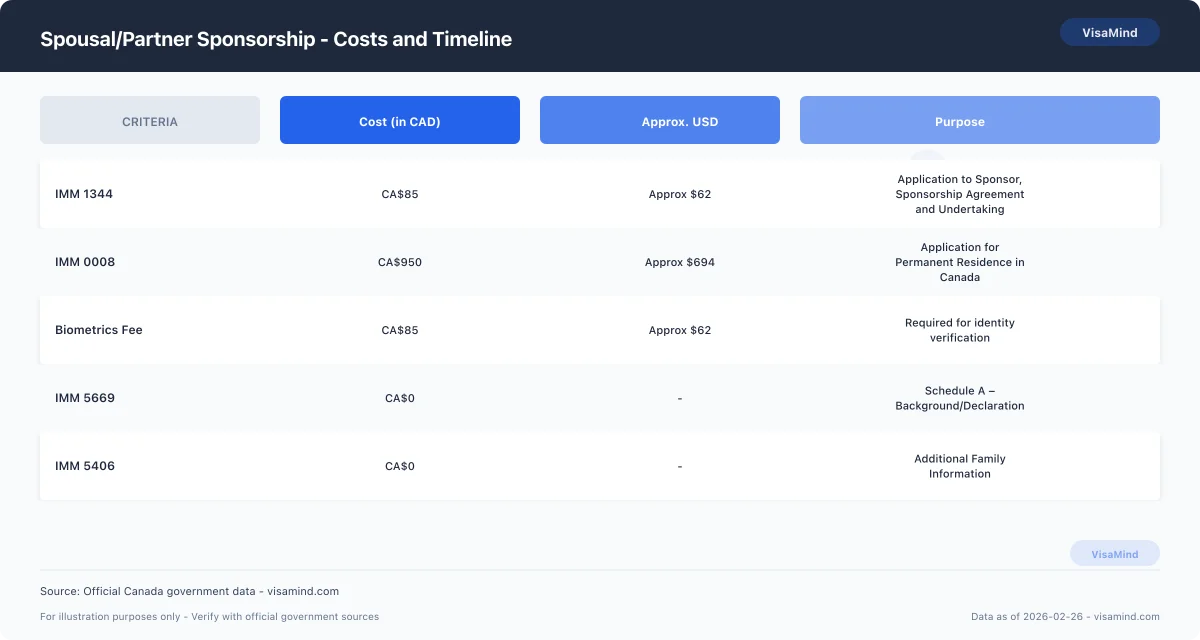
IRCC charges separate fees for sponsorship, permanent residence processing, and biometrics. You pay these fees when you submit your application package, which usually includes Form IMM 1344, Form IMM 0008, Form IMM 5669, Form IMM 5406, and Form IMM 5532.
| Fee Type | Amount (CAD) |
|---|---|
| Sponsorship fee (IMM 1344) | CA$85 |
| Permanent residence processing fee (IMM 0008) | CA$1,525 |
| Biometrics fee | CA$85 |
Biometrics involves fingerprints and a photo. Most applicants complete this step after IRCC sends instructions.
If you apply for a Spousal Open Work Permit at the same time, separate work permit fees apply. Use the IRCC fee calculator to confirm current amounts.
Other family programs, such as Parent and Grandparent Sponsorship or the Super Visa (Parents and Grandparents), use different fee structures.
Processing time estimates
Spousal sponsorship processing usually takes 12 to 24 months as of March 2026, for complete applications.
Processing times vary by:
- Application category
- Processing location
- Annual immigration levels and application volume
IRCC aims to finalize most complete applications within its published time. If more people apply than Canada can admit that year, processing can slow.
If you’re applying from outside Canada and the United States, add 3 to 4 months for mailing and document transmission.
How processing time is calculated
Processing time starts when IRCC receives your complete application. It ends when IRCC makes a decision on your permanent residence file.
IRCC calculates its posted time based on how long it took to process applications submitted in a specific month and year. It’s an estimate, not a guarantee.
If your package is incomplete—say, missing signatures on IMM 1344 or answers on IMM 5532—IRCC may return it. The clock doesn’t start until you resubmit a complete application.
IRCC updates processing times regularly.
The Two-Stage Process
#
Spousal sponsorship requires submitting a sponsorship application and a permanent residence application together to IRCC. You and your spouse each complete specific forms, sign them digitally, validate them, and submit a full package to the correct processing centre.
Select the correct application type
Choose the application package for “Sponsoring your spouse, common-law partner, conjugal partner or dependent child.” Don’t confuse this with other family programs like Parent and Grandparent Sponsorship or the Super Visa (Parents and Grandparents).
Spousal sponsorship is a permanent residence pathway. It’s not the same as a Spousal Open Work Permit, which may be available separately but doesn’t replace the sponsorship application.
Here’s a quick comparison:
| Program | Purpose | Permanent Residence? |
|---|---|---|
| Spousal Sponsorship | Sponsor spouse or partner | Yes |
| Parent and Grandparent Sponsorship | Sponsor parents or grandparents | Yes |
| Super Visa (Parents and Grandparents) | Long-term temporary visits | No |
Selecting the wrong category leads to delays or rejection. Check the package title before downloading forms from IRCC.
Sponsor vs principal applicant responsibilities
You and your spouse fill out different forms, and IRCC expects each person to sign the right documents electronically.
The sponsor completes and digitally signs:
- Form IMM 1344 – Application to Sponsor, Sponsorship Agreement and Undertaking
The principal applicant (person being sponsored) completes:
- Form IMM 0008 – Generic Application Form for Canada
- Form IMM 5669 – Schedule A
- Form IMM 5406 – Additional Family Information
- Form IMM 5532 – Relationship Information and Sponsorship Evaluation
If there’s a co-signer, they must also digitally sign IMM 1344.
| Role | Main Responsibility |
|---|---|
| Sponsor | Submits sponsorship undertaking (IMM 1344) |
| Principal Applicant | Applies for permanent residence (IMM 0008 and supporting forms) |
| Co-signer (if any) | Signs IMM 1344 |
Answer every required question unless a section clearly says otherwise. Incomplete answers can cause processing delays.
Download, sign, validate and submit
Download the forms directly from the IRCC website and complete them on your computer. Use Adobe Acrobat Reader, not a browser preview.
Steps to follow:
-
Complete all required fields.
-
Click the “Validate” button on applicable forms.
-
Fix any flagged errors.
-
Provide electronic signatures from the sponsor, co-signer (if applicable), and principal applicant.
-
Gather all required supporting documents.
-
Submit the complete application to the correct IRCC processing centre for your location.
Validation creates barcode pages on certain forms. Don’t skip this step.
Before submitting, check that all personal details are current and consistent across forms. Even small discrepancies in names, dates, or addresses can slow processing or cause IRCC to return the application.
What to Submit
#You must provide complete identity details, clear proof of your relationship, and accurate information about any dependants. IRCC reviews all forms and supporting documents together, and inconsistencies or missing details can delay processing.
Identity and biographical details
You and your spouse or partner must submit full legal names, including family name(s) and given name(s), exactly as they appear on your identity documents. Use consistent spelling across all forms: Form IMM 1344, Form IMM 0008, Form IMM 5669, and Form IMM 5406.
Provide:
- Current marital status of the sponsor
- Details of any previous marriages or common-law relationships
- Biographical details for both sponsor and principal applicant
- Identification documents for both parties
IRCC checks the information in your forms to confirm identity and personal history.
| Required Item | Who Provides It |
|---|---|
| Full legal name | Sponsor and principal applicant |
| Marital status | Sponsor |
| Previous relationship history | Sponsor |
| Biographical details | Both |
| Identification documents | Both |
Dates and names must match across all submitted forms.
Relationship details and marital history
You must explain your relationship to the sponsored person and provide accurate details about how your relationship developed. Confirm your current marital or common-law status.
Form Form IMM 5532 focuses on the history and authenticity of your relationship. Complete it carefully and keep answers consistent with your other forms.
Include:
- Your relationship type (spouse or partner)
- Date and place of marriage, if applicable
- Information about any prior marriages or relationships
- Evidence that your relationship is genuine
If either of you had previous marriages or partnerships, disclose them fully. Incomplete disclosure can cause issues during IRCC review.
Keep your relationship timeline consistent across all documents.
Dependants and contact information
If you include dependants, list each person accurately in IMM 0008 and related forms. Provide full legal names, biographical details, and current contact information.
Submit:
- Names and dates of birth of all dependants
- Relationship to the principal applicant
- Current address and contact details
- Any required identification documents
Use IMM 5406 to declare additional family information as needed.
| Information Category | Details Required |
|---|---|
| Dependants | Full name, date of birth |
| Relationship | Child or other declared dependant |
| Contact details | Current address and contact information |
| Identity documents | As required for each person |
Keep contact information current throughout processing. IRCC uses these details to communicate about your application.
Evidence Checklist
#You must submit clear proof of your relationship, identity, and admissibility. IRCC reviews your forms and supporting documents together, and missing records or inconsistencies can delay processing.
Relationship evidence and legal documents
IRCC expects objective proof that your relationship is genuine and legally valid. Required forms and civil documents must be included with your application.
Core application forms:
| Form | Who completes it | Purpose |
|---|---|---|
| Form IMM 1344 | Sponsor | Sponsorship application and undertaking |
| Form IMM 0008 | Sponsored person | Generic permanent residence application |
| Form IMM 5669 | Sponsored person | Background and declaration |
| Form IMM 5406 | Sponsored person | Additional family information |
| Form IMM 5532 | Both | Relationship information and sponsorship evaluation |
You’ll need to provide documents confirming your marital status and relationship history. These include:
- Marriage certificate or proof of legal marriage
- Documents confirming any divorce, annulment, or legal name change
- Joint financial records or shared obligations
- Proof of sponsor’s status in Canada, including UCI and date of becoming a permanent resident or citizen
If you don’t know a full date of birth, add a written explanation. All contact information should match across your forms.
This process is different from Parent and Grandparent Sponsorship or a Super Visa (Parents and Grandparents). Only submit documents relevant to spousal sponsorship.
Medical and admissibility documentation
The sponsored person and all dependent family members must complete medical examinations as required by IRCC. Provide confirmation of updated medical results if requested.
Medical results need to match the personal details on IMM 0008 and IMM 5669. Any discrepancy in names, dates of birth, or family composition can cause delays.
Answer all background and declaration questions fully and truthfully. IRCC handles admissibility, while the Canada Border Services Agency (CBSA) enforces decisions at the border.
If your spouse applies for a Spousal Open Work Permit, keep copies of your sponsorship submission and IRCC acknowledgment. Officers might ask for proof that a complete sponsorship application is in process.
Report changes in marital status, address, or family composition immediately through the appropriate IRCC web form.
Updates, custodial and identity documents
Keep your application current from submission to final decision. Any change in address, contact details, or representation requires prompt notification.
If you appoint or change a representative, update the Use of a Representative (IMM 5476) form. Ensure mailing and residential addresses are consistent.
Provide identity and civil status documents for all family members included in the application:
- Government-issued identification
- Legal custody documents for dependent children, if applicable
- Court orders or agreements related to child custody
- Documents confirming changes in marital status
Use this checklist before submission:
-
Confirm all forms are complete and signed.
-
Verify that names and dates of birth match across every document.
-
Include proof of sponsor’s Canadian status and UCI.
-
Attach custody or marital status change documents, if relevant.
Incomplete or outdated records often lead to return or delay by IRCC.
Conditions and Rights
#When you file a Canada spousal sponsorship application, you take on legal and practical responsibilities. IRCC reviews your financial capacity, admissibility, and ongoing compliance before granting approval.
Filing doesn’t guarantee a positive decision.
Sponsor obligations and financial undertakings
Submitting forms like Form IMM 1344, Form IMM 0008, Form IMM 5669, Form IMM 5406, and Form IMM 5532 means you’re confirming you can support your spouse or partner financially. IRCC may reassess your financial situation if it changes during processing.
You must:
- Maintain the ability to support your spouse or partner
- Report significant changes to your financial circumstances
- Respond promptly to any IRCC document requests
If your income, employment, or family situation changes after submission, update IRCC. Failure to do so can delay processing or affect the outcome.
Submitting a spousal sponsorship does not guarantee approval. IRCC verifies all information before making a decision.
| Obligation | What You Must Do |
|---|---|
| Financial support | Show you can support your spouse/partner |
| Document requests | Respond within IRCC deadlines |
| Changes in circumstances | Notify IRCC without delay |
Other family programs, such as Parent and Grandparent Sponsorship or the Super Visa (Parents and Grandparents), involve separate requirements and don’t transfer to a spousal file.
Admissibility: criminal, security and health
IRCC assesses whether your spouse or partner — and all accompanying family members — meet admissibility requirements. This covers criminal, security, and health screening.
Every listed family member must complete required checks. Medical examinations must be valid for all family members at the same time.
If one medical expires, IRCC may request new exams.
You must ensure:
- No unresolved criminal or security concerns
- Valid medical exams for each family member
- Accurate disclosure on forms such as IMM 5669
IRCC reviews these factors before approving permanent residence. At the border, CBSA makes final admissibility determinations.
If your spouse applies for a Spousal Open Work Permit during processing, admissibility requirements still apply.
| Screening Type | Who Is Assessed | Key Requirement |
|---|---|---|
| Criminal | Applicant and family members | No disqualifying issues |
| Security | Applicant and family members | Clearance required |
| Medical | All family members | Exams valid at the same time |
Keeping your information current
Your application must stay accurate from submission to decision. IRCC expects timely updates if anything changes.
Report changes such as:
- A new dependant
- A dependant turning 18
- Marital status changes
- Updated contact information
If a child turns 18 or your family structure changes, IRCC may require updated forms or documents. Delays in reporting can slow processing or affect eligibility.
Respond quickly to any additional document requests. Ignoring requests or missing deadlines can result in refusal.
Use your IRCC account or the official communication channel provided in your file to submit updates. Keep copies of everything you send.
Renewal and Extension
#When extending status or renewing a related permit during spousal sponsorship, pay the correct fees and ensure all required documents remain valid at the same time. IRCC won’t finalize an extension if key items, like medical exams, expire mid‑process.
Group fee and work-permit fee notes
If you apply for a Spousal Open Work Permit or extend a work permit while your sponsorship (for example, forms Form IMM 1344, Form IMM 0008, Form IMM 5669, Form IMM 5406, Form IMM 5532) is in process, you must pay the applicable IRCC work permit fee.
Standard fee
| Type of application | Fee (CAD) |
|---|---|
| Work permit (including extension) – per person | CA$155 |
IRCC charges this amount per applicant. Each person requesting a new or extended work permit must pay separately unless a specific group category applies.
Maximum group fee (CA$500) applies only if:
- All family members apply at the same time and place
- All children qualify as dependants
- You meet IRCC’s definition for the group fee category
If you don’t meet every condition, IRCC will require individual payments.
For current sponsorship or permanent residence processing fees, including programs such as Parent and Grandparent Sponsorship or a Super Visa (Parents and Grandparents), refer to the IRCC fee schedule.
Timing and validity of medical exams
IRCC requires medical exams for all applicants to remain valid at the same time.
This rule matters when:
- You submit a renewal or extension while sponsorship is in progress
- You include dependent children in your application
- You apply together as a family group
If one family member’s medical exam expires, IRCC may require a new exam before continuing processing.
| Requirement | Key rule |
|---|---|
| Multiple applicants | All medical exams must be valid concurrently |
| Extensions | Expired medicals can delay approval |
Check the validity dates carefully before you apply. Try to align renewal timing so that no required medical expires during processing.
Path to Permanent Residence
#You move from sponsorship approval to permanent resident status through a structured IRCC process. It’s all about complete forms, eligibility confirmation, and final admissibility checks.
Pathway progression
Begin by submitting a complete sponsorship and permanent residence package to Immigration, Refugees and Citizenship Canada (IRCC). Key forms typically include:
- Form IMM 1344 – Application to Sponsor, Sponsorship Agreement and Undertaking
- Form IMM 0008 – Generic Application Form for Canada
- Form IMM 5669 – Schedule A: Background/Declaration
- Form IMM 5406 – Additional Family Information
- Form IMM 5532 – Relationship Information and Sponsorship Evaluation
IRCC first assesses you as the sponsor. If approved, IRCC then assesses your spouse or partner for permanent residence.
Under the standard stream, processing currently ranges from 12 to 24 months. Times vary by category and processing location.
If your family situation changes during processing, you must inform IRCC. Programs such as Parent and Grandparent Sponsorship and the Super Visa (Parents and Grandparents) operate separately and don’t affect your spousal file.
| Stage | What IRCC Reviews | Outcome |
|---|---|---|
| Sponsor assessment | Eligibility under IMM 1344 | Sponsorship approval or refusal |
| Applicant assessment | Forms, background, relationship evidence | Permanent residence decision |
Typical post-application steps
After submission, IRCC reviews your file for completeness and eligibility. If anything is missing, IRCC may return the application or request additional documents.
You must respond within the deadline given. Delays in responding extend processing.
If your spouse or partner is in Canada, you may consider applying for a Spousal Open Work Permit while the permanent residence application is in process. This is a separate application assessed by IRCC.
Your spouse or partner must remain admissible to Canada. Canada Border Services Agency (CBSA) officers make final admissibility determinations at the port of entry.
Monitor your application status and keep copies of everything you submit.
-
Submit complete application package.
-
Receive acknowledgment from IRCC.
-
Respond to any document requests.
-
Wait for final decision within the stated processing range.
When to Get Help
#Consider professional help if your case involves unusual facts, missing information, or repeated requests from Immigration, Refugees and Citizenship Canada (IRCC). Early guidance can prevent delays, returned applications, or refusals tied to technical errors.
Special processing situations
Seek help if IRCC classifies your file as non‑routine or can’t provide accurate processing times for your situation. This sometimes occurs in evolving international situations or when the applicant lives outside Canada in complex circumstances.
You should also get advice if:
- You plan to apply for a Spousal Open Work Permit at the same time.
- Your family has prior or pending applications, such as Parent and Grandparent Sponsorship or a Super Visa (Parents and Grandparents).
- You sponsor a minor (under 18) who lives outside Canada.
Timing and document coordination matter in these cases. A mistake in one file can affect another. An experienced representative can align forms, supporting documents, and declarations so IRCC receives consistent information across all applications.
If IRCC requests additional documents or clarification, respond precisely and on time. Delays or incomplete responses can extend processing.
Technical and filing problems
Most delays stem from incomplete or inconsistent forms. Get help if you feel unsure about any required form or supporting document.
Key forms in spousal sponsorship include:
| Form | Purpose | Common Issue |
|---|---|---|
| Form IMM 1344 | Sponsorship application | Missing signatures |
| Form IMM 0008 | Generic permanent residence application | Incomplete personal history |
| Form IMM 5669 | Schedule A – Background/Declaration | Gaps in address or work history |
| Form IMM 5406 | Additional Family Information | Omitted relatives |
| Form IMM 5532 | Relationship information | Inconsistent timelines |
Two frequent causes of delay are:
- Incomplete or incorrect information
- Missing or inconsistent family member details
List every family member exactly as required, even if they’re not immigrating. Omissions can lead to refusal, not just delay.
If you receive repeated return notices or can’t determine why IRCC flagged your file, seek legal review before resubmitting.
Expert tips and common advice
You lower risk by following IRCC instructions line by line. Don’t rely on memory or informal advice from friends.
Before submitting, confirm that you:
-
Completed every required field on each form.
-
Included all documents listed in the checklist.
-
Declared all family members consistently across IMM 5406 and IMM 5532.
-
Reviewed personal history for date gaps.
If your case involves overlapping applications, prior refusals, or complex travel history, get professional input before filing. Fixing errors after submission tends to take longer than preparing the application correctly the first time.
For current processing times and application instructions, consult Immigration, Refugees and Citizenship Canada (IRCC).
Eligibility Requirements (sponsor spouse Canada)
#To sponsor your spouse or common-law partner, you must meet strict status and screening requirements set by Immigration, Refugees and Citizenship Canada (IRCC). You also must complete and sign specific forms and confirm key declarations about your eligibility.
Sponsor eligibility criteria
You qualify as a sponsor only if you meet all core requirements.
- You are a Canadian citizen or permanent resident.
- You live in Canada at the time you apply.
- You answer “Yes” to the first three eligibility questions on the sponsorship assessment.
- You complete all required questions unless instructed otherwise.
Only your spouse or common-law partner may co-sign the sponsorship if a co-signer is permitted.
No other family member can co-sign.
You must also submit the required forms, which typically include:
| Form | Purpose |
|---|---|
| Form IMM 1344 | Application to Sponsor and Undertaking |
| Form IMM 0008 | Generic Application for Permanent Residence (completed by the applicant) |
| Form IMM 5669 | Schedule A – Background/Declaration |
| Form IMM 5406 | Additional Family Information |
| Form IMM 5532 | Relationship Information and Sponsorship Evaluation |
You must provide evidence of your relationship and disclose any changes that occur after filing.
IRCC reviews both your eligibility and your spouse’s admissibility before approval.
Disqualifying answers and screening
Certain answers automatically prevent you from sponsoring.
- If you answer “No” to questions 1–3, you are not eligible to sponsor. You should not submit the application.
- If you answer “Yes” to any question between 6 and 15, you may be ineligible.
The form requires you to review these questions carefully before you proceed.
If you do not meet the requirements, you must select the option that indicates how you wish to proceed.
IRCC screens both you and your family members for eligibility issues.
A problem affecting you or a family member can impact the application.
Do not confuse this process with other programs such as Parent and Grandparent Sponsorship or the Super Visa (Parents and Grandparents).
Each program has separate criteria and screening questions.
What the sponsor must confirm on the form
When you sign IMM 1344, you confirm that all answers are complete and accurate.
You must answer every required question.
You also confirm:
-
You meet the sponsorship eligibility requirements.
-
You understand that ineligible answers can lead to refusal.
-
You will provide supporting documents proving your relationship.
-
You will inform IRCC of any material changes after submission.
Your spouse completes their own required forms, including IMM 0008, IMM 5669, and IMM 5406.
They also provide detailed relationship information on IMM 5532.
If your spouse applies for a Spousal Open Work Permit, that request is assessed separately.
Your sponsorship eligibility still affects the overall application.
Relationship Scrutiny Red Flags
#IRCC reviews your forms for accuracy, completeness, and internal consistency.
Small errors, missing signatures, or unexplained gaps can trigger returns, delays, or refusal for incomplete information.
Common application mistakes
IRCC frequently returns spousal sponsorship applications because applicants overlook basic technical steps.
You must complete every required field on forms such as Form IMM 1344, Form IMM 0008, Form IMM 5669, Form IMM 5406, and Form IMM 5532.
If a question does not apply, follow the form instructions rather than leaving it blank.
Common errors include:
- Failing to digitally sign and date the application
- Skipping the “Validate” button before submission
- Using the wrong version of Adobe Acrobat Reader to open and complete forms
- Entering the principal applicant’s name incorrectly or inconsistently
- Submitting forms without electronic signatures where required
If you do not sign electronically, IRCC will return the entire package.
Use this quick checklist before submission:
| Requirement | What to Confirm |
|---|---|
| Digital signatures | All required signatures are completed |
| Validation | Each form shows barcodes after validation |
| Required fields | No unanswered mandatory questions |
| Names | Spelling matches across all forms |
Double-check every field and document against the official instructions before you submit.
Missing or inconsistent family details
IRCC compares family information across multiple forms.
If details conflict, officers may question credibility.
Forms such as IMM 5406 (Additional Family Information) and IMM 5669 (Schedule A) must match the information provided in IMM 0008 and IMM 5532.
Even small inconsistencies in names, dates, or relationships can raise concerns.
Pay close attention to:
- Full legal names, including middle names
- Date of birth entries
- Family member listings
- Prior marital history
If you cannot provide a date of birth, include a written explanation.
Do not leave the field blank without clarification.
You must also ensure that family information aligns with any related applications, such as a Spousal Open Work Permit, Parent and Grandparent Sponsorship, or a Super Visa (Parents and Grandparents), if applicable.
IRCC expects consistency across all records it holds for you.
How incomplete evidence causes delays or denial
IRCC may delay or refuse your application if you provide incomplete or inaccurate information.
When required fields remain blank, signatures are missing, or validation steps are skipped, IRCC typically returns the application rather than processing it.
This resets your timeline and forces you to resubmit.
If you provide inaccurate information, IRCC can deny the application for failure to supply complete and accurate details.
To reduce risk:
-
Review each form line by line.
-
Confirm all required documents appear in your package.
-
Ensure all electronic signatures are properly applied.
-
Validate every form before uploading or printing.
Accuracy and completeness directly affect whether IRCC processes your application or sends it back.
Fees
#| Component | Amount |
|---|---|
| Filing fee (IMM-1344)Sponsorship application. Plus $545 principal + $575 RPRF for spouse/partner. | CA$85 (approx $62 USD) |
| Filing fee (IMM-0008)Includes processing fee ($950) + Right of Permanent Residence Fee ($575). Spouse: $1,525. Dependent child: $260. | CA$1,525 (approx $1,113 USD) |
| BiometricsBiometrics: CA$85 (approx $62 USD) (as of 2026-02). Verify the current fee on the official schedule before filing. | CA$85 (approx $62 USD) |
Fees change; always verify on IRCC.
Next steps
#Use Find My Visa to build a sequenced plan with official sources and deadlines.
FAQs
What are the basic eligibility requirements to sponsor?
You must meet IRCC’s eligibility criteria before you apply.
- You submit Form IMM 1344 and required supporting documents.
- You meet IRCC’s sponsorship requirements.
- You include all required permanent residence forms for your spouse.
Is this the same as Parent and Grandparent Sponsorship?
No. Parent and Grandparent Sponsorship is a separate program.
The Super Visa (Parents and Grandparents) is different and doesn’t grant permanent residence.
Each program has distinct requirements and forms under IRCC.
What is Canada spousal sponsorship?
It is the form/pathway used to sponsor a spouse or common-law partner for immigration to Canada and is a primary step in family reunification under IRCC rules.
Who can act as a sponsor?
A sponsor must be a Canadian citizen or permanent resident living in Canada; there are screening questions that can make someone ineligible and only a spouse or common-law partner can co-sign when applicable.
Who can be sponsored under this pathway?
This pathway applies to a sponsor wishing to sponsor their spouse, common-law partner, or conjugal partner for permanent residence in Canada.
How long does a spousal sponsorship application typically take?
Processing times vary by category and location; standard spousal-sponsorship processing is typically in the 12–24 month range — always verify current processing times with the issuing authority.
What fees are payable for a spousal sponsorship application?
Fees include the sponsorship filing fee (IMM-1344) of CA$85, the principal application fee (IMM-0008) of CA$1,525, and biometrics at CA$85 (amounts as of the stated date).
What evidence should I include to prove the relationship?
Include relationship evidence such as a marriage certificate or joint financial documents and compiled relationship documentation as indicated on the form and evidence checklist.
Are medical exams required?
Medical exams are required and must be valid for all applicable family members at the same time; updated medical exams may be requested for applicants and dependents.
What happens if the forms are not signed or validated correctly?
Failing to digitally sign and date the application, not completing required fields, or missing the validation step can cause the application to be returned and lead to delays or rejection.
Can a sponsored spouse work while waiting for a decision?
A common next step after filing spousal sponsorship can be applying for a Spousal Open Work Permit.
Does filing a spousal sponsorship guarantee approval?
No — filing a spousal sponsorship application does not guarantee approval; failure to provide complete and accurate information can lead to denial.
Official sources referenced
Last reviewed: 2026-03-11
VisaMind provides informational guidance only and is not a government agency. This is not legal advice. Requirements can change and eligibility depends on your specific facts. If your case is complex or high-stakes, consult a licensed immigration attorney.
Next steps
Every Canada visa case depends on your nationality, purpose, and timeline. Get a personalized plan with official sources and deadlines.
Get my Spousal/Partner Sponsorship plan