When to Read This
#The EU Blue Card is designed for foreign academics and individuals with comparable qualifications who wish to work in Germany. This visa type is particularly suitable for skilled workers with a university degree, offering a streamlined path to employment in Germany. For those considering the Skilled Worker Visa, it's essential to understand how these options differ to make an informed decision. If you hold a recognized degree and have a job offer that meets the salary threshold, the EU Blue Card could be your best option. It not only facilitates entry into the German job market but also offers a pathway to permanent residency. However, if your qualifications are more vocational or you find yourself in a shortage occupation, the Skilled Worker Visa might be more appropriate due to its broader criteria. Compare the requirements for the EU Blue Card and the Skilled Worker Visa to determine which aligns best with your qualifications and career goals. For employers in Germany looking to hire talent from outside the EU, understanding the differences between the EU Blue Card and the Skilled Worker Visa is required. The EU Blue Card is ideal for roles requiring a high level of academic qualification, while the Skilled Worker Visa can accommodate a wider range of professions, including those in shortage occupations. Ensure that the salary offered meets the required threshold for the visa type you choose to sponsor. The Federal Employment Agency may provide approval for lower salaries in certain shortage occupations. Students in Germany nearing graduation should consider which visa aligns with their career path. If your degree is recognized under German standards and you have a job offer, the EU Blue Card could be a direct route to employment. Alternatively, the Skilled Worker Visa may offer more flexibility in terms of job roles and qualifications, especially if you are in a field experiencing a labor shortage. Consult the Blue Card EU and Skilled Worker visa pages for detailed criteria and application processes.
What People Get Wrong
#In 2026, Germany issued over 50,000 EU Blue Cards, making it a popular destination for skilled workers. Yet, many applicants face confusion when choosing between the EU Blue Card and the Skilled Worker Visa.
Salary Threshold Confusion
A common misconception is that both the EU Blue Card and Skilled Worker Visa have the same salary requirements. However, this is not the case. - The EU Blue Card requires a minimum salary of €50,700 as of 2026, but a lower threshold of €45,934.20 applies for shortage occupations. - The Skilled Worker Visa does not have a specific salary threshold, but the job offer must meet local wage standards and be approved by the Federal Employment Agency.
Tip: Check the current salary thresholds on the Federal Office for Migration and Refugees (BAMF) website to ensure compliance.
Misunderstanding Job Qualifications
Applicants often believe that any job offer in Germany qualifies them for these visas. This is a misconception. - For the EU Blue Card, the job must match your academic qualifications and be at a graduate level. - The Skilled Worker Visa requires a job offer relevant to your professional qualifications, which may be trade or vocational in nature.
Important: Ensure your job offer aligns with your qualifications to avoid application issues.
Assumptions About Permanent Residency
Many people assume that obtaining either visa directly leads to permanent residency, but this is not automatically the case. - The EU Blue Card can lead to permanent residency after 21 months if you demonstrate adequate German language skills, or after 33 months without. - The Skilled Worker Visa does not directly lead to permanent residency, but it allows you to work towards it by fulfilling residency requirements over time.
Tip: Explore the EU Blue Card and Skilled Worker Visa pages for details on permanent residency pathways.
Key Differences Explained
#Germany is an attractive destination for skilled workers from around the world. Two popular pathways for gaining employment in Germany are the EU Blue Card and the Skilled Worker Visa. While both options facilitate employment, they cater to different profiles and have distinct requirements.
Eligibility Requirements Overview
The EU Blue Card is primarily designed for foreign academics and individuals with comparable qualifications aiming to work in Germany. To qualify, you must possess either a German academic qualification or a foreign degree that is recognized as equivalent in Germany. Alternatively, IT specialists with substantial work experience may also be eligible even without formal academic credentials. On the other hand, the Skilled Worker Visa is open to a broader range of professionals, including those with vocational training. This visa requires proof of a recognized qualification or adequate professional experience relevant to the job offer. - EU Blue Card: Requires a university degree or equivalent. - Skilled Worker Visa: Recognized qualification or vocational training.
Important: Ensure your foreign qualifications are verified for comparability to German standards. This is key for both visa types to avoid application pitfalls.
Salary and Job Offer Criteria For the
EU Blue Card, a critical requirement is meeting the salary threshold, which is updated annually. As of 2026, the minimum gross annual salary is €50,700, but a lower threshold of €45,934.20 applies for shortage occupations if approved by the Federal Employment Agency. In contrast, the Skilled Worker Visa does not have a specific salary threshold but requires a job offer that reflects your qualifications and experience. This ensures that the employment conditions meet German standards.
| Visa Type | Salary Criteria |
|---|---|
| EU Blue Card | €50,700/year (or €45,934.20 for shortage occupations) |
| Skilled Worker Visa | No specific threshold; must meet German standards |
Permanent Residency Pathways
Both visas offer pathways to permanent residency, but the requirements differ. Holders of the EU Blue Card can apply for permanent residency after 33 months of employment in Germany, or after 21 months if they demonstrate sufficient German language skills (B1 level). Skilled Worker Visa holders can also transition to permanent residency, typically after five years of residing and working in Germany, provided they meet other integration and language requirements. - EU Blue Card: 33 months (21 months with B1 German)
- Skilled Worker Visa: Typically 5 years
Tip: For expedited permanent residency with an EU Blue Card, focus on improving your German language proficiency to at least B1 level.
When to Pick the First Option
#The EU Blue Card is a popular choice for non-EU nationals with high qualifications seeking work in Germany. It offers benefits such as a fast track to permanent residency and is particularly advantageous for high salary professionals. Understanding when to choose the EU Blue Card over other options like the Skilled Worker Visa can significantly impact your career path and residency prospects in Germany.
High Salary Professionals
For professionals with high salaries, the EU Blue Card is often the preferable option. This is due to its requirement for a minimum salary threshold, which ensures that it targets those with substantial earning potential. - You earn at least €50,700 annually as of 2026, which meets the salary threshold for the EU Blue Card. - Your occupation is in a shortage field, allowing you to qualify with a reduced salary threshold of €45,934.20.
Tip: Check if your job falls under a shortage occupation, as this can lower the salary requirement for the EU Blue Card.
Fast-Track to Permanent Residency The EU Blue
Card provides a quicker route to permanent residency compared to other visas. After 33 months of holding an EU Blue Card, you can apply for a settlement permit. This period can be reduced to 21 months if you demonstrate adequate German language skills.
-
Obtain the EU Blue Card and start working in Germany.
-
Complete 33 months of employment, or 21 months with B1 level German.
-
Apply for a settlement permit at the Ausländerbehörde.
Important: Achieving B1 level in German can significantly speed up your path to permanent residency under the EU Blue Card.
Specialized Job Roles
Certain specialized roles are more suited for the EU Blue Card due to its focus on academic qualifications and specific job offers. If you hold a recognized university degree and have a job that matches your expertise, the EU Blue Card is a suitable choice. - You have a university degree recognized in Germany. - Your job offer is directly related to your qualifications.
Important: Ensure your foreign degree is comparable to a German one to avoid complications in your application for the EU Blue Card.
Side-by-Side Comparison
#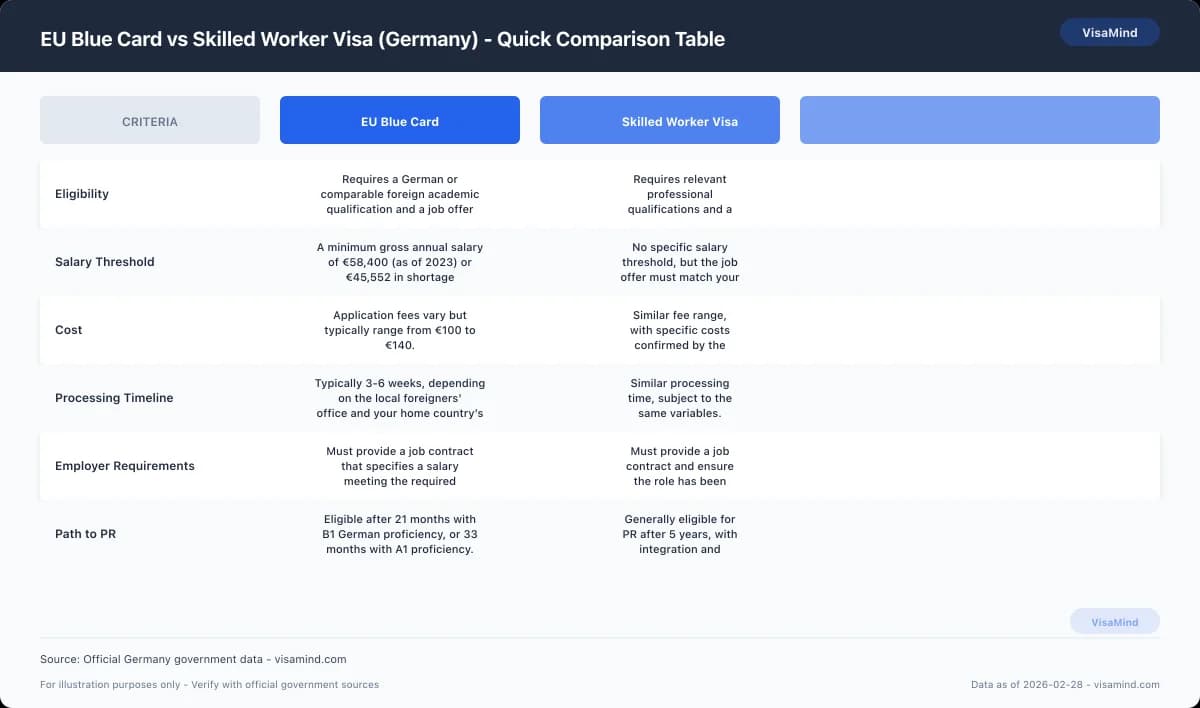
Germany's EU Blue Card and Skilled Worker Visa both provide pathways for professionals seeking employment in the country, yet they cater to different applicant profiles. The EU Blue Card is particularly tailored for those with a higher academic level, while the Skilled Worker Visa is more accessible to varied skill sets. Understanding the distinctions between these two visa types is necessary in determining which option aligns with your qualifications and career goals. Both visas offer unique opportunities and have distinct eligibility criteria, costs, and processes.
Eligibility Criteria Breakdown
| Criteria | EU Blue Card | Skilled Worker Visa |
|---|---|---|
| Qualification | Recognized academic qualification or equivalent (F1, F10) | Vocational training or recognized qualification |
| Job Offer | Required, matching qualifications and salary threshold (F3, F11) | Required, relevant to qualifications |
| Salary Threshold | Above specific minimum; lower for shortage occupations if approved (F3, F4, F19) | No specific minimum, but must be adequate |
| Work Experience | Optional if qualifications are met | Relevant experience may enhance application |
Tip: Ensure your academic qualifications are recognized in Germany to meet eligibility criteria for the EU Blue Card.
Application Cost Analysis
| Cost Factor | EU Blue Card | Skilled Worker Visa |
|---|---|---|
| Application Fee | Up to €140 | Approximately €75 |
| Recognition of Qualifications | May incur additional costs | May incur additional costs |
| Other Costs | Travel and potential relocation expenses | Travel and potential relocation expenses |
Important: Visa fees can change; verify the most current costs on the Federal Foreign Office website.
Processing Time Expectations
The processing time for both visas can vary based on individual circumstances and workload at the respective authorities. Generally, the EU Blue Card may take around 4 to 8 weeks, whereas the Skilled Worker Visa might be processed within 2 to 4 weeks.
Tip: Start your application early to accommodate any potential delays, especially during peak periods.
Employer Sponsorship Requirements
For both the EU Blue Card and the Skilled Worker Visa, a job offer from a German employer is mandatory. The employer must provide a contract or a binding job offer that aligns with the applicant's qualifications. - EU Blue Card: Employer must ensure the salary meets the threshold required. - Skilled Worker Visa: Employer should provide details of the job role and ensure compliance with local labor market regulations.
Important: Any change in employment during the initial period must be reported to the local foreigners' authority to avoid legal issues.
Can You Switch Later?
#In Germany, switching between the EU Blue Card and the Skilled Worker Visa is possible under specific conditions. Both options support skilled professionals, but the requirements and processes differ. To change from a Skilled Worker Visa to an EU Blue Card, you must meet the Blue Card's criteria, such as having a university degree and a job offer that meets the salary threshold. Conversely, switching from an EU Blue Card to a Skilled Worker Visa requires proving your qualifications and job match the Skilled Worker Visa requirements. Ensure your current residence permit remains valid while your new application is processed. Switching visas involves fulfilling specific regulatory requirements. For the EU Blue Card, academic qualifications must be recognized, and the job must meet a salary threshold (F1, F3). The Skilled Worker Visa focuses on the job's alignment with your qualifications (F3, F11). Consult the Federal Office for Migration and Refugees (BAMF) for current regulations and salary thresholds. Switching visas can affect your residency status and timeline. Processing times vary, so plan the transition well before your current visa expires.
Choose Option B If...
#Germany offers two primary pathways for skilled professionals: the EU Blue Card and the Skilled Worker Visa. Each option caters to different profiles, making it necessary to choose the one that aligns with your qualifications and career aspirations. The EU Blue Card is particularly beneficial for foreign academics aiming to work in Germany, while the Skilled Worker Visa may better suit those seeking industry-specific roles or long-term career growth within the country.
Tip: Utilize your university's career services to connect with potential employers who frequently hire through the Skilled Worker Visa program.
Long-Term Skill Development The Skilled Worker
Visa supports professionals who plan to expand their expertise over time, particularly in fields where Germany experiences a shortage of skilled workers. This visa is often seen as a stepping stone for long-term career growth in Germany. - Ideal for professionals aiming to build a career in shortage occupations. - Flexibility to switch employers after two years without reapplying. - Possibility to apply for permanent settlement after a few years of employment.
Warning: Ensure your job offer aligns with your qualifications to avoid delays in the application process. The Federal Employment Agency plays a key role in this verification.
Industry-Specific Opportunities
Certain industries in Germany, such as IT and engineering, actively seek skilled workers through targeted visa programs. The Skilled Worker Visa is particularly suited for professionals in these fields, who may not meet the high salary requirements of the EU Blue Card. - Access to specialized roles in sectors with high demand. - Potential for faster processing times due to demand in specific industries. - Opportunity to work with leading companies in your field.
Important: If you're an IT specialist without formal qualifications, demonstrate at least three years of relevant work experience to qualify for the Skilled Worker Visa.
Who Chose What and Why
#In Germany, the decision between the EU Blue Card and the Skilled Worker Visa often hinges on professional qualifications and specific industry needs. Understanding which option better aligns with your career path can significantly impact your immigration journey.
IT Specialist's Blue Card Journey
An IT specialist from India with over five years of experience in software development faced a decision between the EU Blue Card and the Skilled Worker Visa. The offer he received from a German tech company included a salary that met the EU Blue Card threshold for IT professionals, which is typically adjusted for shortage occupations. Considering his qualifications and the job offer, he opted for the EU Blue Card to take advantage of its benefits, such as the potential for quicker permanent residency and the ability to work across the EU. He gathered the required documents, including proof of his degree equivalence, and submitted his application through the German mission in India.
Tip: For IT specialists without formal qualifications, demonstrating at least three years of relevant work experience can still make the EU Blue Card accessible.
Engineer Opting for Skilled Visa
A mechanical engineer from Brazil was offered a position in a German automotive firm. Despite having a degree in engineering, his salary offer was slightly below the threshold required for the EU Blue Card. Additionally, the company was eager to fill the position quickly. He chose the Skilled Worker Visa because it had a slightly faster processing time in his case and didn't require meeting the higher salary threshold of the EU Blue Card. After his application was approved by the local foreigners authority, he moved to Germany and registered his address at the local Residents' Registration Office.
Healthcare Professional's Decision
A nurse from the Philippines received an opportunity to work in a German hospital. Given Germany's shortage of healthcare professionals, the salary requirements for the EU Blue Card were reduced, making it a feasible option. She initially considered the Skilled Worker Visa but opted for the EU Blue Card due to its longer validity period and the pathway it provides towards permanent residency. Her application process involved verifying her nursing qualifications' recognition in Germany, which was facilitated by the hospital's HR department.
Important: Healthcare professionals should ensure their qualifications are recognized in Germany to meet the application requirements effectively.