Who This Is For
#The EU Blue Card for Germany is primarily intended for foreign academics and skilled workers seeking to reside and work in Germany. As of 2026, you must secure a position that offers a gross annual salary of at least €50,700. For roles in shortage occupations, this threshold is reduced to €45,934.20.
Who Can Apply?
To qualify for an EU Blue Card, you must meet certain criteria:
-
Academic Qualification: You need a German academic qualification or a foreign qualification comparable to a German degree. If you lack a traditional degree, a tertiary-level qualification completed in at least three years may suffice.
-
Job Offer: You must have a specific job offer in Germany that matches your qualifications. The position should align with your academic achievements and offer a salary that meets or exceeds the required threshold.
-
Salary Requirements:
- Standard occupations: At least €50,700 annually.
- Shortage occupations (e.g., IT experts, engineers): At least €45,934.20 annually.
- Young professionals (degree obtained less than three years ago): At least €45,934.20 annually.
Additional Considerations
- Age and Pension: If you are over 45 years of age, you must demonstrate adequate old-age pension provisions. This ensures that you have a financial safety net for retirement.
Tip: Check if your occupation is listed as a shortage occupation, as this can lower the salary threshold for eligibility.
Relevant Pathways and Comparisons
For those considering alternatives, the Skilled Worker Visa may offer a different route based on your qualifications and job offer. Additionally, the Opportunity Card provides another pathway to explore, with varying requirements.
The EU Blue Card is a valuable option for highly qualified individuals looking to advance their careers in Germany. By meeting the outlined eligibility criteria, you can access a range of opportunities in one of Europe's leading economies.
Requirements to Meet
#To qualify for the EU Blue Card for Germany, applicants must meet specific requirements in terms of qualifications, job offers, salary, and other criteria. Understanding these requirements will help you determine your eligibility for this residence permit, which is designed for foreign academics and skilled workers. Below, we break down the key requirements.
Academic Qualifications
- Recognized Qualifications: You must possess either a German academic qualification or a foreign academic qualification that is comparable to a German degree.
- Alternative Qualifications: If you lack a traditional academic degree, you must demonstrate a tertiary-level qualification that took at least three years to complete.
Employment and Salary
- Job Offer: You need a specific job offer from a company in Germany that aligns with your qualifications.
- Salary Thresholds:
- For most professions, the job must offer a gross annual salary of at least €50,700 (as of 2026).
- If the job is in a shortage occupation or if you are a young professional who completed your last degree within the past three years, the gross annual salary requirement is reduced to €45,934.20 (as of 2026).
Important: Ensure the job offer meets the salary threshold and matches your qualifications to avoid application delays.
Additional Requirements
- Age Considerations: If you are older than 45, you must provide proof of adequate old-age pension provision.
- Financial Proof: You should demonstrate the ability to finance your stay and any projects related to your employment.
Language and Other Factors
- Language Skills: While not always mandatory, demonstrating proficiency in German may enhance your application, particularly in fields requiring interaction with local clients or teams.
- Employment Approval: In some cases, obtaining approval from the Federal Employment Agency may be necessary, especially if the job does not fall under the recognized shortage occupations.
For more information on how these requirements compare to other visa types, consider exploring the Blue Card Vs Skilled Worker guide, which provides insights into eligibility differences.
Tip: Use the Opportunity Card as a self-check tool to assess your eligibility for the EU Blue Card and other employment-based permits.
Understanding these criteria will set you on the right path to securing an EU Blue Card for Germany, facilitating your entry into the German workforce. For more details on the application process, you can refer to our How To Apply guide.
How to Apply
#Verify Your Eligibility
Before starting the application process for the EU Blue Card for Germany, ensure you meet the eligibility criteria. You need a recognized academic qualification or an equivalent, a specific job offer in Germany that matches your qualifications, and a salary offer meeting the required threshold. As of 2026, the gross annual salary must be at least €50,700, but if you are employed in a shortage occupation or are a young professional with a recent degree, the threshold is €45,934.20. You can use the Blue Card EU guide to assess your qualifications and job offer.
Gather Required Documents
Prepare all necessary documents to support your application. These typically include:
- A valid passport
- Proof of academic qualifications (degree certificates)
- A job offer or employment contract from a German employer
- Documentation of the salary offered
- Proof of sufficient funds and, if applicable, proof of old-age pension provision if you are over 45
For a detailed list of documents, refer to the Documents Checklist.
Apply at the German Mission Abroad
Submit your visa application at the German mission (embassy or consulate) in your current country of residence. This initial step involves lodging your application for the EU Blue Card visa, which allows you to enter Germany to finalize your residence permit. The Federal Foreign Office (Auswärtiges Amt) handles this consular process. Ensure all documents are complete to avoid delays.
Enter Germany and Apply for the Residence Permit
Once your visa is approved, enter Germany and apply for the residence permit at your local Foreigners Authority (Ausländerbehörde). This step is crucial to obtaining the actual EU Blue Card. You may need to provide additional documentation or information, so ensure you're prepared for any requests.
Pay Applicable Fees
Both the visa application and the residence permit application involve fees. As of 2026, verify the exact amounts on the official websites or at the respective German mission and Foreigners Authority.
Tip: Applying for the residence permit promptly after arriving in Germany helps avoid potential legal issues. Keep track of all deadlines and appointments.
For more comparisons between visa types, see Blue Card Vs Skilled Worker.
What You Need to Submit
#To secure an EU Blue Card for Germany, you must provide a comprehensive set of documents and evidence. This will help demonstrate your qualifications, employment, and eligibility for this residence permit. Below is a detailed list of what you need to submit.
Academic and Professional Qualifications
- Recognized Academic Qualification: Submit proof of your academic degree. If your qualification is from a foreign institution, it must be comparable to a German academic qualification. You can verify this through a recognition process.
- Professional Experience or Training: If you lack a traditional academic degree, provide evidence of a tertiary-level qualification that took at least three years to complete.
Employment and Financial Evidence
- Job Offer: Include a concrete job offer from a German employer that matches your qualifications. This job must be for a position that aligns with your skills and expertise.
- Proof of Salary: Provide documentation showing that your job meets the required gross annual salary threshold of at least €50,700 (as of 2026). If your position is in a shortage occupation or you are a young professional, the threshold is €45,934.20 (as of 2026).
Additional Documentation
- Passport: A valid passport is necessary for identification and travel purposes.
- Health Insurance: Present evidence of valid health insurance coverage for your stay in Germany. This is required for all residence permits.
- Proof of Sufficient Funds: You must show that you have the financial means to support yourself during your stay in Germany.
Certifications and Translations
- Translations: Any documents not in German must be accompanied by certified translations. This ensures all information is accessible and verifiable.
- Certifications: Ensure that all documents, particularly translations, are certified by a recognized authority.
Important: If you are over 45 years old, you must provide proof of adequate old-age pension provision to qualify for the EU Blue Card.
For more detailed guidance on preparing your documents, you might find the Documents Checklist helpful. Additionally, comparing different visa options, such as the Skilled Worker Visa, can help you determine the best path for your situation.
Processing Times and Milestones
#The Federal Office for Migration and Refugees (BAMF) oversees the application process for the EU Blue Card in Germany, which is designed for foreign academics and skilled workers. Understanding the processing times and what can influence them is crucial for managing expectations and planning your move to Germany.
Typical Processing Times
The processing time for an EU Blue Card application can vary significantly based on several factors. Generally, you can expect the process to take anywhere from 6 to 12 weeks from the date of submission at the German mission in your country of residence until you receive your visa. This timeframe includes the assessment of your qualifications and the verification of your employment offer.
- Application Submission: 1-2 weeks for initial processing at the German mission.
- Verification and Approval: 4-6 weeks for processing by BAMF once the application is forwarded.
- Finalization: 1-2 weeks for visa issuance and notification.
Important: Ensure all required documents are complete and accurate to avoid delays. Missing or incorrect documentation is a common reason for extended processing times.
Factors Affecting Processing Speed
Several factors can influence how quickly your EU Blue Card application is processed:
- Completeness of Application: Submitting a comprehensive and accurate application package is vital. Missing documents or errors can lead to delays.
- Demand and Workload: The current workload at the German mission and BAMF can affect how quickly your application is processed.
- Qualification Verification: If your academic qualifications or employment offer requires additional verification, this can add extra time.
- Shortage Occupations: Applications for positions in shortage occupations may be expedited due to demand, potentially reducing processing times.
Expedited Options
While there are no formal expedited processing options for the EU Blue Card, certain actions might help speed up the process:
- Contact the Ausländerbehörde: Once in Germany, maintaining communication with the local foreigners' authority (Ausländerbehörde) can help ensure your residence permit is processed without unnecessary delays.
- Consult with an Immigration Advisor: Professional advice may help streamline your application, especially if your situation involves complex qualifications or job offers.
For more detailed guidance on the process, you can explore resources on How To Apply and Processing Times.
Understanding these timelines and factors can help you better plan your transition to living and working in Germany under the EU Blue Card scheme.
Pitfalls to Avoid
#Applying for an EU Blue Card for Germany can be a smooth process if you carefully avoid common pitfalls. Here are key areas where applicants often face challenges:
Academic Qualifications
- Comparable Academic Qualification: Ensure that your foreign academic qualification is recognized as comparable to a German academic qualification. Use resources like the ANABIN database to verify this.
- Proof of Qualification: Provide official documentation of your qualifications, including translations if they are not in German.
Tip: If you're unsure about the comparability of your degree, consider seeking advice from the Central Office for Foreign Education (ZAB).
Employment and Salary Requirements
- Matching Job Offer: Your job offer must align with your qualifications. The position should be relevant to your academic background and skill set.
- Salary Thresholds: Verify that your gross annual salary meets the specified threshold: at least €50,700 (as of 2026), or €45,934.20 if in a shortage occupation or as a young professional.
Important: Failing to meet the salary requirements is a common reason for application refusal. Double-check with your employer to ensure compliance.
Necessary Approvals and Documentation
- Federal Employment Agency Approval: If required, obtain a pre-approval from the Federal Employment Agency (Bundesagentur für Arbeit). This is crucial for positions not automatically exempt from this requirement.
- Supporting Documents: Gather comprehensive documentation, including your job contract, proof of qualifications, and any necessary translations.
Age and Financial Considerations
- Pension Provision for Applicants Over 45: If you are over 45 years old, ensure you have adequate old-age pension provision as part of your application.
- Sufficient Funds: Be prepared to demonstrate that you have enough financial resources to support your stay in Germany.
For additional guidance, you can consult resources like the Visa Refusal Reasons and the Blue Card Vs Skilled Worker guide. By paying attention to these common pitfalls, you can improve your chances of successfully obtaining an EU Blue Card for Germany.
Should You Consider Something Else?
#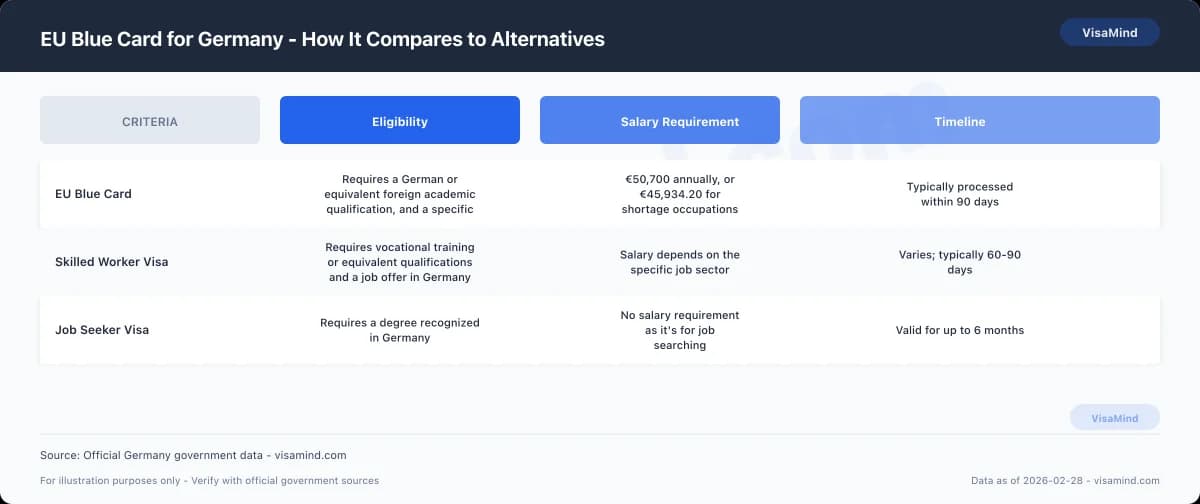
When deciding whether the EU Blue Card is the right choice for your move to Germany, it's important to consider how it compares to other visa options. The EU Blue Card is designed for highly skilled workers and academics, but there may be other pathways that better suit your circumstances. Below is a comparison of the EU Blue Card with the Skilled Worker Visa and the Opportunity Card.
Visa Comparison
| Visa Type | Eligibility | Salary Requirement | Application Process |
|---|---|---|---|
| EU Blue Card | Requires a recognized academic qualification, or equivalent, with a specific job offer in Germany | At least €50,700 annually (or €45,934.20 in shortage occupations or for young professionals as of 2026) | Application through a German mission abroad; further processing by the local Foreigners Authority in Germany |
| Skilled Worker Visa | Requires a vocational or academic qualification, recognized in Germany, with a job offer | No specific salary threshold, but must be adequate | Application through the Skilled Worker Visa process at the German mission abroad |
| Opportunity Card | Based on a points system evaluating qualifications, work experience, and language skills | No specific salary requirement, focus on potential to find employment | Apply for the Opportunity Card to explore job opportunities in Germany |
Considerations for Choosing the Right Visa
Are You Eligible?
For the EU Blue Card, you must hold an academic qualification recognized in Germany and have a job offer with a salary that meets the specified threshold. The Skilled Worker Visa, on the other hand, is more flexible with qualifications, accommodating both vocational and academic credentials. The Opportunity Card introduces a points-based system that may be ideal if you are seeking to explore job opportunities without a pre-existing job offer.
Financial Requirements
The EU Blue Card has specific financial thresholds that must be met, which may not be suitable for all job types or sectors. The Skilled Worker Visa does not stipulate a minimum salary but requires that the salary is in line with German standards for your occupation. The Opportunity Card focuses on your potential to find work rather than pre-set financial criteria.
Tip: If you're unsure which path suits your qualifications and career goals in Germany, consider using the self-check tool provided by the German authorities to evaluate your eligibility for various visas.
In summary, while the EU Blue Card is a robust option for highly skilled professionals with a job offer in Germany, other visas such as the Skilled Worker Visa or the Opportunity Card may provide more flexibility depending on your situation. Be sure to thoroughly review the requirements and processes for each option before making a decision.
What It Costs
#Important: Before applying for the EU Blue Card in Germany, ensure you meet all financial thresholds and have the necessary documentation ready to avoid delays.
What Are the Application Fees?
When you apply for an EU Blue Card in Germany, you should be prepared to pay certain fees. These fees cover the processing of your application and vary depending on the specifics of your situation. Below is a table detailing the potential costs involved:
| Item | Cost |
|---|---|
| EU Blue Card Application Fee | €140 to €260 |
| Residence Permit Fee (in Germany) | Approximately €100 |
These costs are estimates and may change. Always verify the latest fees on the official Federal Office for Migration and Refugees (BAMF) website.
What Are the Salary Requirements?
Meeting the minimum salary requirement is crucial for your eligibility for the EU Blue Card. As of 2026, the salary thresholds are as follows:
- General Occupations: A gross annual salary of at least €50,700.
- Shortage Occupations: A gross annual salary of at least €45,934.20. This includes professions such as engineers, IT specialists, and doctors.
- Young Professionals: If you obtained your last degree less than three years ago, the minimum salary is €45,934.20.
What Other Financial Proof Is Required?
In addition to meeting the salary thresholds, you must provide proof of sufficient funds to support yourself during your stay in Germany. This can include:
- Proof of sufficient funds: Bank statements or a job contract showing that your salary meets the required thresholds.
- Old-age pension provision: If you are over 45 years old, you need to show adequate provision for old age.
For more detailed guidance on financial requirements, you may want to visit the Financial Requirements Guide.
Tip: To expedite the processing of your application, ensure all financial documents are translated into German or English.
Rights and Conditions
#The EU Blue Card for Germany provides numerous benefits, allowing skilled workers to live and work in Germany. However, it's essential to understand the rights and conditions associated with this residence permit.
Work Rights
With an EU Blue Card, you are authorized to work in Germany in a position that matches your qualifications. You must maintain employment that meets the salary thresholds: €50,700 annually for most occupations and €45,934.20 annually for shortage occupations as of 2026. This ensures that your role aligns with the high-skill nature expected for EU Blue Card holders.
Important: If your employment situation changes, such as losing your job, you must notify the local Foreigners Authority (Ausländerbehörde) immediately. They will provide guidance on your status and any actions required to maintain your residence permit.
Travel and Mobility
The EU Blue Card grants you freedom to travel within the Schengen Area without needing additional visas. This facilitates ease of movement across European countries for business or leisure. However, it's crucial to maintain your primary residence in Germany to comply with the Blue Card conditions.
Family Members
Holders of the EU Blue Card can bring their family members to Germany, making it easier to settle into life in the country. Spouses and children are eligible to join you, and spouses can work without needing separate work permits. This is part of the broader goal of promoting family unity and integration.
Restrictions and Conditions
While the EU Blue Card offers substantial benefits, there are conditions to observe:
- Job Offer Alignment: Your job must match your qualifications. Misalignment can lead to complications with your residence status.
- Salary Requirements: Ensure your salary continues to meet the thresholds to maintain your Blue Card status.
- Reporting Changes: Any significant changes in your employment or personal status must be reported to the local Foreigners Authority.
For more detailed insights on the EU Blue Card, visit the Blue Card EU page. If you're considering alternative immigration options, you might explore the Opportunity Card for broader eligibility criteria.
Real Scenarios
#An IT professional from India, with a degree comparable to a German academic qualification, secured a job offer from a Berlin-based tech firm. The offer promised a gross annual salary of €55,000, meeting the required threshold for the EU Blue Card. To proceed, she submitted her visa application through the German mission in India, ensuring all documents, including her academic credentials and job offer, were accurate and complete. Upon arrival in Germany, she promptly visited the local Foreigners Authority (Ausländerbehörde) to apply for her residence title. Within three months, she received her EU Blue Card, allowing her to commence work and settle into her new role in Germany's vibrant tech industry.
Scenario: Young Engineer in a Shortage Occupation
A young mechanical engineer from Brazil, who had graduated less than two years ago, received a job offer from an automotive company in Munich. His position was classified under a shortage occupation, allowing him to apply for the EU Blue Card with a lower salary threshold of €45,934.20. He verified his qualifications through the BAMF's recognition portal to ensure they met German standards. After gathering the necessary documents, he applied for the Blue Card via the German embassy in Brazil. Once in Germany, he finalized his application at the Ausländerbehörde. The process was completed in about four months, enabling him to contribute his skills to Germany's automotive sector.
FAQs
Is a job offer required for the EU Blue Card for Germany?
Can I switch from a Skilled Worker Visa to an EU Blue Card for Germany?
Do I need to prove my pension provision for an EU Blue Card for Germany?
What happens if my job offer does not match my qualifications for the EU Blue Card for Germany?
How can I verify if my foreign degree is comparable to a German qualification for the EU Blue Card?
Can I combine my EU Blue Card with another visa type in Germany?
What is the role of the Federal Employment Agency in obtaining an EU Blue Card for Germany?
VisaMind provides informational guidance only and is not a government agency. This is not legal advice. Requirements can change and eligibility depends on your specific facts. If your case is complex or high-stakes, consult a licensed immigration attorney.
Next steps
Requirements vary by nationality, purpose, timeline, and case details. Use Find My Visa to get a personalized checklist for Germany with official sources and deadlines.
Find my visa