What the Research Visa (§18d) Covers — Germany researcher visa
#The Research Visa (§18d) is for foreign nationals who plan to carry out research activities in Germany. It is part of Germany’s residence framework for academic and institutional research and involves both visa and residence procedures.
Who uses this visa
You use the Research Visa (§18d) if you intend to conduct research in Germany.
This visa is for those whose primary purpose of stay is research activity. It doesn’t cover general employment, job seeking, or self-employment outside a research context.
You should consider other residence titles if your goal differs:
| Purpose of Stay | Relevant Residence Option |
|---|---|
| Long-term qualified employment | EU Blue Card |
| General skilled employment | Skilled Worker Visa |
| Looking for work | Opportunity Card |
| Independent business activity | Self-Employment Visa |
| Independent professional services | Freelance Visa |
The Research Visa (§18d) is specific to research. If your planned activity isn’t research-based, the authorities will expect you to apply under another category.
Before applying, make sure your intended stay qualifies as research activity in Germany.
What the visa allows
The Research Visa (§18d) allows you to enter and stay in Germany for research.
Your permitted activities must align with research. This residence title doesn’t cover unrelated employment or business.
If you apply from outside Germany, you’ll need to submit a national visa application through the German mission abroad. The Federal Foreign Office manages visa processing at embassies and consulates.
After you enter Germany, you convert your visa by applying for a residence permit at the local Ausländerbehörde (foreigners authority), which issues and manages your residence permit.
For application preparation, you might need to complete the Form VIDEX online form, depending on the consular process in your country.
Procedural details can vary by location, so check with the German Federal Foreign Office or your local Ausländerbehörde.
Which authority manages it
Several German authorities have roles in the Research Visa (§18d) process.
The Federal Office for Migration and Refugees (Bundesamt für Migration und Flüchtlinge — BAMF) is part of Germany’s broader migration framework. BAMF primarily handles asylum matters.
The Federal Foreign Office manages visa applications submitted abroad through German embassies and consulates.
Once in Germany, your local Ausländerbehörde handles:
- Issuance of your residence permit
- Extensions or changes to your status
- Local compliance matters
| Stage | Responsible Authority |
|---|---|
| Visa application abroad | Federal Foreign Office |
| Residence permit in Germany | Local Ausländerbehörde |
| Asylum matters | BAMF |
You need to deal with the correct authority at each stage to avoid delays.
Conditions and Portability
#Your researcher visa is tied to your approved research activity and host institution. You must meet defined stay limits, and authorities review each application individually.
Duration and stay limits
Your permitted stay depends on the validity granted in your residence permit and the terms of your Form Aufnahmevereinbarung (hosting agreement). This agreement defines the research project and period for which you may carry it out in Germany.
If you spend time outside Germany, monitor your absences. Immigration rules apply within specific time frames, including a 180‑day period, which can affect how authorities assess your residence status.
You must apply for any extension before your current permit expires.
| Stage | Responsible authority |
|---|---|
| Visa application abroad | Federal Foreign Office (German consulate/embassy) |
| Residence permit inside Germany | Local Ausländerbehörde |
| Asylum matters (not researcher visas) | Federal Office for Migration and Refugees (BAMF) |
If your research project ends earlier than planned, your right to stay may end unless you qualify for another residence title, such as the EU Blue Card, Skilled Worker Visa, Self-Employment Visa, or Freelance Visa.
Approval is not automatic
Submitting a researcher visa application doesn’t guarantee approval. Authorities assess your documents, eligibility, and purpose of stay before issuing a visa or residence permit.
You must provide:
- A valid Aufnahmevereinbarung with a recognized research institution
- Complete application forms (such as Form VIDEX, if applying abroad)
- Supporting documentation required by the consulate or local authority
Incomplete or inconsistent documentation can delay or prevent approval. The Federal Foreign Office reviews visa applications abroad, and the local Ausländerbehörde makes residence decisions inside Germany.
If your application is refused, you can’t begin research activities in Germany. You may need to correct deficiencies or consider another residence route, such as the Opportunity Card, if you no longer meet researcher requirements.
Other conditions to note
Your researcher visa is purpose‑bound. You may conduct the research described in your hosting agreement, but you can’t switch to unrelated employment without authorization.
If you plan to change your status, you must apply for the appropriate residence title. Common alternatives include:
| Situation | Possible residence title |
|---|---|
| Qualified employment | EU Blue Card |
| Other skilled employment | Skilled Worker Visa |
| Independent activity | Self-Employment Visa |
| Project-based independent work | Freelance Visa |
| Seeking employment | Job Seeker Visa |
Each status has separate eligibility rules and documentation requirements. You must file a formal application before changing activities.
Failure to comply with your permit’s conditions can affect future applications. Confirm requirements with your local Ausländerbehörde before making changes to your research, employer, or residence status.
Fees and Processing Times
#You pay a fixed government filing fee and should expect a standard processing window of one to three months. The exact timeline depends on where you apply and which residence category you fall under.
Filing fees
You submit your national visa application through the Form VIDEX (National Visa) system when applying from abroad.
The current government filing fee is:
| Application Type | Fee (EUR) |
|---|---|
| National visa (Researcher) | €75 |
You pay this fee when you lodge your application with the Federal Foreign Office at the German embassy or consulate responsible for your place of residence.
If you apply for your residence permit inside Germany, the local Ausländerbehörde will inform you of any additional residence permit issuance fees. Check current amounts directly with the issuing authority before filing, as fee policies can change.
Your hosting agreement (Form Aufnahmevereinbarung) doesn’t replace the visa fee. It supports eligibility but doesn’t reduce the government charge.
If you qualify under another category, such as the EU Blue Card, Skilled Worker Visa, Opportunity Card, Self-Employment Visa, or Freelance Visa, confirm the correct fee with the relevant authority before applying.
Standard processing timelines
The standard processing time for a researcher visa is 1 to 3 months.
This timeframe applies to applications submitted through a German mission abroad under normal conditions. Processing starts once you submit a complete application, including your signed Aufnahmevereinbarung with the hosting research institution.
| Stage | Typical Timeframe |
|---|---|
| Researcher visa processing | 1–3 months |
Delays can happen if documents are incomplete or if authorities request additional review. The embassy or consulate coordinates with German authorities where required before issuing a decision.
If you apply for a residence permit after entering Germany, your local Ausländerbehörde controls the timeline. Confirm current estimates directly with the responsible office before making travel or employment commitments.
Variation by category/location
Processing times vary based on:
- Your application location (embassy/consulate abroad vs. local Ausländerbehörde in Germany)
- Your legal category (Researcher vs. EU Blue Card or other residence titles)
- Internal coordination requirements between authorities
Applications filed abroad fall under the Federal Foreign Office. Residence permits issued inside Germany fall under your local Ausländerbehörde. The Federal Office for Migration and Refugees (BAMF) doesn’t process standard researcher visa applications but may be involved in broader migration matters.
If you qualify under a different pathway, such as the EU Blue Card, Skilled Worker Visa, or Self-Employment Visa, timelines may differ from the 1–3 month researcher standard.
You need to verify current processing times directly with the authority handling your specific case before submitting your application.
When to Get Professional Help
#You increase your approval chances when you seek advice at the right time. Complex contracts, visa category confusion, and form errors often justify professional support before you submit anything.
Common triggers for legal help
You should consider legal guidance if your situation doesn’t fit a standard research appointment.
Common triggers include:
- You’re unsure whether to apply for a Germany Researcher Visa, EU Blue Card, Skilled Worker Visa, Opportunity Card, Self-Employment Visa, or Freelance Visa
- Your host institution delays or modifies your Form Aufnahmevereinbarung
- Your research funding comes from multiple sources
- You previously overstayed in Germany or another Schengen state
- The local Ausländerbehörde requests additional documents you don’t understand
Visa category confusion is a frequent problem. Choosing the wrong residence title can delay your start date or require a new application through the Federal Foreign Office abroad.
| Situation | Why Legal Review Helps |
|---|---|
| Unclear employment status | Confirms correct residence title |
| Mixed funding (grant + contract) | Aligns documents with visa category |
| Switching from Job Seeker Visa | Prevents status gaps |
| Transition to EU Blue Card | Verifies eligibility criteria |
If your case involves asylum history or protection status, the Federal Office for Migration and Refugees (Bundesamt für Migration und Flüchtlinge) (BAMF) handles asylum matters, not research visas.
How experts can help with forms
Errors in forms cause avoidable delays. You need to complete every section carefully and review all entries before submission.
An immigration professional can:
-
Review your Form VIDEX application form for consistency with your passport and contract
-
Check that your Aufnahmevereinbarung matches your stated research role
-
Align your supporting documents with the correct visa category
-
Prepare you for questions from the Federal Foreign Office or your local Ausländerbehörde
Small inconsistencies create problems. Differences in job titles, funding descriptions, or research duration can trigger follow‑up requests.
Experts also structure your document package clearly. They make sure your employment terms, hosting agreement, and residence purpose all match.
If you plan to switch later to an EU Blue Card or another residence title, early advice helps you avoid gaps in legal status and duplicate filings.
Dependents
#Your spouse and children can apply to join you while you hold a Germany Researcher Visa based on an Form Aufnahmevereinbarung. They must meet relationship and passport requirements and follow the same consular process through the Federal Foreign Office abroad or the local Ausländerbehörde inside Germany.
The rules below focus on who qualifies and when a visa is required for entry.
Who counts as a dependent
Germany recognizes close family members as dependents for residence purposes. In practice, this includes:
- Your spouse
- Your minor children
You must prove the family relationship with official civil documents. Authorities will review these documents during the visa process at the German mission abroad or during residence processing with the local Ausländerbehörde.
Your status as a researcher is separate from other categories such as the EU Blue Card, Skilled Worker Visa, Opportunity Card, Self-Employment Visa, or Freelance Visa. The concept of family reunification applies across these residence titles.
The Federal Office for Migration and Refugees (Bundesamt für Migration und Flüchtlinge – BAMF) is the federal authority for migration matters, while consular visa applications are handled by the Federal Foreign Office. Your dependents must apply under the correct family reunification pathway linked to your researcher residence permit.
Entry requirements for dependents
To join you, your dependents apply for a national visa for the purpose of family reunification, linked to your researcher residence permit. Because this is a long-stay (national) route rather than a short-stay Schengen visit, they generally need a visa issued before travel, regardless of nationality.
Typical entry requirements include:
| Requirement | What Your Dependent Must Show |
|---|---|
| Valid passport | A passport valid for the intended stay |
| Proof of relationship | Marriage or birth certificates linking them to you |
| Your researcher status | Evidence of your valid residence permit or hosting agreement |
| Adequate support | Sufficient financial means and health insurance for the stay |
Your dependent typically completes the national visa application, often prepared through Form VIDEX, and submits supporting documents at the German mission abroad. Once in Germany, they apply for a residence permit at the local Ausländerbehörde, whose requirements you should confirm before travel.
The Dual-Track Application — researcher visa Germany
#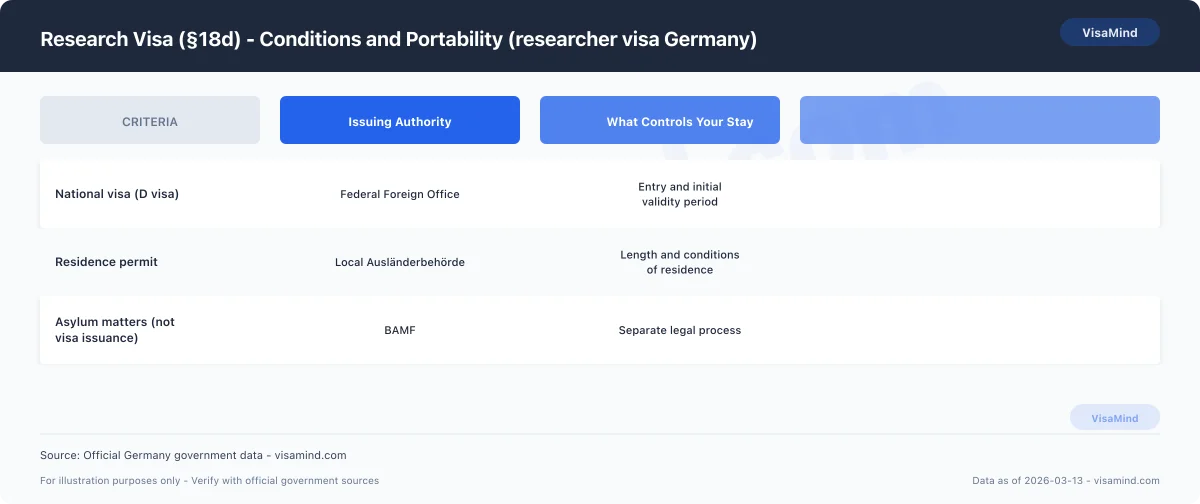
You can apply through your hosting research institution or file the application yourself. When you apply from abroad, you submit a national visa application to the Federal Foreign Office through the German embassy or consulate, typically using the Form VIDEX online system. Once you are in Germany, your local Ausländerbehörde issues the residence permit.
Both paths require accurate personal data, clear information about your research project, and complete supporting evidence.
Employer petition vs. individual filing
Your research institution may take the lead in preparing and submitting the application materials. This approach often centers on the Form Aufnahmevereinbarung (hosting agreement), which confirms the research relationship and project details.
If your employer files, you still remain responsible for the accuracy of your biographical details and background information. Errors in identity data or research descriptions can delay processing.
You may also file independently using the official national visa application (the Form VIDEX system when applying from abroad). In this case, you gather and submit all required documents yourself, including the signed hosting agreement.
The two tracks differ mainly in who organizes the paperwork:
| Feature | Employer-Led Filing | Individual Filing |
|---|---|---|
| Form completion | Often coordinated by host institution | Completed directly by you |
| Supporting documents | Institution may assemble research documents | You collect and organize all evidence |
| Applicant responsibility | Accuracy of personal data remains yours | Full responsibility for form and evidence |
This researcher pathway is distinct from the EU Blue Card, Skilled Worker Visa, Opportunity Card, Self-Employment Visa, and Freelance Visa, each of which follows separate eligibility rules and procedures.
How to complete the form
Always use the most recent version.
Complete every required section. Provide:
- Full legal name and biographical details
- Identity and background information
- Clear description of your research activity
- Details of your hosting institution
Write consistently and match your passport information exactly. Do not abbreviate names unless your passport does.
Follow these steps:
-
Review the instructions for your eligibility category.
-
Enter all required personal and research details.
-
Sign the form where indicated.
If you apply from abroad, the Federal Foreign Office handles the visa application at the consular level. If you apply inside Germany, your local Ausländerbehörde manages the residence permit process.
Submitting evidence
Submit the completed and signed form together with all required supporting documents. Incomplete submissions can result in delays or rejection.
Your evidence typically includes:
- Signed Aufnahmevereinbarung
- Proof of identity
- Documentation describing the research project
- Any additional documents listed in the official instructions
Organize documents clearly and keep copies for your records.
If you are unsure whether a document applies to your category, consult the official guidance from the Federal Foreign Office (for the visa application abroad) or your local Ausländerbehörde (for the residence permit in Germany) before filing. Always rely on the most recent instructions issued by the competent authority.
Path to Permanent Residence
#Your researcher visa can lead to longer-term residence if you continue qualifying employment or switch to another eligible status. You will work primarily with your local Ausländerbehörde for residence permits inside Germany, while the Federal Office for Migration and Refugees (Bundesamt für Migration und Flüchtlinge) (BAMF) oversees broader migration policy.
Typical next steps after the visa
After you enter Germany with your researcher visa, you apply for a residence permit at your local Ausländerbehörde. Your application is based on your hosting agreement (Form Aufnahmevereinbarung) and your research position.
You may later change your status if your professional situation changes. Common pathways include:
- EU Blue Card
- Skilled Worker Visa
- Self-Employment Visa
- Freelance Visa
- Opportunity Card
Each option requires that you meet its specific legal criteria at the time of application. The Ausländerbehörde reviews your employment contract, qualifications, and residence history before approving a change of status.
If you apply from abroad for a new visa category, the Federal Foreign Office processes the visa application. You typically complete the Form VIDEX form as part of that process.
| Scenario | Where You Apply | Authority Responsible |
|---|---|---|
| Change of residence status inside Germany | Local immigration office | Ausländerbehörde |
| New visa application from abroad | German embassy or consulate | Federal Foreign Office |
| Asylum matters (if relevant) | Federal level | BAMF |
Always confirm document requirements directly with your local Ausländerbehörde before filing.
Settlement permit options
A settlement permit allows you to stay in Germany without a time limit. You apply through your local Ausländerbehörde, not BAMF.
Your eligibility depends on the legal basis of your current residence permit. If you hold an EU Blue Card or a residence permit as a skilled worker or researcher, you may qualify for permanent residence once you meet the statutory conditions.
When you apply, the Ausländerbehörde typically reviews:
- Your valid residence permit
- Proof of ongoing lawful employment or self-employment
- Evidence of financial self-sufficiency
- Compliance with the conditions of your original permit
If you previously entered Germany under an Aufnahmevereinbarung, the authority will verify that you complied with its terms.
Because requirements differ by residence category, confirm the exact criteria with your Ausländerbehörde before submitting your application.
Eligibility Requirements
#You must show a clear research purpose and a confirmed institutional link in Germany. Authorities assess your affiliation, the substance of your project, and whether your case fits the correct immigration category.
If you are a non-EU citizen wishing to carry out research in Germany, this is the route that leads to a residence permit for research. Beyond your hosting agreement, you also need to show that you hold valid health insurance covering your stay in Germany.
Research affiliation and project
You need a formal connection to a recognized research institution in Germany. This affiliation forms the foundation of your application.
In most cases, the institution documents the cooperation through an Form Aufnahmevereinbarung (hosting agreement). This document confirms that you will carry out a defined research project.
Your project documentation should clearly state:
- The title and subject of the research
- The host institution’s name and contact details
- The duration of the project
- The scope of your research activities
- The purpose of your stay in Germany
Authorities focus on whether your activities are genuinely research-based. If your role resembles standard employment rather than research, another pathway such as the EU Blue Card, Skilled Worker Visa, Freelance Visa, or Self-Employment Visa may be more appropriate.
If you are still seeking placement and only intend to explore opportunities, the Opportunity Card may fit better than a researcher visa.
| Requirement | What It Must Show |
|---|---|
| Research affiliation | Formal link to a German research institution |
| Defined project | Clear research objective and activities |
| Purpose of stay | Stay in Germany is research-driven |
Applications filed abroad go through the Federal Foreign Office. Residence permits inside Germany are issued by your local Ausländerbehörde. The Federal Office for Migration and Refugees (BAMF) oversees broader migration matters but does not issue entry visas.
Category-specific review
Authorities examine whether your profile matches the researcher category. They do not rely on your job title alone.
You must demonstrate that:
- Your primary activity in Germany is research
- A German institution formally supports your project
- Your stay directly relates to the approved research work
If your activities involve general employment tasks without a structured research component, the application may be redirected to another residence title.
The review also checks whether the researcher visa aligns better than alternatives such as:
- EU Blue Card
- Skilled Worker Visa
- Freelance Visa
- Self-Employment Visa
- Job Seeker Visa
Submitting under the correct category prevents delays and reclassification by the Ausländerbehörde.
What evidence to gather
Prepare documentation that proves both your research purpose and your institutional affiliation. Incomplete files often delay processing.
Gather:
- A signed Aufnahmevereinbarung or equivalent hosting confirmation
- A detailed project description
- Official confirmation of your research affiliation
- Proof of valid health insurance covering your time in Germany
- Documents explaining the purpose and duration of your stay
Complete your visa application through the Form VIDEX system when applying abroad. Submit consistent information across all forms and supporting documents.
If any eligibility detail is unclear, consult the Federal Foreign Office for visa requirements abroad or your local Ausländerbehörde for residence permit criteria inside Germany.
Employer Obligations
#Your host institution in Germany must take formal responsibility for your research stay. It must document the research project, confirm your qualifications, and coordinate with the relevant German authorities before you apply at the consulate or for your residence permit.
Hosting agreements and approvals
Your employer must sign a formal Hosting Agreement (Form Aufnahmevereinbarung) with you. This agreement forms the legal basis for a Germany Researcher Visa application.
The hosting agreement typically confirms:
- The research project title and duration
- Your academic qualifications
- Proof that the project will be carried out at the institution
- That you have sufficient financial support
- That the institution will cover certain public costs if required
You submit this agreement with your visa application to the Federal Foreign Office abroad or to your local Ausländerbehörde if applying inside Germany.
The research visa is distinct from the EU Blue Card, Skilled Worker Visa, Opportunity Card, Self-Employment Visa, and Freelance Visa. Your employer must ensure the position qualifies specifically as research under a hosting agreement, not standard employment.
You complete the visa application using the official forms provided by the German mission abroad. Some applicants may use the Form VIDEX system, depending on the consulate.
Evidence employers commonly provide
Your host institution must supply documentation that supports your eligibility and the legitimacy of the research stay.
Common employer-provided documents include:
- Signed Aufnahmevereinbarung (Hosting Agreement)
- Official confirmation of the research project
- Proof of the institution’s legal status in Germany
- Confirmation of your financial arrangement (salary, stipend, or funded research)
- Contact details for an authorized institutional representative
The table below summarizes key employer documents and their purpose:
| Document | Purpose in Your Application |
|---|---|
| Hosting Agreement | Establishes legal basis for research residence |
| Project Confirmation | Defines scope and duration of research |
| Financial Confirmation | Shows how you will support yourself |
| Institutional Registration Proof | Confirms recognized German entity |
Your employer does not replace the role of the Ausländerbehörde, which issues your residence permit, or the Federal Foreign Office, which processes visa applications abroad. The Federal Office for Migration and Refugees (BAMF) does not handle researcher visa issuance.
Common Petition Challenges
#Most rejections stem from missing project documentation or inconsistent personal data. You must document your research affiliation clearly and ensure every detail matches your passport and supporting records.
Missing proof of project or affiliation
You must prove that a specific research project or host institution in Germany will receive you. If you fail to submit clear evidence of this relationship, the Federal Foreign Office can refuse your visa application.
Your file should clearly show:
- A signed Form Aufnahmevereinbarung (hosting agreement), if applicable
- Written confirmation from the German research institution
- Project details that identify your role and duration
If documents lack signatures, dates, or institutional letterhead, officials may treat them as insufficient. This issue often arises when applicants assume an informal invitation email is enough.
Do not rely on documents prepared for other residence categories, such as the EU Blue Card, Skilled Worker Visa, Opportunity Card, Self-Employment Visa, or Freelance Visa. Each category requires distinct evidence. Submitting the wrong type of documentation can delay or derail your case.
| Issue | How It Affects Your Case | How to Prevent It |
|---|---|---|
| No formal project proof | Immediate refusal risk | Submit signed institutional confirmation |
| Informal invitation only | Considered incomplete | Provide structured project details |
| Wrong visa category documents | Processing delays | Align documents with researcher visa requirements |
Identity and biographical inconsistencies
You must enter your name, date of birth, passport number, and other personal data exactly as shown in your passport. Even minor spelling differences can trigger rejection.
Errors often appear in the Form VIDEX application form when applicants abbreviate names or transpose numbers. If your passport shows multiple given names, you must list them consistently across all forms and attachments.
Review every document for consistency, including:
- Passport biographical page
- Application form entries
- Institutional letters
- Any signed declarations
If your documents contain conflicting personal details, officials may question the credibility of your entire application.
Typical reasons for rejection
Most refusals result from incomplete or inconsistent information. Authorities compare your forms, identification documents, and project evidence side by side.
Common patterns include:
-
Leaving required sections blank.
-
Providing answers that conflict with attached documents.
-
Submitting project proof that does not clearly identify you.
You reduce risk by reviewing your entire application before submission. Use the exact wording and data from your passport and official records.
The Federal Foreign Office assesses visa applications abroad. If you apply for a residence permit inside Germany, your local Ausländerbehörde reviews the file. In both cases, accuracy and complete documentation determine the outcome.
Fees
#| Component | Amount |
|---|---|
| Filing fee (VIDEX-NATIONAL)Verify at auswaertiges-amt.de. | €75 (approx $81 USD) |
Fees change; always verify on AA.