
On this page
- About the Student Visa — Germany student visa
- Student Visa Document Checklist
- How to Apply
- Fees and Processing Times
- When to Get Help — study Germany
- Can You Work?
- Post-Study Options
- Extending Your Student Visa
- Who Can Apply
- What Goes Wrong
- Fees
- Required forms
- Related visa types
- Related guides
- Related goals
- Next steps
About the Student Visa — Germany student visa
#Germany’s Student Visa lets you enter and stay in Germany for study at a higher education institution. It can also cover preparatory and language courses that are part of your academic path.
Who it's for
You apply for a Germany Student Visa if you’re a non‑EU national and plan to study at a higher education institution in Germany. This includes degree programs and structured academic pathways that require preparation before enrollment.
You might also qualify if your study plan includes:
- A preparatory course needed for university admission
- A language course linked to your academic goals
If you haven’t secured final admission, you may need a Student Applicant Visa instead. If your main goal is language study, a Language Course Visa may be the right fit.
Other residence categories serve different purposes and aren’t substitutes for the Student Visa.
| Visa Type | Primary Purpose |
|---|---|
| Student Visa | University studies and related preparation |
| Student Applicant Visa | Applying for university admission |
| Language Course Visa | Stand‑alone language study |
| Vocational Training Visa (Ausbildung) | Recognized vocational training |
| Internship Visa | Structured internship placement |
| Working Holiday Visa | Cultural exchange with limited work rights |
You must apply through the Federal Foreign Office at the German mission responsible for your place of residence abroad.
What it covers
The Student Visa authorizes you to enter Germany for academic study and to remain for the purpose stated in your visa. It supports attendance at:
- Recognized higher education institutions
- Required preparatory programs
- Language courses connected to your studies
After entering Germany, you must apply for a residence permit with your local Ausländerbehörde. This step is often called submitting an Form Aufenthaltstitel Application.
The visa process usually involves:
-
Completing the national visa application, often through Form VIDEX
-
Submitting required documents to the German mission abroad
-
Receiving a visa for entry
-
Registering your address in Germany (Form Residence Declaration)
-
Applying for your residence permit at the Ausländerbehörde
The Federal Office for Migration and Refugees (Bundesamt für Migration und Flüchtlinge — BAMF) oversees migration matters at the federal level. Residence permits for students are handled locally.
Where it applies
The Germany Student Visa applies within the Federal Republic of Germany. It authorizes you to live and study in the city where your institution is located after your residence permit is issued.
You must first obtain the visa from a German embassy or consulate abroad under the authority of the Federal Foreign Office. After arrival, your legal stay depends on approval from the local Ausländerbehörde.
The visa doesn’t convert automatically into other residence categories. If your purpose changes—like moving to vocational training under the Vocational Training Visa (Ausbildung)—you must follow the proper legal process.
Your permission to stay is tied to your academic purpose and the residence title granted inside Germany.
Student Visa Document Checklist
#You must prove three core points: a confirmed place at a recognized institution, enough financial resources, and clear identity and language qualifications. Missing or inconsistent documents cause delays or refusal by the Federal Foreign Office during your visa process.
Proof of admission
Submit an official letter of admission from a recognized German higher education institution. The letter must confirm your acceptance and identify the program.
If you haven’t received full admission, you may qualify for a Student Applicant Visa. In that case, show proof that you’ve applied and meet the academic entry requirements.
Provide documents confirming:
- Your acceptance to a German university, or
- Your eligibility to study in Germany through a recognized school-leaving certificate
If you’re applying for a Language Course Visa, Vocational Training Visa (Ausbildung), or Internship Visa, include the relevant training or course confirmation instead of a university admission letter. Each document must clearly state the institution’s name and your participation.
| Document | What It Must Show |
|---|---|
| Admission letter | Confirmed enrollment and program details |
| School-leaving certificate | Eligibility for German higher education |
| Training/course confirmation | Placement in Ausbildung, internship, or language course |
Proof of finances
You must show you can cover your living expenses in Germany. German authorities require credible financial evidence before issuing a visa.
Acceptable proof includes:
- A blocked bank account confirmation, or
- A valid scholarship award letter
Your financial documents must clearly show funds are available for your stay. Incomplete or unclear bank confirmations often cause processing delays.
Keep copies of all financial records. You’ll need them again when applying for your residence permit (Aufenthaltstitel) at the local Ausländerbehörde after arrival.
Identity & language documents
You must prove your identity and nationality beyond doubt. Submit valid identification documents that confirm who you are and your citizenship.
You also need proof of language proficiency if your program requires it. Most academic programs require at least B2 level under the CEFR.
Include:
- Valid proof of identity and nationality
- A recognized language certificate (if required)
- Any program-specific language confirmation
If you complete your visa application through Form VIDEX, make sure your personal details exactly match your identity documents. Inconsistencies can delay review by the Federal Foreign Office.
After entering Germany, you’ll submit a Form Residence Declaration and apply for your Form Aufenthaltstitel Application at the local Ausländerbehörde. Keep all original documents handy for that step.
How to Apply
#
You apply through the official consular process in your country of residence. Prepare evidence that supports your purpose of stay and financial security.
You must show you qualify for a residence title under German law and submit a complete, accurate application.
Check requirements
Before you file, confirm that you meet the basic conditions for a residence title under Section 5 (1) of the Residence Act (AufenthG). The most important requirement is a secure livelihood—you must prove you can cover your living expenses.
Prepare documents showing:
- Proof of financial means
- Language proficiency documentation, if required for your visa type
- A clear purpose of stay (study, language course, vocational training, or internship)
Different visa categories require different documentation. Review your specific category closely.
| Visa Type | Main Purpose | Typical Focus of Documents |
|---|---|---|
| Student Visa | University studies | Admission and financial proof |
| Student Applicant Visa | Apply to German universities | Proof of application plans and funds |
| Language Course Visa | Intensive language study | Course enrollment and funds |
| Vocational Training Visa (Ausbildung) | Recognized training program | Training contract and funds |
| Internship Visa | Structured internship | Internship agreement and funds |
| Working Holiday Visa | Cultural exchange with work | Eligibility and financial proof |
Complete the required application form, such as Form VIDEX, carefully. If your case involves the Federal Office for Migration and Refugees (Bundesamt für Migration und Flüchtlinge) (BAMF), use the correct form for that procedure.
Check every entry for accuracy before submission.
Submit application
Submit your visa application through the Consular Services Portal and file it with the German mission responsible for your country of residence. The Federal Foreign Office manages visa applications abroad.
Follow these steps:
-
Complete the online application (for example, via VIDEX if required).
-
Upload or prepare all supporting documents.
-
Submit your application through the designated consular channel.
Include all required evidence at the time of filing. Missing documents can cause processing delays.
If you apply for a long-term stay, you’re requesting a national visa that later converts into a residence permit in Germany. The residence permit is handled by the local Ausländerbehörde, not by BAMF, once you enter Germany.
Check the instructions from the German mission handling your case and make sure your file matches those requirements exactly.
After submission
After you submit, the German mission reviews your documents and checks that you meet the legal conditions for a residence title. Authorities assess your financial security and purpose of stay.
You might need to provide more documents if asked. Respond quickly and submit exactly what’s requested.
If your visa is approved, you receive a national visa that lets you enter Germany. After arrival, you must:
- Register your address through a Form Residence Declaration
- Apply for your residence permit by filing an Form Aufenthaltstitel Application with the local Ausländerbehörde
The residence permit you receive in Germany reflects your visa category, such as study, vocational training, or internship.
Fees and Processing Times
#You must budget for a visa fee and plan for several weeks of processing. Timeline depends on your visa category and where you apply. Delays are common with incomplete applications.
Application fees
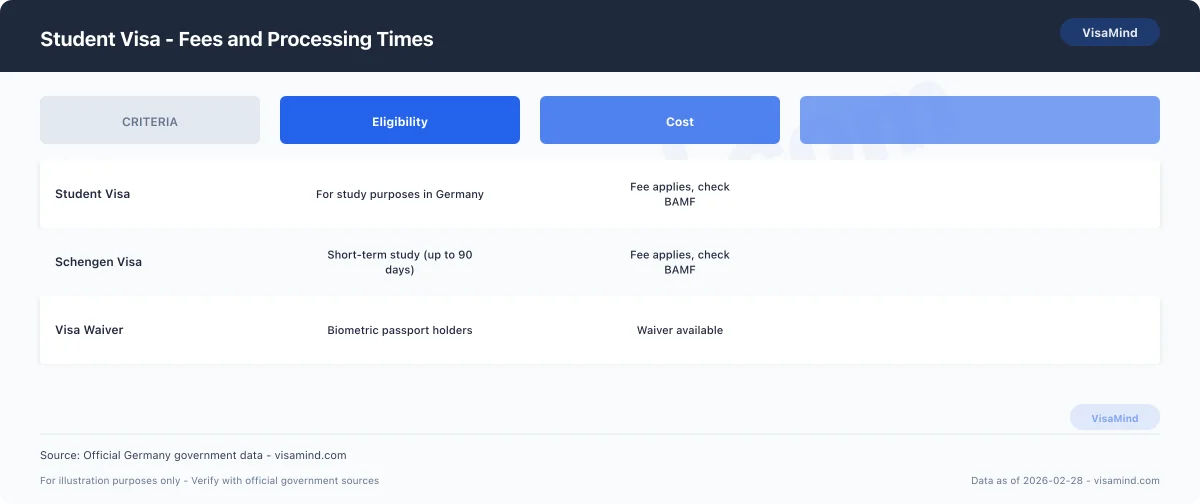
You pay a €75 application fee for a German student visa as of February 2026. This fee applies when you submit your application through the German mission abroad under the Federal Foreign Office.
The fee generally covers long‑stay national visas, including:
- Student Visa
- Language Course Visa
- Student Applicant Visa
- Vocational Training Visa (Ausbildung)
- Internship Visa
- Working Holiday Visa
| Item | Amount (EUR) | Paid To |
|---|---|---|
| National visa application fee | €75 | German mission (Federal Foreign Office) |
Confirm the current fee with the German mission handling your case before you apply. Fee changes happen, and local procedures may differ.
After you enter Germany, you’ll apply for your residence permit (Form Aufenthaltstitel Application) with the local Ausländerbehörde. Confirm any additional residence permit fees directly with that office.
Complete the Form VIDEX form carefully. All supporting documents must match your declarations. Incorrect or inconsistent information can cause delays.
Standard processing times
Standard processing for a student visa typically takes 4 to 8 weeks as of March 2026.
| Visa Type | Standard Processing Time |
|---|---|
| Student Visa (standard cases) | 4–8 weeks |
This timeframe starts once you submit a complete application with all required documents. The German mission reviews your file and may consult relevant authorities in Germany.
You should apply well before your program start date. Never assume approval within the shortest timeframe.
If you later apply for your residence permit in Germany, processing times for the Aufenthaltstitel Application depend on your local Ausländerbehörde. Check current timelines directly with that office.
Variable processing times & delays
Processing times vary based on:
- Your visa category (Student Applicant Visa, Language Course Visa, etc.)
- The location where you apply
- The completeness of your documents
Applications connected to vocational training (Ausbildung), internships, or working holiday programs may need extra review depending on your case. The responsible authorities might coordinate internally before making a decision.
The most common cause of delay is incomplete or incorrect information.
Avoid this by:
-
Double-checking every field in the VIDEX form.
-
Submitting all required documents listed by the German mission.
-
Ensuring your Form Residence Declaration and supporting records are accurate and consistent.
If your case involves questions about status or residence matters inside Germany, the local Ausländerbehörde handles those. For asylum-related matters, the Federal Office for Migration and Refugees (Bundesamt für Migration und Flüchtlinge – BAMF) is the competent authority.
When to Get Help — study Germany
#Some student cases need professional guidance. Passport type, prior immigration history, financial proof, and expulsion concerns often determine whether your application succeeds.
Complex passport & visa-waiver cases
If you rely on a visa waiver or hold a non-standard passport, it's smart to get legal advice. Germany limits visa-free entry to certain passport types, and even minor technical details can change your eligibility.
The visa waiver applies only to biometric passports. Serbian passports issued by the Serbian Coordination Directorate (Koordinaciona uprava) don't qualify for the waiver.
Taiwanese passport holders are exempt only if the passport shows an identity card number.
| Situation | Risk | Why Legal Review Helps |
|---|---|---|
| Non‑biometric passport | Visa-free entry not valid | You may need a Student Visa, Language Course Visa, or Student Applicant Visa before travel |
| Serbian passport (Coordination Directorate) | Waiver excluded | Incorrect entry can lead to refusal of residence permit |
| Taiwanese passport without ID number | Waiver excluded | Entry status may not support an Form Aufenthaltstitel Application |
Switching categories after entry—say, from a Working Holiday Visa, Internship Visa, or Vocational Training Visa (Ausbildung) to student status—requires careful planning. It's best to get advice before you file your Form VIDEX form or submit a Form Residence Declaration.
Errors at the entry stage can block your later application at the local Ausländerbehörde.
Legal issues
If your admissibility is in doubt, consult an attorney. Germany requires that there be no public interest in your expulsion.
If authorities find grounds for expulsion, your student visa won't be approved. Filing the application doesn't guarantee success.
This can happen if you have prior immigration violations, overstayed in Germany or another country, or previously received a removal or expulsion order. Authorities may also question your compliance history.
The Federal Foreign Office reviews visa applications abroad. Inside Germany, the Ausländerbehörde evaluates your residence permit request.
The Federal Office for Migration and Refugees (BAMF) deals with asylum, which can affect your immigration record.
If your background includes enforcement actions, work out a legal strategy before submitting your application.
Funding & prior denials
Failure to show clear financial resources is a common reason for refusal. German authorities expect solid proof you can support yourself.
If your documents don't meet the standard, your application can be denied even if you qualify academically. Submitting incomplete or unclear financial proof creates unnecessary risk.
You should get help if you've had a visa denial, your finances were questioned, your funding source is unusual or hard to document, or you're reapplying after a refusal.
A prior denial doesn't automatically block a new application, but you have to address the original reason directly. Simply filing again through VIDEX without fixing the problem usually leads to another refusal.
Careful preparation before your next Aufenthaltstitel Application can prevent repeated denials.
Can You Work?
#Germany allows limited employment during your studies, but there are strict hour limits. The visa you hold—Student Visa, Language Course Visa, or Vocational Training Visa (Ausbildung)—directly affects your work rights.
Working hours limit
If you have a residence permit for study purposes (Aufenthaltstitel for students), you may work 120 full days or 240 half days per year. Your local Ausländerbehörde checks compliance when you apply for or renew your permit.
A full day typically means more than four hours of work. A half day is up to four hours.
You need to follow these limits exactly. Exceeding them can impact your current permit and future applications.
Your work rights depend on your visa type:
| Visa Type | Work Allowed? | Notes |
|---|---|---|
| Student Visa | Yes | Subject to 120 full / 240 half days per year |
| Language Course Visa | Generally no | Employment is typically restricted |
| Student Applicant Visa | Limited | Confirm conditions with the Federal Foreign Office or Ausländerbehörde |
| Vocational Training Visa (Ausbildung) | Yes | Work is part of the approved training |
| Working Holiday Visa | Yes | Employment is a core purpose of stay |
Check the conditions on your visa sticker and residence permit card. If anything is unclear, confirm with your local Ausländerbehörde.
You apply for your national visa through the Federal Foreign Office using the Form VIDEX form. After arrival, you submit your Form Aufenthaltstitel Application and complete your Form Residence Declaration at the local registration office.
Internships & co-ops
Internships may count toward your annual work limit, depending on whether they're mandatory.
A mandatory internship required by your German university usually doesn't count toward the 120 full or 240 half days. The internship must be clearly required in your study regulations.
A voluntary internship typically counts toward your annual work allowance. This includes internships during semester breaks.
- Mandatory internship
Required by your academic program
-
Confirmed by your university
-
Usually outside annual work quota
-
Voluntary internship
Not required for graduation
- Counts toward annual work limit
If you enter Germany mainly for an internship, you may need an Internship Visa instead of a Student Visa. The Federal Foreign Office determines the correct visa category during consular processing.
Your residence permit conditions set your limits. Before accepting any internship or paid placement, confirm compliance with your Ausländerbehörde.
Post-Study Options
#After graduation, you can stay in Germany by changing your residence status for work, vocational training, or further study. Apply through your local Ausländerbehörde and time your application to avoid gaps in lawful stay.
Common pathways
You may apply for a new Aufenthaltstitel (residence permit) after completing your degree. The local Ausländerbehörde handles these applications inside Germany.
Common options:
- Employment-based residence permit if you have a job
- Vocational Training Visa (Ausbildung) for recognized vocational training
- Internship Visa for a qualifying internship
- Transition to another academic program with a new student residence permit
If you previously held a Language Course Visa or Student Applicant Visa, your new purpose of stay must match your qualifications and admission status.
You typically complete:
-
The Form VIDEX form (if required for status changes linked to prior visa categories)
-
An Form Aufenthaltstitel Application with your Ausländerbehörde
-
A local Form Residence Declaration (Anmeldung) update, if your address changes
For asylum cases, the Federal Office for Migration and Refugees (Bundesamt für Migration und Flüchtlinge) (BAMF) is responsible. Standard post-study permits remain with the Ausländerbehörde.
| Pathway | When It Applies | Authority |
|---|---|---|
| Employment | You have a job offer | Ausländerbehörde |
| Vocational Training (Ausbildung) | You enter formal training | Ausländerbehörde |
| Internship | Structured internship placement | Ausländerbehörde |
| Further Study | New academic admission | Ausländerbehörde |
For eligibility and document requirements, refer to the Federal Foreign Office and your local Ausländerbehörde.
Timing after graduation
You need to act before your student residence permit expires.
- Confirm your official graduation date with your university
- Book an appointment with your Ausländerbehörde as early as possible
- Submit your Aufenthaltstitel Application before your permit runs out
If you're switching to vocational training or an internship, secure the placement first. Your application must show your actual purpose of stay.
If your original entry was on a Student Applicant Visa, you must formally conclude your academic status before changing categories. The same goes for those who held a Language Course Visa.
Visa applications made abroad are handled by the Federal Foreign Office. Inside Germany, only the local Ausländerbehörde can grant or extend your residence permit.
Procedures and document requirements vary by city, so confirm with your local authority.
Extending Your Student Visa
#You must extend your residence permit before it expires and show you can finance your continued stay. The local Ausländerbehörde decides on extensions, not BAMF.
When to extend
Apply for an extension before your current residence permit ends. File the Form Aufenthaltstitel Application with your local Ausländerbehörde in the city where you're registered.
If you entered Germany on a Student Applicant Visa, Language Course Visa, Vocational Training Visa (Ausbildung), Internship Visa, or Working Holiday Visa, apply for the correct student residence permit before your status expires.
Steps:
-
Book an appointment with the Ausländerbehörde.
-
Complete the required application forms (Form VIDEX is typically for visa applications abroad through the Federal Foreign Office, not for local extensions).
-
Submit your Form Residence Declaration (Anmeldung) if your address changed.
-
Provide updated financial proof.
Missing the deadline can mean losing your legal residence status.
| Authority | Role in Extensions |
|---|---|
| Ausländerbehörde | Decides on student residence permit extensions |
| Federal Foreign Office | Handles visa applications abroad |
| BAMF | Oversees asylum matters |
Proofs needed
You must show you can cover your living expenses for the full period of your extended studies. The Ausländerbehörde won't grant an extension without clear financial evidence.
Prepare:
- Valid passport
- Current residence permit
- Completed Aufenthaltstitel Application
- Proof you can finance your stay for the remaining study period
- Updated Residence Declaration (if applicable)
Your financial proof must show you can support yourself for your entire study program. This applies if you switch from a Language Course Visa, Vocational Training Visa (Ausbildung), or similar status into a student residence permit.
If the authority asks for more documents, respond within the set deadline. Failure to prove sufficient funds can mean your extension is refused.
Who Can Apply
#You qualify for a Germany student visa only if you meet academic, language, and identity standards. Authorities expect formal admission to a recognized institution and proof you can complete your studies in the required language.
Academic eligibility
You need formal admission to a state-recognized higher education institution in Germany. This must be tied to a specific study program.
Informal offers or applications in progress don't meet this requirement. If you haven't received final admission, you may need a Student Applicant Visa to enter Germany and complete the process.
Other categories serve different purposes:
| Visa Type | Primary Purpose |
|---|---|
| Student Visa | Full-time study at a state-recognised higher education institution |
| Language Course Visa | Standalone language study without university enrolment |
| Vocational Training Visa (Ausbildung) | Recognised vocational training programme |
| Internship Visa | Approved internship placement |
| Working Holiday Visa | Cultural exchange with limited work rights |
Apply for the correct visa category based on your actual academic activity.
Financial & language eligibility
You must meet the language requirements of your chosen program. The German embassy or consulate will require proof you have the necessary language skills, whether your program is in German or another language.
Prepare documentation that demonstrates your proficiency. The Federal Foreign Office manages visa applications abroad and checks your language evidence.
You must also satisfy financial requirements for a student visa. Specific amounts and acceptable proof can change; refer to the Federal Foreign Office for current requirements.
Complete the Form VIDEX form accurately and make sure your documents match your application.
Nationality & identity
Apply through the German embassy or consulate in your country of residence. Submit valid identity documents and ensure your personal data matches across all records.
After entering Germany, work with your local Ausländerbehörde to obtain your residence permit. This may include submitting an Form Aufenthaltstitel Application and a Form Residence Declaration, depending on local rules.
The Federal Office for Migration and Refugees (BAMF) oversees migration matters at the federal level. Local authorities issue residence permits inside Germany.
You must meet both consular and local requirements to keep lawful student status.
What Goes Wrong
#Most refusals come from paperwork errors and mismatched information. You can avoid rejection by submitting complete forms, using the same details across documents, and picking the correct visa category for your purpose.
Top rejection reasons
You submit an incomplete application form or leave sections blank in Form VIDEX.
Missing dates, unsigned declarations, or inconsistent spellings of your name lead to doubts about credibility.
Details that don’t exactly match your passport or supporting documents can cause issues.
Even small differences in passport numbers, birth dates, or address history create red flags.
Applying under the wrong visa type is a common error. Each category has a specific purpose:
| Visa Type | Common Error |
|---|---|
| Language Course Visa | Applying while intending to enroll in a degree program |
| Student Applicant Visa | Providing inconsistent academic history |
| Vocational Training Visa (Ausbildung) | Mismatched training details |
| Internship Visa | Incomplete host information |
| Working Holiday Visa | Incorrect personal data in forms |
You also risk refusal if you skip required steps like the Form Residence Declaration or later the Form Aufenthaltstitel Application, especially if your information isn’t consistent.
German authorities, including the Federal Foreign Office and local Ausländerbehörde, expect precise and consistent documentation.
How to avoid mistakes
Complete every field in VIDEX carefully.
If a question doesn’t apply, indicate that clearly instead of leaving it blank.
Before submission, compare your application against your passport and all supporting documents.
Check:
- Spelling of your full legal name
- Passport number and expiry date
- Date and place of birth
- Address history
- Study or training details
Stick to one version of your name and details across all forms, including the Residence Declaration and later Aufenthaltstitel Application.
Make sure you’ve chosen the correct visa category based on your actual purpose in Germany.
If your plans change, adjust the visa type before submitting.
Review the Federal Foreign Office instructions for your visa category.
Accuracy and consistency protect you from preventable refusal.
Fees
#| Component | Amount |
|---|---|
| Application feeApplication fee: €75 (approx $81 USD) (as of 2026-02). Verify the current fee on the official schedule before filing. | €75 (approx $81 USD) |
Fees change; always verify on AA.
Next steps
#Use Find My Visa to build a sequenced plan with official sources and deadlines.
FAQs
What does a Germany student visa allow me to do?
The visa allows non‑EU nationals to study at higher education institutions in Germany and to attend preparatory and language courses as part of their studies.
What are the core eligibility requirements?
You must have been admitted to a state‑recognised higher education institution, be able to cover your living costs for the duration of your study programme, meet the language requirements for your chosen programme, and be able to prove a school‑leaving certificate that entitles you to study at a German higher education institution.
Which documents should I include with my application?
Typical documents include proof of admission to a higher education institution, evidence of financial means (for example a blocked account or scholarship), proof of identity and nationality, and any required language certificates such as proof of B2 level if requested by the programme.
How do I apply for the visa?
You must first check you meet the basic requirements, prepare the necessary documents, and then submit the visa application via the Consular Services Portal. Applications are made in your country of residence.
How much does the application cost and how long does processing take?
The application fee is €75 (approx $81 USD, as of 2026‑02). Standard processing time is 4 to 8 weeks, but processing times vary by category and location so verify current times with the issuing authority.
Can I work while studying on this visa?
For university studies in Germany, you can work up to 120 full days per year.
What are common reasons a student visa is refused?
Common refusal reasons include failure to provide proof of sufficient financial resources, submitting an incomplete visa application form, and the fact that filing an application does not guarantee approval.
What steps can I take after graduation?
Common next steps after this visa include applying for a Job Seeker Visa or a Skilled Worker Visa.
Any tips to avoid delays or rejections?
Complete all sections accurately and review your answers before submission, follow the official instructions and include all required documents, and avoid incomplete or incorrect information to prevent delays.
Official sources referenced
Last reviewed: 2026-03-13
VisaMind provides informational guidance only and is not a government agency. This is not legal advice. Requirements can change and eligibility depends on your specific facts. If your case is complex or high-stakes, consult a licensed immigration attorney.
Next steps
Every Germany visa case depends on your nationality, purpose, and timeline. Get a personalized plan with official sources and deadlines.
Get my Student Visa plan