
What Reviewers Look For
#The Directorate General of Immigration (Ditjen Imigrasi) oversees this requirement as part of the document evaluation process. The Indonesian Visa Documents Checklist is required for ensuring your application meets the necessary criteria set by the immigration authorities. Each document submitted plays a key role in the verification process.
Understanding Document Authenticity Standards
The authenticity of your documents is paramount. The Directorate General of Immigration requires that all documents be genuine and verifiable. This means any submitted documents, such as your passport, must be original or certified copies, and they should accurately reflect your current legal status. - Ensure your passport has a minimum of six months' validity.
- Provide original or certified copies of important documents. - Documents should be translated into Indonesian if originally in another language.
Warning: Submitting forged or altered documents can lead to visa denial and future entry bans.
Evaluating Consistency Across Submissions
Consistency across all submitted documents is a key factor in the visa evaluation process. The information provided in your visa application must match the details in your supporting documents. Discrepancies may lead to delays or rejections. It is important to double-check that all names, dates, and other personal information are consistent across your passport, visa application, and any additional documents. This aids in smooth processing by the immigration officers.
Tip: Make a checklist of all required documents and cross-reference them to ensure all entries are consistent.
Verifying Intent and Purpose
The Directorate General of Immigration expects applicants to provide a detailed account of their travel plans, including the duration and nature of their stay. - Include a detailed itinerary of your stay in Indonesia. - Provide evidence of accommodation arrangements. - If applicable, include a letter of invitation from an Indonesian host.
Important: Ensure your travel plans align with the visa type you are applying for, such as the E Visa Tourist.
Photo Requirements
#The Directorate General of Immigration requires applicants to submit visa photos that meet specific criteria. Understanding these requirements is vital to ensure your application is processed smoothly.
Photo Dimensions and Format
Visa photos for Indonesian visas must be 4 cm x 6 cm in size. Images should be recent and in color, with a good resolution to ensure clarity. The format should be in JPEG or PNG to be compatible with both digital and physical submissions.
Appropriate Background Color
The background color for your Indonesian visa photo must be plain white. This ensures a clear contrast between your image and the background, which is essential for identification purposes.
Important: Ensure there are no shadows on the background or your face. This can lead to photo rejection by the Directorate General of Immigration.
Digital vs. Physical Photo Formats
| Aspect | Digital Photo | Physical Photo |
|---|---|---|
| Format | JPEG/PNG | Printed on high-quality photo paper |
| Submission | Upload through the evisa.imigrasi.go.id portal | Attach to physical application forms |
| Resolution | High resolution (minimum 300 dpi) | High resolution print |
Category-Specific Requirements
#In 2026, Indonesia welcomed over 16 million international visitors, highlighting the popularity of its diverse visa options. Understanding specific document requirements is essential for those applying for Indonesian visas such as work, student, or spousal categories. The Directorate General of Immigration (Ditjen Imigrasi) oversees the visa application process, and providing accurate documentation is required for a successful application. Different categories of visas require distinct sets of documents, which are examined closely by immigration officials.
Work Visa Employment Contracts
Applicants for a work visa must provide an employment contract to substantiate their purpose of stay. This ensures that the work arrangement is legitimate and aligns with Indonesian labor laws. - A signed employment contract between the applicant and the Indonesian employer. - The contract must detail the job position, salary, and duration of employment. - The employer's corporate documents, such as business registration and tax identification number.
Tip: Ensure that your employment contract is translated into Bahasa Indonesia, as required by some employers and immigration offices.
Important: Double-check all contract details to avoid discrepancies, which could lead to delays or rejections.
Student Visa Acceptance Letters
To apply for a student visa, an acceptance letter from an Indonesian educational institution is mandatory. This document verifies the applicant's enrollment and the legitimacy of the educational program. - An official acceptance letter from the university or school, printed on institutional letterhead. - The letter must specify the course of study and expected duration. - Proof of payment for tuition fees or a scholarship award letter.
Warning: Ensure that the acceptance letter aligns with your visa application timeline, as delays in the academic calendar can affect your visa's validity.
Spousal Visa Relationship Proof
For a spousal visa, proof of a legitimate marital relationship is required. This documentation helps the immigration authorities in verifying the authenticity of the relationship. - A certified copy of the marriage certificate, recognized by the relevant authorities. - Joint financial documents, such as bank statements or property leases. - Photographic evidence of the relationship, covering various occasions and time periods.
Important: Inconsistencies in documentation can lead to further investigation, so ensure all submitted proofs are accurate and coherent.
Tip: Consider including affidavits from family or friends attesting to the marriage if additional proof is required.
Health and Character Requirements
#Specific documentation is needed to satisfy these criteria, which include tuberculosis tests, comprehensive medical exams, and police clearance certificates.
Tuberculosis Test Requirements
Applicants from certain countries must present a Tuberculosis (TB) test result as part of their visa application. This requirement is to prevent the spread of TB within Indonesia. - TB test results must be from a recognized medical institution. - The test should be conducted no more than six months prior to your application. - Results must be presented in English or accompanied by a certified translation.
Warning: Ensure your TB test is from a reputable medical institution to avoid rejection of your visa application.
Comprehensive Medical Examination
A comprehensive medical examination is often required to assess the overall health of visa applicants. This helps ensure that individuals entering Indonesia are not carrying contagious diseases.
-
Schedule an appointment with a certified medical practitioner.
-
Undergo the required medical tests, including general health evaluations and specific tests as advised.
-
Obtain a medical certificate detailing your health status.
Important: Medical certificates must be dated within three months of your visa application submission.
Obtaining Police Clearance Certificates
A Police Clearance Certificate (PCC) is necessary to demonstrate good character. It shows that you have no criminal record in your home country. - Request a PCC from your local police department. - Ensure the certificate is issued no more than six months before your application. - Translate the PCC into English if originally in another language.
Tip: Start the process early as obtaining a PCC may take several weeks.
Common Document Mistakes
#More than 6 million tourists visit Indonesia each year, and many face common document mistakes when applying for visas. Preparing your documents correctly can save time and avoid potential delays.
Incorrect Photo Specifications
Submitting the wrong type of photo is a frequent error in visa applications. Photos for Indonesian visas must meet specific criteria. - Photos should be 4x6 cm in size. - Background must be plain white without any patterns. - Ensure you have a neutral expression, with both eyes open.
Important: Photos not meeting these specifications may lead to application rejection. Check the E Visa Tourist guidelines for detailed photo requirements.
Expired Financial
Statements are essential to demonstrate your ability to support yourself during your stay in Indonesia. However, expired documents can invalidate your application.
-
Ensure your bank statements are no older than 3 months.
-
Verify that statements clearly show your name and account details.
-
Include sufficient balance to cover your stay in Indonesia.
Warning: Use recent statements to avoid issues. For more guidance, visit the Financial Requirements page.
Missing Document Translations
All documents not originally in English or Bahasa Indonesia must be translated. Missing translations are a common reason for delays. - Use certified translators for all documents. - Ensure translations are clear and accurate. - Attach both the original and translated documents.
Tip: Check official resources such as the Kitas Work page for additional specifics on document requirements.
Passport and ID Requirements
#Indonesian immigration regulations require your passport to be valid for at least six months from your intended date of arrival. This rule is enforced by the Directorate General of Immigration to ensure that all visitors have sufficient passport validity throughout their stay.This regulation emphasizes the importance of individual documentation for each person entering Indonesia.
Passport Validity and Expiry -
Ensure your passport is valid for at least six months from your arrival in Indonesia. This is a mandatory requirement to avoid entry denial. - Check the expiration date of your passport well in advance to allow time for renewal if necessary.
Warning: Travelers with passports expiring in less than six months may be denied entry to Indonesia or face issues during their visa application process.
Required National ID Documents
In addition to a valid passport, you may need to present a national ID or similar documentation when lodging your visa application. This ensures that your identity is verified accurately during the process. - A national ID card or equivalent document may be requested to verify your identity. - Ensure all documents are up-to-date and match the information in your passport.
Electronic vs. Physical Passports
Indonesia accepts both electronic and physical passports as long as they meet the validity requirements. The type of passport does not affect your ability to apply for a visa, provided it is recognized internationally. - Electronic passports contain a microchip with biometric information, offering additional security features. - Physical passports are still widely accepted and should be in good condition without significant wear or damage.
Tip: Check with the Directorate General of Immigration for any updates on passport requirements or changes in acceptance criteria for electronic passports.
Proof of Funds
#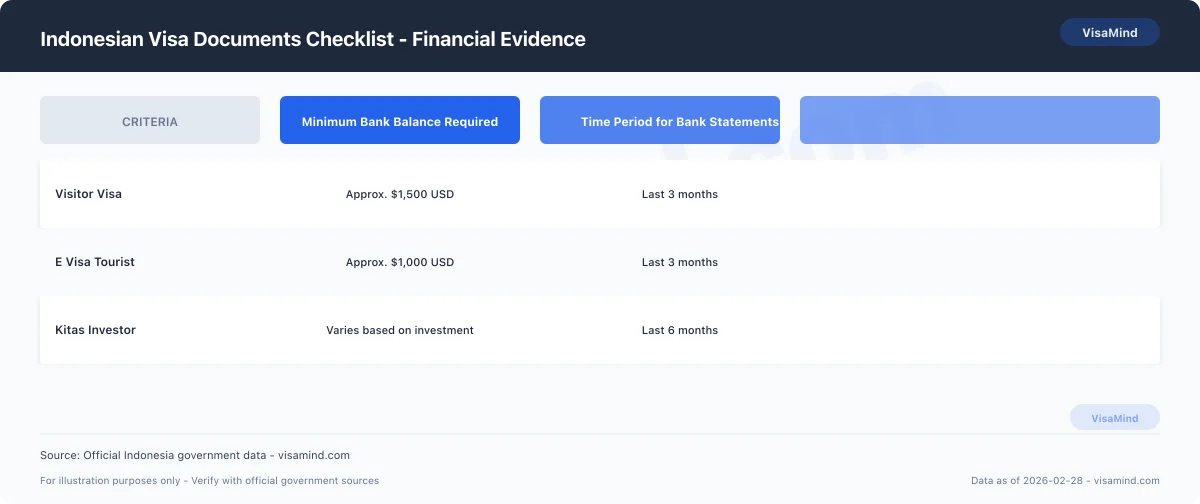
This is a key criterion to ensure that visitors can support themselves financially during their stay in Indonesia. The Directorate General of Immigration requires applicants to provide bank statements and other financial documents. These documents help in evaluating the applicant's financial stability.
Minimum Bank Statement Balance
While the exact amount can vary, it generally reflects the cost of living and expected duration of stay.
| Visa Type | Minimum Balance (IDR) |
|---|---|
| Tourist Visa | Rp 20,000,000 |
| Business Visa | Rp 50,000,000 |
| Social Visa | Rp 30,000,000 |
Tip: Ensure your bank statement covers the entire balance required for the visa type you are applying for.
Financial Documentation Timeframes
Applicants must provide bank statements covering a specific timeframe. Typically, the Directorate General of Immigration requires statements from the last three months. - Statements must be recent, covering at least three months. - Ensure all pages of the statement are clear and readable.
Important: Financial documents older than three months are generally not accepted, so ensure they are up-to-date.
Acceptable Proof of Funds Sources
Indonesia accepts various sources as proof of funds, offering flexibility to applicants. Common sources include personal bank accounts and fixed deposits. - Personal savings or checking account statements
- Fixed deposit certificates
- Official bank letters confirming account balance
Tip: If using a fixed deposit, ensure the maturity date does not conflict with your travel plans.
Additional Local Requirements
#Indonesia requires specific documents for visitor visa applications, administered by the Directorate General of Immigration. Understanding local document needs can streamline the process.
Special Regional Document Needs
Certain regions in Indonesia may have unique document requirements for visa applications. For example, travelers visiting Bali might need to provide additional proof of accommodation or travel plans due to the high influx of tourists. - Proof of accommodation specific to your destination
- Detailed travel itinerary
- Return or onward ticket
Tip: Check with local authorities or the Indonesian embassy for any region-specific requirements before traveling.
Local Language Document Requirements
All submitted documents must be translated into Bahasa Indonesia if they are in another language. This includes any supporting documents like bank statements or employment letters. - Certified translations for all documents not in Bahasa Indonesia
- Use a licensed translator for accuracy
Warning: Non-compliance with language requirements can result in visa application delays or denials.
Indonesian Embassy Submission Guidelines
Visa applications can be lodged at Indonesian embassies or consulates abroad. Ensure all documents are complete before submission to avoid processing delays.
-
Contact the nearest Indonesian embassy or consulate.
-
Prepare all required documents in the correct format.
-
Submit your application and pay the visa fee.
Important: Verify the latest submission guidelines on the official Directorate General of Immigration website to avoid unexpected issues.