
arraigo familiar Spain: Overview
#Arraigo Familiar grants temporary residence in Spain to non‑EU nationals with qualifying family ties.
You apply through the State Secretariat for Migration (SEM), and the decision usually takes 3–6 months.
What it is
Arraigo Familiar is a temporary residence authorization issued on humanitarian and family grounds.
It’s part of Spain’s residence permits for exceptional circumstances, separate from standard visas like the Non‑Lucrative Residence Visa or the Family Reunification Visa.
You request this authorization from the immigration office in Spain using Form EX‑10.
SEM manages immigration policy, while the National Police issue your foreigner identity card (TIE) if approved.
Key features
| Element | Detail |
|---|---|
| Legal basis | Exceptional circumstances residence |
| Who manages policy | State Secretariat for Migration (SEM) |
| Application form | EX‑10 |
| Processing time | 3–6 months |
| Card issuance | National Police (NIE/TIE) |
Arraigo Familiar is not the same as Arraigo Social (Social Ties Regularization) or Arraigo Laboral (Employment Ties Regularization).
It’s based on family relationships, not social integration or work history.
It also stands apart from Long‑Term Residence, which applies after extended lawful stay.
Who it's for
You may qualify if you’re a non‑EU national with a qualifying family connection in Spain.
This route focuses on family relationships, not employment or length of stay.
It’s separate from the Family Reunification Visa, which usually starts at a consulate abroad.
Arraigo Familiar is typically used when you’re already in Spain and need to regularize your status based on family ties.
Core eligibility points
- You’re a non‑EU national.
- You meet the criteria for residence under exceptional circumstances.
- You apply using Form EX‑10.
- You submit your request to the competent immigration office in Spain.
If you don’t qualify under family‑based exceptional circumstances, you might need to look at other options:
- Arraigo Social (Social Ties Regularization)
- Arraigo Laboral (Employment Ties Regularization)
- Non‑Lucrative Residence Visa
Each pathway has its own legal requirements and steps.
Quick timeline
Expect a 3–6 month processing period from when you submit a complete application.
Missing documents can drag out the review.
Process sequence
-
Prepare and submit Form EX‑10 and supporting documents.
-
The immigration office reviews your file under SEM guidelines.
-
You receive a decision.
-
If approved, you apply for your NIE/TIE with the National Police.
| Stage | Responsible authority |
|---|---|
| Policy oversight | SEM |
| Application review | Immigration office |
| Card issuance | National Police |
Spanish consulates handle visa issuance abroad, but Arraigo Familiar is processed within Spain as a residence authorization under exceptional circumstances.
When to Get Help (Spain arraigo familiar requirements)
#Arraigo familiar approval isn’t automatic, and mistakes can delay or block your case.
You need to act early, especially when documents or reports take weeks to obtain and SEM reviews your file closely.
High-risk situations
You’re at higher risk if you submit your application without full documentation or make assumptions about eligibility.
SEM doesn’t approve applications just because you have family ties in Spain.
Pay attention if:
- You’re unsure which residence pathway fits you
- You previously applied under Arraigo Social or Arraigo Laboral
- You’re switching from a Non-Lucrative Residence Visa or seeking Long-Term Residence
- You’re considering a Family Reunification Visa instead of arraigo familiar
Each route has different legal criteria and procedural rules under SEM.
Plan ahead if you need a social integration report from your local Ayuntamiento.
Processing can take weeks and delays may affect when you can file Form EX-10.
| Situation | Why Risk Increases |
|---|---|
| Incomplete documentation | SEM may refuse the application |
| Wrong legal pathway | Application may not match your circumstances |
| Late social integration report | Filing delays or incomplete submission |
| Prior immigration history | Closer review of your file |
Expert assistance
Legal guidance helps when your case involves overlapping residence categories.
Choosing between arraigo familiar and another status calls for a structured review of your immigration history.
An experienced immigration lawyer can:
- Confirm arraigo familiar fits your circumstances
- Review your EX-10 before submission
- Spot missing documentation
- Advise if another residence option is better
If you have prior denials or changes in legal status, professional review reduces preventable mistakes.
SEM sets policy and reviews applications, but it doesn’t correct filing errors for you.
You’re responsible for a complete and accurate file.
Practical tips
Start gathering documentation early.
Don’t wait until the last minute to request official reports or certificates.
Follow these steps:
-
Confirm current requirements with the State Secretariat for Migration (SEM).
-
Request any required municipal reports as soon as possible.
-
Double-check the right residence pathway before filing EX-10.
-
Keep copies of everything you submit.
If you’re unsure whether arraigo familiar or another residence category applies, clarify before filing.
Filing the wrong application can cost time and fees, and approval’s never guaranteed.
What PR Gives You
#
Permanent residence in Spain gives you stability and clear legal status.
You gain access to Long-Term Residence rights and structured paths to bring or regularize family members.
Next-step options
After holding temporary residence through arraigo familiar, you can move toward Long-Term Residence once you meet the legal residence requirements set by SEM.
Long-term residence allows you to live and work in Spain indefinitely under the same conditions as Spanish nationals, except for rights reserved to citizens.
You may also:
- Apply for Family Reunification Visa procedures to bring eligible relatives.
- Transition from other arraigo categories:
Arraigo Social (Social Ties Regularization)
-
Arraigo Laboral (Employment Ties Regularization)
-
Modify your status to other residence types, such as the Non-Lucrative Residence Visa, if you meet the financial requirements.
Most modifications and renewals require filing the relevant application form, often including Form EX-10, depending on your situation.
| Pathway | When Relevant | Authority Involved |
|---|---|---|
| Long-Term Residence | After meeting legal residence period | SEM |
| Family Reunification | Bringing qualifying family members | SEM / Spanish Consulate |
| Status Modification (e.g., Non-Lucrative) | Change in financial or personal circumstances | SEM |
You must file applications within legal deadlines and maintain continuous residence to protect your eligibility.
Practical benefits
Permanent residence status strengthens your legal and economic position in Spain.
You can:
- Work as an employee or self-employed without needing a separate work authorization.
- Register with Spanish social security.
- Access public services under the same general conditions as other legal residents.
- Obtain and renew your TIE (Tarjeta de Identidad de Extranjero) through the National Police.
Your residence status also makes administrative procedures easier.
Banks, employers, and public offices view long-term residence as stable authorization.
In practice, this means:
- Fewer renewal procedures compared to temporary permits.
- Greater flexibility in employment.
- Better footing when applying for mortgages, leases, or long-term contracts.
If you later apply for Spanish nationality, your period of legal residence under arraigo familiar and subsequent long-term residence counts toward the required residence period, as regulated by SEM.
Residency Obligations
#You must meet clear residence and registration duties to keep your arraigo familiar authorization valid.
These duties affect renewals, changes to another residence category, and future applications such as Long-Term Residence.
Not complying can lead to refusal of renewal or loss of status.
Registration and presence
You must register in the municipal register (empadronamiento) at your place of residence and keep that registration updated if you move.
You also need to apply for your NIE/TIE with the National Police after approval, using the relevant form such as Form EX-10 where required.
SEM grants the authorization, but the National Police issue the physical card.
To protect your status:
- Maintain real and effective residence in Spain.
- Keep your address updated in official records.
- Renew your TIE before it expires.
- Comply with Spanish tax and social security rules if you work.
Extended absences can affect future applications, especially if you later apply for Long-Term Residence or modify your status to Arraigo Social or Arraigo Laboral.
| Obligation | Authority Involved | Why It Matters |
|---|---|---|
| Municipal registration | Local Town Hall | Proof of actual residence |
| TIE issuance | National Police | Legal identification in Spain |
| Status compliance | SEM | Renewal and future eligibility |
Special-case rules
Your obligations may change depending on your family link and future immigration plans.
If you later switch to a Non-Lucrative Residence Visa or apply through a Family Reunification Visa, SEM will check whether you maintained lawful residence under your current authorization.
You must also continue to meet the condition that justified your arraigo familiar approval.
For example:
- If based on a Spanish citizen family member, the relationship must remain legally valid.
- If based on parental responsibility, you must maintain that responsibility.
Changes in family status can affect renewal or modification.
Before submitting any renewal or modification request, confirm current requirements with SEM or the official application instructions, as rules may change.
How to Apply
#You file your application with the State Secretariat for Migration (SEM) using the official Form EX-10 form.
Download the current version and follow the specific instructions for your eligibility category before submitting any documents.
Where to file
You submit your arraigo familiar application to the State Secretariat for Migration (SEM).
This authority manages immigration policy and processes this residence authorization in Spain.
If you apply from within Spain, file the completed EX-10 form with SEM as instructed in the official guidance for arraigo familiar.
Always use the most recent version of the form available from SEM.
Other authorities may intervene at later stages:
| Authority | Role in the Process |
|---|---|
| State Secretariat for Migration (SEM) | Receives and processes the EX-10 application |
| Spanish Consulates | Issue visas abroad when applicable |
| National Police | Issue your NIE/TIE after approval |
Don’t use procedures for other residence routes such as Arraigo Social, Arraigo Laboral, Family Reunification Visa, Non-Lucrative Residence Visa, or Long-Term Residence.
Each category has different rules and forms.
Step-by-step application
Follow these steps to avoid delays:
1.2. Read the instructions for your specific eligibility category before completing the form.
-
Complete all required sections accurately.
-
Sign the application where indicated.
-
Prepare the required supporting documents.
-
Submit the form and evidence according to SEM filing instructions.
You must complete the form in full.
Incomplete sections or missing signatures can result in rejection or delays.
Use the EX-10 version specifically for arraigo familiar.
Don’t submit forms from other residence categories, even if your circumstances overlap.
Evidence checklist
You must submit the completed and signed EX-10 application form with supporting documentation for your eligibility category.
Check this list before filing:
- Completed EX-10 form
- Your signature on the form
- Supporting evidence required under your specific arraigo familiar category
- Any additional documents listed in the official SEM instructions
Review the official instructions carefully before submission.
Requirements differ depending on your legal basis for applying under arraigo familiar.
If you previously considered other pathways such as Arraigo Social, Arraigo Laboral, or a Family Reunification Visa, make sure your documents match the arraigo familiar requirements—not those other categories.
Fees and Processing Times
#You must pay a government fee and wait for a decision from the State Secretariat for Migration (Secretaría de Estado de Migraciones, SEM).
processing times change depending on the location and case type. Delays are common, so plan accordingly.
Application fees
You pay the residence authorization fee using Modelo 790.
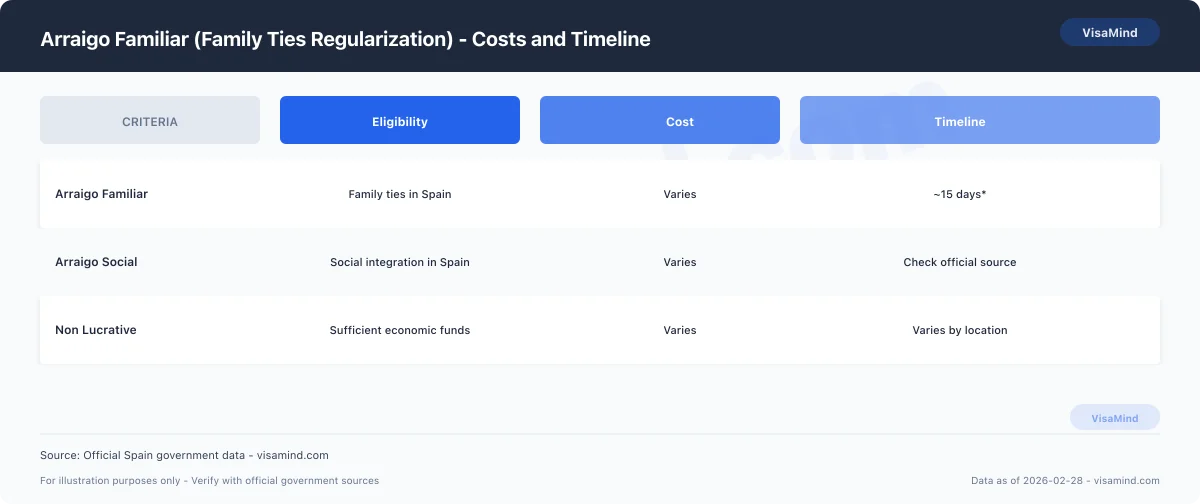
As of February 2026, the government fee for Arraigo Familiar (Family Ties Regularization) is:
| Fee Type | Amount (EUR) | When Paid |
|---|---|---|
| Modelo 790 – Arraigo Familiar | €60 | At or shortly after submission, as instructed by the immigration office |
Proof of payment goes with your application, usually alongside form Form EX-10, which is standard for temporary residence authorizations based on exceptional circumstances.
This fee covers the residence authorization decision under SEM authority.
It doesn't include extra costs like document translations, legal advice, or the later issuance of your foreigner identity card (TIE) by the National Police.
If you’re weighing options like Arraigo Social (Social Ties Regularization), Arraigo Laboral (Employment Ties Regularization), or a Non-Lucrative Residence Visa, check the SEM fee schedule directly since amounts vary by category.
Standard processing window
Arraigo Familiar applications take about 3 to 6 months as of March 2026.
This period starts after you submit your application and all required documents. Missing paperwork can cause further delays.
| Application Type | Standard Processing Time |
|---|---|
| Arraigo Familiar | 3–6 months |
SEM reviews the application and issues the decision.
If approved, you move on to apply for your TIE with the National Police.
The processing times for other routes, like Family Reunification Visa filed from abroad or Long-Term Residence, follow different schedules.
Timelines vary by category.
Processing variations
The processing times depend on:
- Your immigration category
- The province where you file
- The immigration office’s workload
Applications in high-demand provinces may exceed the 3–6 month window.
Case complexity also matters. Missing documents or unclear family relationships can slow things down.
If you apply from abroad under a different family-based route, the Spanish consulate manages the visa stage, while SEM oversees policy inside Spain.
Each authority works at its own pace.
Check current processing estimates with the immigration office before making travel or housing plans.
Renewing Your PR Card
#When renewing your residence card under arraigo familiar, plan for travel and re-entry while your application is pending.
The correct authorization lets you leave Spain and return without breaking your legal stay.
Your renewal is processed by the State Secretariat for Migration (Secretaría de Estado de Migraciones – SEM).
The National Police issue your physical residence card.
Travel while card is processed
If you must travel outside Spain while your renewal is in process, you need a specific re-entry authorization.
This document allows you to leave and return while your new card is being issued.
Without it, you risk being denied boarding or refused entry at the Spanish border.
You’ll typically submit:
- Your renewal application receipt (for example, under Form EX-10 if that fits your category)
- Proof of identity and current residence status
- The correct immigration form for re-entry authorization
Use the right form for your case:
| Form | Purpose |
|---|---|
| EX-13 | Authorization to leave and re-enter Spain while your residence card is being processed |
| EX-15 | General immigration administrative form used for certain procedures |
If you previously held status through Arraigo Social, Arraigo Laboral, a Non-Lucrative Residence Visa, Family Reunification Visa, or Long-Term Residence, the same rule applies: don’t travel without proper authorization while your card renewal is pending.
Re-entry documents
The main document for re-entry during renewal is the authorization linked to EX-13.
This confirms your renewal is in progress and you may return to Spain legally.
If the application concerns a minor traveling temporarily, use:
| Form | When Required |
|---|---|
| EX-14 | Prior report for the temporary movement of foreign minors (“desplazamiento temporal de menores extranjeros”) |
Submit the right form before leaving.
Border authorities check this authorization along with your valid passport.
Proof of renewal alone isn’t enough for re-entry. Always get formal authorization before you travel.
Who Qualifies
#Eligibility for arraigo familiar in Spain is strict. You must meet nationality, background, and family-relationship requirements.
Authorities check your citizenship, criminal history over the last five years, and any security concerns before approving your application.
Nationality & residency status
Arraigo familiar is only for non-EU, non-EEA, and non-Swiss nationals.
If you’re a citizen of a European Union country, European Economic Area country, or Switzerland, this route isn’t available.
You must be a third-country national when you apply.
This requirement sets arraigo familiar apart from other residence options:
| Immigration Path | Intended Applicant Profile |
|---|---|
| Arraigo Familiar | Non-EU/EEA/Swiss nationals with qualifying family ties |
| Arraigo Social (Social Ties Regularization) | Based on social integration factors |
| Arraigo Laboral (Employment Ties Regularization) | Based on employment relationships |
| Family Reunification Visa | Family members of legal residents applying from abroad |
| Non-Lucrative Residence Visa | Applicants residing in Spain without work activity |
| Long-Term Residence | Applicants meeting long-term residence criteria |
Your nationality decides if this path is open to you.
EU citizens must use EU free movement rules instead.
Good character & security
You must show a clean criminal record in Spain and in any country where you’ve lived during the last five years.
Authorities look at:
- Criminal convictions in Spain
- Convictions in countries of residence over the past five years
- Any risk to public order or national security
A criminal record within that period can lead to refusal.
The government also checks for security threats. Even without a conviction, concerns about public safety can affect your case.
These checks are central to Spain’s immigration review process.
Family-based eligibility
Arraigo familiar is a family-based regularization pathway.
You need a legally recognized family connection that fits this category.
Unlike Arraigo Social or Arraigo Laboral, this route doesn’t depend on employment history or social integration reports.
Your eligibility depends on your qualifying family relationship and compliance with nationality and background rules.
Before applying, confirm that:
- You’re a non-EU/EEA/Swiss national
- You have no disqualifying criminal record in the past five years
- You don’t present security concerns
- Your family relationship fits within the arraigo familiar framework
Authorities won’t approve your application unless all criteria are met.
Common Refusal Reasons
#Most refusals under arraigo familiar relate to documentation gaps, not eligibility.
You need to prove continuous presence, submit the required social integration report, and present a compliant job offer if your file requires it, including Form EX-10 reviewed by the State Secretariat for Migration (SEM).
| Refusal Ground | What SEM Expects | How to Reduce Risk |
|---|---|---|
| Lack of continuous presence proof | Clear evidence of uninterrupted stay in Spain | Maintain updated empadronamiento and keep supporting records |
| Missing social integration report | Official informe de arraigo social | Request it at least 2 months before filing |
| Non-compliant job offer | Minimum 1-year contract meeting regional salary rules | Verify contract duration and salary thresholds before submission |
Proof of continuous presence
You must show that you’ve stayed in Spain without interruption for the required period.
Gaps in municipal registration often lead to refusal.
Keep your empadronamiento at the local town hall active. Don’t let it lapse.
Back up your file with documentation that matches your registered address history.
Inconsistencies between your padrón record and other documents raise doubts about your residence.
SEM reviews continuity carefully across all regularization categories.
If your residence history isn’t clear, your application can fail even if your family relationship qualifies.
Accuracy and consistency matter more than the number of documents.
Missing social integration report
Many applicants forget to include the informe de arraigo social from their municipality.
SEM treats this as a significant deficiency.
Request this report at least two months before filing your EX-10 application.
Municipal processing times vary, and delays can leave your file incomplete.
The report confirms your level of integration.
Without it, the authority can’t assess this requirement.
This document is also essential in Arraigo Social cases.
If you previously applied under another residence route, such as a Non-Lucrative Residence Visa or Family Reunification Visa, don’t assume prior approvals replace this report.
Submit the official version from your municipality. Drafts or appointment confirmations aren’t enough.
Insufficient job offer details
If your application depends on employment, your job offer must meet minimum standards.
Contracts that don’t meet requirements cause refusals.
Your employment contract must:
- Be valid for at least one year
- Meet applicable regional salary thresholds
Short-term or unclear offers don’t qualify.
SEM reviews contract duration and salary figures directly.
This mirrors standards in Arraigo Social cases.
If your employment terms look temporary or part-time and don’t meet salary criteria, your file risks rejection.
Before submitting, check that the contract clearly states duration, working conditions, and salary.
A non-compliant offer can block your path to residence and delay future options like Long-Term Residence.
Download and Prepare Forms
#You must submit the correct application forms for your residence pathway.
Each form is tied to a legal basis, and using the wrong one delays your file with SEM.
Prepare forms carefully and make sure your information matches your supporting documents.
Required forms list
The required form depends on your residence authorization type.
| Form | Used For | Who Should Use It |
|---|---|---|
| EX-01 | Non-Lucrative Residence Visa | Applicants seeking residence without authorization to work and who prove sufficient financial means |
| EX-02 | Family Reunification Visa | Applicants bringing family members to Spain or joining relatives already residing in Spain |
If you apply under arraigo familiar, verify the exact form required for that category through SEM guidance.
Forms used for Arraigo Social, Arraigo Laboral, or Long-Term Residence are not automatically valid for your case.
Each pathway has its own designated form, like Form EX-10 for specific authorizations.
Submitting the wrong template may result in rejection or a request for correction.
Where to download
Get the official forms from Spanish immigration authorities.
SEM oversees immigration policy. Spanish consulates process visas abroad.
Always use the most recent version. Don’t rely on old copies or templates from third parties.
If you apply from outside Spain, check requirements with the Spanish consulate handling your case.
If you apply from within Spain, follow instructions from SEM and your local immigration office.
Avoid unofficial sources. Only use government-issued versions to ensure the format and fields are current.
Filling and signing forms
Complete each section clearly and accurately.
Your personal details must match your passport and civil documents.
Follow these steps:
-
Enter your full legal name as it appears on your passport.
-
Provide your current address and contact information.
-
Select the correct residence category.
-
Review all entries for consistency.
-
Sign where indicated.
Don’t leave mandatory fields blank.
If a section doesn’t apply, follow the form’s instructions rather than guessing.
Sign the form yourself. An unsigned application won’t move forward.
Fees
#| Component | Amount |
|---|---|
| Modelo 790 feeFamily Ties Regularization (Arraigo Familiar) | €60 (approx $65 USD) |
Fees change; always verify on SEM.