
Quick summary
#Applicants seeking a visa use DS-156E as part of the visa application process at a U.S, as described in the Online Nonimmigrant Visa Application guide. embassy or consulate.
When the official instructions indicate this form is required
Include it with your application package and follow official instructions for submission.
Names, dates of birth, and passport details on other forms Program checklist requirements Supporting documents and translations
Overview (What is Form DS-156E?)
#By facilitating the entry of foreign nationals who contribute to U.S. economic interests, the E-1 and E-2 visa categories underscore the importance of international trade and investment in fostering global economic partnerships. For related guidance, see the F-1 Student Visa page. For related guidance, see the K-1 Fiancé(e) Visa page.
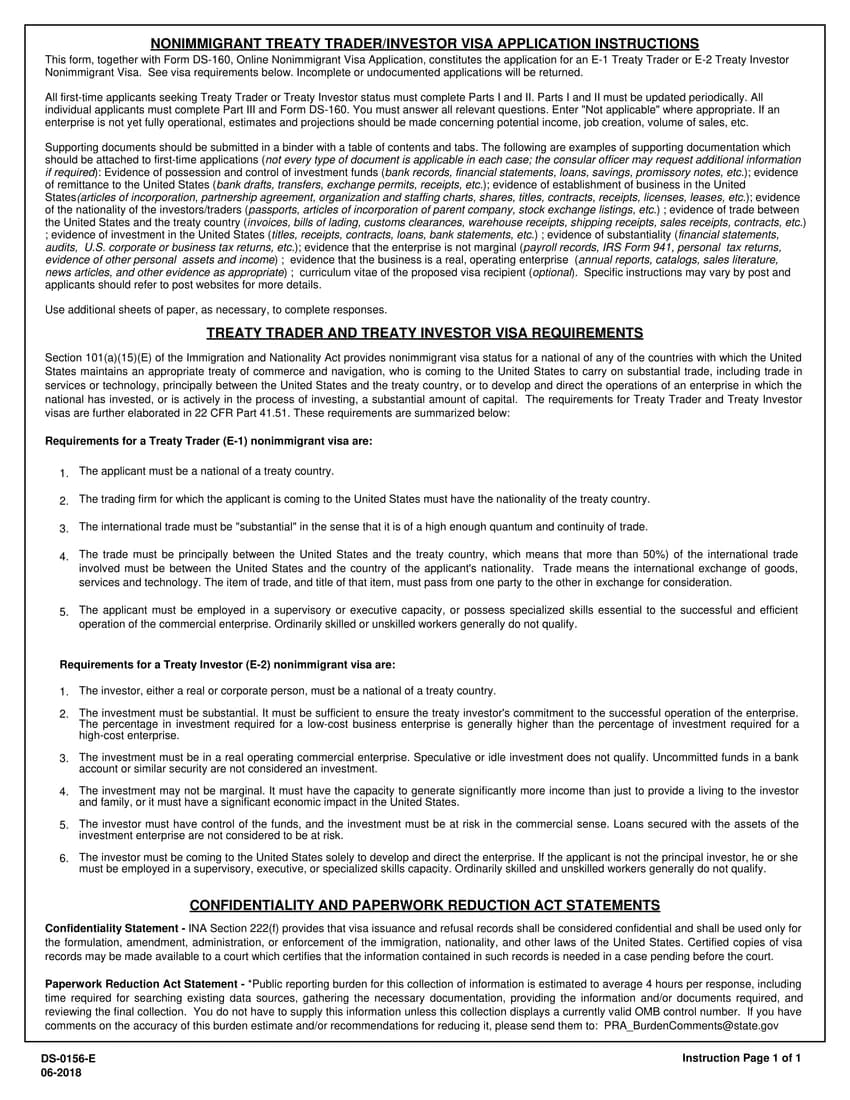
First page of DS-156E form
Source: DS-156E PDF
Context and workflow
#Processing time for DS-156E varies by location — always check the official Department of State processing time tool.
Why this matters
- This form acts as a cross-check point: details here must match other forms and supporting documents.
- This form helps confirm that the application matches the program’s requirements and checklist.
Where it fits in the workflow
- Initiating the application process for a treaty trader or investor visa.
- Receipt Notice (a related form) indicating the form has been received.
- Potentially leading to an interview at a U.S. consulate or embassy.
- DS-156E is commonly filed alongside Form DS-160, Form DS-156.
Who uses it
Applicants seeking a visa use DS-156E as part of the visa application process at a U.S, as described in the Online Nonimmigrant Visa Application guide. embassy or consulate.
When it is used
- When the official instructions indicate this form is required
- As part of a complete application package with supporting documents
- When filing DS-156E alongside DS-160 (DS-160 required alongside DS-156E for E-1/E-2 visa processing)
- When filing DS-156E alongside DS-156 (DS-156 base nonimmigrant form required with DS-156E at legacy posts)
- When filing DS-156E alongside I-129 (I-129 petition used for E visa extensions or changes of status within the U.S.)
- After filing DS-156E — I-539 may be the next step (Extension of stay or change of status for E visa dependents)
Failure prevention (What causes Form DS-156E rejections?)
#Technical rejections
- Ensure form edition is current
Substantive weaknesses
- Insufficient evidence of investment or trade volume.
- Inadequate documentation proving the nationality of the business.
- To avoid incomplete or inconsistent information across form: Use exact passport and document details; review all answers before submission.
- To avoid invalid or unreachable agent address: Use an address that can receive international mail; NVC correspondence is time-sensitive.
- To avoid submitting ds-261 after fees or documents: Complete DS-261 early in the NVC process before paying fees.
What it asks for (What does Form DS-156E ask for?)
#- Name and address of the U.S. enterprise, business, or company.
- Nature of the business and type of business enterprise.
- Investment and financial information
- Applicant identification information
- Supporting documentation inventory
- Eligibility or purpose details
- Declarations and signatures
- Your full legal name as it appears on official documents
- Your date and place of birth
- Your current passport number and issuance details
- Documentation related to: Complete all required sections, sign, and submit with required evidence
Sources for this section
What you need (What do you need for Form DS-156E?)
#- The current edition of DS-156E
- Proof of current immigration status
- Government-issued photo identification
- Passport-style photographs meeting specifications
- Supporting documents in a binder with a table of contents and tabs.
- Complete all required sections, sign, and submit with required evidence.
- Failure to provide evidence of substantial investment or trade.
- Copy of your filed or approved DS-160 (DS-160 required alongside DS-156E for E-1/E-2 visa processing)
- Copy of your filed or approved DS-156 (DS-156 base nonimmigrant form required with DS-156E at legacy posts)
Checklist (What is the Form DS-156E checklist?)
#- To begin, obtain the latest version of Form DS-156E along with its instructions from the official Department of State website.
- Review the official DS-156E instructions before filing
- Gather required supporting documents per the instructions
- Complete all required sections of DS-156E
- Sign, date, and submit DS-156E with all required supporting evidence
Sources for this section
Fees
#| Component | Amount |
|---|---|
| Filing FeeThe standard filing fee for form ds-156e. | See official schedule |
Can the Form DS-156E fee be waived?
Fee waivers may be available for qualifying applicants. See official instructions for eligibility.
What happens if I submit the wrong fee?
Department of State will reject your application if the incorrect fee is submitted. Verify the current fee on the official schedule before filing.
Fee waiver: Fee waivers may be available for qualifying applicants. See official instructions for eligibility. For related guidance, see Nonimmigrant Visa Application (legacy – replaced.
Department of State fee schedule
Fees change; always verify on Department of State.
Where to file
#Online filing is available for some categories — verify on the official form page. Otherwise, file by mail to the address in the instructions.
File online
Check the official DS-156E page to see if online filing is available for your category.
Submit application
Paper filing addresses vary by eligibility category and state of residence. Check the official instructions for the correct filing address.
Filing locations and procedures may change. Always verify on the official Department of State website before submitting.
Form sections (What sections does Form DS-156E have?)
#Note
DS-156E has been replaced by DS-160.
- Use Form DS-160 for all nonimmigrant visa applications
- Access via the Consular Electronic Application Center
- Complete online at ceac.state.gov
Key terms
#- Substantial Investment
- An investment that is significant enough to ensure the investor's commitment to the business.In this form: Required for E-2 visa applications to demonstrate economic impact.
- Treaty Country
- A country that has a treaty of commerce and navigation with the United States.In this form: Applicants must be nationals of a treaty country to qualify for E-1 or E-2 visas.
Strategy tips
#Mistake severity
#| Mistake type | Severity | How to avoid |
|---|---|---|
| Incomplete or inconsistent information across form | Rejection | Use exact passport and document details; review all answers before submission. |
| Invalid or unreachable agent address | Delay | Use an address that can receive international mail; NVC correspondence is time-sensitive. |
| Submitting DS-261 after fees or documents | Delay | Complete DS-261 early in the NVC process before paying fees. |
| Agent cannot receive or forward mail | Delay | Designate someone who can reliably receive and forward NVC correspondence. |
Examples (What are examples for Form DS-156E?)
#- Strong application: An applicant submits the form with all required documents and receives a timely decision.
- Weak application: An applicant submits the form without sufficient evidence of trade activities, leading to a request for additional information and a delay in processing.
- An applicant overseas completes DS-156E as part of the consular visa interview process
- A beneficiary of an approved petition uses DS-156E to apply for their immigration visa at the embassy
Common misconceptions (What misconceptions surround Form DS-156E?)
#- Some applicants assume that having a substantial investment automatically qualifies them for the visa; however, the investment must also ensure the successful operation of the enterprise.
- Meeting the document requirements guarantees visa approval — The consular officer retains discretion to approve or deny the visa based on the totality of circumstances, even when all documents are submitted.
- Paying the DS-156E filing fee does not guarantee acceptance — the fee is generally non-refundable even when the form is rejected for technical errors.
- A fee waiver for DS-156E is not automatic — only specific qualifying categories are eligible, and a waiver request can be denied while the underlying form is still expected to be filed.
- DS-156E cannot always be filed in any way — the correct filing method depends on the applicant's category, and using the wrong channel can result in rejection.
- DS-156E can be rejected before substantive review for technical errors such as “Ensure form edition is current.”
Edge cases and variations
#- If you are asked to submit or update DS-156E, treat it as a package update: check every place the same details appear and keep them consistent.
Scenarios
#An applicant finds an old DS-156E form online. This form has been replaced by DS-160 for nearly all nonimmigrant visa applications.
DS-156E is obsolete. The applicant must use DS-160 at CEAC instead.
DS-156E was the electronic predecessor to DS-160. All nonimmigrant visa applicants now use DS-160.
A consulate's website still references DS-156E in old instructions.
Applicant should follow the CEAC link and use DS-160. Consulates may have outdated web pages.
Always use the current Consular Electronic Application Center (CEAC) for nonimmigrant visa applications.
A visa consultant provides a completed DS-156E from 2010.
Form is no longer valid. Must use DS-160.
Do not use old form versions.
Key differentiators
#- Unlike DS-160: DS-156E is specifically for E-1 and E-2 visa applications, focusing on trade and investment details.
- Unlike Form DS-160: Online Nonimmigrant Visa Application: Filed together: DS-160 required alongside DS-156E for E-1/E-2 visa processing
- Unlike Form DS-156: Nonimmigrant Visa Application (legacy – replaced by DS-160): Filed together: DS-156 base nonimmigrant form required with DS-156E at legacy posts
Why it matters
#What happens after you submit
#- Receive a Receipt Notice (a related form) confirming the form has been filed.
- Attend a consular interview if required.
- Receive a decision on the visa application.
- If approved, receive the visa and prepare for travel to the United States.
- Begin operations or trade activities as outlined in the application.
Verification
#This guide is based on official Department of State instructions for DS-156E and is updated with changes to form editions or filing rules. Always confirm current requirements on the official Department of State website.
Resources
#Free United States planning tools
#Itemize the government fees that go alongside Form DS-156E.
United States eligibility checker
See which United States visas your profile fits before you finalize Form DS-156E.
United States processing times
Get the typical wait time for the visa associated with Form DS-156E.
United States interview practice
Practice United States interview questions if your filing route includes one.