About the Student Visa
#The F-1 student visa allows you to study full time in the United States at an approved academic institution. You must attend a school certified by SEVP and enroll in a qualifying program that leads to a degree or certificate.
Who uses it
The F-1 visa is for foreign nationals who plan to study in the United States as full-time students. This visa applies only to students accepted by an SEVP-certified school.
You can’t use this visa for part-time or informal study. Your primary purpose in the United States must be education.
The F-1 visa is issued by the U.S. Department of State after you complete the required visa application process, including submission of Form DS-160 and attending a visa interview. USCIS oversees certain immigration benefits related to student status, while the Department of State handles visa issuance.
| Requirement | Applies to F-1 Students |
|---|---|
| Foreign national | Yes |
| Full-time study | Required |
| SEVP-certified school | Required |
| Academic or language program | Required |
A valid student visa is required before you travel to the United States for study.
Programs covered
The F-1 visa covers academic programs and language training programs in the United States. Your program must lead to a U.S.-conferred degree or certificate.
Eligible institutions include schools that hold SEVP certification. If your school isn’t SEVP-approved, you can’t use the F-1 visa for that program.
Programs typically include:
- Academic degree programs
- Certificate-granting academic programs
- English language training programs
The visa doesn’t apply to casual courses or recreational study. Your enrollment has to meet full-time requirements set by your institution and immigration rules.
If you’re unsure whether your program qualifies, confirm directly with your school and review guidance from the U.S. Department of State and USCIS.
Basic requirements
To qualify for an F-1 visa, you must meet specific baseline criteria. These requirements focus on your school, your enrollment status, and your intent to study full time.
You must:
- Be accepted by an SEVP-certified U.S. school
- Enroll as a full-time student
- Enter the United States solely to pursue your academic or language training program
- Apply for a visa using Form DS-160 with the U.S. Department of State
You also need to obtain the F-1 visa before traveling to the United States. U.S. Customs and Border Protection (CBP) determines whether to admit you at the port of entry.
How to Apply
#You’ll need to complete the online application, schedule a visa interview, and bring the right documents to the interview. Accuracy and preparation matter—missing or inconsistent information can delay or prevent visa issuance.
Complete the DS-160
Submit Form DS-160, Online Nonimmigrant Visa Application, for an F-1 Student visa. Complete it online through the Consular Electronic Application Center (CEAC).
Follow these steps:
-
Start the DS-160 and save your application ID.
-
Complete every required section, including security and background questions.
-
Upload your photo if prompted.
-
Review all answers carefully.
-
Electronically sign and submit the form.
After submission, print the DS-160 confirmation page with the barcode. You must bring this page to your visa interview.
A few tips:
- Save your application ID so you can return to the form within 30 days.
- Complete the form in one sitting if possible.
- Answer all background questions fully; leaving sections incomplete can lead to delays or refusal.
- Review current F-1 instructions on the USCIS website before starting so you understand eligibility requirements.
| Item | Why It Matters |
|---|---|
| DS-160 confirmation page | Required for interview entry and processing |
| Complete background section | Reduces risk of delays or refusal |
| Saved application ID | Allows you to retrieve your form |
Schedule and attend the interview
After submitting the DS-160, schedule a visa interview at a U.S. embassy or consulate. The U.S. Department of State manages this process and makes the final visa decision.
Bring the required documents to your appointment, including:
- Your DS-160 barcode confirmation page
- Any additional documents required for your F-1 category, as listed by the embassy or consulate
- Supporting evidence requested in the instructions
Arrive on time and answer all questions clearly and truthfully. A consular officer will review your application and supporting materials during the interview.
If you omit required documents or provide inconsistent information, the officer may delay processing or refuse the visa.
Submission steps and tips
Treat the process as a sequence and complete each step fully before moving forward.
Application sequence
-
Review F-1 instructions on the USCIS website.
-
Complete and submit the DS-160.
-
Print the DS-160 confirmation page.
-
Schedule your visa interview.
-
Attend the interview with required documentation.
Before your interview, confirm that:
- All DS-160 sections are complete.
- Your answers match your supporting documents.
- You have printed the confirmation page.
If you need details about appointment procedures or document requirements, check the U.S. Department of State website for your specific embassy or consulate.
Fees and Processing Times
#You must pay government fees and plan for variable processing times before you can attend your visa interview. Costs are set in U.S. dollars, but wait times depend on visa category and consular location.
Application fees
You pay the Machine Readable Visa (MRV) application fee when you submit Form DS-160 and schedule your interview with the U.S. Department of State.
| Fee Type | Amount (USD) | Who Pays | Paid To |
|---|---|---|---|
| MRV Application Fee | $185 | F-1 student visa applicants | U.S. Department of State |
This $185 fee applies to F-1 Student visa applicants as of February 2026. You pay it directly to the U.S. Department of State as part of the consular process, not to USCIS.
The fee is generally nonrefundable, even if the visa is denied. For confirmation of current fees or payment methods, consult the U.S. Department of State before you submit your DS-160.
USCIS fees apply only if you later file a petition or benefit request inside the United States. For current USCIS filing fees, use the USCIS fee schedule.
Category-based processing times
F-1 applicants usually see timeframes within the 0.5 to 7.5 month range, but your actual wait depends on local interview demand and staffing.
Interview appointment wait times vary by visa category and by U.S. embassy or consulate. These are appointment estimates, not processing times for Form DS-160. Check the State Department’s Global Visa Wait Times tool for current, location-specific data.
Some sources reference overall processing windows of 2 to 8 weeks in certain situations. Always confirm the specific timeline for your consulate.
Check current timelines
Verify current interview wait times before you plan travel or commit to a school start date.
The processing times depend on:
- The visa category selected on your DS-160
- The U.S. embassy or consulate where you apply
- Local appointment availability
The U.S. Department of State publishes category-based wait time estimates by location. Review the official data for your specific consular post before scheduling flights or housing.
If you’re applying for a change of status inside the United States, check USCIS processing times instead. USCIS timelines do not control overseas F-1 visa interview scheduling.
Post-Study Options
#
You may bring certain family members with you and must complete specific steps before entering the United States. You also need to understand how officers review your documents and how they treat dependent applications.
Dependents and entry steps
You may bring qualifying dependents to the United States after you gain admission to an SEVP-certified school.
Eligible dependents must show a valid relationship to you. This includes spouses, and officers review same-sex and opposite-sex spouse applications under the same standards.
When applying for a visa abroad, each dependent must complete Form DS-160, the Online Nonimmigrant Visa Application, and attend a visa interview with the U.S. Department of State if required.
At the interview, dependents must present:
- A copy of your F-1 visa
- Proof of the family relationship (such as a marriage certificate)
- Confirmation of their completed DS-160
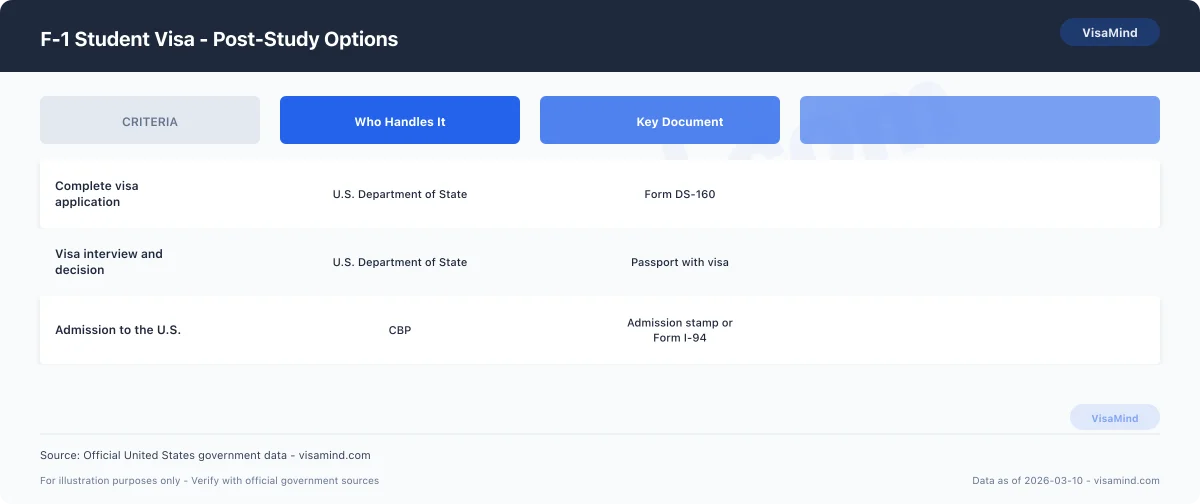
The Department of State adjudicates the visa. CBP decides whether to admit your dependent at the port of entry.
| Step | Who Handles It | Key Document |
|---|---|---|
| Complete visa application | U.S. Department of State | Form DS-160 |
| Visa interview and decision | U.S. Department of State | Passport with visa |
| Admission to the U.S. | CBP | Admission stamp or Form I-94 |
Arrival documentation
Before you travel, confirm that you’ve been accepted to an SEVP-certified school. Admission to a non-certified school does not qualify you for F-1 entry.
When you arrive in the United States, CBP will issue proof of admission. This may include:
- An admission stamp in your passport, or
- A paper Form I-94, Arrival/Departure Record
Keep this record. It shows your lawful entry and status in the United States.
Your dependents must also receive their own admission record. Each person’s entry is documented separately, even if you travel together.
If you notice an error in your admission record, review correction procedures on the CBP or USCIS website, depending on the issue.
Special adjudication notes
Visa officers review each application individually. They verify your eligibility, your school’s SEVP certification, and your relationship to any dependents.
For spouses, adjudicators apply the same standards to same-sex and opposite-sex marriages. The reviewing officer does not apply a different test based on gender.
You must provide clear documentation of the relationship. Insufficient or inconsistent documents can delay or affect a decision.
USCIS does not issue the visa itself. The U.S. Department of State handles visa issuance, and CBP determines whether to admit you at the port of entry.
When to Get Help
#Some F‑1 situations involve petition approvals, strict document matching, or sensitive personal data. In these cases, mistakes lead to delays or refusal, and you should seek guidance before you submit forms or attend an interview.
Complex petitioned cases
Most F‑1 students file Form DS‑160 and attend a visa interview with the U.S. Department of State. If your situation involves an approved petition with USCIS, timing and documentation matter.
If you’re connected to an H‑1B or L‑1 petition, make sure USCIS has approved Form I‑129 before you complete the DS‑
- The consulate will verify the petition’s status during visa processing.
You should get help when:
- You are changing status based on a petition.
- Your SEVIS record connects to a prior employment-based petition.
- You’re unsure whether USCIS approval is required before your interview.
| Issue | Why It Matters | Who Verifies It |
|---|---|---|
| Approved Form I‑129 | Must be approved before visa processing in petition-based cases | U.S. Citizenship and Immigration Services (USCIS) |
| DS‑160 information | Must align with petition data | U.S. Department of State |
| Petition status | Confirmed during consular review | U.S. Department of State |
An error in petition timing or status can result in administrative delay or refusal. Confirm your approval notice and ensure your DS‑160 reflects the same details.
Privacy and personal data
Your DS‑160 has to match your passport and all supporting documents exactly. Even small differences can cause processing delays or a visa denial.
You should review:
- Full legal name (including middle names)
- Date and place of birth
Check your passport number and expiration date. Review prior visa or petition details.
If your passport shows one spelling and your academic records show another, resolve the discrepancy before you submit the DS‑
- The consular officer compares your application against your passport and supporting documents.
Don’t share your passport biographic page, DS‑160 confirmation page, or USCIS approval notices through unsecured email or public file-sharing links. These documents contain sensitive personal data.
If you’re not sure how to correct an error before your interview, get help right away. Fixing mistakes after submission is much more difficult.
When expert tips apply
Certain procedural steps require strict order and consistency. If you skip a step or enter inconsistent data, the consulate may delay your case.
You should get help when:
-
You’re unsure whether a petition must be approved before completing DS‑160.
-
You notice a mismatch between your passport and your draft application.
-
You previously filed a petition with USCIS and don’t know how to disclose it correctly.
Follow this sequence in petition-related cases:
-
Confirm USCIS approval (if required).
-
Complete the DS‑160 using information that matches your passport and approval notice.
Bring supporting documents that reflect the same data.
If you can’t confirm petition status, use the USCIS case status tools. For visa interview procedures, review guidance from the U.S. Department of State.
Can You Work?
#You must follow specific employment rules based on your student classification and education level. U.S. immigration authorities expect you to comply with the terms of your status from the moment you enter the country.
Enrollment and eligibility for work
Your ability to work depends on your status as an F‑1 Student and your continued enrollment in an approved program.
You must:
- Maintain valid F‑1 status
- Follow the conditions tied to your education level
You also need to comply with rules issued by U.S. Citizenship and Immigration Services (USCIS). Respect the terms under which your visa was issued by the U.S. Department of State.
The Form DS‑160 supports your visa application at a U.S. consulate, but it doesn’t grant work authorization by itself. Admission at a port of entry is determined by U.S. Customs and Border Protection (CBP), and employment authorization is governed by immigration regulations.
Eligibility isn’t automatic. It depends on meeting and maintaining the requirements connected to your program.
| Requirement | Why It Matters |
|---|---|
| Valid F‑1 status | Required to remain lawfully present |
| Proper enrollment | Determines compliance with student rules |
| Adherence to visa terms | Affects future immigration benefits |
| USCIS compliance | Required for any employment authorization |
If you violate your status, you risk losing eligibility for benefits and remaining in the United States.
Rules by student type
Employment rules vary depending on your student classification and education level. Nonimmigrant students must follow a defined set of conditions tied to their specific category.
These rules control whether you may work, under what circumstances, and whether you need authorization from USCIS. Key factors that affect you include:
- Your visa classification
- Your level of study
Whether you remain in good standing and whether you have obtained any required authorization also matter.
Different student categories operate under different employment limits. Don’t assume that rules applying to one type of student apply to you.
| Student Factor | Impact on Work Eligibility |
|---|---|
| Visa classification | Determines governing regulations |
| Education level | May affect permitted activities |
| Status compliance | Required for any work benefit |
If you’re unsure which rules apply, review official guidance from USCIS and the U.S. Department of State before accepting employment.
Transitions toward employment
Some students seek to move from academic study toward employment opportunities in the United States. Any transition from study to work must comply with immigration law.
USCIS oversees applications for employment-related benefits, while the Department of State handles visa issuance abroad.
You must:
-
Maintain valid F‑1 status.
-
Follow the conditions attached to your classification.
Obtain any required authorization before working.
Working without authorization can affect future immigration filings and visa applications.
If you plan to pursue employment beyond your student period, consult the USCIS website for current eligibility rules and filing requirements. Your long-term immigration record depends on strict compliance.
Extending Your Student Visa
#You must keep your F-1 student status valid and follow the correct process if you need more time. Approval is never automatic, and you must meet all requirements set by U.S. government agencies.
Maintain status and extensions
You must maintain valid F-1 status before seeking any extension or new visa. Filing an application does not guarantee approval, even if you believe you qualify.
You are responsible for:
- Following the terms of your Student classification
- Submitting complete and accurate forms
Respond to any requests from U.S. Citizenship and Immigration Services (USCIS).
USCIS reviews applications on a case-by-case basis. If you fall out of status, you may lose eligibility for benefits related to your F-1 classification.
If you’re applying for a new visa stamp outside the United States, the U.S. Department of State handles visa issuance. Approval at the consulate is separate from any USCIS benefit request.
| Situation | Government Agency Involved | Key Point |
|---|---|---|
| Change or extension request inside the U.S. | USCIS | Filing does not guarantee approval |
| Visa issuance at a U.S. consulate | U.S. Department of State | Interview and visa decision required |
| Admission to the U.S. | U.S. Customs and Border Protection (CBP) | Final decision at port of entry |
Program changes and timelines
If your academic program changes or requires more time, you must act before your current authorized stay ends. Waiting until the last moment increases risk.
You must monitor your program dates and any documentation tied to your Student classification. Late filings can affect your status and future eligibility.
When applying for a new visa abroad, you must complete the Form DS-160, Online Nonimmigrant Visa Application. The Department of State reviews the DS-160 and makes the visa decision.
processing times vary. You should check:
-
The USCIS website for current case processing estimates
-
The U.S. Department of State for visa appointment availability
Never assume prior approval guarantees future approval. Each application stands on its own.
Filing considerations
Accuracy matters. Incomplete or inconsistent information can delay or harm your case.
Before filing, confirm:
- Your information matches all prior submissions
- You meet current eligibility requirements
You need to know which agency has authority over your request.
Use the official USCIS website to confirm filing instructions and required forms. For visa issuance questions, consult the U.S. Department of State.
Keep copies of everything you submit. If USCIS or a consular officer requests additional evidence, you must respond fully and on time.
You carry the burden of proving eligibility. Approval depends on meeting all legal requirements at the time of filing and decision.
Student Visa Document Checklist
#You must gather specific forms, confirmations, and identity documents before your F‑1 visa interview. Missing or incorrect paperwork leads to delays or refusal.
Prepare originals where required and keep copies for your records.
Primary forms and confirmations
Your application centers on two core documents: Form I-20 and the Form DS-160 confirmation page.
- Form I-20, Certificate of Eligibility for Nonimmigrant (F-1) Student Status
Issued to you for F‑1 classification
- Must reflect your correct personal information
You present it during the visa process handled by the U.S. Department of State.
- Form DS-160 confirmation page
Confirms you submitted the Online Nonimmigrant Visa Application
- You must bring the confirmation page to your interview
If you file any related benefit request with U.S. Citizenship and Immigration Services (USCIS), follow the specific form instructions and include required evidence.
| Document | Issued By / Submitted To | Purpose |
|---|---|---|
| Form I-20 | For F‑1 student classification | Establishes eligibility for student status |
| DS-160 Confirmation | U.S. Department of State process | Confirms online visa application submission |
Review every form for spelling, dates, and passport number accuracy before your appointment.
Passport and travel documents
You must present a passport valid for travel to the United States.
Check the expiration date carefully. If your passport will expire soon, renew it before your visa interview to avoid complications.
Ensure the passport biographic information matches your Form I-20 and DS-160 confirmation. Inconsistent names, dates of birth, or passport numbers can delay processing.
Keep your passport in good condition. Damaged or altered passports can raise concerns during visa adjudication.
Bring any required travel-related documents connected to your F‑1 classification as instructed by the U.S. Department of State for consular processing.
Photos and payment evidence
Prepare passport-style photos before you begin the process. Non-compliant photos cause delays.
Photos submitted to USCIS must meet these standards:
- Unmounted
- Unretouched
- Not digitally altered or enhanced
Edited images do not meet submission requirements.
If you prepaid your visa application fee, bring the application fee payment receipt as proof.
For current fee amounts, review the U.S. Department of State or USCIS official website, depending on where you are paying or filing.
Organize your photos and payment receipt in a folder so you can present them immediately when requested.
Who Can Apply
#You can apply for an F-1 student visa if you enroll in a qualifying program and show that you can financially support yourself during your studies. You must also meet basic eligibility standards set by U.S. immigration authorities and complete the required visa application steps.
Eligible program types
You qualify for an F-1 visa only if you enroll in a recognized academic, language-training, or vocational program in the United States. The program must be educational in nature and structured around formal instruction.
The following program categories qualify:
- Academic programs at accredited institutions
- Language-training programs focused on English or other academic language instruction
Vocational programs that provide structured, skills-based training also qualify.
Your primary purpose in the United States must be full-time study in one of these categories.
If your program does not fall clearly into one of these types, confirm eligibility directly with your school and review official guidance from U.S. Citizenship and Immigration Services (USCIS) and the U.S. Department of State.
| Program Type | Qualifies for F-1 | Primary Purpose Must Be Study |
|---|---|---|
| Academic | Yes | Yes |
| Language Training | Yes | Yes |
| Vocational | Yes | Yes |
You must intend to complete the specific course of study for which you apply.
Financial and school requirements
You must prove that you have enough funds to support yourself for the entire proposed course of study. This requirement applies before the visa is issued and remains essential for maintaining status.
You need to show that you can cover:
- Tuition and required school costs
- Living expenses
Other necessary education-related expenses must also be covered.
You can’t rely on unauthorized employment to meet this requirement. Your funding must be available and credible at the time you apply.
The U.S. Department of State reviews your financial documentation during the visa process after you submit Form DS-160, the Online Nonimmigrant Visa Application. Be prepared to present clear evidence of available funds at your interview.
You must also be formally accepted into a qualifying educational program before applying.
Other basic criteria
You must apply for the visa using Form DS-160 and attend a visa interview with the U.S. Department of State, unless exempt. The consular officer determines whether you qualify for visa issuance.
U.S. Citizenship and Immigration Services (USCIS) governs F-1 status inside the United States, while the Department of State handles visa issuance abroad. U.S. Customs and Border Protection (CBP) decides whether to admit you at the port of entry.
As an F-1 student, you must:
- Seek entry for the primary purpose of study
- Comply with the terms of your educational program
- Maintain eligibility under U.S. immigration rules
If you do not meet these core standards, the consular officer can refuse your visa application.
What Goes Wrong
#Most F-1 visa denials and delays result from avoidable paperwork errors. You control accuracy, document quality, and fee compliance.
Common documentation mistakes
You must present a complete and consistent record at your interview with the U.S. Department of State. Inconsistent answers or missing signatures often lead to refusal or delay.
Frequent rejection triggers
- Selecting the wrong visa category instead of F-1
- Entering travel or biographic details that do not exactly match your passport
Providing different answers across multiple Form DS-160 sessions is a common problem. Leaving security or background questions blank can also cause trouble.
Bringing an unsigned or improperly signed Form I-20 will delay your interview.
Use the exact spelling, passport number, and dates shown in your passport. Review every DS-160 field before submission and confirm that your Form I-20 is properly signed.
| Issue | What Happens | How You Prevent It |
|---|---|---|
| Wrong visa type | Application refusal | Select F-1 for academic study |
| Inconsistent data | Refusal or administrative delay | Match passport and DS-160 details exactly |
| Incomplete answers | Request for clarification or delay | Answer every question; use “None” or “N/A” where appropriate |
| Unsigned Form I-20 | Interview delay | Confirm required signatures before the interview |
Accuracy matters. Even small discrepancies can stop visa issuance.
Photo and DS-160 errors
Photo problems often slow down processing. The U.S. Department of State enforces strict image standards.
You risk delay if you submit:
- Retouched or digitally altered photos
- Photos mounted on other materials
- Images that do not meet official size or quality rules
Use a professional service familiar with Department of State photo requirements, or a validated tool. Avoid editing the image yourself.
Bring the DS-160 confirmation page to your interview. Without it, the consular officer can't proceed.
Review your DS-160 carefully before you submit. After submission, correcting inconsistencies isn't simple and can create new issues in your record.
Fee and passport issues
Pay any required visa application fee before your interview if the embassy or consulate expects advance payment. If payment doesn't register, your interview won't move forward.
Review the Department of State instructions for your specific post. For current fee amounts in USD ($), consult the Department of State fee schedule.
Your passport must be valid at the time you apply. An expired or invalid passport stops processing immediately.
| Problem | Consequence |
|---|---|
| Unpaid required fee | Interview cannot proceed |
| Expired passport | Visa cannot be issued |
| Missing payment confirmation | Processing delay |
Check payment status, passport validity, and document completeness several days before your appointment. Small oversights tend to cause the biggest disruptions.
Fees
#Total estimated cost: $535
| Component | Amount |
|---|---|
| Application fee (MRV)MRV fee (non-petition). SEVIS I-901 fee ($350 for F/M, $220 for J) paid separately at fmjfee.com. | $185 |
| SEVIS I-901 feeF-1/M-1 SEVIS fee, paid at fmjfee.com before the visa interview | $350 |
Verify current fees — official United States fee schedule
Fees shown are as of 2026-05-14. Verify on the official United States government website before applying.
Required forms
#Plan your F-1 Student Visa with free United States tools
#Itemized government fees for F-1 Student Visa and other United States categories.
Check United States eligibility
See how your profile scores against F-1 Student Visa and other United States visas.
United States processing times
Typical wait times and stage breakdowns for F-1 Student Visa and related United States visas.
Practice United States interview
Common interview questions and feedback for United States visa applicants.
Verified United States directory
#Browse source-backed, publication-certified records related to this visa route.
Browse source-backed, publication-certified records related to this visa route.
Browse source-backed, publication-certified records related to this visa route.