Quick summary
#NOTE: You may be eligible for a provisional unlawful presence waiver You do not meet all of the requirements listed in the Who May File Form I-601A section of these Instructions;, as described in the Form DS-2019 guide.
When the official instructions indicate this form is required
Include it with your application package and follow official instructions for submission.
Names, dates of birth, and passport details on other forms Program checklist requirements Supporting documents and translations
Overview (What is Form I-601A?)
#Form I-601A lets certain immigrant-visa applicants who are physically present in the United States ask USCIS to provisionally waive the unlawful presence ground of inadmissibility before they depart for consular processing. The point is to reduce the risk of being stuck abroad for years because of the three- or ten-year unlawful-presence bar. But the scope is limited. I-601A is not a universal waiver, and approval does not guarantee visa issuance if another inadmissibility ground appears later at the consular stage.
That is why the page has to be read as a waiver-strategy guide, not as a general cure-all for immigration problems.
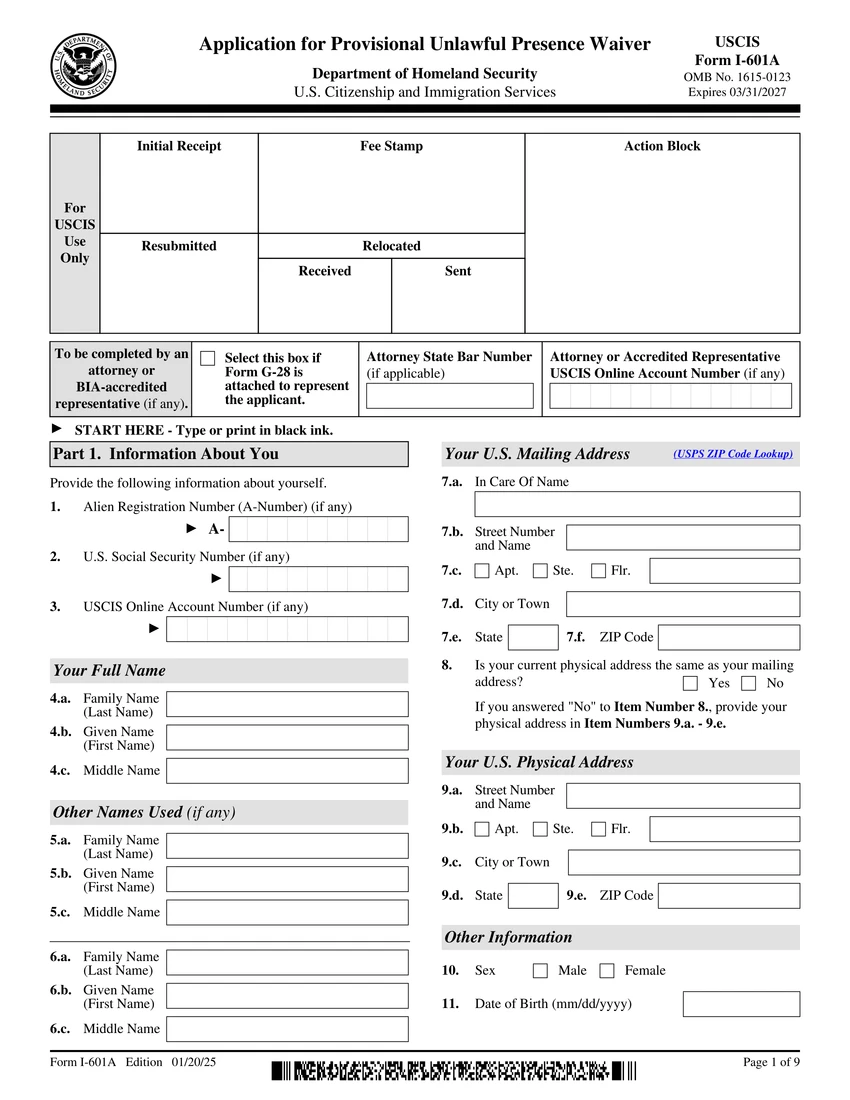
First page of I-601A form
Source: I-601A PDF
Context and workflow
#I-601A usually appears after the immigrant-visa path is already in motion through an approved petition and a Department of State immigrant-visa case with the IV fee paid. The waiver is filed before departure from the United States, and if approved the applicant still has to leave for the immigrant-visa interview later. Timing, physical presence, and the exact inadmissibility issue are all critical.
Why this matters
- This form helps confirm that the application matches the program’s requirements and checklist.
- This form acts as a cross-check point: details here must match other forms and supporting documents.
Where it fits in the workflow
- Initiating the waiver process for unlawful presence.
- Receipt Notice (a related form) to confirm filing.
- Attend biometrics appointment (fingerprints, photo, and signature).
- Decision on waiver before attending consular interview abroad.
Who uses it
I-601A is for certain people physically present in the United States who seek a provisional waiver of the unlawful-presence ground before leaving for consular immigrant-visa processing. It is often tied to approved I-130, I-140, or I-360-based immigrant cases or certain Diversity Visa situations. It is not the right form for every waiver problem, and it does not automatically solve removal-order, fraud, criminal, or other inadmissibility issues.
When it is used
- When the official instructions indicate this form is required
- As part of a complete application package with supporting documents
Failure prevention (What causes Form I-601A rejections?)
#Technical rejections
- Submitting the form with other applications or petitions.
- Failing to sign the application properly.
- Not attending the biometric services appointment.
Substantive weaknesses
- Omitting required translations for documents not in English.
- To avoid departing the u.s. before waiver approval (abandons application): Stay in the U.S. until I-601A is approved; travel abroad before approval voids the application.
- To avoid incomplete extreme hardship evidence: Document qualifying relative's hardship with affidavits, medical records, and financial evidence.
- To avoid filing before i-130 approval: Wait for I-130 approval; attach approval notice with I-601A packet.
- To avoid attending visa interview before waiver approval: Do not schedule or attend the immigrant visa interview until I-601A is approved.
What it asks for (What does Form I-601A ask for?)
#- Details about your qualifying relative
- Provide biographic information such as ethnicity, race, height, weight, eye color, and hair color.
- Details about your immigrant visa case and any approved petitions.
- Applicant identification information
- Supporting documentation inventory
- Eligibility or purpose details
- Declarations and signatures
- Biometrics appointment requirement, including fingerprints, photograph, and/or signature.
- Adjudication and determines that it has a deficient signature, USCIS may deny the request.
Sources for this section
What you need (What do you need for Form I-601A?)
#- The current edition of I-601A
- Proof of current immigration status
- Government-issued photo identification
- Passport-style photographs meeting specifications
- All evidence and supporting documents listed in the Specific Instructions.
- Failing to submit all required evidence and supporting documents.
- Failure to submit required evidence may result in rejection or denial of your application.
- Failure to provide a copy of the immigrant visa petition approval notice may result in processing delays or rejection.
- Copy of your filed or approved G-28 (Attorney or accredited representative (optional))
Checklist (What is the Form I-601A checklist?)
#- Download the current I-601A and instructions from the official USCIS website
- Review the official I-601A instructions before filing
- Collect the necessary supporting documents as outlined in the instructions.
- Complete all required sections of I-601A
- Confirm the form is signed and dated in all required fields
- Ensure that you sign and date Form I-601A before submission. Include all necessary supporting documents to complete your application.
Sources for this section
Fees
#| Component | Amount |
|---|---|
| Filing FeeYou have an immigrant visa case pending with DOS because you are the principal beneficiary of an approved Form I-130, I-140, or I-360, and have paid the immigrant visa processing fee to DOS. | See official schedule |
| Biometrics Services FeeYou must still meet all the eligibility requirements for the provisional unlawful presence waiver at the time of filing, including requirements to be physically present in the United States and to appear for your biometric services appointment at a USCIS Application Support Center (ASC) | See official schedule |
Can the Form I-601A fee be waived?
Fee waivers may be available for qualifying applicants. See official instructions for eligibility.
What happens if I submit the wrong fee?
USCIS will reject your application if the incorrect fee is submitted. Verify the current fee on the official schedule before filing.
Fee waiver: Fee waivers may be available for qualifying applicants. See official instructions for eligibility. For related guidance, see Petition for Alien Relative.
Fees change; always verify on USCIS.
Processing times
#| Category | Processing time |
|---|---|
| Provisional Waiver of Unlawful Presence | 28.5 to 32.5 monthsas of January 2026 |
- Processing time for I-601A under "Provisional Waiver of Unlawful Presence": 28.5 to 32.5 months (as of January 2026).
- Processing times for I-601A vary by eligibility category and service center. Data sourced from the official USCIS processing times tool.
- Processing times differ significantly by eligibility category. Initial applications, renewals, and replacements each go through different adjudication queues, and some categories consistently take longer than others.
- Renewal filings are often processed differently than initial applications. If you are renewing, file well before your current authorization expires — some categories allow you to continue working while the renewal is pending if filed on time.
- The service center assigned to your case affects how long it takes. USCIS distributes filings across multiple centers, and each has different workloads. You cannot choose which center processes your case.
- To check your estimated timeline: visit the official USCIS processing times tool, select your form and eligibility category, and note that the tool shows the filing date of cases currently being worked on — not a countdown from when you filed.
Auto-extension note: You believe you are or will be inadmissible only for a period of unlawful presence in the United States that was more than 180 days but less than 1 year, or one year or more during a single stay.
Where to file
#Online filing is available for some categories — verify on the official form page. Otherwise, file by mail to the address in the instructions.
Submit application
Mail your Form I-601A to the Chicago lockbox.
Filing locations and procedures may change. Always verify on the official USCIS website before submitting. For related guidance, see Online Immigrant Visa Application.
Form sections (What sections does Form I-601A have?)
#Eligibility Basis
Grounds for the waiver.
- Waiver type and statutory basis
- Inadmissibility being waived
- Evidence of eligibility for each element
Supporting Evidence
Documentation for discretionary approval.
- Personal affidavits
- Medical or psychological reports
- Country condition evidence
- Financial documentation
Strategy tips
#Mistake severity
#| Mistake type | Severity | How to avoid |
|---|---|---|
| Departing the U.S. before waiver approval (abandons application) | Rejection | Stay in the U.S. until I-601A is approved; travel abroad before approval voids the application. |
| Incomplete extreme hardship evidence | RFE | Document qualifying relative's hardship with affidavits, medical records, and financial evidence. |
| Filing before I-130 approval | Rejection | Wait for I-130 approval; attach approval notice with I-601A packet. |
| Attending visa interview before waiver approval | Rejection | Do not schedule or attend the immigrant visa interview until I-601A is approved. |
Examples (What are examples for Form I-601A?)
#- Strong application: An applicant submits the form with all required documents and receives a timely decision.
- An individual found inadmissible due to a prior removal files I-601A to request permission to reapply
- An applicant in the IR-1 category files I-601A as part of their immigration process
Common misconceptions (What misconceptions surround Form I-601A?)
#- Some applicants assume that filing Form I-601A will automatically resolve all issues related to their immigration status; however, it only addresses specific grounds of inadmissibility related to unlawful presence.
- A waiver is routinely granted if you meet the filing requirements — Waivers are discretionary. You must demonstrate that the qualifying relative would suffer extreme hardship if the waiver is not approved.
- I-601A has more than one fee component (e.g. Filing Fee and Biometrics Services Fee); paying only one or paying the wrong amount can result in rejection of the entire filing.
- A fee waiver for I-601A is not automatic — only specific qualifying categories are eligible, and a waiver request can be denied while the underlying form is still expected to be filed.
- Having I-601A pending does not automatically extend any prior authorization — automatic extensions apply only to specific renewal categories listed in the official rules.
- I-601A can be rejected before substantive review for technical errors such as “Submitting the form with other applications or petitions.”
Edge cases and variations
#- If you are asked to submit or update I-601A, treat it as a package update: check every place the same details appear and keep them consistent.
Scenarios
#An applicant files a waiver with strong supporting evidence and a clear explanation of eligibility.
Waiver approved. Applicant can proceed with visa or adjustment of status.
Waivers are discretionary. Present compelling evidence meeting each element of the standard.
An applicant files a waiver without establishing the required eligibility standard.
Waiver denied. Applicant may need to wait or pursue alternative relief.
Understand the legal standard for your waiver type. Document each element thoroughly.
An applicant includes detailed country condition reports and medical evidence for a hardship waiver.
Comprehensive evidence strengthens the case. Adjudicator has sufficient basis to approve.
Document everything. Expert reports, country conditions, and medical evidence support discretionary approval.
Key differentiators
#- Unlike Form I-130: Petition for Alien Relative: Required for: Approved I-130 required before filing waiver (Family-based immigration pathway)
- Unlike Form DS-260: Online Immigrant Visa Application: Next step after approval: Immigrant visa interview after waiver approved (Family-based immigration pathway)
- Unlike Form G-28: Notice of Entry of Appearance as Attorney or Accredited Representative: Supporting form: Attorney or accredited representative (optional) (Family-based immigration pathway)
Why it matters
#What happens after you submit
#- Receive Receipt Notice (a related form) confirming the application has been filed.
- Attend biometrics appointment (fingerprints, photo, and signature).
- USCIS reviews the waiver application and supporting documents.
- Receive a decision on the waiver application.
- If approved, proceed with the consular interview abroad for the immigrant visa.
Verification
#This guide is based on official USCIS instructions for Form I-601A and is updated in response to changes in form editions or filing rules. Always check the official USCIS website for the most current requirements.
Resources
#Free United States planning tools
#Itemize the government fees that go alongside Form I-601A.
United States eligibility checker
See which United States visas your profile fits before you finalize Form I-601A.
United States processing times
Get the typical wait time for the visa associated with Form I-601A.
United States interview practice
Practice United States interview questions if your filing route includes one.