Quick summary
#This form is not intended for general public self-filing, as described in the Form DS-260 guide.
If you were in removal proceedings which have been terminated by the immigration judge prior to this request, you may use this form to request that USCIS consider deferring action in your case.
Include it with your application package and follow official instructions for submission.
Names, dates of birth, and passport details on other forms Program checklist requirements Supporting documents and translations
Overview (What is Form I-821D?)
#As such, careful preparation and understanding of the DACA program's requirements are essential for those seeking its benefits. For related guidance, see the U.S. Visa Photo Requirements page. For related guidance, see the F-1 Student Visa Checklist page.
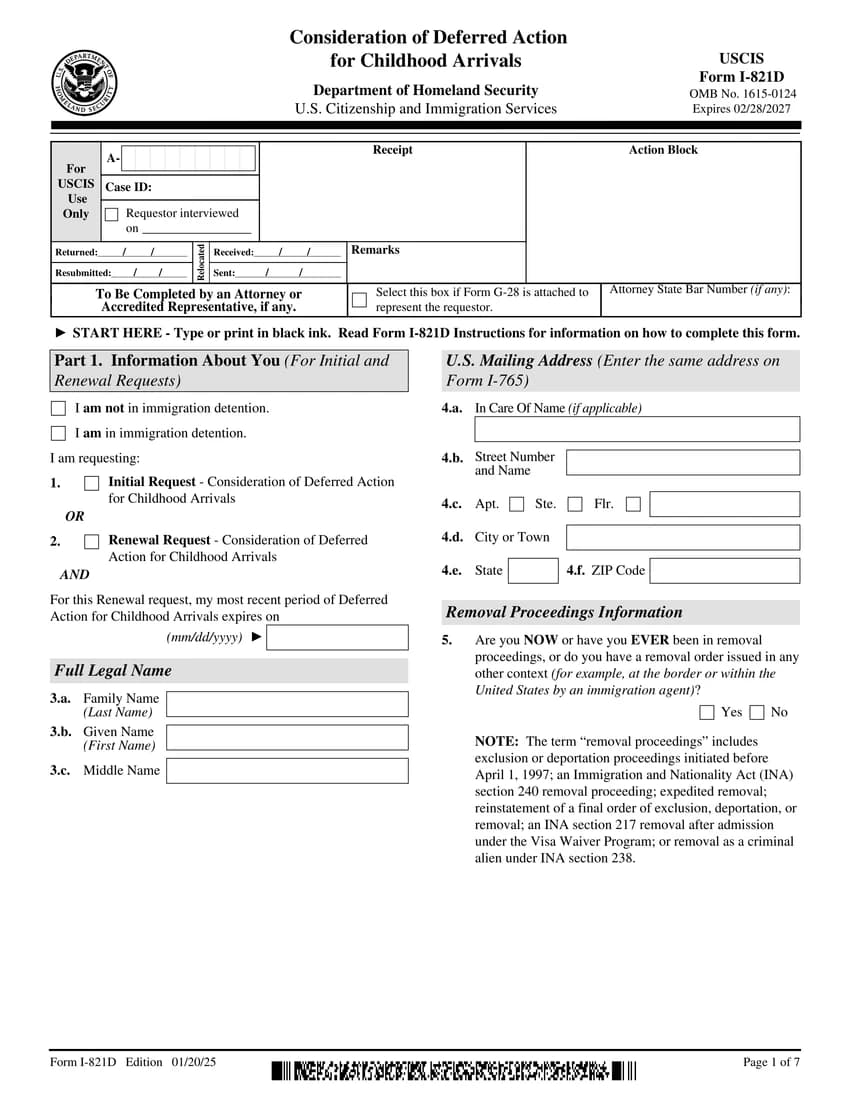
First page of I-821D form
Source: I-821D PDF
Context and workflow
#The processing time for Form I-821D can vary based on case type and current workload. Always consult the official USCIS processing time tool for updates.
Why this matters
- Small mismatches inside I-821D (or between I-821D and supporting evidence) can force rework later in processing.
- This form helps confirm that the application matches the program’s requirements and checklist.
Where it fits in the workflow
- Receipt Notice (a related form)
- Attend biometrics appointment (fingerprints, photo, and signature)
- Receive decision notice regarding deferred action status
- If approved, receive Employment Authorization Document (EAD)
- I-821D is commonly filed alongside Form I-765.
Who uses it
Form I-821D is intended for applicants seeking consideration for Deferred Action for Childhood Arrivals (DACA). It is specifically for individuals who arrived in the United States as childhood arrivals before their 16th birthday and meet specific criteria. To be eligible, applicants must have been under the age of 31 as of June 15, 2012, and have continuously resided in the U.S. since June 15, 2007. This form is used both for initial requests and for those seeking renewal of their DACA status.
When it is used
- If you were in removal proceedings which have been terminated by the immigration judge prior to this request, you may use this form to request that USCIS consider deferring action in your case.
- If you are in removal proceedings, have a final order of removal, exclusion, or deportation issued in any other context, have a voluntary departure order, or if your proceedings have been administratively closed, you may use this form to request that USCIS consider deferring action in your case, even if you are under 15 years of age at the time of filing.
- Asylum — DACA - deferred action
- When filing I-821D alongside I-765 (Work authorization required with DACA request)
- After filing I-821D — I-131 may be the next step (Advance parole for urgent humanitarian travel)
- When supplementing G-28 — I-821D provides additional required information
Requirements snapshot
#- Letters must include: your address at the time of employment, exact periods of employment, periods of layoff, and duties with the employer
Failure prevention (What causes Form I-821D rejections?)
#Technical rejections
- Submitting the request too early before the current DACA period expires.
- Failing to provide an original handwritten signature.
- Not attending the required biometrics appointment.
Substantive weaknesses
- Lack of sufficient evidence for continuous residence.
- Inadequate documentation of educational or military status.
- To avoid incomplete application or insufficient evidence: Follow instructions carefully; include all required supporting documents.
- To avoid filing renewal too late (beyond 150-120 days before expiry): Renew 120-150 days before DACA expiration; late filings may lapse work authorization.
- To avoid not filing i-765 with i-821d: File I-765 with I-821D; EAD request is required with DACA application.
What it asks for (What does Form I-821D ask for?)
#- Criminal, national security, and public safety information.
- Evidence of your identity and age.
- Proof of your continuous residence in the U.S. since June 15, 2007.
- Applicant identification information
- Supporting documentation inventory
- Eligibility or purpose details
- Declarations and signatures
- You must be 15 years of age or older at the time of filing and meet the criteria described in 8 CFR Part 236, Subpart C
- The certification must also include the translator’s signature, printed name, the signature date, and the translator’s contact information
- Biometrics appointment details including fingerprints, photograph, and signature.
- Provide an original, handwritten signature and date your request.
- Failing to sign the form with an original handwritten signature.
What you need (What do you need for Form I-821D?)
#- The current edition of I-821D
- Valid government-issued identification
- Supporting documentation for your case
- Filing fee or fee waiver documentation
- Evidence of your presence in the U.S. on June 15, 2012, such as school records or employment documents
- Are unable to provide such documentation or if it is not available, you may need to provide an explanation, including a description of your efforts to obtain such evidence, in Part 8
- Evidence of your educational status or military service.
- Evidence of continuous residence in the U.S. since June 15, 2007.
- Proof of identity and age, such as a birth certificate or passport.
- Gather and submit all necessary supporting documents.
- Omitting required supporting documents.
- Copy of your filed or approved I-765 (Work authorization required with DACA request)
Checklist (What is the Form I-821D checklist?)
#- Download the current I-821D and instructions from the official USCIS website
- Review the official I-821D instructions before filing
- Collect the necessary supporting documents as outlined in the instructions.
- Complete all required sections of I-821D
- Confirm the form is signed and dated in all required fields
- Sign, date, and submit I-821D with all required supporting evidence
Fees
#| Component | Amount |
|---|---|
| Filing FeeSubmit the filing fee for Form I-821D. | See official schedule |
| Biometrics Services FeeBiometrics appointment requirements and oath affirmation | See official schedule |
Can the Form I-821D fee be waived?
Fee waivers may be available for qualifying applicants. See official instructions for eligibility.
What happens if I submit the wrong fee?
USCIS will reject your application if the incorrect fee is submitted. Verify the current fee on the official schedule before filing.
Fee waiver: Fee waivers may be available for qualifying applicants. See official instructions for eligibility. For related guidance, see Application for Employment Authorization.
Fees change; always verify on USCIS.
Processing times
#| Category | Processing time |
|---|---|
| Renewal | 3 to 3.5 monthsas of January 2026 |
- adjudicate the majority of DACA renewal requests within 120 days and make every effort to efficiently process these requests as we receive them.
- processing time for DACA renewals and associated Employment Authorization Documents in fiscal year 2023 was 1 month, and less than 2 months for the first quarter of FY 2024.
- Processing time for I-821D under "Renewal": 3 to 3.5 months (as of January 2026).
- Processing times for I-821D vary by eligibility category and service center. Data sourced from the official USCIS processing times tool.
- Processing times for this form vary by the type of filing, the office handling your case, and current workload. Timelines are not fixed and change regularly.
- Renewal filings are often processed differently than initial applications. If you are renewing, file well before your current authorization expires — some categories allow you to continue working while the renewal is pending if filed on time.
Where to file
#Online filing is available for some categories — verify on the official form page. Otherwise, file by mail to the address in the instructions.
File online
Check the official I-821D page to see if online filing is available for your category.
Submit application
Paper filing addresses vary by eligibility category and state of residence. Check the official instructions for the correct filing address.
Filing locations and procedures may change. Always verify on the official USCIS website before submitting. For related guidance, see Application for Travel Document.
Form sections (What sections does Form I-821D have?)
#Personal Information
Applicant identification.
- Full name and A-Number if applicable
- Date of birth and nationality
- Current address and contact
Eligibility
Basis for the application.
- Category or classification claimed
- Supporting evidence type
- Dates establishing eligibility
Supporting Documents
Required attachments.
- Identity and status documents
- Category-specific evidence
- Fee payment or waiver request
Strategy tips
#Mistake severity
#| Mistake type | Severity | How to avoid |
|---|---|---|
| Incomplete application or insufficient evidence | Rejection | Follow instructions carefully; include all required supporting documents. |
| Filing renewal too late (beyond 150-120 days before expiry) | Delay | Renew 120-150 days before DACA expiration; late filings may lapse work authorization. |
| Not filing I-765 with I-821D | Rejection | File I-765 with I-821D; EAD request is required with DACA application. |
| Traveling without advance parole | Rejection | Obtain I-131 approval before travel; reentry without parole may terminate DACA. |
Examples (What are examples for Form I-821D?)
#- Complete all certifications: Ensure all required official certifications are properly signed and dated.
- Verify documentation: All supporting documents must be current and properly formatted.
- Cross-reference information: Information must be consistent across all sections and supporting documents.
- A national from a designated country files I-821D after the government extends protected status for their homeland
- An individual who fled persecution in their home country uses I-821D to seek protection
- An applicant in the Asylum category files I-821D as part of their immigration process
Common misconceptions (What misconceptions surround Form I-821D?)
#- Filing I-821D guarantees protection from removal — Filing creates a pending application but does not guarantee approval. Eligibility requirements must be met and verified.
- You can apply at any time without regard to deadlines — Many humanitarian programs have strict filing windows. Late applications may be rejected unless qualifying exceptions apply.
- I-821D has more than one fee component (e.g. Filing Fee and Biometrics Services Fee); paying only one or paying the wrong amount can result in rejection of the entire filing.
- A fee waiver for I-821D is not automatic — only specific qualifying categories are eligible, and a waiver request can be denied while the underlying form is still expected to be filed.
- I-821D cannot always be filed in any way — the correct filing method depends on the applicant's category, and using the wrong channel can result in rejection.
- I-821D can be rejected before substantive review for technical errors such as “Submitting the request too early before the current DACA period expires.”
Edge cases and variations
#- If you are asked to submit or update I-821D, treat it as a package update: check every place the same details appear and keep them consistent.
Scenarios
#An applicant files the application with all required supporting documents and the correct fee.
Application accepted. Biometrics may be scheduled. Case proceeds to adjudication.
Follow the evidence checklist for your category. Missing documents trigger RFEs or denial.
An applicant files before the eligibility window (e.g., I-751 outside the 90 days before conditional residence expires).
Application rejected. Fee returned. Must refile when eligible.
Verify eligibility dates carefully. Filing too early is as problematic as filing late.
An applicant forgets to sign the form.
Application rejected. Must resubmit with signature. Unsigned forms are not accepted.
Sign and date the form. Review the signature block before mailing.
Key differentiators
#- Unlike Form I-765: Application for Employment Authorization: Filed together: Work authorization required with DACA request
- Unlike Form I-131: Application for Travel Document: Next step after approval: Advance parole for urgent humanitarian travel (DACA pathway)
- Unlike Form G-28: Notice of Entry of Appearance as Attorney or Accredited Representative: Supporting form: Attorney or accredited representative (optional) (DACA pathway)
Why it matters
#What happens after you submit
#- Receive Receipt Notice (a related form) acknowledging the application.
- Attend biometrics appointment (fingerprints, photo, and signature) if required.
- Await decision notice regarding deferred action status.
- If approved, receive Employment Authorization Document (EAD) by mail.
- Prepare for renewal by maintaining eligibility and gathering necessary documentation.
Verification
#This guide is derived from official USCIS instructions for I-821D and is updated when form editions or filing rules change. Always verify current requirements at the official USCIS website.
Resources
#Free United States planning tools
#Itemize the government fees that go alongside Form I-821D.
United States eligibility checker
See which United States visas your profile fits before you finalize Form I-821D.
United States processing times
Get the typical wait time for the visa associated with Form I-821D.
United States interview practice
Practice United States interview questions if your filing route includes one.