
Overview
#Asylum in the United States allows you to request protection if you fear persecution in your home country.
You apply by filing Form I-589 with U.S. Citizenship and Immigration Services (USCIS), and approval is not guaranteed.
What it covers
Form I-589, Application for Asylum and for Withholding of Removal, lets you request specific forms of protection while you are physically present in the United States.
You use one form to seek more than one type of protection.
| Protection Type | What You Request |
|---|---|
| Asylum | Permission to remain in the United States due to past persecution or a well‑founded fear of persecution |
| Withholding of Removal | Protection from being returned to a country where you would face persecution |
| Protection under the Convention Against Torture (CAT) | Protection from return to a country where you would likely face torture |
You must already be in the United States to file this application.
USCIS reviews your request and determines whether you qualify for any of these protections.
Filing the form starts a formal legal process.
It does not automatically grant lawful status, work authorization, or permanent residence.
USCIS makes a decision after reviewing your application.
Who it's for
You may file Form I-589 if you meet the following core condition:
- You are physically present in the United States
- You seek protection because you experienced persecution or fear persecution in your home country
This process applies to individuals who believe returning to their country would put them at risk.
Your claim must relate to persecution or a fear of persecution.
You do not need to apply for asylum and withholding separately.
Form I-589 allows you to request:
- Asylum
- Withholding of removal
- CAT protection
USCIS handles these requests within the same application framework.
You submit one form, and the agency evaluates all requested protections based on the information you provide.
Key limitation
Filing Form I-589 does not guarantee approval.
USCIS evaluates each case individually.
The agency may approve one form of protection and deny another.
For example, you might qualify for withholding of removal but not asylum, depending on how USCIS assesses your eligibility.
You must provide sufficient information to support your claim of persecution or fear of persecution.
If USCIS determines that you do not meet the legal standard for any requested protection, it can deny your application.
Current Policy Considerations
#Asylum law and processing have changed significantly since early 2025, and several policies now affect who can apply, how cases move, and who can work while a case is pending. This page reflects developments as of mid-2026, but the landscape shifts quickly — always confirm the current rules on the official USCIS asylum page.
Recent developments to be aware of
- January 2025 Presidential Proclamation. A proclamation restricted asylum eligibility for many people who crossed the southern border, limiting access to the asylum process for affected arrivals.
- December 2025 pause on final asylum decisions. USCIS paused issuing final decisions on many asylum cases. The pause was partially lifted in March 2026 but still affects applicants from certain nationalities.
- December 2025 expanded travel ban. An expanded travel ban affects applications connected to 39 countries, which can influence how and whether some cases proceed.
- New limits on work authorization. New rules restrict employment authorization (EAD) eligibility for asylum seekers who crossed the border between ports of entry.
What this means for you
These changes can affect your eligibility, your timeline, and your ability to work while you wait. Because rules are being added, paused, and lifted on short notice, do not rely solely on older guidance. Check the USCIS asylum page for the latest status before you file and while your case is pending, and consider speaking with a qualified immigration attorney about how current policy applies to your specific situation.
What Happens Next
#After you file Form I-589 with U.S. Citizenship and Immigration Services (USCIS), your case moves through review and decision.
What happens to your ability to work, travel, and stay in the United States depends on whether USCIS grants asylum.
Work and authorization
If USCIS grants your asylum application, you are authorized to work in the United States immediately.
You do not need to wait for a separate approval to begin lawful employment once asylum is granted.
Your work authorization is tied directly to your approved asylum status.
Keep documentation of your approval for your records and for any employment verification process.
| Status of Form I-589 | Work Authorization |
|---|---|
| Pending | Check the USCIS website for current rules |
| Granted | Authorized to work immediately |
If your Form I-589 remains pending, review the USCIS website for current guidance on employment eligibility and related procedures.
Rules and processes can change, and USCIS provides the official requirements.
Travel considerations
Do not leave the United States after filing Form I-589 unless you first obtain advance parole.
Departing without advance parole can affect your asylum case.
Advance parole is permission to reenter the United States after temporary travel abroad.
You must receive approval before you travel.
Returning to the country where you fear persecution is especially dangerous — even with advance parole. Going back to that country can be treated as evidence that you do not actually fear persecution there, and it can severely damage or terminate your asylum case. Advance parole protects your ability to reenter the United States; it does not protect your asylum claim from the consequences of returning to the country you fled.
| Action | Risk Level |
|---|---|
| Travel without advance parole | May be treated as abandoning your application |
| Travel with approved advance parole (not to the feared country) | Follow USCIS terms and conditions |
| Return to the country of feared persecution (even with advance parole) | May severely damage or terminate your asylum case |
Review current instructions and filing requirements on the USCIS website before making plans.
Remaining in the U.S.
If USCIS grants you asylum, you may remain in the United States.
Your approved status allows you to stay lawfully.
Keep copies of your asylum approval notice and all related USCIS documents.
You will need them to prove your lawful presence and eligibility for benefits tied to asylum status.
If your case is still pending, you may remain in the United States while USCIS adjudicates your Form I-589.
Monitor all mail from USCIS and respond promptly to any requests for information.
Path to a green card after asylum
Asylum can lead to lawful permanent residence. One year after you are granted asylum, you may apply for a green card by filing Form I-485, Application to Register Permanent Residence or Adjust Status, with USCIS. You generally must have been physically present in the United States for at least one year after the asylum grant, continue to meet the refugee definition (or be the spouse or child of someone who does), and not be firmly resettled in another country.
Adjusting from asylee status is a separate step from the asylum grant itself. Keep your asylum approval notice and evidence of your continuous presence, since you will need them when you file Form I-485.
Bringing family members who are abroad (Form I-730)
If USCIS grants you asylum, you can petition to bring your spouse and unmarried children under 21 who are outside the United States by filing Form I-730, Refugee/Asylee Relative Petition, for each family member. You generally must file within two years of being granted asylum, unless USCIS excuses the deadline for humanitarian reasons.
This is different from listing dependents already in the United States on your Form I-589. Form I-730 is specifically how a granted asylee reunites with immediate family members who remain abroad.
When to Consult a Professional
#Asylum cases carry strict deadlines, detailed evidence requirements, and serious consequences if you make mistakes.
You should seek professional guidance when timing is tight, facts are complicated, or you are unsure how to present your claim clearly to U.S. Citizenship and Immigration Services (USCIS).
Deadlines & timing
You must file Form I-589, Application for Asylum and for Withholding of Removal, within 1 year of your last arrival in the United States.
Missing this deadline can lead to rejection unless you qualify for a limited exception.
Many applicants wait too long because they misunderstand the one-year rule.
If you plan to file late, you must clearly document any changed circumstances that justify the delay.
A professional can help you:
- Confirm your exact deadline based on your last entry date
- Prepare a detailed personal affidavit
- Organize country conditions evidence
- Address timing issues before USCIS reviews your case
| Issue | Why It Matters |
|---|---|
| Filing after 1 year | May result in rejection without a valid exception |
| Weak explanation for delay | USCIS may not accept late filing |
| Incomplete affidavit | Undermines credibility |
Act early.
Preparing a strong I-589 takes time, especially when gathering evidence from abroad.
When cases are complex
Some asylum claims involve facts that require careful legal framing.
If your situation includes multiple incidents, gaps in documentation, or fear based on evolving conditions in your home country, you should not handle the case alone.
Your written affidavit must clearly explain what happened, who was involved, and why you fear returning.
USCIS officers look for consistency and detailed facts.
You should seek help if:
- Your case depends heavily on country conditions evidence
- You have difficulty obtaining proof
- Your timeline includes long gaps or multiple departures and reentries
- You are unsure how to explain key events clearly
Complex cases require strategic presentation.
Small inconsistencies can affect how USCIS evaluates credibility.
Getting legal advice
Asylum applications are confidential, but the stakes are high.
A denial can affect your ability to remain in the United States.
An immigration attorney can review your completed Form I-589 before filing and identify weaknesses.
They can also help structure your affidavit so it aligns with supporting evidence.
Professional guidance is especially important if:
-
You are close to the one-year deadline.
-
You plan to request an exception for late filing.
-
You feel uncertain about how to describe your fear clearly and consistently.
If you are unsure about any requirement, consult qualified legal counsel rather than risking avoidable errors.
Processing Times and Costs
#Filing Form I-589 now carries a fee under current law, and you must also track processing times and follow mailing rules exactly.
Delays often result from filing at the wrong address, missing a required fee, or misunderstanding employment authorization eligibility.
USCIS processing timelines
U.S. Citizenship and Immigration Services (USCIS) lists standard affirmative asylum processing times at 6 to 18 months as of March 2026.
The processing times vary by:
- Eligibility category
- USCIS service center
- Case volume and staffing
You should confirm current estimates using the official USCIS processing times tool.
The agency updates timelines regularly.
| Case Type | Form | Current Standard Processing Time* |
|---|---|---|
| Affirmative Asylum | I-589 | 6–18 months |
*As reported by USCIS in March 2026.
If you already filed Form I-589 and your case remains pending, processing continues under the same general timeframe unless USCIS transfers your case.
USCIS may also route certain filings through specialized units, which can affect timing.
Always monitor your case status directly through USCIS.
Fees and EAD costs
Asylum is no longer free to apply for. Under H.R. 1, Form I-589 now carries a $100 initial filing fee. In addition, there is a separate $102 Annual Asylum Fee (AAF) for each year your case remains pending for more than one year. USCIS began enforcing the Annual Asylum Fee on May 29, 2026.
These fees matter because non-payment of the Annual Asylum Fee can cause USCIS to reject your asylum application and cancel your work permit. Do not assume asylum is free — confirm the current amounts and payment procedures on the USCIS website before and during your case.
| Fee | Amount | When It Applies |
|---|---|---|
| Form I-589 initial filing fee | $100 | When you first file the application |
| Annual Asylum Fee (AAF) | $102 per year | Each year a case stays pending beyond one year (enforced from May 29, 2026) |
If you seek employment authorization, you must also file Form I-765, Application for Employment Authorization, under the appropriate eligibility category.
The fees vary by category and filing type. Examples mentioned in USCIS guidance include:
- Initial Employment Authorization Document (EAD) under category (c)(11)
- Renewal EAD for certain parolees
Because fees can change, you should:
-
Review the Form I-589 and Form I-765 instructions.
-
Use the USCIS Fee Calculator.
-
Confirm your eligibility category before filing.
| Application | Form | Filing Fee |
|---|---|---|
| Asylum (initial) | I-589 | $100 |
| Annual Asylum Fee | — | $102 per year pending |
| Employment Authorization | I-765 | Check USCIS Fee Calculator |
USCIS will reject filings with incorrect or missing payments.
Special filing / mailing rules
You must mail your paper Form I-589 to the correct USCIS filing location based on your residence and case type.
USCIS does not accept asylum filings at all locations.
Follow these steps carefully:
-
Review the Form I-589 webpage.
-
Identify your filing category.
-
Confirm the correct mailing address.
-
Mail the complete application to that address.
Certain applicants must file by mail with the Asylum Vetting Center, including:
- Individuals in removal proceedings under specific statutory categories
- Applicants directed by the Special Instructions section of the Form I-589 webpage
If you already submitted Form I-589 and it remains pending with USCIS, do not refile unless USCIS instructs you to do so.
Mailing to the wrong address can delay your case or result in rejection.
Always verify the correct filing location before sending your application.
Who Qualifies for Protection
#You must be in the United States, not be a U.S. citizen, and show that you fear persecution tied to a specific legal ground.
You also must meet strict filing deadlines and avoid disqualifying factors when you submit Form I-589 to U.S. Citizenship and Immigration Services (USCIS).
Protected grounds
U.S. asylum law protects you only if the harm you fear connects to one of five specific grounds.
General violence or economic hardship does not qualify unless it ties directly to one of these categories.
| Protected Ground | What You Must Show |
|---|---|
| Race | You face persecution because of your racial identity. |
| Religion | You face persecution for your religious beliefs or practices. |
| Nationality | You face persecution due to your nationality or ethnic background. |
| Political opinion | You face persecution because of your actual or perceived political views. |
| Particular social group | You face persecution because you belong to a defined social group. |
You must clearly explain which ground applies to you in Form I-589.
USCIS will evaluate whether the harm you describe is directly connected to one or more of these protected grounds.
Basic eligibility conditions
You must meet threshold requirements before USCIS will consider the merits of your case.
If you fail to meet these conditions, your application can be denied without reviewing your persecution claim.
You must:
- Be physically present in the United States
- Not be a U.S. citizen
- File Form I-589 within 1 year of your last arrival in the United States
- Review your entry and immigration status to confirm you are eligible to file with USCIS
The one-year filing deadline is strict.
Section 208(a)(2)(B) of the Immigration and Nationality Act requires you to submit Form I-589 within one year of arrival unless an exception applies.
If you are unsure about deadlines or filing procedures, check the USCIS website for current instructions.
Exceptions to the one-year deadline
The one-year filing deadline has two statutory exceptions. If one applies, you may still file after a year has passed, but you must file within a reasonable time given the circumstances and clearly document why.
- Changed circumstances that materially affect your eligibility — for example, conditions in your home country have worsened, or your own situation has changed (such as new political activity, a change in your religion, or a change in your identity or membership in a particular social group).
- Extraordinary circumstances that prevented a timely filing — for example, serious illness or mental or physical disability, legal disability (such as being an unaccompanied minor), ineffective assistance of counsel, or the death or serious illness of a family member or your legal representative.
You must explain and document the exception in your Form I-589. Because late filings are closely scrutinized, consider consulting a professional if you are past the one-year mark.
Ineligibility rules
Certain factors can prevent you from qualifying for asylum, even if you fear persecution.
You may be ineligible if:
- You fail to file Form I-589 within 1 year of arrival and do not qualify for an exception
- You do not meet the physical presence requirement
- You are a U.S. citizen
USCIS also reviews your immigration history, including whether you have ever been issued an A-Number, as part of its eligibility review.
You must provide complete and accurate information on Form I-589.
Incomplete or incorrect filings can delay processing or lead to denial.
How to Apply for Protection
#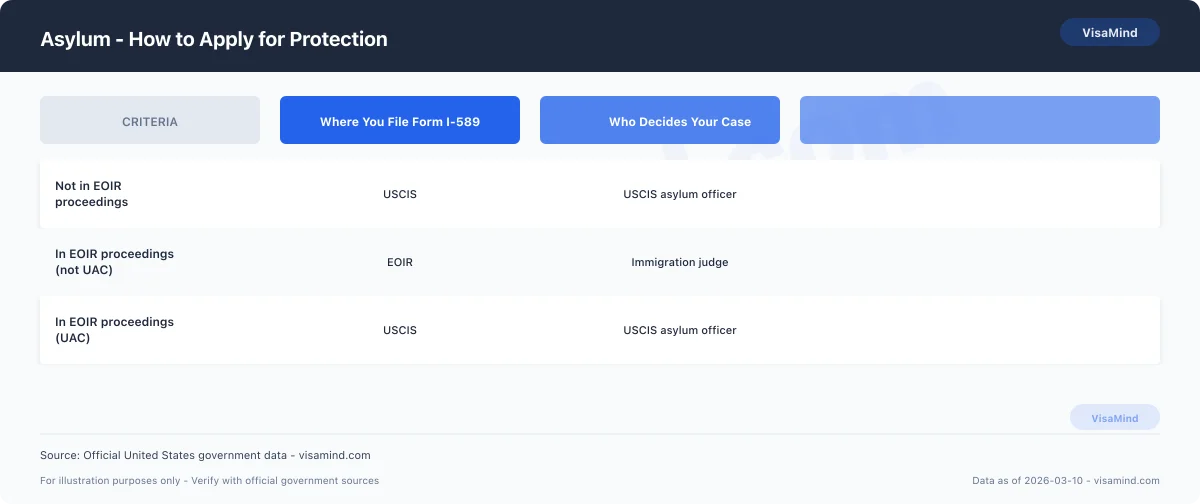
You apply for asylum by filing Form I-589, Application for Asylum and for Withholding of Removal.
Where you file depends on whether you are in immigration court proceedings and whether you were classified as an unaccompanied alien child (UAC).
Filing with the wrong agency can delay your case.
Affirmative vs defensive filing
You file affirmatively with U.S. Citizenship and Immigration Services (USCIS) if:
- You are physically present in the United States
- You are not a U.S. citizen
- You are not in proceedings before the Executive Office for Immigration Review (EOIR)
- You are in proceedings but were determined to be a UAC
You file defensively if you are already in removal proceedings before an immigration judge or the Board of Immigration Appeals (BIA) and were never determined to be a UAC.
The main difference is who decides your case. USCIS handles affirmative cases.
An immigration judge at EOIR decides defensive cases.
| Situation | Where You File Form I-589 | Who Decides Your Case |
|---|---|---|
| Not in EOIR proceedings | USCIS | USCIS asylum officer |
| In EOIR proceedings (not UAC) | EOIR | Immigration judge |
| In EOIR proceedings (UAC) | USCIS | USCIS asylum officer |
You cannot file Form I-589 with USCIS if you are currently in EOIR proceedings unless you qualify under the UAC exception.
Where and how to file
Form I-589 must be completed in English. Submit it to the correct agency based on your case status.
File with USCIS if you qualify for affirmative asylum. File with EOIR if you are in immigration court proceedings and do not qualify for the UAC exception.
Follow these steps:
-
Complete Form I-589 fully and accurately.
-
Sign the form.
-
Include all required information about your spouse and children.
-
If you have more than four children, attach Form I-589 Supplement A for additional children.
-
Mail the form to the address listed in the official Form I-589 instructions.
If you have an A-Number but are not in EOIR proceedings, you may still file affirmatively with USCIS.
If you file with USCIS but are actually in EOIR proceedings and do not qualify as a UAC, USCIS will not accept your application.
Interpreter, referrals, and special rules
You must provide a competent interpreter if USCIS requires one for your interview. The interpreter must translate accurately between you and the asylum officer.
USCIS may refer your case to an immigration judge rather than approve or deny it. In that situation, your case continues in immigration court as a defensive asylum case.
Special rules apply to applicants determined to be unaccompanied alien children (UACs). Even if you are in EOIR proceedings, you may file Form I-589 with USCIS if you qualify under this classification.
Complete every section of the form carefully. Incomplete or inconsistent information can delay your case or lead to referral to immigration court.
Your Rights During Processing
#While USCIS reviews your Form I-589, you have specific rights tied to employment authorization. The most important issues involve when you can apply, how the 180-day clock works, and what actions can delay or stop your eligibility.
Work authorization timeline
You can qualify for employment authorization based on a pending asylum application after 180 days have passed since filing Form I-589.
You may file Form I-765, Application for Employment Authorization, after 150 days have passed, as long as USCIS has not made a decision on your asylum case.
Many applicants file Form I-765 together with Form I-589 or shortly after filing. USCIS will not approve the work permit until the full 180-day period has passed.
| Day Count From I-589 Filing | What Happens |
|---|---|
| Day 0 | USCIS receives your Form I-589 |
| Day 150 | You may file Form I-765 (if no decision yet) |
| Day 180 | You become eligible for employment authorization |
If USCIS grants or denies your asylum application before 180 days pass, you will not receive work authorization based on the pending I-589.
EAD-clock rules
USCIS tracks your eligibility using what is commonly called the 180-Day Asylum EAD Clock.
The clock measures the number of days your Form I-589 has been pending without a final decision. If the clock reaches 180 days, you become eligible for employment authorization, assuming no disqualifying delays apply.
The clock can stop in certain situations. When it stops, you will not continue earning days toward the 180-day requirement.
If your case moves to immigration court and the clock stops, it will not start again until your first hearing with an immigration judge. This delay can directly affect when you qualify for a work permit.
You may receive a notice related to the EAD clock. Review any such notice carefully because it affects your eligibility for employment authorization based on your pending Form I-589.
Limits on authorization
Employment authorization based on a pending asylum application is not automatic.
You will be ineligible for employment authorization if:
- The 180-day period has not been completed
- The EAD clock has stopped and has not resumed
- USCIS has already issued a decision on your Form I-589 before you reach eligibility
Approval depends on meeting the timing requirements tied to your pending case. Filing Form I-765 at 150 days does not guarantee approval; USCIS can only approve it once you meet the 180-day threshold.
Monitor your case status through USCIS and keep copies of all filings and notices related to your Form I-589 and Form I-765.
Why Claims Get Denied
#Most asylum denials result from preventable filing errors, weak documentation, or credibility concerns. You reduce risk when you submit a complete Form I-589, provide detailed facts, and support your account with consistent evidence.
Common application mistakes
USCIS can reject or deny your case before it reaches the merits if you do not follow the Form I-589 instructions exactly. Technical errors often stop a case from moving forward.
Frequent filing problems include:
- Leaving required fields blank, such as your full legal name, U.S. residence, or date of birth
- Failing to sign the Form I-589
- Submitting missing pages or using the wrong form edition
- Filing at the wrong location or using the wrong filing method (for example, filing online when instructions require mailing)
- Not providing a competent interpreter when required
- Missing your scheduled asylum interview
- Failing to acknowledge a decision in person when instructed
Traveling outside the United States without approved advance parole after filing can also lead USCIS to treat your application as abandoned.
Use this checklist before filing:
| Item | What to Confirm |
|---|---|
| Form completion | All required fields completed |
| Signature | Signed in ink if mailing |
| Correct edition | Matches current USCIS version |
| Filing method | Online or mail as instructed |
| Supporting documents | Included and organized |
Credibility and evidence problems
USCIS closely reviews whether your testimony is detailed, specific, and consistent with country conditions evidence. Vague statements such as “I was threatened” without dates, locations, or names weaken your claim.
You must explain events in clear chronological order. Describe who harmed you, what happened, when it occurred, and why you believe it happened.
Applications often face Requests for Evidence (RFEs) when the personal statement lacks detail or when supporting documents are minimal. Generic affidavits carry less weight than statements that describe specific incidents.
If you answer “Yes” to eligibility questions on Form I-589, provide a clear explanation and supporting documentation. Unexplained answers raise credibility concerns.
Stronger evidence may include:
- Detailed personal declaration
- Country conditions reports that match your facts
- Affidavits from witnesses
- Expert statements when available
Consistency across your written statement, interview testimony, and documents is critical.
How to strengthen a claim
Start with a thorough, fact-based personal statement. Include dates, locations, names, and the sequence of events.
Organize your evidence so USCIS can easily follow your story.
Practical steps:
-
Review the Form I-589 instructions line by line before filing.
-
Attach a detailed written declaration.
-
Include supporting country conditions evidence that reflects your specific harm.
-
Add affidavits from people with direct knowledge of your situation.
-
Double-check signatures, required fields, and correct filing location.
Prepare carefully for your asylum interview. Review your application so your testimony remains consistent with what you filed.
Prepare Your Evidence
#Build your case with clear proof of persecution, identity, and presence in the United States. Submit a complete and signed Form I-589, Application for Asylum and for Withholding of Removal, in English to U.S. Citizenship and Immigration Services (USCIS) with supporting documents that match your written statements.
Persecution evidence
You must document past harm or a well‑founded fear of future harm in your home country. Tie each incident to at least one protected ground: race, religion, nationality, membership in a particular social group, or political opinion.
Organize your evidence chronologically. Include dates, locations, and the people involved.
Strong supporting documents may include:
- Written statements describing threats, attacks, or detention
- Records showing harm or targeting
- Documents that show why you were targeted based on a protected ground
- Any other material that supports your fear of returning
Make sure your written answers on Form I-589 clearly explain who harmed you, why they targeted you, and what you fear will happen if you return. If you need more space, attach additional pages and label them clearly.
Proof of presence and identity
You must prove who you are and that you are physically present in the United States. USCIS requires biographical details that match your supporting documents.
Provide complete and consistent information, including:
- Your full legal name and any other names used
- Your current U.S. residence address
- Biographical information about yourself
- Information about your spouse and children, if applicable
If you are not in Immigration Court (EOIR) proceedings, include evidence showing that status. Your identity documents and personal details must match the information listed on Form I-589.
If you include your spouse or children as dependents, list them accurately and provide the required personal information for each person.
Documentation & past filings
Submit a completed and signed Form I-589 in English. An incomplete or unsigned form can lead to rejection.
Your filing should include:
- All required sections of Form I-589 fully answered
- Clear explanations for any “yes” responses that require details
- Information about your current U.S. residence
- Information about your spouse and children, whether included as dependents or not
If you previously filed Form I-589 and later lost derivative status, provide details about that prior filing when submitting a new independent application. Make sure dates, names, and case history are accurate.
Gather Your Documents
#Prepare complete and accurate information before you start Form I-589. You must provide detailed biographical data, your U.S. residence history, and full information about your spouse and children, along with a signed form submitted to U.S. Citizenship and Immigration Services (USCIS).
Biographical & identity fields
Form I-589 asks for precise identity information about you, your spouse, and your children. Enter your complete last name, date of birth, and country of birth exactly as they appear on your identity documents.
Provide consistent spelling across every section of the form. Inconsistent names or dates can delay review by USCIS.
Use this checklist to confirm accuracy:
- Full legal last name
- Date of birth (day, month, year)
- Country of birth
- Biographical details for spouse
- Biographical details for each child
You must also clearly explain why you are applying for asylum. Describe the fear of persecution that led you to seek protection.
Before submission, review every biographical field and sign Form I-589 in the designated signature section. USCIS will not accept an unsigned form.
| Required Field | Who Must Provide It |
|---|---|
| Last Name | You, spouse, children |
| Date of Birth | You, spouse, children |
| Country of Birth | You, spouse, children |
| Reason for Applying | You |
Residence & contact details
You must state where you physically reside in the United States. The form specifically asks for your current U.S. residence.
List your residence clearly and completely. Do not leave this section blank.
Include:
- Your current physical address in the United States
- Any required residence details requested in Question 8 of Form I-589
Residence information helps USCIS identify your location while your asylum application is pending. Ensure the address is accurate at the time you file.
If you move, follow USCIS instructions on updating your address. Keep your records consistent with what you report on Form I-589.
Dependents and supporting forms
You must provide complete details about your spouse and all children, even if they are not applying with you. The form requires biographical information for each dependent.
Include:
- Full last name
- Date of birth
- Country of birth
Do not omit a child. The form requires you to disclose all children.
Download Form I-589 directly from the USCIS website and complete all relevant sections in English. Answer every applicable question.
Before filing:
-
Review all entries for accuracy.
-
Confirm you included your spouse and each child.
-
Sign the completed Form I-589.
Submit the signed form with all required information to USCIS following the official filing instructions.
Fees
#Total estimated cost: $202
| Component | Amount |
|---|---|
| Filing fee (I-589)Initial asylum application fee introduced under H.R. 1. | $100 |
| Annual Asylum Fee (AAF)Charged each year a case stays pending beyond one year; USCIS began enforcing on May 29, 2026. Non-payment can lead to rejection of the application and cancellation of the work permit. | $102 |
Verify current fees — official United States fee schedule
Fees shown are as of 2026-07-12. Verify on the official United States government website before applying.
Required forms
#Plan your Asylum with free United States tools
#Itemized government fees for Asylum and other United States categories.
Check United States eligibility
See how your profile scores against Asylum and other United States visas.
United States processing times
Typical wait times and stage breakdowns for Asylum and related United States visas.
Practice United States interview
Common interview questions and feedback for United States visa applicants.
Verified United States directory
#Browse source-backed, publication-certified records related to this visa route.
Browse source-backed, publication-certified records related to this visa route.