
What the E-2 Treaty Investor Visa Covers
#The E-2 Treaty Investor classification allows you to enter the United States based on a substantial investment in a U.S. business.
It also extends to certain employees who share your treaty nationality and qualify under this category.
Who uses this classification
You use the E-2 Treaty Investor visa if you are a national of a country that maintains a qualifying treaty with the United States and you invest a substantial amount of capital in a U.S. enterprise.
This classification also covers certain employees of the treaty investor.
Those employees must share the same treaty nationality as the principal investor and qualify under the E-2 rules.
You may interact with different agencies depending on where you apply:
| Applicant Type | Primary Agency Involved |
|---|---|
| Investor applying from abroad | U.S. Department of State |
| Employee applying from abroad | U.S. Department of State |
| Investor or employee seeking benefits in the U.S. | U.S. Citizenship and Immigration Services (USCIS) |
For visa issuance abroad, you apply through a U.S. embassy or consulate using the Department of State process, which includes submitting Form DS-160.
What the visa allows
The E-2 visa allows you to seek admission to the United States to direct and develop the business in which you invested.
Your authorized stay is tied to your role in that specific enterprise.
You may only work in the activity that forms the basis of your E-2 classification.
If you are an eligible employee, the visa allows you to work for the same qualifying enterprise as the treaty investor.
Your employment must fall within the scope of the approved E-2 activity.
Admission to the United States is determined by U.S. Customs and Border Protection at the port of entry, even after a visa is issued by the Department of State.
Treaty country requirements
You must hold the nationality of a country that has a treaty of commerce and navigation or a qualifying agreement with the United States.
The business must also reflect that treaty nationality.
The treaty relationship is central to eligibility.
Key eligibility points include:
- You are a national of a qualifying treaty country.
- You invest a substantial amount of capital in a U.S. business.
- You seek entry solely to direct and develop that business.
- If applying as an employee, you share the treaty nationality of the principal investor.
Employer Obligations
#You must document continued eligibility and act promptly when an employee’s status changes.
USCIS expects clear proof that the treaty investor or employee still qualifies for E-2 classification and remains authorized to work under the approved terms.
Petition evidence requirements
When you file Form I-129 with USCIS, you must include evidence showing that the treaty investor or affected employee continues to meet E-2 requirements.
USCIS does not assume eligibility continues; you must prove it.
Provide documentation that confirms:
- The individual still qualifies for E-2 classification
- The business and investment relationship remains consistent with prior approval
- The employee continues to engage in authorized Work for the E-2 enterprise
Use organized exhibits and label each document clearly.
Incomplete submissions delay processing and may lead to requests for additional evidence.
| Evidence Focus Area | What You Must Show |
|---|---|
| Investor eligibility | The treaty investor continues to qualify under E-2 standards |
| Employee eligibility | The affected employee still meets E-2 classification criteria |
| Ongoing qualification | The enterprise and role remain consistent with E-2 requirements |
If the individual applies for a visa abroad, they will submit Form DS-160 to the U.S. Department of State.
Your petition evidence must align with the information provided in that application.
Employer responsibilities on change of status
You must act when an E-2 employee’s status changes.
Continued employment depends on maintaining valid E-2 classification.
File Form I-129 with USCIS if you seek to extend or amend the employee’s E-2 status.
Include documentation proving the individual continues to qualify at the time of filing.
Take these steps when a change occurs:
-
Review whether the employee still meets E-2 eligibility requirements.
-
Prepare supporting documentation confirming continued qualification.
-
Submit Form I-129 with required evidence to USCIS before continued employment.
Do not assume prior approval covers new circumstances.
If the employee applies for a new visa abroad after a status change, they must complete Form DS-160 through the U.S. Department of State, and the information must match your petition.
You remain responsible for ensuring that any E-2 employee only performs authorized work under approved classification terms.
Dependents
#Your qualifying family members may seek derivative classification based on your E-2 status as a treaty investor or qualifying employee.
U.S. Citizenship and Immigration Services (USCIS) and the U.S. Department of State govern eligibility and visa processing.
Who counts as a dependent
Your dependents are the qualifying family members of an E-2 treaty investor or an eligible E-2 employee.
Both principal investors and certain employees in E-2 status may have family members who apply for derivative classification.
The immigration agencies evaluate the family relationship in connection with the principal E-2 holder’s status.
USCIS oversees immigration benefits inside the United States.
The U.S. Department of State handles visa issuance through U.S. embassies and consulates abroad.
| Principal E-2 Holder | Family Members May Seek Derivative Classification |
|---|---|
| E-2 Treaty Investor | Yes, if they qualify as dependents |
| E-2 Employee | Yes, if they qualify as dependents |
You must maintain your own E-2 status for your dependents to remain eligible.
Eligibility of family members
Your family member’s eligibility depends on your approved E-2 classification as either a treaty investor or a qualifying employee.
Immigration officers review:
- Your valid E-2 status
- The qualifying relationship between you and the family member
- Compliance with applicable U.S. immigration rules
If your status ends, your dependent’s eligibility also ends.
USCIS determines eligibility for benefits within the United States.
The U.S. Department of State determines whether to issue a visa abroad, and U.S. Customs and Border Protection decides admission at the port of entry.
The Dual-Track Application
#You can pursue E-2 classification from inside the United States through U.S. Citizenship and Immigration Services (USCIS) or apply for an E-2 visa abroad through a U.S. Embassy or Consulate.
The correct path depends on your physical location and whether you seek a change of status or a visa for entry.
Petition vs. visa application
Your process differs based on where you apply and which agency has authority over your case.
| Situation | Agency | Primary Form | Purpose |
|---|---|---|---|
| Inside the United States | USCIS | Form I-129 | Request change or extension of E-2 status |
| Outside the United States | U.S. Department of State | Form DS-160 | Apply for E-2 visa at a consulate |
If you are already in the United States in valid nonimmigrant status, you file Form I-129 with USCIS to request E-2 classification.
This filing does not grant you a visa.
It only changes or extends your status.
If you are outside the United States, you complete the DS-160, Online Nonimmigrant Visa Application, and apply at a U.S. Embassy or Consulate.
The Department of State handles visa interviews and issuance.
Consular application steps
When applying abroad, you must complete the DS-160 online for an E-2 visa.
Follow these steps:
-
Complete the DS-160 through the Consular Electronic Application Center (CEAC).
-
Save your application ID so you can return to the form if needed (data remains available for 30 days).
-
Submit the form and print the DS-160 confirmation barcode page.
-
Upload and bring the confirmation page as required for your visa interview.
-
Attend your scheduled interview at the U.S. Embassy or Consulate.
Prepare compliant passport-style photos before starting.
Non-compliant photos often delay processing.
After visa issuance, U.S. Customs and Border Protection (CBP) determines your admission at the port of entry.
Practical tips for form completion
Treat the DS-160 and Form I-129 as formal legal documents.
Provide complete and accurate information about your business and your role in it.
Use these practical steps:
- Complete the DS-160 in one sitting when possible.
- Print and keep the confirmation barcode page before leaving the CEAC system.
- Review all answers for consistency with your supporting documents.
- Download the latest E-2 forms and instructions directly from the USCIS website.
- Confirm you are using the correct form version before filing.
If you apply for a change of status inside the United States, file Form I-129 with USCIS and follow the form instructions carefully.
For current filing fees or form updates, review the official USCIS website.
Renewal and Extension
#You can extend your E-2 status in the United States in limited increments.
You must file properly and document that you continue to qualify under E-2 requirements.
Extension length and limits
U.S. Citizenship and Immigration Services (USCIS) may grant extensions of stay in E-2 classification in periods of up to two years at a time.
Each approval covers a specific validity period.
You must file a new request if you want to remain in E-2 status beyond the approved end date.
| Action | Authority | Maximum Period Granted |
|---|---|---|
| Extension of stay in E-2 status | USCIS | Up to 2 years per approval |
| change of status to E-2 | USCIS | Up to 2 years per approval |
USCIS reviews each request independently.
Approval of prior extensions does not guarantee future approval.
If you apply for an E-2 visa abroad instead of filing with USCIS, you complete Form DS-160 and follow U.S. Department of State procedures.
The visa allows you to seek admission, but U.S. Customs and Border Protection (CBP) determines your period of admission at entry.
What to include in extension requests
You must show that you still qualify for E-2 classification at the time you file.
Submit clear documentation that supports your continued eligibility.
Include:
- Evidence that you continue to direct and develop the E-2 enterprise
- Proof that the business remains active and operating
- Documentation confirming your ongoing qualifying role and work
- A properly completed extension or change of status filing with USCIS
Present organized records.
Use labeled exhibits and concise explanations.
If you are unsure about required forms, filing fees, or document formatting, review the official instructions and fee information on the USCIS website before submitting your request.
Conditions and Portability
#
You must actively maintain your E-2 status and comply with reporting rules.
USCIS expects you to follow the exact terms of your approval and to keep your record accurate.
Status conditions and responsibilities
Your E-2 status ties directly to the approved investment and business activity.
You must continue to direct and develop the enterprise as described in your application.
You must:
- Maintain the intent to depart the United States when your E-2 status ends or terminates
- Engage only in authorized Work consistent with your E-2 approval
- Keep the underlying terms of your investment and role consistent with what USCIS or the U.S. Department of State approved
If you applied for a visa abroad using Form DS-160, the U.S. Department of State issued the visa, but U.S. Customs and Border Protection determines your admission at entry.
If you changed status inside the United States, USCIS governs your stay.
Failure to maintain these conditions can place you out of status.
| Requirement | What You Must Do | Authority Involved |
|---|---|---|
| Intent to depart | Maintain nonimmigrant intent | USCIS / CBP |
| Authorized work | Work only under approved E-2 terms | USCIS |
| Consistent business activity | Continue directing and developing the enterprise | USCIS |
Reporting changes and compliance
You must notify USCIS of any substantive changes to the terms or conditions of your E-2 status.
Substantive changes can include material shifts in your role, ownership structure, or core business terms if they alter the basis of your original approval.
Don’t assume a change is minor. If it affects how your enterprise operates or your position within it, review USCIS guidance.
You’re responsible for keeping your record accurate and current. Failure to report significant changes can lead to status violations.
Follow these steps if your business changes:
-
Identify whether the change affects the approved E-2 terms.
-
Review the relevant form instructions from USCIS.
-
File the appropriate request with USCIS before implementing the change, if required.
If you process through a consulate using Form DS-160, visa issuance remains under the U.S. Department of State.
Compliance with status conditions inside the United States remains your responsibility while you are present in E-2 status.
Fees and Processing Times
#You will pay a nonrefundable visa application fee. Consular processing times vary by category and location.
Timelines depend on the U.S. Department of State’s workload at the specific embassy or consulate where you apply.
Application fees and MRV
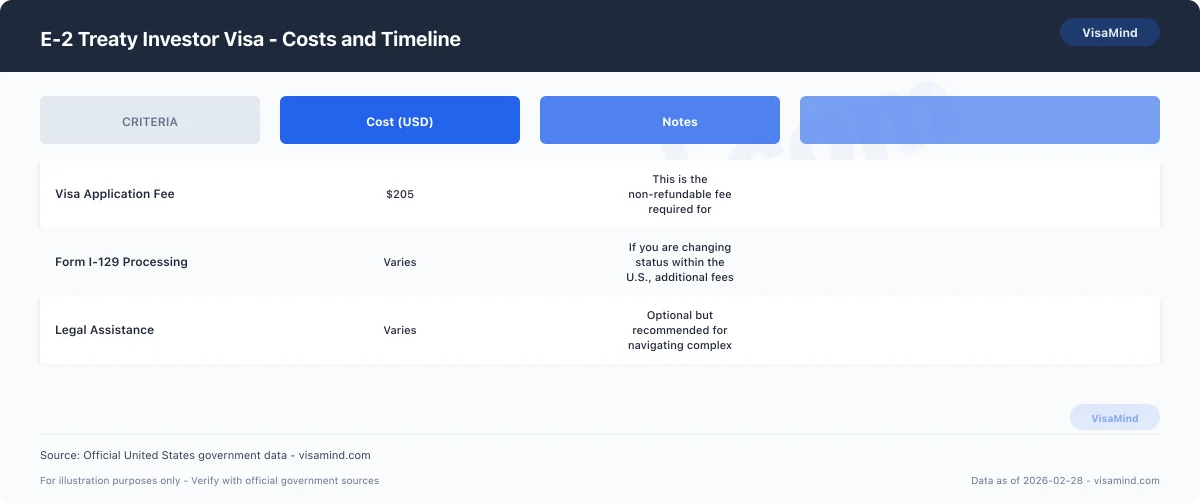
You must pay the Machine Readable Visa (MRV) fee before scheduling your E-2 visa interview.
As of February 2026, the MRV fee is $315.
| Fee Type | Amount (USD) | Paid To | When You Pay |
|---|---|---|---|
| MRV (E-2 visa application) | $315 | U.S. Department of State | Before interview scheduling |
You submit Form Form DS-160, Online Nonimmigrant Visa Application, then pay the MRV fee through the consular system for your location.
The fee is nonrefundable, even if the officer refuses your visa.
If you change interview locations, you may need to follow that post’s payment procedures.
If you file a related petition with U.S. Citizenship and Immigration Services (USCIS) for a change or extension of status inside the United States, USCIS charges separate filing fees.
Processing time ranges by category
E-2 visa processing times depend on the consular post and overall workload.
The U.S. Department of State reports time ranges by nonimmigrant visa category.
Recent reported ranges for Form DS-160 processing include:
| Visa Category | Reported Time Range |
|---|---|
| Visitor (B1/B2) | 0.5 to 23 months |
| Student/Exchange (F, M, J) | 0.5 to 7.5 months |
| Petition-based (H, L, O, P, Q) | 0.5 to 4.5 months |
| Crew and Transit (C, D, C1/D) | 0.5 to 14 months |
Although E-2 visas fall under treaty categories, these ranges show how widely timelines can vary.
Many E-2 applicants experience processing in approximately 2 to 8 weeks, but this is not guaranteed.
Your timeline depends on:
- The embassy or consulate where you apply
- Local interview backlogs
- Administrative processing, if required
- The completeness of your DS-160 and supporting documents
You cannot begin work in the United States until you receive your E-2 visa and are admitted by U.S. Customs and Border Protection at a port of entry.
How to verify current timelines
You should confirm current wait times directly with the U.S. Department of State.
Each embassy or consulate publishes its own estimated interview wait times.
Follow these steps:
-
Identify the embassy or consulate where you will apply.
-
Check that post’s nonimmigrant visa appointment wait times.
-
Review any post-specific E-2 instructions.
If you apply for a change or extension of E-2 status inside the United States, review posted processing times on the USCIS website.
USCIS processing differs from consular visa issuance.
The processing times change frequently.
Always verify current estimates before making travel, investment, or employment commitments.
Eligibility Requirements
#To qualify for E-2 classification, you must meet strict nationality, investment, and enterprise requirements.
If you plan to bring employees, they must also satisfy specific nationality and job criteria.
Investor nationality and treaty status
You must be a national of a country that maintains a qualifying treaty of commerce and navigation with the United States.
Your nationality controls eligibility.
The enterprise must share your treaty nationality.
This means individuals or entities from the same treaty country must own the business.
You must enter the United States to develop and direct the enterprise.
You cannot qualify as a passive investor.
Key requirements include:
- You hold nationality of a qualifying treaty country
- The U.S. enterprise has the same treaty nationality
- You will develop and direct the business
If you apply from abroad, you submit Form Form DS-160 to the U.S. Department of State for visa processing.
If you are already in the United States and seek a change or extension of status, you file with U.S. Citizenship and Immigration Services (USCIS).
| Requirement | What You Must Show |
|---|---|
| Nationality | Citizenship of a treaty country |
| Enterprise nationality | Majority ownership by treaty nationals |
| Role in business | You will develop and direct operations |
Required investment and enterprise standards
You must have invested, or be actively investing, a substantial amount of capital in a bona fide U.S. enterprise.
The funds must place the enterprise at risk and support real business operations.
A bona fide enterprise is an active commercial business.
It must produce goods or services for profit.
You must show:
- A substantial capital investment
- An active, real operating enterprise
- Intent to develop and direct the business
The enterprise must have the present or future capacity to generate income.
In certain cases, the business should be able to produce sufficient income within five years from the start of your E-2 classification.
| Standard | Description |
|---|---|
| Substantial investment | Significant capital committed to the business |
| Bona fide enterprise | Active, profit-seeking commercial activity |
| Income capacity | Ability to generate income within five years (when applicable) |
Employee qualification rules
Certain employees of a qualifying E-2 investor or enterprise may also receive E-2 classification.
The employee must share the same nationality as the principal treaty investor employer.
The enterprise must maintain the treaty nationality structure that supports the employee’s eligibility.
To qualify, the employee must:
- Hold the same treaty nationality as the E-2 investor
- Work for the qualifying treaty enterprise
- Be connected to an enterprise that meets E-2 standards
Employees apply through the U.S. Department of State using Form DS-160 if outside the United States.
If seeking status from within the country, the petition is filed with USCIS.
Admission at a U.S. port of entry is determined by U.S. Customs and Border Protection.
When to Get Professional Help
#E‑2 filings often fail because applicants skip required information or misunderstand who handles each step.
You need accurate forms, complete security disclosures, and clear documentation before USCIS or the U.S. Department of State reviews your case.
What employers commonly handle
If you invest through your own company, you usually coordinate the E‑2 process directly.
Some businesses assign an internal manager or outside consultant to organize documents and track deadlines.
Employers typically handle:
- Collecting company formation and ownership records
- Preparing business plans and financial documents
- Completing the online Form DS-160 for consular processing
- Scheduling the visa interview with the U.S. Department of State
- Responding to basic document requests
For example:
| Task | Who Oversees It |
|---|---|
| DS-160 submission | Investor or company representative |
| Document assembly | Company management |
| Interview scheduling | Investor or staff member |
You remain responsible for accuracy.
If you leave security or background questions blank on the DS-160 or in a USCIS filing, the agency may issue a Request for Evidence (RFE) or deny the case.
Always answer every question fully and write “None” or “N/A” where it applies.
Situations that usually benefit from a lawyer
You should consider an immigration lawyer when your case involves risk factors or prior issues.
Filing does not guarantee approval, and small errors can delay your ability to work.
Legal guidance becomes important if:
- You previously received a visa denial
- You have any arrests, charges, or security concerns
- USCIS issues an RFE
- Your answers to background questions require detailed explanations
- You are changing status in the United States through USCIS rather than applying abroad
An attorney can review your disclosures before submission.
They ensure you do not omit required information and can prepare a structured response to an RFE.
| Situation | Why Legal Review Helps |
|---|---|
| Prior denial | Identify and correct weaknesses |
| Security questions | Draft clear, complete explanations |
| RFE from USCIS | Provide organized legal response |
If you feel uncertain about how to answer a background or security question, get advice before you file.
Errors at this stage often affect your ability to obtain the visa and begin work.
Common Petition Challenges
#Most E-2 treaty investor cases face delays because of avoidable filing errors.
Inconsistent answers, poor-quality photos, and selecting the wrong visa category create processing problems with the U.S. Department of State and can affect related filings with U.S. Citizenship and Immigration Services (USCIS).
Inconsistent or mismatched information
You must ensure every detail matches your passport and supporting documents exactly.
Even small differences in spelling, birth dates, passport numbers, or travel history can trigger delays or denial.
Applicants often submit multiple Form DS-160 sessions and accidentally change answers between drafts.
The consular officer compares your final DS-160 to your passport and supporting documents, and mismatches raise credibility concerns.
Focus on these points before you submit:
- Use your name exactly as it appears in your passport.
- Enter the correct passport number and expiration date.
- Confirm all travel dates match your records.
- Review every answer before final submission.
| Issue | How It Affects Your Case | How to Prevent It |
|---|---|---|
| Different answers across DS-160 sessions | Delay or refusal at interview | Review prior drafts before submitting |
| Passport data entered incorrectly | Administrative delay or denial | Copy details directly from passport |
| Travel history inconsistencies | Extra questioning at interview | Verify dates before submission |
Accurate and consistent information protects your credibility and supports your stated purpose of entering the United States for E-2 work.
Document and photo problems
Your visa photo must meet the U.S. Department of State’s technical requirements.
A poor-quality or non-compliant image can delay scheduling or processing.
Common problems include incorrect sizing, improper background, shadows, or outdated photos.
The system may accept the upload, but the consular post can still reject the photo later.
Take these steps to reduce risk:
- Follow the Department of State photo specifications exactly.
- Use a professional photographer familiar with U.S. visa standards, or a validated photo tool.
- Do not reuse old passport photos unless they meet current requirements.
If the photo does not comply, you must replace it before your case can move forward.
That adds time and may disrupt interview planning.
Wrong category or skipped questions
Selecting the wrong visa category leads to rejection.
You must choose the correct visa type based on your purpose of travel.
If you select a category that does not match your intended E-2 work, the consular officer cannot issue the proper visa.
You may need to complete a new DS-160 and restart scheduling.
Avoid these mistakes:
- Confirm you are applying under the correct treaty investor classification.
- Do not select visitor or student categories unless that matches your true purpose.
- Answer every required question; do not leave sections incomplete.
Choosing the correct category ensures the U.S. Department of State evaluates your case under the proper legal standard.
Gather Required Documents
#You must document your investment, your enterprise, and your identity with clear and organized evidence.
Focus on proving that you invested in a real business and that you actively direct and develop it.
Investment and enterprise evidence
You must show details about your investment and your enterprise.
The evidence should confirm that your funds are committed to the business and that the enterprise operates as a real commercial undertaking.
Include documents that demonstrate:
- The amount invested and how it relates to the cost of the enterprise
- That the investment is substantial in proportion to the business
- Your active involvement in directing and developing the enterprise
- The structure and ownership of the business
Use records that clearly connect you to the enterprise and to the invested funds.
| Evidence Type | What It Should Prove |
|---|---|
| Investment records | Funds committed to the enterprise |
| Enterprise documentation | The business exists and operates |
| Ownership documents | Your qualifying role in the company |
| Operational evidence | Active direction and development |
Organize documents in a logical order.
Label each exhibit so the adjudicating officer can quickly verify your investment and your role.
Personal and identity documentation
You must provide documents that establish your identity and support your visa application.
Complete Form DS-160, ensuring all sections are accurate and consistent with your supporting evidence.
Review every entry before submission.
Inconsistencies between the DS-160 and your supporting documents can delay processing.
Prepare:
- Government-issued identification
- Confirmation of your completed DS-160
- Any required signed forms
- Supporting evidence submitted with your application
If you file any petition or benefit request with U.S. Citizenship and Immigration Services (USCIS), follow the specific form instructions and include all required signatures.
For visa issuance, follow U.S. Department of State procedures.
Accuracy matters more than volume.
Submit documents that directly support your eligibility and your intent to direct and develop the enterprise in the United States.
Preparing and submitting supporting evidence
Complete every section of your application and sign where required. Submit the full package with supporting evidence.
Incomplete submissions often cause delays.
Follow this process:
-
Complete every required form section.
-
Review entries for consistency with your investment evidence.
-
Sign all required forms.
-
Submit the application with organized supporting documentation.
Group documents by category, such as investment evidence and identity documentation. Use a cover index to list each exhibit.
If you want authorization to work in your enterprise, your evidence should show your active role in directing and developing the business. Present documentation in a clear, structured format so the reviewing officer can confirm eligibility without digging for key details.
Fees
#Total estimated cost: $315
| Component | Amount |
|---|---|
| Application fee (MRV)MRV fee (E treaty investor) | $315 |
Verify current fees — official United States fee schedule
Fees shown are as of 2026-02. Verify on the official United States government website before applying.
Required forms
#Plan your E-2 Treaty Investor Visa with free United States tools
#Itemized government fees for E-2 Treaty Investor Visa and other United States categories.
Check United States eligibility
See how your profile scores against E-2 Treaty Investor Visa and other United States visas.
United States processing times
Typical wait times and stage breakdowns for E-2 Treaty Investor Visa and related United States visas.
Practice United States interview
Common interview questions and feedback for United States visa applicants.
Verified United States directory
#Browse source-backed, publication-certified records related to this visa route.
Browse source-backed, publication-certified records related to this visa route.
Browse source-backed, publication-certified records related to this visa route.