What This Family Visa Covers
#The F2B category allows certain adult children of lawful permanent residents to immigrate through family-based immigration.
You must meet strict relationship and marital status requirements, and USCIS must approve a petition before you can move forward.
Who qualifies
You qualify for the F2B visa category if you meet all of the following criteria:
- You are 21 years of age or older.
- You are unmarried.
- Your parent is a U.S. lawful permanent resident (LPR).
- Your parent files Form I-130, Petition for Alien Relative, with U.S. Citizenship and Immigration Services (USCIS).
If you marry at any point before becoming a lawful permanent resident, you no longer qualify under F2B.
Your LPR parent must prove the qualifying parent-child relationship to USCIS when filing Form I-130.
After USCIS approves the petition, you continue the immigrant visa process either through consular processing with the U.S. Department of State (including Form DS-260) or, if eligible, through adjustment of status.
You must also submit Form I-864, Affidavit of Support, as part of the financial sponsorship process.
| Requirement | F2B Standard |
|---|---|
| Age | 21 or older |
| Marital status | Unmarried |
| Petitioner | Lawful permanent resident parent |
| Petition form | Form I-130 |
Scope of the category
The F2B visa falls under the family-based immigration system.
It applies only to unmarried adult sons and daughters of lawful permanent residents.
This category does not cover:
- Married children of lawful permanent residents
- Children under 21
- Children of U.S. citizens (these fall under different family-based categories)
The process begins when your LPR parent files Form I-130 with USCIS.
After approval and visa availability, you complete immigrant visa processing through the U.S. Department of State, including Form DS-260, or pursue adjustment of status if eligible.
USCIS handles the petition and immigration benefits.
The U.S. Department of State manages visa interviews and issuance.
Final admission into the United States is determined by U.S. Customs and Border Protection at the port of entry.
Path to Permanent Residence
#After USCIS approves your Form I-130, you move from petition approval to applying for lawful permanent residence.
You must choose either adjustment of status inside the United States or consular processing abroad, and each path follows a different agency and procedure.
Adjustment of status vs consular processing
You select one option in Part 4 of Form I-130 to show whether your adult child will apply inside the United States or through a U.S. consulate abroad.
USCIS requires you to choose either adjustment of status or consular processing, not both.
| Process | Who Handles It | Where Beneficiary Applies | Key Forms |
|---|---|---|---|
| Adjustment of Status | U.S. Citizenship and Immigration Services (USCIS) | Inside the United States | Form I-485 |
| Consular Processing | U.S. Department of State | U.S. embassy or consulate abroad | Form DS-260 |
If your child is in the United States and eligible, you may file Form I-130 and Form I-485 together.
USCIS will adjudicate properly filed applications and may use the I-130 receipt notice in the I-485 packet.
If your child applies abroad, the U.S. Department of State manages the immigrant visa process and interview.
Customs and Border Protection (CBP) determines admission at the port of entry after visa issuance.
Approved petition and next steps
USCIS must approve Form I-130 before your child can move forward with permanent residence processing.
Approval confirms the qualifying relationship under family-based immigration but does not grant a Green Card by itself.
After approval:
-
USCIS issues a Form I-130 approval notice.
-
Your child proceeds with either Form I-485 (if eligible in the United States) or Form DS-260 (if processing abroad).
-
You must submit Form I-864, Affidavit of Support, as required.
If your child’s plan changes after approval, they may switch from consular processing to adjustment of status, or vice versa, depending on eligibility.
USCIS adjudicates properly filed adjustment applications.
The U.S. Department of State conducts immigrant visa interviews and issues visas for applicants processing abroad.
When to Get Help
#Some F2B cases move smoothly.
Others stall because of missing documents, inconsistent answers, or affidavit of support problems that you could have avoided with guidance.
When a case is complex
You should seek help when your file involves more than a basic Form I-130 petition and standard civil documents.
Common risk areas include:
- Unclear proof of the petitioner’s lawful permanent resident status
- Name variations across passports, birth certificates, and forms
- Prior immigration filings that contain different biographic information
- Missing or incomplete sections in Form I-130
- Problems preparing Form I-864, Affidavit of Support
USCIS rejects or delays petitions that lack proper proof of LPR status.
Include a clear copy of the green card and ensure every name matches your civil records.
You should also get help if you are unsure how to align your I-130 with the later Form DS-260 immigrant visa application.
All answers must match.
Discrepancies between USCIS filings and Department of State forms often lead to delays or visa refusal.
Expert tips & tricky situations
Many delays happen at the National Visa Center (NVC) stage, not during the initial USCIS review.
You reduce problems when you:
-
Complete Form DS-261 (Choice of Address and Agent) promptly.
-
Prepare Form I-864 and civil documents before starting Form DS-260.
-
Use identical spelling of names across every form and document.
The NVC typically requests the affidavit of support and civil documents together.
If you submit incomplete financial evidence, processing slows.
Use this checklist before submitting:
| Item | Why It Matters |
|---|---|
| Consistent name spelling | Prevents identity mismatches |
| Accurate family member listing | Avoids delays or denials |
| Matching answers across I-130 and DS-260 | Prevents credibility issues |
| Proper LPR status proof | Avoids rejection |
If you discover inconsistencies after filing, consult a qualified immigration attorney before responding to USCIS or the Department of State.
Early correction is easier than defending a denial later.
Fees and Processing Times
#F2B cases move slowly and involve multiple government stages.
You deal first with U.S. Citizenship and Immigration Services (USCIS) for the petition, then with the U.S. Department of State for visa processing and fees.
USCIS processing times (by category)
You start the F2B process by filing Form I-130, Petition for Alien Relative with USCIS under the category permanent resident filing for an unmarried son or daughter 21 or older.
As of January 2026, USCIS reports the following I-130 time ranges:
| I-130 Category | Reported Processing Time |
|---|---|
| Permanent resident for unmarried son or daughter 21 or older (F2B) | 48 to 240 months |
| Permanent resident filing for spouse or child under 21 | 49.5 to 213.5 months |
| U.S. citizen filing for unmarried son/daughter 21 or older | 50 to 198 months |
| U.S. citizen filing for married son or daughter | 47.5 to 178.5 months |
Times vary by service center and workload.
Always confirm your specific estimate using the USCIS processing times tool.
After USCIS approves the I-130, your case transfers to the National Visa Center (NVC) for immigrant visa processing.
The visa stage often takes about 12 to 24 months, depending on document review and interview scheduling by the U.S. Department of State.
Fees, NVC steps and payment order
Family-based immigration under F2B includes both USCIS filing fees and Department of State visa processing fees.
At the NVC stage, follow this sequence carefully:
-
Pay the required visa processing fees as instructed.
-
Submit Form DS-260, Immigrant Visa Application.
-
Upload required civil documents.
-
Submit Form I-864, Affidavit of Support, from your sponsoring parent.
Do not submit the DS-260 before paying fees and uploading required documents.
This mistake delays case review.
Avoid rejections by:
- Using the correct edition of Form I-130 and Form I-864.
- Paying the correct fee type.
- Following NVC instructions in the order given.
The Department of State schedules your immigrant visa interview only after it reviews and accepts all required documents and payments.
Your Rights After Approval
#
Approval of your F2B visa petition and immigrant visa gives you lawful permanent resident status.
Your sponsor accepts ongoing legal duties, and you gain defined rights tied to maintaining residence in the United States.
Financial sponsorship obligations
Your petition began with Form I-130, but approval required a binding financial contract: Form I-864, Affidavit of Support.
U.S. Citizenship and Immigration Services (USCIS) and the National Visa Center will not approve your case without it.
Your sponsor must show income at 125% of the federal poverty guidelines, based on household size.
They must count all dependents and anyone already sponsored.
Common issues that delay approval include:
- Income below the required level
- Missing tax transcripts or W-2s
- Incorrect household size calculations
- No proof of current employment
If the sponsor’s income is not enough, they may:
- Add a household member using Form I-864A
- Use a joint sponsor
- Document qualifying assets
The sponsor must include recent tax returns and proof of employment.
If self-employed, they must provide business records.
This obligation is legally enforceable.
Before signing Form I-864, your sponsor commits to financially support you under U.S. law.
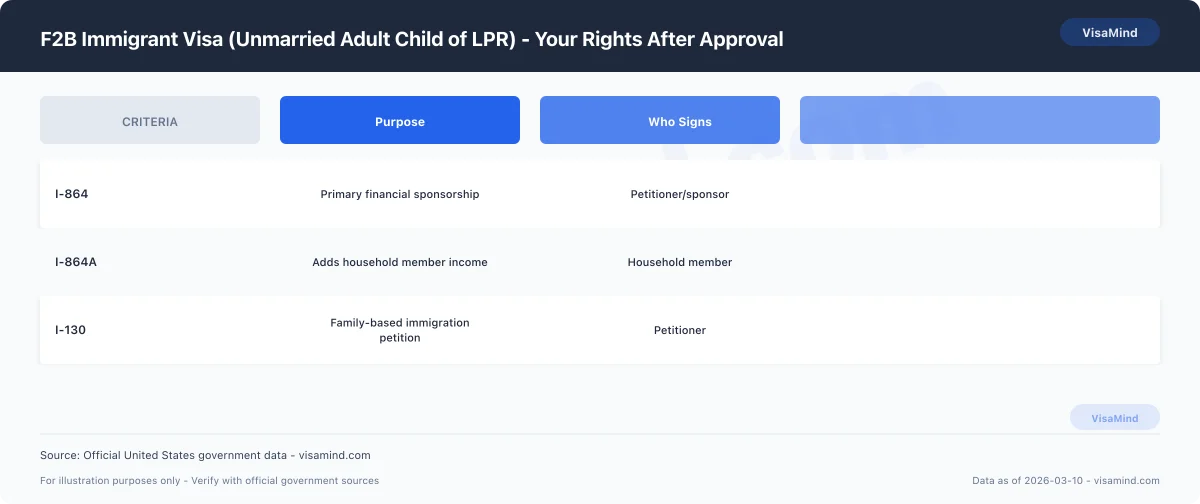
| Form | Purpose | Who Signs |
|---|---|---|
| I-864 | Primary financial sponsorship | Petitioner/sponsor |
| I-864A | Adds household member income | Household member |
| I-130 | Family-based immigration petition | Petitioner |
Residency rights and conditions
After the U.S. Department of State issues your immigrant visa and you enter the United States, you become a lawful permanent resident.
U.S. Customs and Border Protection (CBP) determines your admission at the port of entry.
As a permanent resident, you have the right to:
- Live permanently in the United States
- Work lawfully
- Receive a Permanent Resident Card (Green Card)
You must also maintain your residence.
USCIS expects you to reside primarily in the United States.
Your approval followed submission of Form DS-260 and review of your financial sponsorship documents.
Family-based immigration does not grant temporary status; it grants permanent resident status, subject to compliance with U.S. immigration laws.
If you fail to maintain residence or violate immigration rules, USCIS may review your status.
Always keep your address updated with USCIS and follow all residency requirements listed on the USCIS website.
The Two-Stage Process
#The F2B category follows a structured, two-step path.
First, your lawful permanent resident parent proves the qualifying relationship to U.S. Citizenship and Immigration Services (USCIS).
Then you apply for the immigrant visa or seek adjustment of status, depending on where you live.
Stage 1 — Sponsor files Form I-130
Your parent begins the process by filing Form I-130, Petition for Alien Relative with USCIS.
This petition establishes that a valid parent–child relationship exists for family-based immigration.
The petition must include:
- Completed and signed Form I-130
- All required sections fully answered
- Evidence of the qualifying relationship
- Personal and contact information for both you and your parent
USCIS requires accurate and complete information.
Your parent must sign and date the form before submission.
USCIS accepts Form I-130 online or by mail, depending on eligibility and filing considerations.
After submission, USCIS issues a receipt notice confirming it received the petition.
| Purpose of Form I-130 | What It Does Not Do |
|---|---|
| Establishes qualifying relationship | Does not grant a Green Card |
| Starts the immigration process | Does not provide work authorization |
| Places you in the F2B category | Does not issue a visa |
Approval of the I-130 confirms the relationship only.
It does not give you permanent resident status.
Stage 2 — Visa application or adjustment
Once USCIS approves Form I-130, you move to the next stage. You’ll either apply for an immigrant visa through consular processing or, if eligible, apply for adjustment of status while you’re in the United States.
If you’re applying from abroad, you’ll file Form DS-260, Immigrant Visa Application with the U.S. Department of State. Every section needs to be filled out accurately, and you’ll have to submit all required civil documents.
Your parent must also file Form I-864, Affidavit of Support to demonstrate financial sponsorship.
If you’re applying from within the United States, you’ll file for adjustment of status with USCIS instead of submitting DS-260.
| Location | Main Agency | Key Form |
|---|---|---|
| Outside the U.S. | U.S. Department of State | DS-260 |
| Inside the U.S. | USCIS | Adjustment of status application |
Visa issuance is handled by the U.S. Department of State. Final admission to the United States is determined at the port of entry.
Extending Your Family Visa
#Your petition can’t just sit unchanged while it’s pending. If your status changes, you must contact USCIS so your adult child’s classification reflects your new situation.
Sponsor becomes a U.S. citizen
If you naturalize while Form I-130 is pending or already approved, you can ask USCIS to update your relative’s visa category.
You’ll need to send USCIS:
- A written notice explaining you became a U.S. citizen
- A photocopy of your naturalization certificate
USCIS will update the petition record upon receiving these documents.
| Situation | Required Action | Agency Involved |
|---|---|---|
| Lawful permanent resident files I-130 | No update needed | USCIS |
| Petitioner naturalizes during process | Send letter + naturalization certificate | USCIS |
If your case is already in consular processing, the U.S. Department of State will handle the immigrant visa interview and issuance after USCIS updates the petition. Your child may still need to complete Form DS-260 and submit Form I-864 as required.
Updating the petition
Act quickly after you naturalize. USCIS won’t update your case automatically.
Here’s what you should do:
-
Write a letter listing your name and your relative’s name.
-
State that you became a U.S. citizen and ask for an update to the pending or approved Form I-130.
-
Attach a copy of your naturalization certificate.
-
Submit the request as directed in the Form I-130 instructions.
Make copies of everything you send.
If your case is already at the National Visa Center, keep an eye on any notices from the U.S. Department of State after the update.
Required Documents
#You’ll need to prove the parent‑child relationship and the petitioner’s lawful permanent resident status. Complete civil records, certified translations, and required medical and police documents are mandatory before the visa interview.
Identity and civil documents
With Form I‑130, submit evidence to USCIS showing:
- The petitioner’s lawful permanent resident (LPR) status
- The parent‑child relationship
- Accurate biographical details
Use certified copies of civil records. Missing or incomplete documents often lead to requests for evidence.
| Document Type | What It Must Show | Who Provides It |
|---|---|---|
| Birth certificate | Parent and child names | Beneficiary |
| Marriage certificate | Legal marriage of parents | Petitioner |
| Divorce decree | Termination of prior marriages | Petitioner or parent |
| Adoption decree | Legal parent‑child relationship | Petitioner |
If required, include Form I‑130A and double-check that every form is complete and signed.
For consular processing, submit Form DS‑260 to the U.S. Department of State and provide updated civil documents to the National Visa Center. The petitioner must submit Form I‑864, Affidavit of Support, as part of the process.
Translations, medicals and police certificates
If a document isn’t in English, provide a full, certified English translation. The translation must be accurate and complete.
You’ll need a medical examination before your immigrant visa interview. It’s best to schedule the exam early to avoid last-minute problems.
Get police certificates from the appropriate authorities. Bring these documents to your visa interview as instructed by the U.S. Department of State.
Checklist before the interview:
-
Certified civil documents
-
Certified English translations
-
Completed medical examination
-
Required police certificates
-
Confirmation page for Form DS‑260
Check the document requirements from the U.S. Department of State and USCIS to make sure you meet current standards.
Who Can Apply
#You qualify for the F2B category only if a lawful permanent resident parent sponsors you. USCIS reviews both the sponsor’s status and the parent‑child relationship before approving Form I-130.
Sponsor eligibility
Your sponsor must be a lawful permanent resident (LPR) of the United States. USCIS won’t approve an F2B petition from anyone without valid permanent resident status.
The sponsor files Form I-130, Petition for Alien Relative, with USCIS to establish the qualifying relationship. The petition must include:
- Proof of the sponsor’s lawful permanent resident status
- Biographical information about both you and the sponsor
- Details confirming the parent‑child relationship
USCIS will look at the information in the I-130, including identity, immigration history, and relationship evidence.
After approval, you may continue immigrant visa processing through the U.S. Department of State by filing Form DS-260 if you’re applying from outside the United States. Your sponsor also submits Form I-864, Affidavit of Support, to confirm financial responsibility.
| Requirement | Who Must Meet It | Reviewed By |
|---|---|---|
| Lawful permanent resident status | Sponsor | USCIS |
| Filed Form I-130 | Sponsor | USCIS |
| Financial sponsorship (Form I-864) | Sponsor | USCIS / Department of State |
Relationship and age requirements
You must be the unmarried son or daughter (age 21 or older) of a lawful permanent resident to qualify under the F2B category. If you marry before becoming a permanent resident, you’re no longer eligible for this category.
USCIS requires clear documentation of the parent‑child relationship. The I-130 must include:
- Evidence identifying both you and your parent
- Biographical and identity details for both parties
- Information about your current immigration status and history, if applicable
Provide consistent and complete information on all forms, including the I-130 and, if applicable, the DS-260.
| Criteria | F2B Requirement |
|---|---|
| Parent’s status | Lawful permanent resident |
| Your age | 21 or older |
| Marital status | Unmarried |
| Relationship proof | Required with Form I-130 |
USCIS won’t move the case forward until all legal and documentary requirements are met.
Why Family Visas Get Denied
#USCIS and the U.S. Department of State deny many F2B cases because of preventable mistakes or weak financial documentation. Most problems stem from incomplete forms, inconsistent answers, or missing evidence.
Form and information errors
USCIS rejects or denies many Form I-130 petitions due to basic filing errors. An unsigned form gets rejected.
Complete every required field, including the relationship classification and the sections about you and your adult child. Leaving sections blank can lead to rejection.
Inconsistent information is another problem. Details on your I-130 must match civil documents like birth certificates, marriage records, and divorce decrees.
For consular processing, the immigrant visa application (Form DS-260) must match the approved petition and all civil records. Even small discrepancies in names, dates, or prior marital history can cause delays or denial.
You also need to:
- Provide proof of lawful permanent resident status
- Submit full English translations for any foreign-language documents
- List complete address and travel history, without gaps
- Sign and date every required section
| Common Error | Likely Outcome |
|---|---|
| Missing signature | Immediate rejection |
| Incorrect visa category | Delay or denial |
| Mismatched biographic data | Request for Evidence (RFE) or denial |
| Missing required fields | Rejection |
Accuracy and consistency across all documents matter in family-based immigration cases.
Evidence and income red flags
Even if USCIS approves the I-130, your case can stall at the financial stage. You must show you can financially support your adult child.
Form I-864, Affidavit of Support, is key. Leaving sections blank, failing to sign, or submitting incomplete financial documentation can lead to a Request for Evidence or denial.
Watch out for these issues:
- Unsigned or undated Form I-864
- Missing sponsor or joint sponsor signatures
- Incomplete supporting financial documents
- Information conflicting with prior filings
Inconsistencies between the I-864, tax records, and other submissions can raise credibility concerns. USCIS reviews these details closely.
If your case is in consular processing, the U.S. Department of State will also review your financial sponsorship documents before issuing the immigrant visa. Weak or inconsistent financial evidence can delay visa issuance.
Review every form line by line before filing. In F2B cases, even minor documentation errors can cause months of delay.
Required forms
#Plan your F2B Immigrant Visa (Unmarried Adult Child of LPR) with free United States tools
#Itemized government fees for F2B Immigrant Visa (Unmarried Adult Child of LPR) and other United States categories.
Check United States eligibility
See how your profile scores against F2B Immigrant Visa (Unmarried Adult Child of LPR) and other United States visas.
United States processing times
Typical wait times and stage breakdowns for F2B Immigrant Visa (Unmarried Adult Child of LPR) and related United States visas.
Practice United States interview
Common interview questions and feedback for United States visa applicants.
Verified United States directory
#Browse source-backed, publication-certified records related to this visa route.
Browse source-backed, publication-certified records related to this visa route.