What the H-4 Dependent Visa Covers
#The H-4 visa lets certain family members of H-1b visa workers stay in the United States in a lawful dependent status. It defines who qualifies, why the status exists, and how families use it to remain together during authorized employment.
Who it covers
The H-4 classification applies only to specific family members of an H-1B nonimmigrant worker. You must fall within a narrow relationship category to qualify.
Eligible dependents include:
- A spouse of an H-1B visa holder
- An unmarried child under 21 years of age of an H-1B visa holder
If you’re a parent, sibling, married child, or a child age 21 or older, you won’t qualify for H-4 status under this category.
The table below outlines basic eligibility:
| Requirement | H-4 Dependent |
|---|---|
| Relationship to H-1B holder | Spouse or unmarried child |
| Age limit for children | Under 21 |
| Marital status for children | Must be unmarried |
U.S. Citizenship and Immigration Services (USCIS) manages applications to extend or change to H-4 status inside the United States. If you apply for a visa stamp abroad, the U.S. Department of State handles the Form DS-160 and visa issuance process.
Purpose and scope
The H-4 visa exists to keep immediate family members of H-1B workers together in the United States during the worker’s authorized stay. It supports family unity while the principal worker maintains valid H-1B status.
If you’re already in the United States in another nonimmigrant category, you can apply with USCIS to change or extend your status to H-1. This process helps you maintain lawful presence while your H-1B family member continues authorized employment.
If you’re outside the United States, you apply for an H-4 visa through consular processing. You must submit Form DS-160 and attend a visa interview as required by the U.S. Department of State.
A U.S. Customs and Border Protection (CBP) officer determines your admission at the port of entry. H-4 classification is a nonimmigrant status, not the same as family-based immigration, which involves immigrant visas and permanent residence.
Typical uses
You use the H-4 visa to live in the United States as the dependent of an H-1B worker. Most applicants seek H-4 status in one of the following situations:
-
You are outside the United States and need a visa to join your H-1B spouse or parent.
-
You are already in the United States and need to change to H-4 status.
-
You need to extend your H-4 status to match the H-1B worker’s authorized stay.
Common actions include:
- Filing an application with USCIS to extend or change status
- Completing Form DS-160 for visa issuance abroad
- Maintaining lawful status while the H-1B worker remains authorized
You must keep your status valid at all times.
Eligibility Requirements
#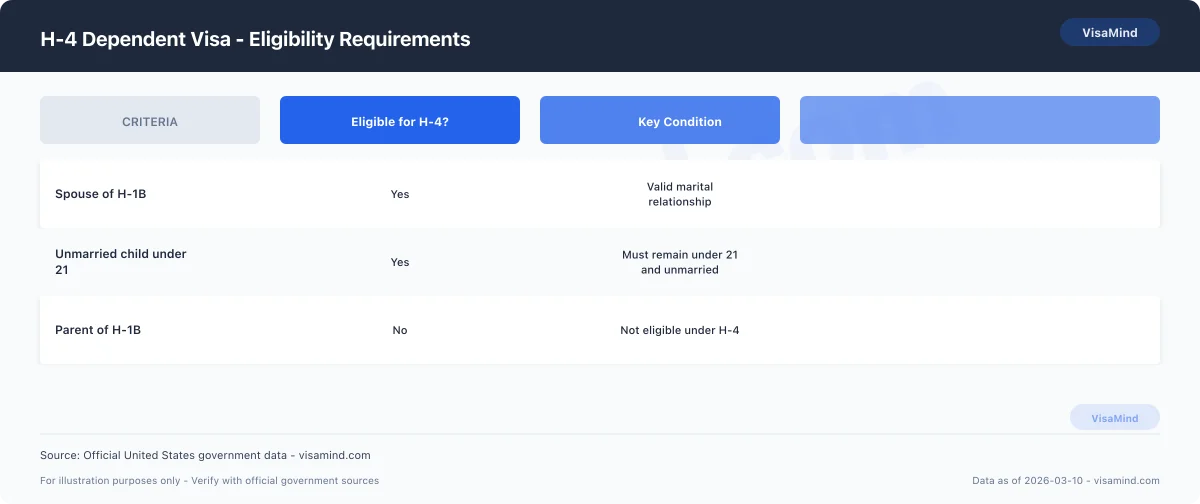
To qualify for an H-4 visa, you must have a specific family relationship to an H-1b visa nonimmigrant and meet clear status and age rules. You must also document that relationship and provide accurate information to U.S. Citizenship and Immigration Services (USCIS) or the U.S. Department of State, depending on where you apply.
Who can apply
You may apply for H-4 classification only if you are:
- The spouse of an H-1B nonimmigrant, or
- The unmarried child under 21 years of age of an H-1B nonimmigrant
Your eligibility depends entirely on the H-1B visa holder’s valid nonimmigrant status. If the H-1B worker seeks to extend or change status in the United States, you may request to extend or change your status as a dependent at the same time with USCIS.
If you apply from outside the United States, you must complete Form DS-160, Online Nonimmigrant Visa Application, and attend a visa interview with the U.S. Department of State. If you apply inside the United States to extend or change status, USCIS decides your request.
| Applicant Type | Eligible for H-4? | Key Condition |
|---|---|---|
| Spouse of H-1B | Yes | Valid marital relationship |
| Unmarried child under 21 | Yes | Must remain under 21 and unmarried |
| Parent of H-1B | No | Not eligible under H-4 |
H-4 classification is a dependent, nonimmigrant category. It is not a family-based immigration immigrant visa.
Relationship evidence
You must prove your qualifying relationship to the H-1B visa holder. USCIS and the U.S. Department of State require clear documentation.
Provide:
- A marriage certificate if you apply as a spouse
- A birth certificate if you apply as a child
- Information identifying the H-1B visa holder and confirming their status
You must also include details about your relationship when completing Form DS-160 or filing with USCIS. The information must match the H-1B worker’s records.
If you file with USCIS to extend or change status, include documentation showing the H-1B nonimmigrant’s current status. If you apply at a U.S. consulate, the consular officer from the U.S. Department of State reviews your relationship evidence during the visa process.
Incomplete or inconsistent relationship documentation can delay or prevent approval. Make sure names, dates, and biographical details are consistent across all forms.
Status and age limits
Your eligibility depends on both your relationship and your current status.
To qualify:
- The H-1B visa holder must hold valid H-1B nonimmigrant status.
- You must currently hold a valid nonimmigrant status if applying to extend or change status in the United States.
- If applying as a child, you must be unmarried and under 21 years old at the time of eligibility.
If you turn 21 or marry, you no longer qualify for H-4 classification. USCIS will not approve an extension or change of status once you fall outside these limits.
H-4 classification remains tied to the H-1B principal’s status. If the H-1B status ends, your H-4 status also ends.
The Two-Stage Process
#You complete two separate steps to obtain H-4 status. First, the principal H-1b visa worker must secure or maintain valid status through a petition with U.S. Citizenship and Immigration Services (USCIS) when required.
Then you apply for H-4 classification either inside the United States with USCIS or through a U.S. consulate abroad under the U.S. Department of State.
Sponsor petition (I-129) — when required
You cannot receive H-4 status unless the H-1B worker has valid H-1B classification.
If the employer files a new or extension Form I-129, Petition for a Nonimmigrant Worker, USCIS must approve it before you can obtain or extend H-4 status. Certain employment-based requests must use Form I-129 rather than Form I-539.
For applicable occupations, the employer must include:
- A certified Labor Condition Application (Form ETA-9035/9035E) from the Department of Labor
- Supporting evidence required by Form I-129 instructions
- The correct filing fee
Employers may create an online account to submit Form I-129 and upload evidence.
If the H-1B worker does not maintain status, USCIS will not grant your H-4 request.
| Item | Filed By | Agency | Purpose |
|---|---|---|---|
| Form I-129 | H-1B employer | USCIS | Request or extend H-1B classification |
| Certified LCA | H-1B employer | Department of Labor | Required for certain H-1B occupations |
Dependent application (I-539) or consular process
You apply for H-4 classification either inside or outside the United States.
If you are in the United States and eligible to change or extend status, you file Form I-539, Application to Extend/Change Nonimmigrant Status, with USCIS. You must:
- Select the correct application type (extension or change of status)
- State your current nonimmigrant status
- Identify the status you request (H-4)
- Complete all required sections
- Include the correct fee
If you apply abroad, you complete Form DS-160, Online Nonimmigrant Visa Application, and attend a visa interview at a U.S. consulate. The U.S. Department of State manages visa issuance.
After approval, U.S. Customs and Border Protection (CBP) determines admission at the port of entry.
| Location | Form | Agency |
|---|---|---|
| Inside U.S. | Form I-539 | USCIS |
| Outside U.S. | Form DS-160 | U.S. Department of State |
Application details and counts
You must clearly identify the basis of your request on Form I-130. The form asks you to indicate:
-
The application type
-
The status you are requesting
-
Your current nonimmigrant status
You must also state the total number of people included in the application. This section matters if more than one dependent files together.
Provide accurate biographical details and current status information for each applicant. Incomplete forms delay processing.
H-4 classification is a nonimmigrant dependent category, not a family-based immigration petition. You do not file it under family-based immigration procedures.
Your eligibility depends entirely on the principal H-1B worker’s status and the accuracy of your filing with USCIS or the Department of State.
Evidence Checklist
#You must prove your identity, your relationship to the H-1b visa principal, and your current and requested immigration status. Submit clear copies and make sure all names, dates of birth, and biographical details match across every form, including Form DS-160 and any filing with U.S. Citizenship and Immigration Services (USCIS).
Identity and biographical information
You must provide complete biographical details exactly as they appear on your passport and immigration records. Inconsistent spellings or date errors can delay processing.
Include:
- Valid passport (biographic page)
- Full legal name (family name and given name)
- Date of birth
- Mailing address
- Current nonimmigrant status, if you are in the United States
- Details of the status you are requesting
If you apply for a visa abroad, you will enter this information on Form DS-160, which the U.S. Department of State uses for consular processing.
If you apply for a change or extension of status in the United States, USCIS will review the same core identity data.
Make sure your information is consistent with the H-1B principal’s records, including the Form I-129 filed on their behalf.
| Document | What It Confirms | Reviewed By |
|---|---|---|
| Passport biographic page | Identity and nationality | Department of State or USCIS |
| DS-160 confirmation | Biographical and status details | Department of State |
| Current status documents | Lawful presence in U.S. (if applicable) | USCIS |
Relationship documents
You must prove a qualifying relationship to the H-1B nonimmigrant. H-4 classification is based on family ties, not employment or family-based immigration categories.
Submit:
- Marriage certificate if you are the spouse
- Birth certificate if you are a child
The document must clearly show the names of both parties and establish the legal relationship to the H-1B principal. Names should match passports and immigration filings.
If a document reflects a prior name, ensure all records remain consistent.
USCIS or the U.S. Department of State will compare your relationship documents with the H-1B principal’s petition records. Discrepancies between your documents and the principal’s Form I-129 filing can result in requests for additional evidence.
Other supporting evidence
Include documentation tied to the H-1B principal’s approved status. Your eligibility depends on the principal maintaining valid H-1B classification.
Provide evidence that:
- A Form ETA-9035 or ETA-9035E (Labor Condition Application) was certified by the Department of Labor
- The H-1B principal’s Form I-129 was filed and approved
This documentation connects your request to an existing H-1B petition. If you apply from abroad, the U.S. Department of State will review your visa application.
If you file inside the United States, USCIS will evaluate your submission.
Your Rights After Approval
#After approval, you may qualify for work authorization, live in the United States with your H-1b visa spouse, and travel under specific rules. State licensing rules can also impact your household’s employment plans.
Employment authorization
Not every H-4 spouse is eligible to work. You must first qualify under the federal regulation that allows certain H-4 dependent spouses to apply for employment authorization.
If eligible, you’ll file Form I-765, Application for Employment Authorization, with U.S. Citizenship and Immigration Services (USCIS).
Key points:
- Only certain H-4 spouses qualify under federal regulation.
- You must file Form I-765 with USCIS.
- You cannot work until USCIS approves the application.
- USCIS issues an Employment Authorization Document (EAD) after approval.
| Step | What You Do | Agency Involved |
|---|---|---|
| 1 | Confirm eligibility under H-4 spouse rules | USCIS |
| 2 | File Form I-765 | USCIS |
| 3 | Wait for approval before working | USCIS |
If you applied for your H-4 visa abroad using Form DS-160, that application does not grant work authorization by itself.
Employment authorization under H-4 status does not convert your status to an employment-based visa. It remains dependent on the H-1B principal’s status and is separate from family-based immigration categories.
Residency and travel considerations
Your H-4 status allows you to reside in the United States as long as the H-1B principal maintains valid status. Your stay is tied directly to the H-1B approval.
If you apply for an H-4 visa outside the United States, you complete Form DS-160 and attend a visa interview through the U.S. Department of State. Visa issuance is handled by the Department of State, not USCIS.
Admission at a U.S. port of entry is determined by U.S. Customs and Border Protection (CBP). A visa allows you to seek entry; it does not guarantee admission.
When traveling:
- Confirm your H-4 visa stamp is valid.
- Ensure the H-1B principal maintains valid status.
- Carry documentation showing the relationship and H-1B approval.
H-4 status is nonimmigrant. It does not provide permanent residence.
If you later pursue family-based immigration, that process follows separate eligibility and filing rules with USCIS.
Occupation licensing note
State and local licensing rules can affect employment in certain professions. This requirement directly applies to many H-1B specialty occupations, but it can also affect your household’s employment stability.
In many regulated fields, the H-1B beneficiary must hold the required state or local license before petition approval. Approval does not replace a professional license.
| Issue | What It Means for You |
|---|---|
| Regulated profession | The H-1B worker must meet state licensing rules |
| Petition approval | Does not override licensing laws |
| H-4 work authorization | Separate from H-1B licensing requirements |
If you plan to work under an approved EAD in a licensed field, you must also comply with state licensing laws. USCIS grants work authorization, but states control professional licensing.
What It Costs
#You’ll pay government fees at two stages: the visa application through the U.S. Department of State and any related filings with U.S. Citizenship and Immigration Services (USCIS). Costs also depend on whether you request premium processing or file a change of status inside the United States.
Fees & recent fee changes
If you apply for an H-4 visa at a U.S. consulate, you must pay the Machine Readable Visa (MRV) fee of $205. The U.S. Department of State collects this fee when you submit Form Form DS-160 and schedule your interview.
If you file for a change of status to H-4 inside the United States, USCIS sets the filing fees. Fee amounts change periodically.
Premium processing requires a separate filing using Form I-907.
- Requests postmarked on or after March 1, 2026 must include the updated premium processing fee for the specific benefit.
- If you send the wrong premium processing fee, USCIS will reject the request.
If USCIS issues special payment instructions for a benefit, such as during adjudication of a change of status, you must follow those instructions exactly.
| Type of Cost | Amount (USD) | Paid To | When It Applies |
|---|---|---|---|
| MRV fee (DS-160) | $205 | U.S. Department of State | Consular H-4 visa application |
| Premium processing (Form I-907) | Check USCIS | USCIS | Optional expedited processing |
| Change of status filing fees | Check USCIS | USCIS | Filing from inside the U.S. |
H-4 classification is not a family-based immigration petition, but it is tied to the principal H visa holder’s approved status.
Payment methods and proof
You must use the payment method specified for your filing type. USCIS may require:
- Electronic payment through your USCIS online account
- Paper-based payment if allowed for the form
- An exemption form, if you qualify for one
For certain electronic registrations or filings, you must submit the completed electronic payment form and retain proof of payment from the pay.gov system or your USCIS account.
Steps to follow:
-
Confirm the correct fee on the USCIS or Department of State website.
-
Select the authorized payment method for your form.
-
Keep confirmation receipts and include required proof with your filing.
If you submit Form I-907 with an incorrect premium processing fee, USCIS will reject it rather than issue a request for more evidence. That delay can affect your timing.
Processing time estimates
processing times depend on where and how you apply.
For consular processing, the DS-160 falls under the “Petition-based (H, L, O, P, Q)” category. As of February 2026, reported processing times range from 0.5 to 4.5 months, depending on the consulate.
| Application Type | Estimated Time (as of Feb 2026) |
|---|---|
| DS-160 (Petition-based categories) | 0.5 to 4.5 months |
| General processing reference range | 2 to 8 weeks (varies by case) |
The processing times vary by location and workload. The U.S. Department of State controls visa interview scheduling and issuance, while USCIS controls change-of-status adjudications.
Extending Your Family Visa
#You must take action before your current stay expires. USCIS controls extensions and change‑of‑status requests inside the United States, while the U.S. Department of State issues visas abroad.
Extensions and change-of-status requests
File with U.S. Citizenship and Immigration Services (USCIS) to extend H‑4 status or to change to another nonimmigrant category.
File your request before the expiration date on your Form I‑94. USCIS may deny late filings unless you show extraordinary circumstances.
Use this general process:
-
Confirm your current I‑94 expiration date.
-
Prepare the required USCIS form for an extension or change of status.
-
Submit the application online or by mail, following the official form instructions.
-
Pay the required fee listed on the USCIS website.
If you instead apply for a new H‑4 visa stamp abroad, complete Form DS‑160 and attend a visa interview through the U.S. Department of State. The visa allows you to seek admission at a port of entry, but U.S. Customs and Border Protection decides your admission.
Family-based immigration rules do not automatically extend your H‑4 status. You must maintain valid nonimmigrant status until you qualify for another immigration benefit.
| Action | Agency | Where You Apply |
|---|---|---|
| Extend H‑4 stay | USCIS | Inside the United States |
| Change to another nonimmigrant status | USCIS | Inside the United States |
| Apply for H‑4 visa stamp | U.S. Department of State | U.S. embassy or consulate abroad |
CNMI, reinstatement and special cases
Certain applicants follow special procedures.
If you live in the Commonwealth of the Northern Mariana Islands (CNMI) and seek an initial grant of status, use your CNMI P.O. Box as your mailing address on the application. Follow the specific filing instructions listed for CNMI residents on the USCIS website.
Other categories also file with USCIS for status-related benefits:
- F and M nonimmigrants requesting reinstatement
- Individuals seeking V nonimmigrant status
- V nonimmigrants applying for an extension of stay
Each group must meet the eligibility rules for its classification. Review the official form instructions carefully to confirm required evidence and filing location.
Do not assume that approval in one category transfers automatically to another. USCIS reviews each request under the specific legal standard for that status.
Filing deadlines and I-94
Your Form I‑94 controls how long you may remain in the United States.
You must file any extension or change‑of‑status request before the I‑94 expiration date. Filing even one day late can place you out of status.
USCIS may excuse a late filing only if you demonstrate extraordinary circumstances. You must explain the reason for the delay and provide supporting documentation.
Track these key items:
- I‑94 expiration date
- Date you submit your application
- Delivery confirmation if you file by mail
- USCIS receipt notice
| Item | Why It Matters |
|---|---|
| I‑94 expiration date | Sets your authorized stay |
| Filing date | Determines whether your request is timely |
| Receipt notice | Confirms USCIS accepted your case |
From Family Visa to PR
#Your long-term path depends almost entirely on your H-1b visa spouse’s status and strategy. The H-1B cap and employment stability shape whether you remain in temporary status or pursue permanent residence through family-based immigration.
How H-1B context affects long-term options
Your H-4 status exists because your spouse holds H-1B status. If your spouse maintains valid H-1B classification, you can remain in H-4 and later transition as part of a permanent residence process.
The H-1B category has an annual numerical limit of 65,000 new approvals per fiscal year, with certain statutory adjustments. This cap affects whether your spouse can obtain or extend H-1B status, which directly affects your ability to stay in the United States.
If your spouse pursues permanent residence through an employment-based process filed with U.S. Citizenship and Immigration Services (USCIS), you may qualify to immigrate as a dependent under family-based immigration rules tied to that case.
If you apply for an H-4 visa abroad, you complete Form DS-160 and attend a visa interview with the U.S. Department of State. Visa issuance depends on your spouse’s valid H-1B approval.
| Factor | Why It Matters for You |
|---|---|
| H-1B cap limits | May delay new H-1B approvals |
| USCIS filings | Control extensions and immigrant petitions |
| DS-160 processing | Required for visa issuance abroad |
| Employment-based case | Can create a path to permanent residence for you |
Key limits to be aware of
H-4 status does not exist independently. If your spouse loses H-1B status or falls out of status, your H-4 status also ends.
You cannot apply for permanent residence on your own through H-4 classification alone. You must qualify through:
- Your spouse’s approved immigrant petition filed with USCIS, or
- A separate family-based immigration category if you independently qualify.
The annual H-1B cap can interrupt long-term planning. If your spouse needs a new cap-subject H-1B approval, availability depends on the yearly numerical limit.
You should also distinguish between agencies:
- USCIS handles petitions and status changes inside the United States.
- The U.S. Department of State issues visas after you submit Form DS-160 and attend an interview abroad.
- U.S. Customs and Border Protection (CBP) decides admission at the port of entry.
| Limitation | Practical Impact |
|---|---|
| Dependent status | Your stay depends on H-1B validity |
| Annual H-1B cap | May restrict new approvals |
| No standalone PR path | Requires employment-based or family-based process |
When to Get Help
#Seek qualified help when your H-4 case involves unusual facts or when you have concerns about how your personal information is handled. Errors on forms such as the Form DS-160 or in filings with U.S. Citizenship and Immigration Services (USCIS) can delay or complicate your case.
Complex or unusual situations
If your case doesn't fit the usual H-4 application mold, it's smart to get guidance. This covers situations that overlap with Family-based immigration or other matters handled by USCIS.
Professional help makes sense if you:
- Have multiple applications pending with USCIS
- Want to pursue Family-based immigration while on H-4
- Need to fix information already submitted on Form DS-160
- Got a request for additional evidence from USCIS
Mistakes in your biographic data, immigration history, or family relationship details can create inconsistencies between systems used by USCIS and the U.S. Department of State.
| Situation | Why Help Matters |
|---|---|
| Multiple pending applications | Ensures consistent information across filings |
| Prior submission errors | Reduces risk of further discrepancies |
| Transition to Family-based immigration | Aligns long-term strategy with current status |
An experienced immigration attorney can review your filings before you send them and make sure your records match across agencies.
Privacy and feedback concerns
If you're unsure how your personal data is handled, it's best to ask for help. Immigration forms require detailed information about your identity, family, and immigration history.
When you submit the DS-160 or documents to USCIS, you'll be providing:
- Your full legal name and any previous names
- Passport details
- Family relationship information
- Immigration history
If you plan to give feedback to a government agency, don't include sensitive personal details unless it's specifically required. Sharing more than necessary can put your privacy at risk.
| Action | Recommended Approach |
|---|---|
| Submitting forms | Double-check all personal data before filing |
| Providing feedback | Exclude unnecessary identifying information |
| Correcting records | Use official correction procedures through USCIS or the U.S. Department of State |
If you think there's incorrect personal data in your record, address it promptly with the right agency.
Why Family Visas Get Denied
#USCIS and the U.S. Department of State deny H-4 visas for document-based reasons. Most denials are due to missing information, weak proof of the family relationship, or filing mistakes.
Common evidence gaps
USCIS rejects or denies cases if required fields are blank or forms are incomplete. Missing basic data can stop your case before anyone reviews it.
Common gaps:
- Missing family name, mailing address, or date of birth
- Not identifying your current nonimmigrant status
- Submitting forms without all required documents
- No proof of your relationship to the H-1b visa nonimmigrant
- Not filing Form I-765 if you're requesting employment authorization
You need to show clear documentation of your relationship to the H-1B worker. If you don't include this, USCIS can't approve your H-4 classification under family-based immigration rules.
If you're applying for a visa abroad, the Form DS-160 must be complete and accurate. Incomplete or inconsistent answers can delay or derail visa issuance with the U.S. Department of State.
| Evidence Area | What Happens If Missing |
|---|---|
| Biographic details | Application rejection |
| Proof of relationship | Denial for lack of eligibility |
| Supporting documents | Request for Evidence or denial |
| Form I-765 (if applicable) | No employment authorization |
Filing an H-4 application doesn't guarantee you'll get an approval. Eligibility depends on providing complete and consistent documentation.
Procedural and timing mistakes
You risk delays or denial if you ignore filing requirements or send the wrong forms. USCIS checks whether you followed the correct procedures, not just your eligibility.
Common errors include:
-
Forms missing required signatures or sections
-
Applications sent without all supporting documents
-
Requesting work authorization but skipping Form I-765
-
Inconsistent information across forms
Procedural mistakes usually trigger rejections before anyone reviews your eligibility. A rejection means USCIS didn't accept your filing at all.
If you apply through consular processing, the U.S. Department of State will look at your DS-160 and supporting documents. Inaccurate or incomplete submissions can lead to refusal at the interview.
| Stage | Agency | Common Mistake |
|---|---|---|
| Filing in the U.S. | USCIS | Incomplete forms or missing documents |
| visa interview abroad | U.S. Department of State | Errors or omissions on DS-160 |
Reduce risk by carefully reviewing every form field, confirming required documents, and submitting all related applications together if needed.
Before You Submit
#Check every entry for accuracy and consistency. Make sure your passport, forms, and supporting documents all show the same names, dates, and status details before you schedule a visa interview or mail anything to USCIS.
Form completion checklist
Fill in every required field on your application, including your family name, mailing address, date of birth, and current nonimmigrant status. Enter information exactly as it appears in your passport.
Use this checklist:
- ✅ Family name matches your passport exactly
- ✅ Mailing address is current and complete
- ✅ Date of birth is in the correct format
- ✅ Current nonimmigrant status is accurate
- ✅ All security and background questions are answered
- ✅ No blank required fields
Answer each security question completely. Incomplete answers often lead to a Request for Evidence (RFE) from USCIS or a denial.
If you complete the Form DS-160 for consular processing, review every page before you submit. Don't send multiple versions with conflicting information. Inconsistencies between DS-160 sessions or between the DS-160 and your passport can cause delays at the interview with the U.S. Department of State.
Prepare passport-style photos in advance. Non-compliant photos can slow down visa processing.
Documents to have ready
Gather all required civil and identity documents before you start. Your information needs to match across every document.
Keep these items organized:
| Document | What to Confirm |
|---|---|
| Passport | Name, date of birth, and validity period are correct |
| Biographical information | Matches passport exactly |
| Mailing address records | Current and consistent across forms |
| Evidence of current nonimmigrant status | Matches what you list on the form |
Make sure your passport is valid for the entire period of stay you request. If it expires sooner, you might get a shorter period of admission.
Check every document for spelling, spacing, and date accuracy. Even small differences—like a missing middle name—can cause delays.
If you apply in the United States through USCIS, follow the official form instructions for document submission. For visa issuance abroad, follow U.S. Department of State procedures.
Passport & reentry items
Check that your passport stays valid for the full requested H-4 stay before filing or going to a visa interview.
If you're traveling outside the United States, you need:
- A valid passport
- A valid H-4 visa for reentry, if required
The U.S. Department of State issues visas at embassies and consulates. U.S. Customs and Border Protection (CBP) decides admission at the port of entry.
Review your visa foil and passport expiration date before travel. If either expires while you're abroad, you may not be able to reenter until you have a new visa.
Keep copies of your biographical page and any issued visa for your records. Accurate documents help avoid unnecessary delays at reentry.
Save Time: Tips & Common Mistakes
#Accurate forms, a compliant photo, and the correct visa category prevent most H-4 delays. Small errors—like missing signatures or skipped questions—often lead to rejections or requests for more evidence from USCIS or delays at the Department of State interview.
Online form and DS-160 tips
Complete every part of your application fully and accurately. Don't leave blanks.
If a question doesn't apply, use “None” or “N/A.” Skipping security or background questions can cause delays or extra review.
When preparing the Form DS-160:
-
Save your application ID right away.
-
Try to complete the form in one session; saved data is available for 30 days.
-
Print the DS-160 confirmation page before leaving the CEAC system.
-
Upload the confirmation page with your visa application.
If your H-4 application is based on an H-1b visa or L-1 principal, make sure the principal worker’s Form I-129 petition is approved before you complete the DS-160. The consulate will check petition status.
Select the correct visa category. Picking the wrong one may result in rejection or denial without a refund.
| Common Error | How to Prevent It |
|---|---|
| Missing signature | Review and sign before submission |
| Wrong form edition or missing pages | Use one complete, current edition |
| Incorrect visa category | Confirm H-4 selection before submitting |
Photo and identity tips
Visa photo issues are a frequent source of delay. The U.S. Department of State uses strict photo standards.
Submit a recent photo that meets official size, background, and quality rules. Blurry images, shadows, or wrong dimensions can lead to rejection.
You can:
- Use a professional photo service familiar with U.S. visa standards, or
- Use a validated tool that checks compliance before submission.
Look over your photo before uploading or bringing it to your interview. A non-compliant photo can delay visa issuance, even if everything else is complete.
Avoiding common rejections
Rejections often happen due to technical errors, not eligibility issues under family-based immigration rules.
Avoid these mistakes:
- Filing on the wrong form
- Submitting incomplete pages
- Mixing pages from different form editions
- Missing required signatures
Submitting the wrong form or leaving sections incomplete can mean rejection with no refund of filing fees.
Before you submit, do a final review:
- Make sure all pages are from the same form edition
- Check every required field for an answer
- Confirm signatures are present where needed
- Double-check the visa category
A careful review protects your time and filing fees and lowers the risk of delays with USCIS or the U.S. Department of State.
Fees
#Total estimated cost: $205
| Component | Amount |
|---|---|
| Application fee (MRV)MRV fee (petition-based dependent) | $205 |
Verify current fees — official United States fee schedule
Fees shown are as of 2026-02. Verify on the official United States government website before applying.
Required forms
#Plan your H-4 Dependent Visa with free United States tools
#Itemized government fees for H-4 Dependent Visa and other United States categories.
Check United States eligibility
See how your profile scores against H-4 Dependent Visa and other United States visas.
United States processing times
Typical wait times and stage breakdowns for H-4 Dependent Visa and related United States visas.
Practice United States interview
Common interview questions and feedback for United States visa applicants.
Verified United States directory
#Browse source-backed, publication-certified records related to this visa route.
Browse source-backed, publication-certified records related to this visa route.