On this page
- What the D Crew Member Visa Covers
- Dependents
- Fees and Processing Times
- Conditions and Portability
- Renewal and Extension
- What Your Employer Must Do
- When Self-Preparation Isn't Enough
- Application Process
- Eligibility Requirements
- Path to Permanent Residence
- Common Petition Challenges
- Gather Required Documents
- Fees
- Required forms
- Related visa types
- Related guides
- Related goals
- Next steps
What the D Crew Member Visa Covers
#The D visa allows you into the United States as a working crewmember on a commercial sea vessel or international airline. It limits your stay to the time needed to perform your duties and depart on a vessel or aircraft.
Who uses this visa
You use the Crewmember (D) visa if you serve on board a commercial sea vessel or an international airline and need to enter the United States temporarily to carry out your job.
Eligible applicants include crew who:
- Work on commercial ships that dock at U.S. ports
- Serve on international flights that land in the United States
- Perform ship-to-ship liquid cargo transfers (D-3 classification)
- Conduct lightering activities in U.S. waters (D-3 classification)
You must plan to depart the United States on the same vessel or aircraft, or another one, within the allowed time.
As part of the visa process handled by the U.S. Department of State, you complete Form DS-160 and provide details about your employer and the vessel or airline. You’ll also attend a visa interview and submit biometrics if required.
Scope and purpose
The D visa supports the normal operations of commercial vessels and international airlines. It doesn’t authorize you to live in the United States or look for other employment.
Your stay must directly relate to your assigned crew duties. You may enter the United States only to:
- Join your vessel or aircraft
- Continue service as a crewmember
- Perform approved cargo transfer or lightering operations (if issued D-3)
- Depart the United States as part of your crew assignment
You can’t use this visa for unrelated work. Authorization is strictly tied to your crew position and your specific vessel or airline.
At the port of entry, U.S. Customs and Border Protection (CBP) decides whether to admit you and for how long, based on your visa classification and assignment.
Typical durations and limits
Your permitted stay depends on your visa type and assignment.
| Visa Type | Purpose | Maximum Stay in the U.S. |
|---|---|---|
| D | Standard crewmember duties | Up to 29 days |
| D-3 | Ship-to-ship liquid cargo or lightering | Up to 180 days |
For a standard D visa, you must depart within 29 days on the same vessel or another qualifying vessel or aircraft.
For a D-3 visa, you may remain in the United States for up to 180 days if you perform ship-to-ship cargo transfers or lightering activities.
You need to maintain a clear intent to leave the United States after completing your assignment. If your plans change, review official guidance from the U.S. Department of State and USCIS before taking any action.
Dependents
#Your spouse and children may travel with you, but they must qualify for and obtain their own visas. Each family member applies separately and must meet interview and travel document requirements set by the U.S. Department of State.
Who can accompany a crewmember
Only certain family members may seek to accompany you. Confirm eligibility with the U.S. Department of State before starting the application process.
Eligible dependents generally include:
- Your legal spouse
- Your unmarried children, if they qualify under U.S. immigration rules
Each dependent must apply for a visa individually. A derivative visa isn’t issued automatically just because you hold a D visa.
Dependents can’t work in the United States unless they qualify for and obtain separate work authorization from U.S. Citizenship and Immigration Services (USCIS). A dependent visa alone does not grant employment authorization.
| Topic | Key Point |
|---|---|
| Separate application | Each family member files their own visa application |
| Employment | No automatic permission to work |
| Issuing authority | U.S. Department of State |
Interview requirements for accompanying family
Each dependent must complete Form DS-160, Online Nonimmigrant Visa Application, before scheduling a visa interview. The DS-160 confirmation page is required for the appointment.
The process typically involves:
-
Completing and submitting Form DS-160.
-
Scheduling a visa interview at a U.S. Embassy or Consulate.
-
Appearing in person for the interview.
The U.S. Department of State conducts the interview and decides whether to issue the visa. Officers review the application, confirm identity, and determine eligibility.
USCIS does not conduct visa interviews for applicants outside the United States.
Travel document requirements
Each dependent must hold a valid passport for travel to the United States. The passport must remain valid for at least six months beyond the intended stay unless an exception applies under U.S. agreements.
Bring the passport to the visa interview. If approved, the consular officer places the visa inside the passport.
At a minimum, dependents should prepare:
- A valid passport meeting validity requirements
- The DS-160 confirmation page
- Any appointment confirmation issued by the U.S. Embassy or Consulate
| Document | Requirement |
|---|---|
| Passport | Valid for at least six months beyond intended stay |
| DS-160 | Completed and submitted before interview |
| Interview | In-person appearance at U.S. Embassy or Consulate |
U.S. Customs and Border Protection (CBP) makes the final admission decision at the port of entry, even if a visa has been issued.
Fees and Processing Times
#You must pay a fixed visa application fee and plan for variable processing times. Timelines depend on the visa category and the U.S. embassy or consulate handling your case.
Application fees
You must pay the Machine Readable Visa (MRV) fee of $185 for a D visa crewmember application. This fee applies as of March 2026 and covers the review of your Form DS-160 and your visa interview scheduling through the U.S. Department of State.
Pay this fee before scheduling your interview. The fee is non‑refundable, even if the visa is refused.
If you apply for a combined C1/D (Transit/Crewmember) visa, the same $185 MRV fee applies. Confirm current fee amounts through the U.S. Department of State before payment, as fees can change.
USCIS does not collect this visa application fee because USCIS does not issue D visas. The Department of State handles visa interviews and issuance, while U.S. Customs and Border Protection (CBP) decides admission at the port of entry.
| Fee Type | Amount (USD) | Paid To | Notes |
|---|---|---|---|
| MRV Application Fee | $185 | U.S. Department of State | Required for D or C1/D visa |
Typical processing windows
Processing times vary by visa category and location. For Crew and Transit (C, D, C1/D) visas, reported DS-160 processing time ranges from 0.5 to 14 months as of February 2026.
Other DS-160 categories show different ranges:
| Visa Category | Reported Processing Range |
|---|---|
| Visitor (B1/B2) | 0.5 to 23 months |
| Student/Exchange (F, M, J) | 0.5 to 7.5 months |
| Petition-based (H, L, O, P, Q) | 0.5 to 4.5 months |
| Crew and Transit (C, D, C1/D) | 0.5 to 14 months |
In many cases, you may see overall processing completed within 2 to 8 weeks, but this depends on local interview availability and administrative processing. Delays can occur if the consulate requires additional review before issuing your visa for work as a crewmember.
How to verify current timelines
You should confirm current wait times before submitting your DS-
- Processing estimates change frequently and differ by embassy or consulate.
Follow these steps:
-
Check the U.S. Department of State’s visa appointment wait time tool for your specific location.
-
Select the correct category: Crew and Transit (C, D, C1/D).
-
Review both interview wait times and any notes about administrative processing.
If your employer or vessel operator requires a start date for work, verify timelines early. Don’t rely on estimates from other visa categories or different countries. Use official Department of State sources for the most current figures.
Conditions and Portability
#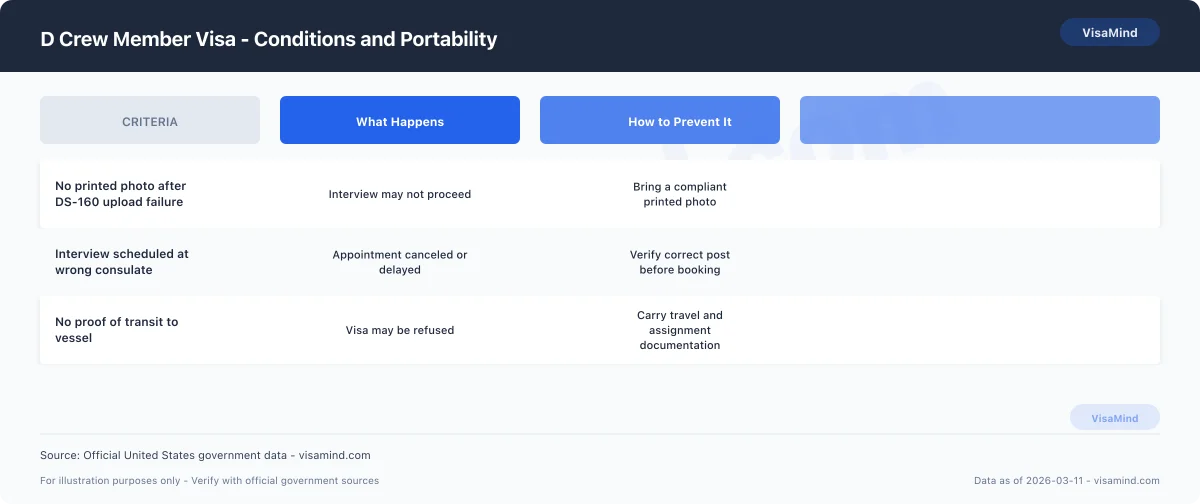
You must follow strict operational and procedural rules when applying for a D visa crewmember classification. Errors in documentation, interview scheduling, or transit proof can delay or prevent visa issuance by the U.S. Department of State.
Operational and transit conditions
You must show that you will join a vessel or aircraft as part of your authorized work duties. If you are transiting to meet the vessel, you need clear evidence of that transit arrangement.
Bring documentation that confirms:
- Your assignment to a specific vessel or aircraft
- The location where you will board
- Your travel plans to reach that location
If you can’t demonstrate that you are traveling to join the vessel, the consular officer may refuse the visa.
Your D visa is tied to your role as a crewmember. It does not grant open-ended employment in the United States. You must limit your activities to the operational duties connected to the vessel or aircraft.
If you have questions about eligibility standards, review official guidance from the U.S. Department of State. USCIS does not issue D visas, but it governs certain immigration benefits related to status inside the United States.
Interview and scheduling rules
You must complete Form DS-160 accurately before scheduling your visa interview. The confirmation page connects your application to your appointment.
Pay close attention to two common issues:
- Photo upload failure in DS-160
- Scheduling at the wrong U.S. Embassy or Consulate
If your digital photo upload fails in the DS-160 system, you must bring a printed photo that meets the required specifications to your interview. Arriving without it can delay processing.
You must schedule your interview at the correct U.S. Embassy or Consulate based on your location and case requirements. An appointment at the wrong post can result in cancellation or rescheduling.
For current procedural details, consult the U.S. Department of State’s official instructions for nonimmigrant visa processing.
Procedural failures to avoid
Small mistakes often cause denials or delays. Focus on accuracy and documentation.
| Issue | What Happens | How to Prevent It |
|---|---|---|
| No printed photo after DS-160 upload failure | Interview may not proceed | Bring a compliant printed photo |
| Interview scheduled at wrong consulate | Appointment canceled or delayed | Verify correct post before booking |
| No proof of transit to vessel | Visa may be refused | Carry travel and assignment documentation |
Before your interview:
-
Review your DS-160 confirmation page.
-
Confirm the correct embassy or consulate location.
-
Organize evidence that shows you will join your assigned vessel or aircraft.
You control most procedural errors. Careful preparation protects your timeline and your ability to begin work as scheduled.
Renewal and Extension
#You must use the correct government form, follow the official instructions, and submit a complete filing with required evidence. Accuracy and completeness determine whether USCIS or the U.S. Department of State can process your request without delay.
Which forms to use
The form you use depends on where you apply and what action you request.
| Situation | Government Agency | Form |
|---|---|---|
| Filing inside the United States for a benefit | U.S. Citizenship and Immigration Services (USCIS) | Form required for your eligibility category (see USCIS website) |
| Applying through a U.S. embassy or consulate | U.S. Department of State | Form DS-160, Online Nonimmigrant Visa Application |
If you file with USCIS, you must use the form designated for your specific eligibility category. USCIS publishes the current edition of each form on its official website.
If you apply for a new visa stamp abroad, you complete Form DS-160 through the U.S. Department of State. The consular officer reviews that application during the visa process.
Always confirm you use the most current edition before submitting anything.
Downloading and reviewing instructions
Download the form and its separate instructions directly from the official USCIS website. Don’t rely on outdated copies from third parties.
Read the instructions for your specific eligibility category before you begin. The instructions explain:
- Who qualifies to file
- What evidence you must submit
- Where to file
- Whether a filing fee applies (verify current amounts on the USCIS website)
If you apply through a U.S. consulate, review the Form DS-160 instructions provided by the U.S. Department of State.
Careful review prevents avoidable mistakes. Many delays occur because applicants skip required evidence or misunderstand eligibility rules. Treat the instructions as mandatory requirements, not suggestions.
Completing and submitting filings
Complete every required section of the form. If a question doesn’t apply, follow the official instructions for how to respond.
Before submitting, double-check that you:
- Sign the form where required
- Attach all necessary supporting evidence
- Use the correct edition of the form
- Follow the instructions for your specific category
USCIS won’t process an unsigned or incomplete filing. Missing evidence often leads to rejection or requests for more documentation.
If you’re submitting Form DS-160, answer every question fully. Review your entries before final submission. The information you provide supports your eligibility to continue or resume authorized work as a crewmember under D classification.
What Your Employer Must Do
#Your employer or vessel operator plays a direct role in your D visa application. They must provide specific information, coordinate with the U.S. Department of State, and make sure any required USCIS petition is approved before you apply.
Information the employer or operator provides
Your employer or vessel operator must give you clear, verifiable details about your crewmember position and duties. You’ll need this information when completing Form DS-160, which the U.S. Department of State requires for visa processing.
At a minimum, your employer should provide:
- Name of the vessel or aircraft
- Type of vessel or aircraft
- Your job title and onboard duties
- Intended port of entry
- Expected date you’ll arrive in the United States to begin work
You need to enter this information accurately on your DS-
- Inconsistent or vague entries can slow down visa issuance.
If you’re applying under a category that requires an approved petition, such as the H-1b visa or L-1 visa, your employer must first get approval of Form I-129 from USCIS. The consular officer will verify that approval at your visa interview.
| Employer Responsibility | Why It Matters to You |
|---|---|
| Provide vessel/aircraft details | You must list them on DS-160 |
| Confirm your work role | Consular officer evaluates eligibility |
| Secure I-129 approval (if required) | Visa cannot be issued without valid petition |
Coordination with consular processes
Your employer doesn’t issue your visa. The U.S. Department of State controls visa interviews and issuance.
Your employer needs to coordinate timing so you can:
-
Complete and submit the DS-160
-
Schedule your visa interview
-
Attend the interview with accurate employment details
If a petition is required, your employer must ensure USCIS has approved it before you complete the DS-160 and appear for your interview. Consular officers check petition status through government systems.
You’re responsible for the DS-160 and the interview. Your employer supports the process by making sure all employment-related information matches what the government has on record.
When employer paperwork matters
Employer documentation matters in three main situations:
- When your visa category requires a USCIS-approved petition
- When a consular officer questions the legitimacy of your work assignment
- When there are discrepancies between your DS-160 and employer records
If your employer files Form I-129, USCIS must approve it before you can receive a visa in that classification. The consulate will confirm that approval during processing.
Inaccurate job descriptions, incorrect vessel information, or missing petition approval can lead to visa refusal. You need to confirm your employer’s records match your own entries.
Your ability to work in the United States depends on this alignment. Without proper employer documentation, the U.S. Department of State won’t issue the visa, and U.S. Customs and Border Protection will determine admission at the port of entry based on the approved classification.
When Self-Preparation Isn't Enough
#Some D visa crewmember applications fail because of preventable errors. Small inconsistencies in your Form DS-160 or incomplete answers about your background can delay your ability to work or lead to denial.
When to Consult a Qualified Professional
You should consult a qualified immigration attorney if your application contains inconsistencies, prior refusals, or complex background issues. Even minor discrepancies between your passport and DS-160 can cause delays.
A professional is especially important if:
- You previously received a visa denial
- You submitted multiple DS-160 sessions with differing answers
- Your passport details changed during the application process
- You’re unsure how to answer security or background questions
Every answer must match your passport and supporting documents exactly. Dates of travel, spelling of your name, and employment details related to your work as a crewmember need to be consistent across all forms.
If your case involves communication with USCIS or coordination with your employer, legal guidance helps ensure all records align. Mistakes often happen when applicants assume small details don’t matter.
| Issue | Risk if Uncorrected |
|---|---|
| Name mismatch with passport | Visa delay or denial |
| Incomplete security answers | Request for Evidence (RFE) or refusal |
| Different travel dates across forms | Processing delays |
High-Complexity Situations
Certain situations require more than careful form preparation. You should seek help if your background includes prior immigration issues or incomplete disclosures.
Security and background questions on the DS-160 require full and accurate responses. Leaving sections blank or providing partial information can trigger additional review.
High-complexity cases often include:
- Prior visa refusals
- Past overstays or status violations
- Inconsistent employment history
- Multiple corrections to submitted DS-160 forms
Your work as a crewmember depends on smooth visa processing. Administrative delays can disrupt employment schedules and vessel assignments.
You must review every answer before submitting the DS-
- Once submitted, inconsistencies between sessions or with your passport create credibility concerns that are difficult to fix without structured legal support.
Preparing for RFEs or Denials
If a consular officer or USCIS issues a Request for Evidence (RFE), respond with precise and consistent documentation. Don’t submit new information that conflicts with your original DS-160.
Focus on:
-
Matching all personal data exactly to your passport
-
Addressing every requested item directly
-
Avoiding unnecessary explanations
An RFE often results from incomplete background answers or mismatched details. A denial may follow if discrepancies remain unresolved.
Before responding, compare your DS-160, passport, and supporting documents line by line. Small errors—such as incorrect travel dates—can undermine credibility.
If you receive a denial, review the written notice carefully and consult a qualified attorney before reapplying. Refiling without correcting inconsistencies increases the risk of another refusal and may affect your ability to obtain a D visa for future work.
Application Process
#You must complete the online application, upload a compliant photo, and attend an in-person interview. The U.S. Department of State manages visa interviews and issuance, while USCIS oversees immigration benefits within the United States.
Complete the DS-160 online
Submit Form DS-160, Online Nonimmigrant Visa Application, for a D crewmember visa. This form applies to all nonimmigrant visa categories.
Complete the DS-160 electronically and answer every question fully and accurately. The information you enter supports your eligibility to enter the United States for work as a crewmember.
After submission, print the DS-160 confirmation page. You’ll need to bring this page to your visa interview.
Key steps:
-
Access and complete Form DS-160 online.
-
Review all entries before final submission.
-
Submit the form electronically.
-
Print the confirmation page right after submitting.
If you have technical questions about the form, review instructions provided through the U.S. Department of State. For immigration benefit questions inside the United States, consult USCIS resources.
| Requirement | Action You Must Take |
|---|---|
| Form | Complete DS-160 online |
| Submission | Submit electronically |
| Proof | Print confirmation page |
Photo and confirmation requirements
You must upload a photo while completing the DS-
- The image has to meet the required format specifications.
If the uploaded photo doesn’t meet technical standards, your application may not process correctly. Follow the photo guidelines provided during the DS-160 process.
Bring the following to your interview:
- Printed DS-160 confirmation page
- Any required photo if instructed during scheduling
- Any additional documents listed by the U.S. Department of State
The confirmation page proves you completed and submitted the required online application. Without it, the consular officer can’t process your case.
| Item | Purpose |
|---|---|
| Digital photo upload | Identity verification |
| DS-160 confirmation page | Proof of completed application |
Schedule and attend the interview
After submitting the DS-160, schedule a visa interview at a U.S. embassy or consulate. The U.S. Department of State conducts all visa interviews and decides whether to issue the D visa.
Attend your appointment in person. Bring your DS-160 confirmation page and any required supporting documents.
During the interview, a consular officer will review your application and determine whether you qualify for a D crewmember visa to perform your work duties in the United States.
For current appointment procedures and any applicable fees, refer to the official guidance from the U.S. Department of State.
Eligibility Requirements
#You must show that you’re a crewmember traveling to the United States to perform services on a vessel or aircraft and that you’ll depart after your assignment ends. You also need to properly complete the required online application and follow U.S. Department of State procedures for visa issuance.
Who qualifies to apply
You qualify for a D visa if you seek to enter the United States as a crewmember to perform work on board a vessel or aircraft. Your travel must relate directly to your duties as a crew member.
To meet the basic eligibility standard, you must:
- Intend to enter the United States to work in your capacity as a crewmember
- Have a role connected to the operation or service of a vessel or aircraft
- Complete the Online Nonimmigrant Visa Application (Form DS-160)
- Apply through a U.S. embassy or consulate, as visa issuance is handled by the U.S. Department of State
You must complete Form DS-160 online before your interview. After submitting it, print and keep the confirmation page with the barcode.
Use this checklist to stay organized:
| Requirement | What You Must Do |
|---|---|
| Online application | Submit Form DS-160 electronically |
| Confirmation page | Print and retain the barcode page |
| Application ID | Save your ID number for future access |
| Timely completion | Finish the form in one session when possible |
If you have questions about visa procedures or documentation, consult the U.S. Department of State. USCIS does not issue D visas.
Intent to depart and travel intent
You must demonstrate that you plan to depart the United States after completing your crewmember duties. The D visa does not authorize open-ended stays or employment outside your crew assignment.
Your purpose of travel must match your declared work as a crewmember. Your documentation and interview answers need to reflect that purpose.
Be prepared to show:
- That your entry relates to specific crewmember duties
- That your stay will be temporary
- That you will leave after your authorized period ends
A consular officer from the U.S. Department of State will evaluate your application and determine visa eligibility. Even with a valid visa, U.S. Customs and Border Protection (CBP) makes the final decision on admission at the port of entry.
Expert preparation tips
Complete Form DS-160 carefully and accurately. Inconsistent answers can delay processing or affect your eligibility.
Follow these steps to avoid common errors:
-
Save your application ID immediately after starting the DS-160.
-
Complete the form in one sitting when possible.
-
If needed, retrieve your saved application within 30 days.
-
Print and securely store the barcode confirmation page after submission.
Keep your answers consistent with your intended crew work. Don’t include information that conflicts with your travel purpose.
If you’re unsure about procedural requirements, verify instructions directly with the U.S. Department of State. For immigration benefits inside the United States, consult USCIS, but D visa issuance occurs through consular processing.
Path to Permanent Residence
#A D visa allows you to serve as a crewmember in the United States, but it doesn’t place you on a direct track to permanent residence. You need to understand the limits of this nonimmigrant category before making long-term immigration plans.
Nonimmigrant vs immigrant status
A D visa places you in a nonimmigrant classification. You enter the United States for a specific, temporary purpose related to your crewmember duties and authorized work.
Permanent residence, by contrast, falls under immigrant status. Immigrant status allows you to live and work in the United States without the temporary restrictions that apply to D visa holders.
| Feature | D Visa (Nonimmigrant) | Permanent Residence (Immigrant) |
|---|---|---|
| Purpose | Temporary crewmember duties | Long-term residence |
| Intent | Limited, temporary stay | Permanent stay |
| Work | Restricted to authorized crewmember work | Broad work authorization |
You must keep these differences clear. A D visa doesn’t automatically convert into immigrant status, and it doesn’t provide built-in immigrant benefits.
Does filing lead to permanent residence?
Submitting an application or filing related paperwork doesn’t guarantee approval. Immigration authorities review each case on its own merits.
U.S. Citizenship and Immigration Services (USCIS) evaluates petitions and immigration benefits. The U.S. Department of State manages visa issuance through consular processing, including the Form DS-160 form.
Filing any form doesn’t by itself create eligibility for permanent residence. Approval depends on meeting all legal requirements for the specific immigrant category.
If you’re considering permanent residence, you must:
- Identify a qualifying immigrant category.
- Meet all eligibility criteria for that category.
You’ll also need to follow the correct filing process with USCIS or the Department of State. Wait for a formal decision before making plans to stay permanently.
Next steps after the decision
If your immigrant application is approved, follow the instructions in your approval notice. The Department of State issues an immigrant visa if you process abroad, and U.S. Customs and Border Protection (CBP) determines admission at the port of entry.
If your filing is denied, the notice will explain why. Review it carefully and consider whether you can file again or pursue a different immigration option.
Don’t continue to work or remain in the United States beyond your authorized stay based on the assumption of approval. Status depends on formal authorization, not on a pending or previously filed application.
Common Petition Challenges
#Small errors on your application can delay a D visa crewmember case or lead to refusal. Most issues involve photo compliance, selecting the correct visa category on the Form DS-160, and fully answering security questions.
Photo and document quality issues
A non-compliant visa photo is a frequent cause of avoidable delays. The U.S. Department of State sets strict photo requirements, and the consular officer reviews the image you submit with your DS-160.
You must follow the official photo specifications exactly. Don’t guess or reuse an old image.
Use this checklist before submitting:
- Photo meets U.S. Department of State size and format rules
- Image is clear, in focus, and properly exposed
- No cropping errors or digital alterations
- Background and composition follow official standards
If your photo fails review, the consulate may require a replacement before continuing your case. That pause can disrupt your scheduled work assignment or vessel reporting.
When in doubt, use a professional service or a validated photo tool that confirms compliance with Department of State standards.
Selecting the correct visa category
Choosing the wrong visa classification can result in refusal. The D visa is for crewmembers serving on a vessel or aircraft in the United States.
You select your visa category when completing Form DS-
- An incorrect selection signals that your purpose of travel doesn’t match your stated work duties.
Review your role carefully before submission. Your visa category must align with your actual position and travel purpose.
| Purpose of Travel | Correct Action |
|---|---|
| Serving as crewmember on vessel or aircraft | Select D visa classification |
| Tourism or personal visit | Select appropriate visitor category |
| Study or specialty employment | Select the specific visa tied to that activity |
If you choose the wrong category, the consular officer may refuse the application and require a new DS-
- USCIS does not issue D visas; the U.S. Department of State handles visa issuance.
Confirm your employer’s documentation matches the category you select.
Completing security/background questions
Incomplete security answers often trigger delays or extra review. The DS-160 requires you to answer every background and security question.
Don’t leave any field blank.
Follow these rules:
- Answer every question fully and truthfully
- Enter “None” or “N/A” where appropriate
- Review all sections before electronically signing
An unanswered question can lead to requests for clarification or further administrative processing. That delay can affect your ability to report for work as scheduled.
Before submitting, review each page of the DS-160 carefully. Once you certify and submit the form, you confirm that all answers are complete and accurate.
Gather Required Documents
#You must present a valid passport, a complete Form DS-160 confirmation, and compliant passport-style photos. Errors or missing items delay your D visa interview and can disrupt your ability to work as a crewmember.
Passport and validity
Your passport must be valid and in good condition. It must accurately reflect your legal name and biographic details.
Check the following before your interview:
- Passport is signed, if signature is required.
- Biographic page is undamaged and legible.
No torn, loose, or altered pages. Personal data must match your DS-160 exactly.
If your passport will expire soon, renew it before scheduling or attending your interview. A passport that doesn’t meet validity standards can delay visa issuance by the U.S. Department of State.
Bring your current passport to the interview. If you hold more than one passport, verify which one you used when completing the DS-160 and bring that same document.
DS-160 confirmation and uploads
You must complete the Online Nonimmigrant Visa Application (Form DS-160) before scheduling your visa interview. The U.S. Department of State uses this form to process your D visa application.
After you submit the DS-160:
-
Save your confirmation page.
-
Print the confirmation page before leaving the CEAC system.
Upload the confirmation page with your visa application, if required by your post.
The confirmation page contains a barcode. Consular staff scan this barcode to retrieve your application. If you arrive without it, the consulate may delay or reschedule your interview.
Ensure all information on the DS-160 matches your passport and employment details related to your crewmember work. Inconsistent information can result in processing delays.
| Document | Required Action | Why It Matters |
|---|---|---|
| DS-160 confirmation page | Print and bring to interview | Allows consular access to your application |
| Uploaded confirmation (if required) | Submit before interview | Prevents administrative delays |
Passport-style photos
Prepare your passport-style photos before you begin the application process. Non-compliant photos commonly cause delays.
Your photos must:
- Meet U.S. visa photo specifications.
- Be recent.
They should clearly show your full face without obstruction.
Don’t submit photos with shadows, glare, or improper background. If your photo doesn’t meet Department of State standards, you may need to obtain new photos before your interview can proceed.
Bring physical copies if your consulate requires them, even if you uploaded a digital image with your DS-
- Verify specific photo submission rules with the U.S. Department of State instructions for your interview location.
Fees
#| Component | Amount |
|---|---|
| Application fee (MRV)MRV fee (non-petition) | $185 |
Fees change; always verify on USCIS.
Required forms
#Next steps
#Use Find My Visa to build a sequenced plan with official sources and deadlines.
FAQs
Where can you find current fees or processing details?
For visa application fees and interview procedures, refer to the U.S. Department of State.
If you need information about immigration forms or benefit requests processed within the United States, check with USCIS.
What is the Crewmember (D) visa?
The Crewmember (D) visa is a nonimmigrant visa for people serving aboard commercial sea vessels or international airlines to facilitate normal vessel operations. Crewmembers generally must intend to depart the United States on the same vessel or another within 29 days. In general, foreign nationals must obtain a visa (nonimmigrant or immigrant) to enter the United States.
What's the difference between a regular D visa and a D-3 visa?
A D-3 visa covers crewmembers performing ship-to-ship liquid cargo (lightering) operations and may be issued for up to 180 days. Regular crewmember D visas are for those joining commercial sea vessels or international airlines with intent to depart within 29 days.
How long can I stay in the United States on a crewmember visa?
Typical limits: standard crewmembers are expected to depart within 29 days; crewmembers performing lightering activities (D-3) may be issued visas for up to 180 days.
Do I need to complete the DS-160 to apply?
Yes. Applicants for nonimmigrant visas must submit a completed Form DS-160 (Online Nonimmigrant Visa Application) and should complete it online and print the application confirmation page.
What documents should I prepare for the interview?
Prepare a valid passport (valid for at least six months beyond the intended stay), the Form DS-160 confirmation page (upload as required), passport-style photos in the correct format, and details about the vessel or airline where employment is intended.
How much is the visa application fee?
The Machine-Readable Visa (MRV) application fee is $185 (as of 2026-03).
What are typical processing times for crewmember visa applications?
processing times vary by category and location. For Form DS-160 under 'Crew and Transit (C, D, C1/D)' the listed range is 0.5 to 14 months (as of February 2026). Processing times vary and should be verified with the issuing authority; a general processing time listed is 2–8 weeks.
What common mistakes should I avoid when applying?
Common mistakes include submitting inconsistent information across Form DS-160 sessions or with your passport, using poor-quality or non-compliant photos, selecting the wrong visa category, and leaving security/background questions incomplete. All information must match your passport and supporting documents exactly.
What should I do immediately after completing the DS-160?
After completing the Form DS-160, print and keep the DS-160 barcode/confirmation page, save your application ID (and try to complete the form in one sitting when possible), upload the DS-160 confirmation page with your visa application, and schedule and attend a visa interview at the appropriate U.S. Embassy or Consulate.
If I file the application, is approval guaranteed?
No. Filing does not guarantee approval.
Official sources referenced
Last reviewed: 2026-03-11
VisaMind provides informational guidance only and is not a government agency. This is not legal advice. Requirements can change and eligibility depends on your specific facts. If your case is complex or high-stakes, consult a licensed immigration attorney.
Next steps
Every United States visa case depends on your nationality, purpose, and timeline. Get a personalized plan with official sources and deadlines.
Find my visa