
On this page
- What the L-1B Intracompany Transferee (Specialized Knowledge) Covers
- The Dual-Track Application
- Filing Fees and Wait Times
- Bringing Your Spouse and Children
- What Your Employer Must Do
- From Work Visa to PR
- Changing Employers
- Who Can Apply
- How to Renew
- Why Petitions Get Questioned
- What Documents to Prepare
- Fees
- Required forms
- Related visa types
- Related guides
- Related goals
- Next steps
What the L-1B Intracompany Transferee (Specialized Knowledge) Covers
#The L-1B Intracompany Transferee (Specialized Knowledge) category allows a company to move a qualifying employee from a foreign office to a U.S. office. USCIS reviews the petition to determine whether both the employer and the employee meet the requirements.
Purpose and scope
The L-1B visa allows your employer to transfer you to the United States if you possess specialized knowledge related to the company’s operations. You must already work for the organization abroad before the transfer.
This category differs from the L-1a visa Intracompany Transferee (Manager/Executive), which applies to managers and executives. It also differs from the H-1b visa Specialty Occupation Visa and the O-1 visa Extraordinary Ability Visa, which are separate nonimmigrant classifications with different eligibility standards.
The L-1B is strictly for internal company transfers. It does not apply to new hires recruited directly from abroad.
If approved, your eligible family members may seek status under the L-2 visa Dependent Visa classification.
Key elements include:
- Transfer from a foreign office to a U.S. office
- Employment with the same organization
- A role requiring specialized knowledge
- A petition filed with USCIS
USCIS evaluates each case based on the evidence submitted.
How USCIS handles the petition
Your employer must file Form I-129, Petition for a Nonimmigrant Worker, with USCIS to request L-1B classification. USCIS reviews the petition to determine whether the company and the employee qualify.
USCIS looks at whether:
- A qualifying organizational relationship exists
- You currently work for the foreign office
- Your role involves specialized knowledge
- The transfer is to a U.S. office of the same organization
If USCIS approves the petition and you’re outside the United States, you apply for a visa through the U.S. Department of State. The Department of State issues visas, while U.S. Customs and Border Protection (CBP) determines admission at the port of entry.
Approval of the petition does not automatically grant permanent residence, such as under the EB-2 visa Employment-Based Second Preference category. Those processes are separate.
What the form collects
Form I-129 collects detailed information about both the employer and the employee. USCIS uses this information to assess eligibility under the L-1B classification.
The form requires information about:
- The U.S. petitioner
- The foreign office
- Your current employment status
- Your employment history
- Your specialized knowledge qualifications
You must provide accurate and complete information. Inconsistent or missing details can affect how USCIS evaluates the petition.
| Category | Examples of Information Collected |
|---|---|
| Employer details | U.S. office information and foreign office relationship |
| Employee background | Current position and prior employment |
| Qualifications | Description of specialized knowledge |
| Classification request | L-1B category under Form I-129 |
USCIS bases its decision on the total record submitted with the petition.
The Dual-Track Application
#You and your employer each complete specific parts of the L-1B process. USCIS reviews the employer’s petition first, and you then use the approval for visa issuance or admission.
Employer petition (Form I-129) steps
Your employer must file Form I-129, Petition for a Nonimmigrant Worker, with USCIS and include the required fee. The petition must be complete, signed with an original handwritten signature, and filed using the correct edition of the form.
For an individual L-1B petition, the employer files for you specifically. If the company has an approved blanket L petition, it may transfer multiple eligible employees through a streamlined process.
| Petition Type | Who Is Covered | Key Form |
|---|---|---|
| Individual L-1B | One named beneficiary | Form I-129 |
| Blanket L | Multiple eligible employees | Form I-129S (with blanket approval notice) |
The employer must:
-
Complete all L-1 classification sections accurately.
-
Attach evidence of business operations and your credentials.
-
Include any required supplements, such as Part 6, which applies to L-1 and certain other classifications like the H-1b visa Specialty Occupation Visa and O-1 visa Extraordinary Ability Visa.
-
Sign and date the form after completion.
If more than one person is included, the employer must attach the appropriate additional forms. USCIS will issue Form I-797, Notice of Action, if it approves the petition.
Worker-side forms and supplements
You do not file Form I-129 yourself, but you must provide complete and accurate information to your employer for inclusion in the petition. In blanket cases, you’ll use Form I-129S and the blanket approval notice for visa processing or admission.
After USCIS approval, you apply for a visa through the U.S. Department of State if you are outside the United States. Visa issuance is separate from USCIS petition approval.
If your family plans to join you, they may apply for the L-2 visa Dependent Visa. Their eligibility depends on your approved L-1B status.
If you later pursue permanent residence, options such as EB-2 visa Employment-Based Second Preference may become relevant, but that is a separate process from the L-1B petition.
Filing checklist and signatures
Before filing, your employer should confirm that the petition package includes:
- ✅ Correct Form I-129 edition (all pages from the same edition)
- ✅ Completed L-1B classification sections
- ✅ Required supplements (including Part 6, if applicable)
- ✅ Supporting evidence of company operations
- ✅ Documentation of your qualifications
- ✅ Required filing fee
- ✅ Original handwritten signature
USCIS rejects incomplete or unsigned petitions. Review every page for accuracy, including page, part, and item numbers when adding supplemental information.
A precise, complete filing reduces delays and prevents avoidable rejections.
Filing Fees and Wait Times
#
You must budget for several mandatory USCIS fees and plan for processing that can last months unless you pay for expedited review. Costs depend on the forms you file and whether you request premium processing.
Required government fees
Your employer files Form I-129, Petition for a Nonimmigrant Worker, with USCIS to request L-1B classification.
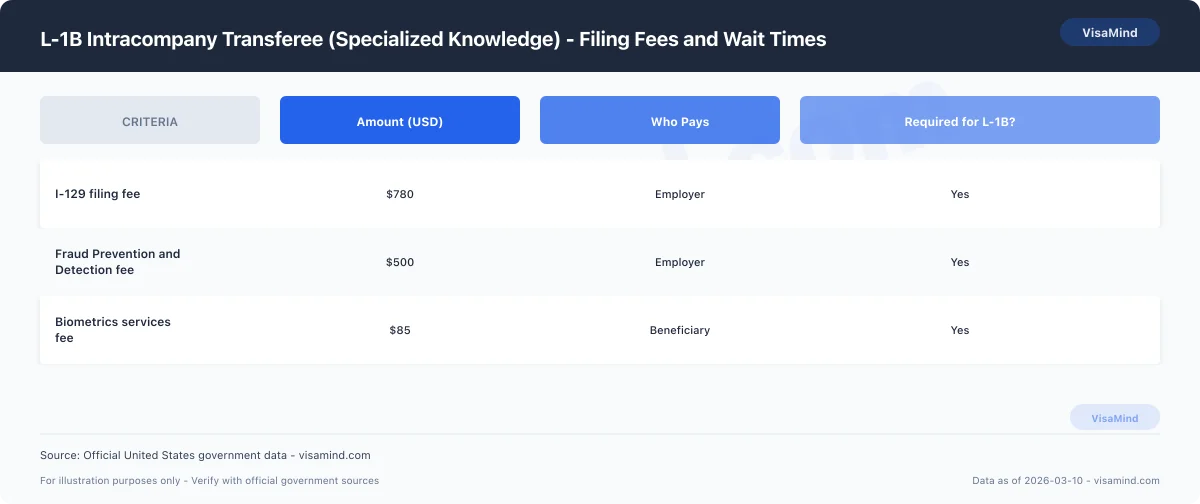
As of February 2026, the core government fees are:
| Fee Type | Amount (USD) | Who Pays | Required for L-1B? |
|---|---|---|---|
| I-129 filing fee | $780 | Employer | Yes |
| Fraud Prevention and Detection fee | $500 | Employer | Yes |
| Biometrics services fee | $85 | Beneficiary | Yes |
USCIS requires separate checks or money orders for each applicable fee.
The $500 Fraud Prevention and Detection fee applies to L-1 petitions, including L-1B and L-1a visa Intracompany Transferee (Manager/Executive). This fee differs from the similar fraud fee used in the H-1b visa Specialty Occupation Visa context.
If your spouse or children apply for L-2 visa Dependent Visa status, they file separate applications and pay separate filing fees. Always verify the current amounts using the USCIS fee calculator before filing.
Premium processing and special fees
If timing affects your start date, you can request premium processing by filing Form I-907 with Form I-129.
As of February 2026, the premium processing fee is:
| Service | Amount (USD) | USCIS Action Time |
|---|---|---|
| Premium processing (Form I-907) | $2,965 | 15 calendar days |
USCIS will issue an approval, denial, request for evidence, or notice of intent to deny within 15 calendar days.
This option is also available for other categories filed on Form I-129, including the H-1B Specialty Occupation Visa and the O-1 visa Extraordinary Ability Visa. It does not increase your chances of approval. It only shortens USCIS processing time.
Premium processing does not control visa interview scheduling or visa issuance abroad. The U.S. Department of State manages those steps.
Typical USCIS processing times
If you don’t request premium processing, your case follows standard USCIS timelines.
As of January 2026, reported processing times for Form I-129 under “Intracompany transferees and blanket L” range from:
| Category | Typical Processing Time |
|---|---|
| L-1 (Intracompany transferees and blanket L) | 6 to 8 months |
Processing times vary by service center and workload. You should check the USCIS processing times tool for the specific office handling your petition.
For comparison, other I-129 categories show different timelines:
- H-1B Specialty Occupation Visa: roughly 5 to 8 months, depending on case type
- O-1 Extraordinary Ability Visa: about 9.5 to 14 months
If you later pursue permanent residence, such as the EB-2 visa Employment-Based Second Preference, that process follows a separate timeline and filing structure.
Bringing Your Spouse and Children
#Your spouse and unmarried children under 21 can seek L-2 visa Dependent Visa status based on your L-1B petition. You can often submit their applications with your petition to keep processing aligned and reduce delays.
Which dependent forms to file
Your dependents apply using Form I-539, Application to Extend/Change Nonimmigrant Status with USCIS when they are requesting a change or extension of status inside the United States.
USCIS may decide your family’s request at the same time as your Form I-129 if you properly submit Form I-539 together with your L-1B petition in the same package and to the correct filing location.
| Situation | Form Filed | Agency |
|---|---|---|
| You file L-1B petition (Form I-129) and dependents are in the U.S. seeking change/extension | Form I-539 with Form I-129 | USCIS |
| Dependents apply for visas abroad | Visa application after petition approval | U.S. Department of State |
Your spouse qualifies for the L-2 Dependent Visa, not the H-4 visa category used with the H-1b visa Specialty Occupation Visa or the O-3 visa category tied to the O-1 visa Extraordinary Ability Visa.
Eligible dependents include:
- Your legally married spouse
- Your unmarried children under age 21
USCIS determines eligibility for status in the United States. The U.S. Department of State handles visa issuance at U.S. consulates abroad.
Timing: file together vs separately
You increase efficiency when you submit Form I-539 with your Form I-130. USCIS can review both filings at the same time if you properly package and file them together.
Filing together often helps keep expiration dates aligned. This approach reduces the risk that your dependents receive shorter periods of stay than you do.
If you file separately, USCIS processes each case on its own timeline. That separation can lead to gaps in status if one case moves faster than the other.
| Filing Strategy | Key Effect |
|---|---|
| File I-129 and I-539 together | USCIS may adjudicate at the same time |
| File separately | Cases proceed independently |
This same coordinated strategy applies to other categories, including the L-1a visa Intracompany Transferee (Manager/Executive), H-1B Specialty Occupation Visa, and O-1 Extraordinary Ability Visa.
Always confirm current filing instructions and fees using the USCIS fee calculator before submitting. Fee amounts change, and USCIS rejects improperly filed applications.
Practical tips for dependents
Keep your family’s documents consistent with your L-1B petition. Names, passport details, and validity dates should match across all forms.
Before filing, confirm that each dependent:
- Holds valid nonimmigrant status (if inside the United States)
- Meets the definition of spouse or unmarried child under 21
- Submits a properly completed and signed Form I-539
Track expiration dates closely. Your dependents’ L-2 status depends on your L-1B approval and period of stay.
If you later pursue permanent residence, such as through the EB-2 visa Employment-Based Second Preference, your spouse and children may qualify as derivative beneficiaries.
Plan early so your nonimmigrant status and any future immigrant process remain aligned.
What Your Employer Must Do
#Your employer must prove the companies qualify, file the correct petition with U.S. Citizenship and Immigration Services (USCIS), disclose workforce details, and confirm how you’ll be paid.
USCIS reviews these items closely before approving L-1B classification.
Qualifying-organization documentation
Your employer needs to show that the U.S. and foreign entities have a qualifying relationship. This means documenting branches, subsidiaries, or affiliates.
Petitioners must have three or more domestic and foreign branches, subsidiaries, or affiliates, and the related organizations together must meet at least one required business activity standard.
The company doesn’t need to engage in international trade, but it must operate as a viable business.
Your employer must also:
- Confirm it’s authorized to file on your behalf
- Demonstrate the corporate relationship between entities
- File Form I-129 with USCIS requesting L-1B classification
USCIS evaluates whether the petitioning entity properly supports an intracompany transfer. The same corporate structure rules apply to the L-1a visa Intracompany Transferee (Manager/Executive) category.
| Requirement | What Your Employer Must Show |
|---|---|
| Corporate relationship | Branch, subsidiary, or affiliate structure |
| Number of entities | At least three qualifying domestic/foreign entities |
| Filing authority | Authorization to file Form I-129 |
| Business activity | Meets one required qualifying business activity criterion |
If USCIS needs clarification, it may request additional documentation before making a decision.
Company-size and compliance items
Your employer must disclose workforce composition when filing Form I-130. This requirement focuses on companies with a significant U.S. presence.
If the company employs 50 or more individuals in the United States, it must state whether more than 50% of those employees hold:
- L-1A Intracompany Transferee (Manager/Executive) status
- L-1B status
- H-1b visa Specialty Occupation Visa status
USCIS uses this information to monitor compliance trends.
Your employer must also certify that it will comply with USCIS verification and inspection requirements. USCIS has authority to review records and confirm that the petition information is accurate.
This disclosure requirement doesn’t apply to smaller employers below the 50-employee threshold, but all petitioners must provide truthful and complete information.
Compensation and sponsorship duties
Your employer must clearly state how you’ll receive compensation in the United States. USCIS requires details whether the pay is salaried or non-salaried.
The petition must include:
- The type of compensation (salary or other structure)
- Confirmation that the compensation arrangement is legitimate
- If applicable, proof that the position supports self-sustenance within a temporary missionary program
USCIS expects the employer to provide real compensation for your work. There’s no specific wage formula for L-1B petitions, but compensation must be documented.
Your employer acts as your petitioner and sponsor for L-1B classification. If approved, your spouse and children may seek the L-2 visa Dependent Visa through the U.S. Department of State for visa issuance.
Accurate compensation reporting also affects future immigration steps, such as employment-based immigrant categories like EB-2 visa Employment-Based Second Preference, where prior employment records may become relevant.
From Work Visa to PR
#You can use L-1B employment as part of a longer-term permanent residence strategy. The path often depends on your role, your employer’s sponsorship plan, and whether a different nonimmigrant or immigrant category fits your qualifications.
When L-1B can be a step toward PR
Your L-1B status allows you to work in the United States for a qualifying employer that filed Form I-129 with U.S. Citizenship and Immigration Services (USCIS). While L-1B itself is temporary, your employer may later sponsor you for an employment-based immigrant category such as EB-2 visa Employment-Based Second Preference.
If your duties evolve into a managerial or executive role, your employer may consider the L-1a visa Intracompany Transferee (Manager/Executive) category. Some employers reassess your long-term plan and compare options such as:
| Visa Category | Purpose | Long-Term Strategy Consideration |
|---|---|---|
| L-1B | Specialized knowledge work | Employer may later sponsor for EB-2 |
| L-1A | Manager/executive role | May align with certain immigrant paths |
| H-1b visa Specialty Occupation Visa | Specialty occupation role | Requires certified LCA before filing |
| O-1 visa Extraordinary Ability Visa | Extraordinary ability | Used when qualifications support it |
Your dependents in L-2 visa Dependent Visa status remain tied to your underlying L classification during this process.
Key immigration steps employers may need
Permanent residence through employment usually requires employer sponsorship and multiple filings with USCIS. The exact sequence depends on the immigrant category selected.
For many EB-2 cases, employers must:
-
Complete the required labor certification process if applicable.
-
File the immigrant petition after that step is approved.
-
Follow USCIS instructions for required forms and evidence.
If your employer considers switching you to the H-1B Specialty Occupation Visa before pursuing permanent residence, they must ensure the Labor Condition Application is certified before filing the H-1B petition.
For employment-based categories that require labor certification, your employer must complete that process before submitting the immigrant petition.
Changing Employers
#You cannot freely change employers in L-1B status. Your authorization to work ties directly to the petitioning company and the specific qualifying relationship it established with its affiliated offices.
Any change requires careful review of corporate relationships, control, and your specialized knowledge role.
Portability and control issues
The L-1B visa does not provide portability like the H-1b visa Specialty Occupation Visa. You can’t begin work for a new, unrelated employer based on a pending petition.
If you want to move to a different company, that company must independently qualify and file a new Form I-129 with U.S. Citizenship and Immigration Services (USCIS). It must prove:
- A qualifying corporate relationship with a foreign entity
- Your prior employment with that qualifying organization
- Your specialized knowledge
- Details of your prior stays in L or H classification
Until USCIS approves the new petition, you may not work for that employer.
If you seek more flexibility, you may explore other classifications such as the H-1B Specialty Occupation Visa, the O-1 visa Extraordinary Ability Visa, or permanent residence through the EB-2 visa Employment-Based Second Preference category. Each has separate eligibility rules and filing standards.
Your L-2 visa Dependent Visa family members remain tied to your valid L-1B status. A lapse or denial affects their status as well.
Transfers between affiliated offices
You may transfer between affiliated offices if the qualifying relationship continues and the U.S. entity remains your petitioner.
L-1B classification covers intracompany transferees with specialized knowledge moving from an international branch, parent, subsidiary, or affiliate to a U.S. office.
If your employer reassigns you to another U.S. affiliated office, it must confirm that:
- The corporate relationship still qualifies
- You’ll continue to perform work requiring specialized knowledge
- The petition reflects accurate organizational information
USCIS evaluates whether your role, job duties, and reporting structure remain consistent with the approved classification.
If the transfer represents a material change, your employer may need to file an amended Form I-129. The petition must clearly describe the new work location, your duties, and how your knowledge remains specialized within the organization.
Keep records of your employment history, prior L or H stays, and organizational charts. USCIS reviews these details when assessing continued eligibility.
Third-party worksite rules
If you’ll work primarily at the site of an unaffiliated company, USCIS closely examines who controls your work.
Your petitioning employer must show that the unaffiliated company will not control your day-to-day duties. USCIS looks for evidence that your employer:
- Directs and supervises your work
- Retains the right to hire, fire, and evaluate you
- Controls your specialized knowledge assignments
- Maintains the qualifying corporate relationship
Use clear documentation such as contracts, statements of work, and organizational charts to demonstrate control.
If the third party directs your daily activities or supervises you, USCIS may find that you no longer qualify for L-1B classification. In that case, you may need to consider a different visa category that better fits the work arrangement.
Admission to the United States remains subject to inspection by U.S. Customs and Border Protection. Visa issuance, if required, falls under the U.S. Department of State.
Who Can Apply
#To qualify for an L-1B visa, both your employer and you must meet strict requirements. USCIS reviews the company’s corporate relationship and your prior work history before approving the Form I-129 petition.
Employer and business eligibility
Your U.S. employer must have a qualifying relationship with a foreign company. This typically means a parent company, branch, affiliate, or subsidiary relationship that supports an intracompany transfer.
The organization must:
- Conduct active commercial trade or services
- Do business in the United States and at least one other country
- Maintain an operating U.S. office
If the U.S. office has been operating, it must have done business for at least one year.
The company must file Form I-129 with USCIS to request your transfer in a specialized knowledge role.
The petitioning employer must seek to transfer you temporarily from a foreign affiliated office to a U.S. office. The business must show that the intracompany relationship is real and ongoing.
| Requirement | What USCIS Looks For |
|---|---|
| Qualifying relationship | Parent, branch, affiliate, or subsidiary structure |
| Active business operations | Commercial trade or services in the U.S. and abroad |
| U.S. presence | Operating office in the United States |
| Petition filing | Properly completed Form I-129 |
This category differs from the L-1a visa Intracompany Transferee (Manager/Executive), which applies to managers and executives rather than employees with specialized knowledge.
Employee eligibility and work history
You must have worked for a qualifying foreign organization for at least one continuous year within the three years before the petition is filed. The work must have been full-time and with the related foreign entity.
Your prior employment must connect directly to the U.S. petitioning company through the qualifying corporate relationship. USCIS examines whether your role abroad supports your transfer to a specialized knowledge position in the United States.
You must be coming to the United States to perform work that requires specialized knowledge for the related U.S. employer. The petition must clearly describe your duties and confirm that the position requires your specific experience.
| Requirement | Key Standard |
|---|---|
| Prior employment | 1 continuous year within past 3 years |
| Employer relationship | Same qualifying organization abroad |
| U.S. role | Specialized knowledge position |
Unlike the H-1b visa Specialty Occupation Visa or the O-1 visa Extraordinary Ability Visa, the L-1B focuses on your employment within a related corporate group rather than your academic degree or national recognition.
Special/conditional eligibility situations
In limited situations, additional conditions apply. If your case involves prior religious employment, you may need to show that you worked in R-1 visa status during the two years immediately before the petition was filed.
In those cases, USCIS may require proof that:
- You were a member of the petitioning organization’s denomination for at least two years
- You maintained self-support if the role was traditionally uncompensated
- You did not engage in unauthorized secular employment
These conditions apply only when relevant to your specific employment history. They do not replace the core L-1B requirements.
If USCIS approves the petition, your spouse and unmarried children under 21 may seek status under the L-2 visa Dependent Visa category. Visa issuance occurs through the U.S. Department of State, and admission to the United States is determined by U.S. Customs and Border Protection at the port of entry.
How to Renew
#You renew L-1B status by filing an extension of stay with U.S. Citizenship and Immigration Services (USCIS). You must use the correct petition type, submit complete documentation, and avoid errors that delay or deny your continued work authorization.
Extension filing basics
You request an extension of stay by filing Form I-129, Petition for a Nonimmigrant Worker, with USCIS before your current L-1B status expires.
Your employer—not you—files the petition.
Follow these core steps:
-
Confirm you remain eligible for L-1B classification.
-
Prepare Form I-129 and the required L supplement.
-
Gather supporting documents that show your qualifying employment continues.
-
Submit the petition with the correct filing fee.
Your extension must demonstrate that:
- You continue to work for a qualifying organization.
- Your U.S. role still requires specialized knowledge.
- The employer-employee relationship remains valid.
If you previously held L-1a visa Intracompany Transferee (Manager/Executive) status or plan to change categories, your employer must clearly document the qualifying role.
If your dependents hold L-2 visa Dependent Visa status, they must file separate extension requests to remain in the United States.
| Item | Who Files | Agency |
|---|---|---|
| Form I-129 (L-1B extension) | Employer | USCIS |
| L-2 extension | Dependent | USCIS |
If you are considering switching to another status, such as the H-1b visa Specialty Occupation Visa or the O-1 visa Extraordinary Ability Visa, your employer must file a separate petition.
Blanket-petition extensions
If your employer uses an approved L blanket petition, you must still submit proper documentation when requesting an extension of stay.
USCIS reviews whether you continue to qualify under the blanket approval.
Your filing should include evidence that:
- The blanket petition remains valid.
- You are employed in a qualifying capacity under that blanket.
- Your role and work location align with the approved structure.
A common mistake is submitting incomplete documentation for a blanket extension.
USCIS may delay processing or deny the request if the record does not clearly confirm eligibility.
Do not assume prior approval guarantees renewal.
Each extension stands on its own record.
| Requirement | Individual Petition | Blanket Petition |
|---|---|---|
| Form I-129 required | Yes | Yes |
| Proof of qualifying relationship | Required | Required under blanket structure |
| Evidence of specialized knowledge role | Required | Required |
Common extension pitfalls
Most extension problems arise from incomplete or inconsistent filings.
USCIS evaluates whether your current employment matches what was previously approved.
Avoid these errors:
- Omitting required supporting documentation.
- Failing to show that your specialized knowledge role continues.
- Submitting inconsistent job descriptions.
- Filing after your current status expires.
If you plan long-term employment in the United States, you may also explore immigrant pathways such as the EB-2 visa Employment-Based Second Preference category.
That process is separate from an L-1B extension.
You must maintain valid status at all times.
Filing a complete and timely extension protects your ability to continue working while USCIS reviews the petition.
Why Petitions Get Questioned
#USCIS questions L-1B petitions when the evidence does not match the legal standard, when forms contain technical errors, or when the record creates inconsistencies.
Most issues arise from classification problems, missing documentation, or filing mistakes on Form I-129.
Documentation and classification mismatches
You must prove that the employee worked abroad for the related company for the required period and that the U.S. role requires specialized knowledge.
If you fail to document either element, USCIS will question the petition.
Common triggers include:
- Vague job descriptions that do not explain the specialized knowledge.
- Evidence that shows general skills rather than company-specific expertise.
- Inconsistent employment dates between support letters and Form I-129.
- Petition validity dates that do not match the requested period of stay.
Classification errors also create problems.
Filing under the wrong I-129 supplement, such as using the H-1b visa Specialty Occupation Visa or O-1 visa Extraordinary Ability Visa supplement instead of the L classification, results in rejection.
If the job duties resemble those of an L-1a visa Intracompany Transferee (Manager/Executive), USCIS may question whether you selected the correct category.
Inconsistent descriptions between internal documents and the petition often lead to a Request for Evidence (RFE).
Form, fee and edition errors
Technical mistakes cause immediate rejection before USCIS reviews the merits.
An unsigned Form I-129 will not be accepted.
You must also:
- Use the current edition of Form I-129 listed by USCIS.
- Submit all required pages from the same edition.
- Include the correct filing fee and any separate fee for premium processing, if requested.
- File any required supplements, such as Form I-129S, when applicable.
Submitting pages from different form editions or omitting required supplements leads to rejection.
USCIS does not correct these errors for you.
If you include incorrect fees or fail to follow edition deadlines, USCIS will reject the filing and return it.
Always confirm the current form version and fee schedule before you file.
USCIS adjudication outcomes
After review, USCIS takes one of several actions.
Officers follow internal adjudication guidance and evaluate eligibility based on the record you submit.
| Possible Action | What It Means for You |
|---|---|
| Approval | USCIS finds you meet L-1B requirements. |
| Request for Evidence (RFE) | USCIS needs more documentation before deciding. |
| Notice of Intent to Deny (NOID) | USCIS believes the petition is deficient but allows a response. |
| Denial | USCIS determines eligibility was not established. |
| Referral for investigation | USCIS sends the case for further review. |
An RFE often results from inconsistent job descriptions, unclear specialized knowledge claims, or mismatched dates.
A denial usually follows when you cannot establish qualifying employment abroad or the required knowledge standard.
USCIS adjudicates each petition on its own record.
Strong, consistent documentation reduces the risk of delays that may also affect related applications, such as the L-2 visa Dependent Visa or future filings like EB-2 visa Employment-Based Second Preference.
What Documents to Prepare
#You must submit a complete and organized package to U.S. Citizenship and Immigration Services (USCIS) with Form I-129.
Your evidence must prove the qualifying corporate relationship, your specialized knowledge, and your prior immigration history.
Employer documentation
Your U.S. employer (the petitioner) files Form I-129 and must document the company’s structure and operations.
Include:
- Full legal name, address, and contact information
- Description of business operations
- Ownership details and relationship to the foreign entity
- Evidence of a qualifying corporate relationship (parent, branch, subsidiary, or affiliate)
- Basis for the requested L-1B classification
You must clearly show how the U.S. company and the foreign company are related.
Provide corporate records that establish ownership and control.
If USCIS previously approved the beneficiary under L classification (including L-1a visa Intracompany Transferee (Manager/Executive) or L-1B), include copies of prior approval notices.
If any final administrative determinations, debarment notices, or prior USCIS decisions apply to the petitioner, submit complete copies.
Do not omit pages.
Use a table to organize core employer evidence:
| Document Type | Purpose |
|---|---|
| Corporate ownership records | Prove qualifying relationship |
| Business operation summary | Show active commercial activity |
| Prior USCIS approval notices (Form I-797) | Confirm past classification |
| Final agency determinations (if any) | Disclose compliance history |
USCIS evaluates whether the company can support the offered role.
Provide clear documentation, not general statements.
Beneficiary documentation
You must prove that you qualify as a specialized knowledge employee.
Submit:
- Full biographical information (name, aliases, date of birth)
- Passport and travel document details
- Current immigration status (if in the United States)
- Date and manner of last arrival
- Residential address abroad and intended U.S. address
- Detailed work history with the qualifying organization
Describe your specialized knowledge in specific terms.
Explain what you know, how you gained that knowledge, and why it is important to the company’s U.S. operations.
Include evidence of your employment with the foreign entity and documentation showing your proposed U.S. duties.
The job description must match the specialized knowledge standard for L-1B.
If you previously held H or L status—such as under the H-1b visa Specialty Occupation Visa—list all periods of stay in the last six years.
Provide supporting documentation.
| Evidence | Why It Matters |
|---|---|
| Employment verification | Confirms qualifying employment |
| Detailed duty description | Shows specialized knowledge |
| Passport and I-94 | Confirms lawful status |
| Prior approval notices (Form I-797) | Verifies immigration history |
USCIS focuses on the connection between your past work abroad and your proposed U.S. role.
Make that link clear.
Supplementary evidence and prior-status documents
If you are in the United States, include copies of:
- Forms I-94 (Arrival/Departure Record)
- Forms I-797 approval notices
- Any other USCIS-issued documents showing periods of stay in H or L status
List each prior period of stay in H or L classification during the past six years.
Present the dates in chronological order.
If USCIS previously approved you under the same classification, include the approval notice to support continuity.
If the petition involves dependents applying for the L-2 visa Dependent Visa, maintain consistent biographical and status records across filings.
If your immigration history includes prior filings such as O-1 visa Extraordinary Ability Visa or immigrant classifications like EB-2 visa Employment-Based Second Preference, disclose those approvals and provide copies of final USCIS decisions.
You must submit complete copies of any final administrative determinations related to your case.
Partial records trigger requests for evidence.
Organize supplementary documents clearly:
| Category | Examples |
|---|---|
| Status history | I-94 records, I-797 notices |
| Prior USCIS decisions | Approval or denial notices |
| U.S. stay documentation | Evidence of lawful presence |
Accurate records help USCIS confirm that you maintained status and remain eligible for the requested L-1B classification.
Fees
#| Component | Amount |
|---|---|
| Filing fee (I-129)Filing fee (I-129): $780 (as of 2026-02). Verify the current fee on the official schedule before filing. | $780 |
| Fraud Prevention and Detection feeRequired for L-1 petitions | $500 |
| BiometricsBiometrics: $85 (as of 2026-02). Verify the current fee on the official schedule before filing. | $85 |
| Premium processing (optional)Premium processing (optional): $2,965 (as of 2026-02). Verify the current fee on the official schedule before filing. | $2,965 |
Fees change; always verify on USCIS.
Required forms
#Next steps
#Use Find My Visa to build a sequenced plan with official sources and deadlines.
FAQs
Which form does the employer file to request L-1B classification?
The employer must file Form I-129, Petition for a Nonimmigrant Worker, with the required fee and complete/sign the form.
Can companies use a blanket petition for L transfers?
Yes. A blanket petition allows companies to transfer multiple eligible employees with a simplified process; an individual petition is used for specific beneficiaries not included in the company's blanket petition.
What fees will I usually encounter for filing an I-129?
Common fees include the Form I-129 filing fee ($780 as of 2026-02), the Fraud Prevention and Detection fee ($500 as of 2026-02, required for L-1 petitions), and biometric or premium processing fees when applicable.
How long does USCIS typically take to process intracompany-transferee petitions?
processing times vary by category and service center, but for intracompany transferees and blanket L petitions Form I-129 processing is typically about 6 to 8 months according to USCIS processing data.
Can I file dependent applications together with the principal petition?
Yes. You can have a dependent spouse or child's application adjudicated together with Form I-129 if Form I-539 is packaged and properly filed at the same time and in the same location as the Form I-129; filing I-539 with I-129 is an expert tip for dependents.
What common filing mistakes lead to RFEs or rejections?
Common issues include failing to demonstrate specialized knowledge and required foreign employment time, submitting unsigned forms, using the incorrect form edition after deadlines, and submitting forms with missing pages or inconsistent editions.
Does filing an L-1B petition guarantee approval?
No. Filing an L-1B petition does not guarantee approval; after adjudicative review USCIS may issue an approval, denial, RFE, NOID or refer the petition for an investigation.
Official sources referenced
Last reviewed: 2026-03-10
VisaMind provides informational guidance only and is not a government agency. This is not legal advice. Requirements can change and eligibility depends on your specific facts. If your case is complex or high-stakes, consult a licensed immigration attorney.
Next steps
Every United States visa case depends on your nationality, purpose, and timeline. Get a personalized plan with official sources and deadlines.
Get my L-1B Intracompany Transferee (Specialized Knowledge) plan