
Is This Comparison for You?
#Australia offers two main paths for partner visas: onshore and offshore applications. The choice between these options is vital for partners of Australian citizens, permanent residents, or eligible New Zealand citizens seeking to live in Australia together. Choosing the right application process can significantly impact your visa journey. Onshore applications require you to be in Australia, while offshore applications are lodged from outside the country. Understanding these differences helps ensure you're applying correctly. This guide is particularly useful for partners of Australian citizens, permanent residents, or eligible New Zealand citizens. It helps determine whether an onshore (Subclass 820/801) or offshore (Subclass 309/100) visa is most appropriate for your situation. If you are already in Australia and wish to apply for a partner visa, this comparison will guide you in understanding how location impacts the application process. Conversely, if you are overseas, knowing the requirements for each visa type can streamline your preparation. Ensure you are in the correct location—inside or outside Australia—when lodging your application. Applying from the wrong location can lead to delays or rejections. Partner 820 801 | Partner 309 100 Unique circumstances, such as holding a different temporary visa or having specific travel restrictions, may affect your choice between onshore and offshore applications. It's required to evaluate your current location and future plans. For those in complex scenarios, consulting with an immigration expert can provide clarity on the best path forward. This is especially important if your relationship status or location flexibility is uncertain. Begin by gathering necessary documentation, such as evidence of your relationship, to support your application. Preparing these documents in advance can save time and reduce stress.
Option A Is Better When...
#In Australia, the Subclass 820 Partner Visa allows partners of Australian citizens, permanent residents, or eligible New Zealand citizens to reside in Australia temporarily. For those already living in Australia with their partner, the onshore option can offer certain advantages. Choosing to apply onshore can be beneficial for couples living together in Australia, seeking faster processing, and in need of immediate work and health rights. Understanding these benefits can help in deciding the best course of action.
Living Together in Australia
If you and your partner are already residing together in Australia, applying for the Subclass 820 Partner Visa onshore is often the more convenient option. - You can continue to live with your partner without the need for separation during the application process. - It allows for a seamless transition from your current visa to the Partner Visa, provided you meet the eligibility criteria.
Tip: Being in Australia at the time of your application means you can directly engage with local resources and support networks during the process.
Faster Processing for Onshore Applicants
Onshore applications can sometimes benefit from quicker processing times, allowing couples to move forward with their plans sooner. - Processing times for the Subclass 820 Partner Visa are often more predictable when applying from within Australia. - Applicants can remain in Australia on a bridging visa while waiting for a decision, preventing the need for international travel.
Important: Ensure you are in Australia when applying for the Subclass 820 Visa to avoid issues with location-specific requirements.
Health and Work Rights in Australia
Applying for the Partner Visa onshore grants you access to immediate work and health rights, which can be necessary for maintaining your lifestyle in Australia. - Upon application, you may be eligible for a Bridging Visa A, which allows you to work in Australia. - Access to Australia's Medicare system is often available, providing essential health coverage during the processing period.
Tip: Registering for Medicare as soon as you lodge your application can help you access healthcare services without delay.
Common Misconceptions
#The Partner Visa application process in Australia can be pursued either onshore or offshore, each with its own set of rules and timelines. Despite clear guidelines from the Department of Home Affairs, misconceptions still persist around these options.
Visa Processing Times Myths
Many applicants mistakenly assume that offshore applications are processed faster than those lodged onshore. However, processing times can vary significantly based on individual circumstances and the completeness of your application. - Onshore applications can sometimes take longer due to additional checks. - Offshore processing is not guaranteed to be quicker.
Tip: Regularly check the Processing Times on the Home Affairs website for the most current information.
Eligibility Criteria Confusion
A common misconception is that the eligibility criteria for onshore and offshore partner visas are identical. While both require a genuine relationship with an Australian citizen, permanent resident, or eligible New Zealand citizen, location-specific criteria apply. - For the Subclass 820 visa, you must be in Australia when you apply. Partner Visa (onshore) (subclasses 820/801)
- For the Subclass 309 visa, you must be outside Australia at the time of application. Partner Visa (offshore) (subclasses 309/100)
Important: Ensure you meet the location requirements to avoid application rejection. Reference Partner Visa for detailed criteria.
Misunderstood Costs and Fees
Applicants often believe that the costs for onshore and offshore partner visas are vastly different. In reality, both visa pathways involve similar fees, though additional costs may arise depending on the specific circumstances of each case. - Both visa applications require payment of a base fee. - Extra costs may include health checks and police certificates.
Tip: Consult the Partner Visa section for a detailed breakdown of fees.
Converting Between Options
#Australia offers both onshore and offshore partner visa options to accommodate different circumstances. As of 2026, applicants must ensure they apply from the correct location to meet eligibility requirements.
Changing from Offshore to Onshore
Switching from an offshore to an onshore partner visa involves specific steps and considerations. Initially, you need to be in Australia on a valid visa to apply for the onshore option. - Ensure you have a valid visa allowing you to stay in Australia. - Apply for the Subclass 820 Partner Visa while in Australia. - Provide evidence of an ongoing relationship.
Tip: Ensure your current visa allows you to lodge a new application in Australia, as not all visas permit this.
Visa Bridging Options Available
While your onshore partner visa application is processed, you may be eligible for a Bridging Visa A (BVA). This visa allows you to stay in Australia until your application is finalized. - Bridging Visa A (BVA) allows you to remain in Australia legally. - You may need to apply for a Bridging Visa B (BVB) if you wish to travel.
Important: A BVA does not automatically allow international travel. Consider a BVB if you plan to leave and return to Australia.
At a Glance
#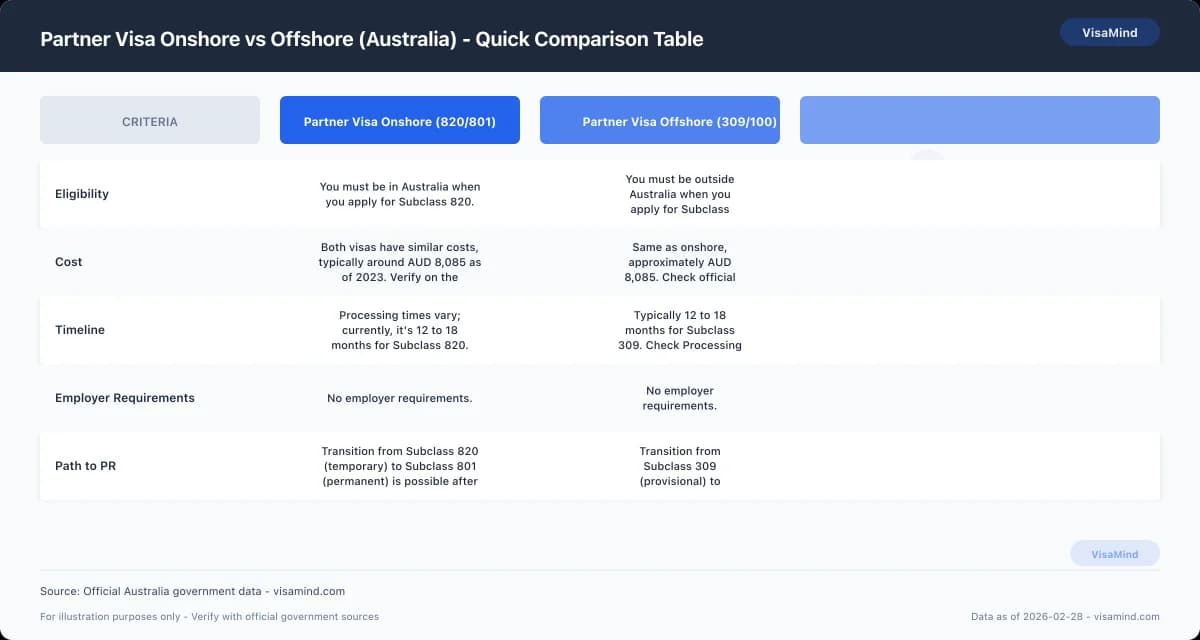
Australia offers both onshore and offshore partner visas, catering to different needs based on the applicant's location. The choice between Subclass 820/801 and Subclass 309/100 largely depends on where you are when applying.
Eligibility Requirements Overview
Eligibility for the partner visa requires you to be either married or in a de facto relationship with an Australian citizen, permanent resident, or eligible New Zealand citizen. The onshore Subclass 820 visa requires you to be in Australia at the time of application. - For Subclass 820: You must be in Australia. - For Subclass 309: You must be outside Australia. - Genuine relationship evidence is required for both.
Important: Ensure you apply from the correct location to avoid application issues.
Cost Differences Highlighted
Costs for partner visas vary based on the location of application. The onshore visa typically incurs a higher fee due to processing complexities.
| Visa Type | Application Fee (AUD) |
|---|---|
| Subclass 820 | A$7,850 |
| Subclass 309 | A$7,850 |
Tip: Check for the most current fees on the Department of Home Affairs website.
Processing Timeline Comparison
The processing times can be significantly different based on application type and individual circumstances. Onshore applications might take longer due to additional verification processes.
| Visa Type | Estimated Processing Time |
|---|---|
| Subclass 820 | 20 to 24 months |
| Subclass 309 | 12 to 18 months |
Warning: Processing times are estimates and subject to change. Always verify on the official website.
Employer Sponsorship Needs
Partner visas do not require employer sponsorship, unlike other visa categories. This makes the process more standard for the applicants. You only need to focus on proving your relationship, with no need for a job offer or employer involvement.
What Really Sets Them Apart
#In 2026, Australia offers two main pathways for partner visas: onshore and offshore. The choice between these can significantly affect your visa processing experience. Each option has unique implications for applicants, particularly in terms of where you apply, your status while waiting for the decision, and your rights during this period.
Processing Location Impact
The location at which you apply for a partner visa in Australia plays a necessary role in the process. If you apply onshore for the Subclass 820 visa, you must be physically present in Australia. Conversely, for the Subclass 309 visa, you need to apply from outside the country.
Tip: Ensure you are in the correct location when you apply. Applying from the wrong location can lead to application complications.
Important: Check the specific requirements for each visa subclass on the Department of Home Affairs website to confirm your eligibility.
Bridging Visa Availability
One significant advantage of applying for an onshore partner visa is the eligibility for a Bridging Visa. This visa allows you to stay in Australia legally while your partner visa application is being processed. For offshore applicants, there is no equivalent bridging visa. This means you must remain outside Australia until a decision on your application is made, potentially affecting your plans and timelines.
Tip: Applying onshore can provide more flexibility with your stay in Australia, as you can legally remain in the country during the processing period.
Rights While Awaiting Decision
While waiting for a decision on an onshore partner visa, you may be granted certain rights, such as work rights, through a Bridging Visa. This can ease financial burdens during the waiting period. - Work rights may be granted with certain bridging visas. - Access to Medicare may be available. - Offshore applicants do not receive these benefits until the visa is granted.
Important: Ensure you understand the specific conditions attached to your bridging visa, as this can affect your employment and healthcare access in Australia. For more detailed information, you can explore related visa types such as Partner 820 801 and Partner 309 100.
When to Pick the Second Option
#Over 75,000 Partner visas are granted each year in Australia, with many applicants opting for the offshore route. The choice between applying onshore or offshore can significantly impact your life plans and financial commitments.
Living Abroad with Your Partner
Choosing to apply for the Partner visa offshore might be beneficial if you and your partner currently live outside Australia. This option allows you to maintain your current lifestyle without the need to relocate immediately. - You are both working overseas and want to continue your employment until the visa is granted. - Your children are settled in school abroad, and relocating them immediately is not ideal. - You have ongoing commitments, such as caring for family members, that require you to stay abroad temporarily.
Important: Ensure that you are outside Australia when you lodge your application for the Subclass 309 Partner visa, as this is a critical requirement.
Travel Freedom While Waiting
Applying offshore provides greater freedom to travel without the need to apply for a Bridging Visa. This can be particularly advantageous for those with international commitments. - Frequent business trips are part of your or your partner's job. - You plan to visit family in different countries while waiting for the visa decision. - You have personal projects or interests that involve international travel.
Tip: While waiting for your offshore visa decision, you can apply for a Visitor visa if you need to visit Australia temporarily.
Lower Initial Financial Burden
The initial financial burden of applying offshore can be lower, especially if you are in a country with a lower cost of living compared to Australia. - Cost of living savings while residing in a country with lower expenses. - Avoiding the immediate need to pay for relocation expenses to Australia. - Possibility to save on additional costs related to temporary accommodation in Australia.
Important: Keep in mind currency fluctuations and verify current visa application fees on the official Home Affairs website.
Real Scenarios
#Every year, thousands of couples apply for partner visas to live together in Australia. Whether applying from inside or outside the country, understanding the challenges and successes others have faced can be invaluable.
Case Study: Onshore Success
James, an Australian citizen, and Maria, his de facto partner from Brazil, decided to lodge an application for a Subclass 820 Partner visa while Maria was already in Australia on a student visa. Before proceeding, they ensured Maria met all requirements, such as proving the genuineness of their relationship and gathering all necessary documents. They submitted their application through the Department of Home Affairs' online portal and used the IMMIACCOUNT-PORTAL to track their progress. Within eight months, Maria's temporary visa was granted, allowing her to remain in Australia while waiting for permanent residency.
Important: Ensure you are physically in Australia when applying for the Subclass 820 visa to avoid complications.
Offshore Application Challenges Emma, a New
Zealand citizen living in Australia, wanted her Canadian partner, Alex, to join her permanently. They applied for the Subclass 309 Partner visa, which requires the applicant to be outside Australia during the process. The couple faced challenges due to processing delays and logistical issues in proving their relationship across two countries. They frequently communicated with the Department of Home Affairs and provided additional evidence when requested. After a year, Alex was granted the provisional visa, allowing him to move to Australia.
Warning: Delays are common in offshore applications; maintain clear communication with the Department of Home Affairs to mitigate issues.
Mixed-Citizenship Couples
Sophie, an Australian permanent resident, and her partner Liam, a British citizen, faced a unique situation. They were unsure whether to apply onshore or offshore given their frequent travels. Ultimately, they decided on an offshore application, allowing Liam to continue working in the UK. Liam applied for the Subclass 309 Partner visa while in the UK. They kept a detailed record of their visits and shared expenses, which proved necessary in satisfying the relationship evidence requirement. After 10 months, Liam received his visa, enabling their next chapter in Australia.