On this page
- Is This Program for You?
- Eligibility Criteria
- Step-by-Step Application
- Supporting Documents Checklist
- Timeline and Processing
- Where Applicants Go Wrong
- How It Compares to Alternatives
- Fees and Financial Requirements
- What You Can and Cannot Do
- Real-World Examples
- Visa options for this goal
- Guides for Australia
- Other goals for Australia
Is This Program for You?
#To apply for permanent residence in Australia, you must meet specific eligibility criteria managed by the Department of Home Affairs. This pathway allows individuals to live, work, and study in Australia indefinitely. It's essential to determine if this program aligns with your personal circumstances and goals.
Who Qualifies for Permanent Residence?
-
Spouse or Partner: You qualify if you are the spouse or de facto partner of an Australian citizen, Australian permanent resident, or eligible New Zealand citizen. Consider exploring the Partner Visa 820 801 for more information on partner pathways.
-
Parent with Eligible Children: If you have a child who is a settled Australian citizen, permanent resident, or eligible New Zealand citizen, you may apply. The Parent Visa 103 is a relevant option to consider.
-
Retirees: Certain retirees who held an Investor Retirement or Retirement visa as of 8 May 2018 and have not held another substantive visa since may also qualify. You do not need to meet the balance of family test or have a sponsor if applying under this category.
Key Eligibility Requirements
-
Balance of Family Test: At least half of your children must be permanently residing in Australia, or more of your children should live in Australia than in any other single country.
-
Health and Character: All applicants must fulfill health and character requirements set by the Department of Home Affairs. Failure to meet these can result in application refusal.
-
Financial Assurance: An assurance of support may be required unless applying as a retiree. This financial commitment ensures that you will not need to rely on government assistance.
Important: Before applying, make sure you have not applied for or currently hold a Sponsored Parent (Temporary) (subclass 870) visa, as this will affect your eligibility.
Considerations for Prospective Applicants
-
Living Requirements: Generally, you must be a permanent resident or a New Zealand citizen holding a Special Category (subclass 444) visa when you apply and when the decision is made.
-
Australian Values Statement: If you are 18 years or older, signing the Australian Values Statement is mandatory, affirming your understanding and respect for the Australian way of life.
-
Good Character Requirement: Applicants aged 18 or over must demonstrate good character, which involves police checks and other background assessments.
For a detailed comparison of your options, consider reviewing pathways like the Skilled Independent Visa 189 or the Employer Nomination Scheme 186 if your situation fits those categories.
Tip: Use the Immi Account portal to manage your application and stay updated on any changes or additional requirements throughout the process.
Understanding these criteria and ensuring you meet them is the first step toward securing permanent residence in Australia. Make sure to gather all necessary documents and verify details on the official website for the most current information.
Eligibility Criteria
#To be eligible for Permanent Residence in Australia, you must meet specific criteria set by the Department of Home Affairs. These criteria encompass various aspects such as relationship status, family connections, residency requirements, and personal qualifications.
Relationship and Family Connections
- Spouse or Partner: You must be the spouse or de facto partner of an Australian citizen, permanent resident, or eligible New Zealand citizen.
- Child Sponsorship: You can apply if you have an eligible child who is a settled Australian citizen, permanent resident, or eligible New Zealand citizen.
- Balance of Family Test: This requires at least half of your children to be eligible children or more eligible children living in Australia than any other country. Retirees applying for a subclass 103 visa are exempt from this requirement.
Sponsorship and Support
- Eligible Sponsor: You must have a sponsor, usually an eligible child. If your child is under 18, an eligible relative or community organization can sponsor you.
- Assurance of Support: You need to obtain assurance of support unless applying as a retiree.
Residency and Visa Requirements
- Previous Visa Status: You must be a permanent resident or a New Zealand citizen holding a Special Category (subclass 444) visa when you apply and when your application is decided.
- Residency in Australia: You must have been ordinarily resident in Australia as the holder of a valid Australian permanent visa throughout the two years immediately before applying. Additionally, you must have lived in Australia for at least 180 days during these two years, including at least 90 days in the year immediately before applying.
Health, Character, and Language
- Health and Character Requirements: Both you and any family members included in your application must meet the health and character requirements.
- Good Character: If you are 18 years or over, you must be of good character.
- English Language: A basic knowledge of the English language is necessary for becoming an Australian citizen.
Financial and Legal Obligations
- Outstanding Debts: If you or any family members owe money to the Australian Government, these debts must be settled or have an approved arrangement in place to pay them back.
- Australian Values Statement: You must sign the Australian Values Statement if you are 18 years of age or older.
Important: Ensure that you gather all necessary documents and meet all eligibility criteria before lodging your application. Not meeting these requirements can lead to application refusal.
For more detailed information on specific visa options related to permanent residence, you can explore the Parent Visa (subclass 103) or the Skilled Independent Visa (subclass 189). If you're interested in understanding the process better, you might find the Documents Checklist helpful.
Step-by-Step Application
#Check Your Eligibility
Before starting your application for permanent residence in Australia, ensure you meet the eligibility requirements. You may qualify if you are the spouse or de facto partner of an Australian citizen, permanent resident, or eligible New Zealand citizen. Alternatively, having an eligible child who is a settled Australian citizen or permanent resident can also support your application. Be aware of specific requirements such as the balance of family test and the need for a sponsor — usually an eligible child or relative.
Gather Necessary Documents
Collect and prepare all required documents before lodging your application. Essential documents include:
- Valid passports for all applicants.
- Proof of relationship with children or dependents.
- Certified copies of original documents and English translations where necessary.
- Health and character documents, including original police certificates.
- Proof of permanent residency or Special Category Visa (subclass 444) status.
Ensure that all family members included in your application meet the health and character requirements.
Important: Missing or incorrect documents can lead to application refusal. Check the Documents Checklist for detailed requirements.
Create or Access Your Immi Account
Log into your existing Immi Account or create a new one. This portal is essential for managing your application process, including importing your application by entering your application ID, date of birth, and identity document number.
Lodge Your Application
Once your documents are in order, you can proceed to lodge your application. Follow these steps:
- Complete Form 47PA for parent migration, if applicable.
- If required, complete Form 40 for sponsorship.
- Pay the first instalment of the visa application charge.
Applications can be lodged online through your Immi Account or by post if necessary. Keep a record of your lodgement, as it is crucial for tracking your application's progress.
Monitor Your Application Status
After lodging your application, regularly check your Immi Account for updates or requests for additional information. Be prepared to provide further documentation if requested by the Department of Home Affairs. Remember to notify them of any changes in your circumstances, such as changes to your contact details or family composition.
Tip: Applying online ensures faster processing times and immediate receipt confirmation.
By following these steps and ensuring all requirements are met, you can streamline your application process for permanent residence in Australia. For more in-depth guidance, explore the Parent Visa page and related Visa Refusal Reasons to avoid common pitfalls.
Supporting Documents Checklist
#To successfully apply for Permanent Residence in Australia, it is crucial to gather all the necessary supporting documents. This ensures your application is complete and meets the requirements set by the Department of Home Affairs. Below, you will find a detailed checklist of the documents needed, including necessary certifications and translations.
Identity and Status Documents
- Valid Passport: Ensure all applicants have a valid passport.
- Certified Copies: Submit certified copies of your original documents. For online applications, you may need to provide scans of original documents.
- Proof of Permanent Residency or SCV Status: If applicable, provide documents confirming your permanent residency or Special Category Visa status.
- Proof of Identity: Include documents such as a birth certificate, national ID, or other relevant identity documents.
Relationship and Family Evidence
- Proof of Relationship with Children: Provide evidence of your relationship with your children and their Australian citizenship or permanent residency status.
- Proof of Dependency: For dependents over 18, include proof of dependency.
- Relationship Status: If adding a spouse or de facto partner, provide evidence of your relationship.
Health and Character Requirements
- Health Requirements: You and your family members must meet health requirements. This may involve medical examinations.
- Original Police Certificates: Submit original police certificates to demonstrate your character. Ensure these are up-to-date and cover all countries you have lived in for 12 months or more in the past 10 years.
- Australian Values Statement: If you are 18 or older, you must sign the Australian Values Statement, indicating your understanding and commitment to Australian values.
Financial and Support Evidence
- Assurance of Support: Unless applying as a retiree, you must provide an assurance of support. This is a commitment from an eligible sponsor to provide financial support to you, ensuring you do not rely on public funds.
- Health Insurance: If applying as a retiree, you need evidence of health insurance covering your stay in Australia.
Additional Documents
- Four Recent Passport-Sized Photographs: Provide four recent passport-sized photographs for each applicant.
- Translations: If any of your documents are not in English, include certified translations.
Important: Ensure all documents are current and accurately reflect your situation. Failure to include required documents or providing incorrect information can lead to application refusal or significant delays.
For more detailed information on the application process and specific document requirements, visit the Documents Checklist or consult the Parent Visa section for related visa types. Additionally, you can explore the Visa Refusal Reasons guide to avoid common pitfalls.
Timeline and Processing
#Understanding the timeline and processing expectations is crucial. The processing times can vary significantly based on the specific visa subclass, the completeness of your application, and other factors. Generally, the processing time for a permanent residency application can range from a few months to several years.
What Affects Processing Speed?
Several factors can influence how quickly your application is processed:
- Completeness of Application: Ensure that all required documents are submitted with your application. Missing documents can delay processing.
- Demand and Quotas: Certain visa subclasses may have limited places available each year, which can affect processing times.
- Complexity of Case: Applications requiring additional checks, such as character assessments or health examinations, may take longer.
- Current Workload: The Department of Home Affairs' current workload can impact how quickly applications are processed.
Tip: File your application online through the ImmiAccount portal to avoid mail delays and receive an immediate confirmation.
Expected Processing Times
The following table gives an overview of the expected processing times for some common pathways to permanent residency:
| Visa Subclass | Processing Time (as of 2023) |
|---|---|
| Parent Visa (subclass 103) | Up to 30 years |
| Contributory Parent Visa (subclass 143) | 4 to 6 years |
| Skilled Independent Visa (subclass 189) | 4 to 9 months |
| Partner Visa (subclass 820/801) | 12 to 24 months |
Important: These times are estimates and subject to change. Always verify on the official website.
Are Expedited Options Available?
While there are no official expedited processing options for permanent residency applications, ensuring that your application is complete and accurate can help avoid delays. In certain urgent situations, such as a family emergency, you may contact the Department of Home Affairs to inquire if any special considerations can be applied to your case.
Important: Paying the correct visa application charge is essential, as errors can halt the processing of your application. Ensure you check the latest fees on the official website.
For those exploring different pathways to permanent residency, consider options like the Skilled Nominated Visa (subclass 190) or the Employer Nomination Scheme (subclass 186), each with its own set of requirements and processing times.
Where Applicants Go Wrong
#Applying for permanent residence in Australia involves several steps and requirements that applicants must carefully follow. Unfortunately, common pitfalls can lead to application delays or even refusals. Understanding these potential issues is crucial for a successful application process.
Missing or Incorrect Documentation
-
Failure to Include Required Documents: Not providing all necessary documents, such as certified copies of identity documents, can lead to delays or refusals. Ensure you have a comprehensive Documents Checklist before lodging your application.
-
Incorrect Certification of Documents: All documents must be certified by an authorized person. Submitting original documents instead of certified copies, except for police certificates, can invalidate your application.
-
Incomplete Proof of Identity: Failing to provide adequate proof of identity can result in severe consequences, including a 10-year ban on future visa applications. Always double-check that your identification documents meet the requirements.
Inaccurate or Incomplete Information
-
Incorrectly Filled Applications: Any mistakes or omissions on your application can lead to processing delays or refusal. It's critical to review your application thoroughly for accuracy.
-
Failure to Update Information: Changes in your personal circumstances, such as phone number, email address, or family composition, must be promptly reported to the Department of Home Affairs. Not doing so could negatively impact your application.
Tip: Use the ImmiAccount Portal to update your information quickly and efficiently, ensuring that all details are current.
Health, Character, and Financial Requirements
-
Not Meeting Health and Character Requirements: All applicants must meet Australia's health and character standards. This includes obtaining valid police certificates and undergoing health examinations where required.
-
Unpaid Debts to the Australian Government: If you or any family member owes money to the Australian Government, it must be paid back or an arrangement made to settle it before your application can proceed.
-
Incorrect Visa Application Charge: Paying the wrong fee can halt the processing of your application. Always verify the current fee structure on the official website before making a payment.
Understanding the Balance of Family Test
- Misunderstanding the Balance of Family Test: This test requires that at least half of your children reside in Australia as citizens or permanent residents. Misinterpreting this requirement could lead to a refusal.
Important: Always verify the most current information on the Parent Visa requirements to ensure compliance with all criteria.
By addressing these common pitfalls, you can significantly increase the likelihood of a successful application for permanent residence in Australia. For more detailed guidance, refer to the Visa Refusal Reasons to understand specific issues that may impact your application.
How It Compares to Alternatives
#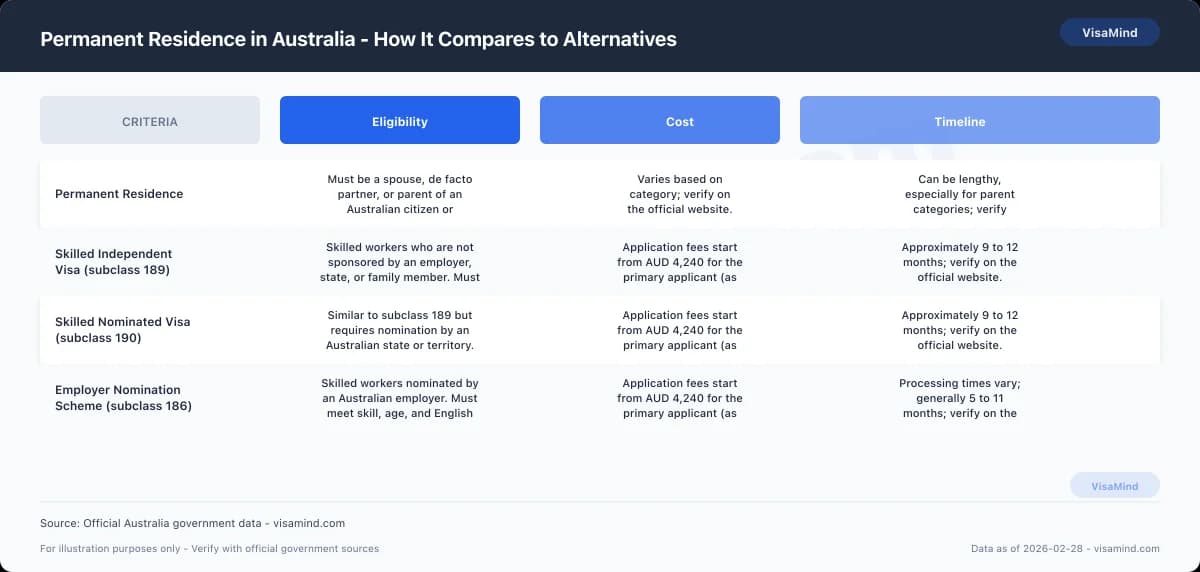
It's important to compare the Permanent Residence pathway with other visa alternatives. Below is a detailed comparison of Permanent Residence with similar visa types, highlighting key differences in eligibility, costs, and timelines.
How It Compares to Alternatives
| Visa Type | Eligibility | Cost | Timeline |
|---|---|---|---|
| Permanent Residence | Must have an eligible child who is a settled Australian citizen or be the spouse/de facto partner of an Australian citizen | Varies by specific visa subclass | Several months to years, depending on the subclass and individual circumstances |
| Skilled Independent Visa (subclass 189) | Based on points for skills, age, English proficiency, and work experience | AUD 4,640 | Approximately 9 to 12 months |
| Skilled Nominated Visa (subclass 190) | Requires nomination by an Australian state/territory | AUD 4,640 plus state fees | Approximately 9 to 12 months |
| Employer Nomination Scheme (subclass 186) | Sponsored by an Australian employer | AUD 4,640 | 9 to 12 months |
| Skilled Work Regional (Provisional) Visa (subclass 491) | Requires state/territory nomination or sponsorship by an eligible relative | AUD 4,240 | 12 to 18 months |
Key Considerations
-
Eligibility Requirements: The Permanent Residence option generally requires family connections, such as having an eligible child or partner in Australia. In contrast, the Skilled Independent Visa (subclass 189) and Skilled Nominated Visa (subclass 190) focus on skills and job experience, which do not require familial ties in Australia.
-
Cost Implications: Visa costs for permanent residency can vary significantly. The Employer Nomination Scheme (subclass 186) and Skilled Nominated Visa (subclass 190) have similar application fees, but additional costs may apply, such as state nomination fees or employer sponsorship fees.
-
Processing Timeline: The Permanent Residence pathway can take longer due to family-related requirements and processing times. Skilled visas, like the Skilled Work Regional (Provisional) Visa (subclass 491), often have more predictable timelines but require meeting specific skill criteria.
Tip: When choosing the best pathway for permanent residency, consider not only your eligibility but also the potential timeline and financial commitments involved with each visa type. Always verify the most current information on the Department of Home Affairs website to ensure accuracy.
Fees and Financial Requirements
#Australia offers a variety of pathways for permanent residence, each with specific fees and financial requirements. Understanding these is crucial for a successful application. Let's explore the key components.
Visa Application Fees
When applying for permanent residence in Australia, the costs can vary significantly depending on the visa type. Below is a comparison of some popular permanent residency visas.
| Visa Type | Application Fee (AUD) | Additional Fee Notes |
|---|---|---|
| Parent Visa (Subclass 103) | $6,490 | Additional charges apply for each dependent child. |
| Contributory Parent Visa (Subclass 143) | $47,825 | Second instalment required before visa is granted. |
| Skilled Independent Visa (Subclass 189) | $4,115 | Each additional applicant incurs extra costs. |
| Employer Nomination Scheme (Subclass 186) | $4,115 | Includes both Temporary Residence Transition and Direct Entry streams. |
Important: Fees are subject to change. Verify current fees on the Department of Home Affairs website.
Financial Requirements
Financial commitments extend beyond application fees. Applicants must also meet specific financial criteria to ensure they can support themselves in Australia.
- Salary Thresholds: For employer-sponsored visas like the Employer Nomination Scheme (Subclass 186), applicants must meet the market salary rate.
- Investment Minimums: Certain visas, such as the Business Innovation and Investment Visa (Subclass 188), require substantial financial investment in Australian businesses.
- Assurance of Support: For family visas like the Parent Visa (Subclass 103), an Assurance of Support may be required, ensuring financial backing if the applicant cannot support themselves.
Proof of Financial Capacity
Applicants need to demonstrate their financial capacity, which may include:
- Bank Statements: Showing sufficient funds for initial settlement.
- Employment Contracts: Validating ongoing income for self-support.
- Sponsorship Documents: For family-sponsored visas, proof of the sponsor's ability to provide financial support.
Tip: Providing comprehensive financial documentation can strengthen your application and expedite processing.
For more detailed information, consult the Financial Requirements Guide and ensure your application meets all necessary criteria.
What You Can and Cannot Do
#When you obtain permanent residence in Australia, you are granted a range of rights and responsibilities. Understanding what you can and cannot do is essential for making the most of your residency status.
What You Can Do
As a permanent resident in Australia, you enjoy many benefits similar to those of Australian citizens:
- Work and Study: You can work for any employer and study at any educational institution across Australia. You may also be eligible for government support for education and training.
- Healthcare: You have access to Australia's public healthcare system, Medicare, which provides essential medical services at little or no cost.
- Social Security: After a waiting period, you may qualify for certain social security benefits through Services Australia.
- Travel: You can travel in and out of Australia freely. However, if you plan to leave and re-enter Australia after the initial five-year period as a permanent resident, you'll need a Resident Return Visa.
What You Cannot Do
Despite the extensive rights, there are restrictions that apply to permanent residents:
- Voting: Permanent residents cannot vote in federal elections, though some states may allow voting in state elections.
- Government Jobs: Certain government jobs, especially those requiring security clearance, are only open to Australian citizens.
- Extended Absences: If you leave Australia for an extended period, you may lose your permanent residence status. It's crucial to maintain your ties to Australia.
Family Members
Permanent residency extends benefits to your family members who are included in your application:
- Dependent Children: Your children can access the same rights to education and healthcare.
- Spouse or Partner: They can enjoy the same work and study rights as you, provided they are included in your application.
Important: Ensure you keep your Immi Account details updated with any changes in your family composition or personal details to avoid complications with your residency status.
For more information on maintaining your permanent residency or transitioning to citizenship, you can consult the Australian Citizenship section or explore the Pr Pathway Guide.
Real-World Examples
#"I'm concerned about meeting the balance of family test for my Parent visa application. I have two children: one lives in Australia, while the other resides in Canada. Before applying, I made sure to gather all necessary documents to prove my close ties to my child in Australia, such as copies of communication records and evidence of regular visits. I also consulted with an immigration adviser to ensure my understanding of the test was correct. Thankfully, my application was accepted because I demonstrated that more of my eligible children live in Australia."
"As someone who previously held an Investor Retirement (subclass 405) visa, I worried about maintaining my eligibility for the Parent visa (subclass 103) as a retiree. I was anxious about the requirement to not have held any other substantive visa since May 2018. To address this, I meticulously documented my visa history and ensured that all my records were accurate and up to date. This preparation helped ease my concerns, and I successfully lodged my application, satisfied that I met the criteria."
"My biggest fear was not meeting the health requirements due to a pre-existing condition. I knew any issues could delay or even jeopardize my application. I proactively underwent a comprehensive health check with an approved panel physician and submitted the report along with my application. By doing this early, I ensured there was ample time to address any potential concerns the Department of Home Affairs might have had, which ultimately led to a smooth application process."
FAQs
What are the financial requirements for Permanent Residence in Australia?
What are the eligibility criteria for Permanent Residence in Australia if sponsored by a child?
Can Permanent Residence applicants in Australia add a spouse to their application?
How does the Permanent Residence process in Australia compare to the Skilled Nominated Visa (subclass 190)?
What is the application fee for a Permanent Residence visa in Australia with the Department of Home Affairs?
How can failing to meet health requirements affect my Permanent Residence application in Australia?
What are the benefits and limitations of holding Permanent Residence in Australia?
VisaMind provides informational guidance only and is not a government agency. This is not legal advice. Requirements can change and eligibility depends on your specific facts. If your case is complex or high-stakes, consult a licensed immigration attorney.
Next steps
Requirements vary by nationality, purpose, timeline, and case details. Use Find My Visa to get a personalized checklist for Australia with official sources and deadlines.
Find my visa