Visa-Free or Visa Required?
#Australia offers several options for visitors regarding visa requirements. As of the latest guidelines, many travelers can visit Australia visa-free, while others must obtain a visa before arrival.
Visa-Free Travel and ETA Eligibility
Visitors from certain countries can enter Australia without a visa for short stays, using the Electronic Travel Authority (ETA) or the eVisitor visa. The ETA allows eligible passport holders to enter Australia multiple times within a 12-month period, with each visit lasting up to 3 months. You must apply for an ETA using the Australian ETA app before traveling to Australia.
Eligibility for ETA:
- You must be outside Australia when you apply and when the decision is made.
- You must hold a valid passport from an eligible country.
- You cannot apply if you are an Australian citizen.
The eVisitor (subclass 651) is available to citizens of European Union member states and a few other countries. Like the ETA, this allows multiple visits over a year, each lasting up to 3 months.
eVisitor Eligible Countries Include:
- Austria
- Belgium
- France
- Germany
- United Kingdom – British Citizen
- More countries listed in the eVisitor visa
When Is a Visa Required?
If you do not qualify for visa-free entry or an ETA, you will need to apply for a suitable visa. The Visitor Visa (subclass 600) is a common choice for tourists, business visitors, or those visiting family. This visa can allow a stay of up to 12 months, depending on your circumstances.
Important: Ensure you meet all health and character requirements when applying. For those with a criminal conviction, the Visitor visa (subclass 600) is recommended.
Requirements Across All Processes
Regardless of the visa type, ensure you have:
- A valid passport from your country.
- Evidence of financial capacity to support your stay.
- Accurate and truthful application details.
Tip: Always verify eligibility and requirements on the official Department of Home Affairs website, as policies and eligible countries can change.
Additional Considerations
For those involved in business activities, such as signing contracts or attending conferences, review the specifics of your visa to ensure compliance with Australian regulations. The eVisitor and ETA are not work visas, and you cannot perform paid work for an Australian employer under these visas.
For more detailed information about specific visas or scenarios, explore related options such as the Visitor Visa (subclass 600) or the Electronic Travel Authority (subclass 601).
Your Visitor Visa Options
#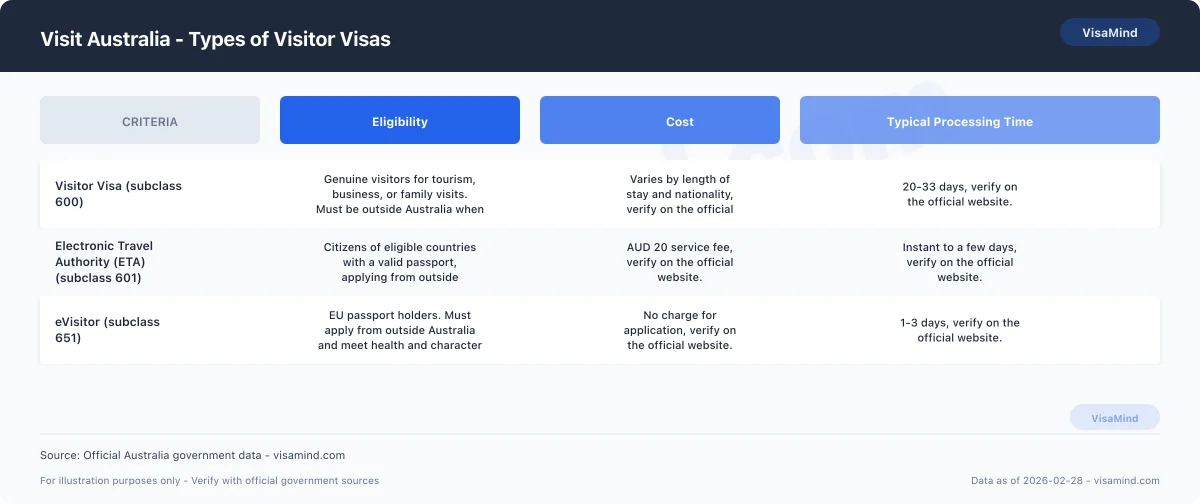
Australia offers several visitor visa options, each designed to cater to different needs and eligibility criteria. Understanding these options will help you choose the most suitable visa for your visit. Here's a comparison of the primary visitor visa types available:
| Visa Type | Eligibility | Cost | Timeline | Key Features |
|---|---|---|---|---|
| Visitor Visa (subclass 600) | Genuine visitors with sufficient funds; may require sponsorship by a family member who is an Australian citizen or permanent resident | AUD 150 - 365 | Varies; generally processed within 20 - 30 days | Suitable for tourists, business visitors, and family visits. Allows stays of 3, 6, or 12 months |
| Electronic Travel Authority (subclass 601) | Passport holders from eligible countries outside Australia; must meet health and character requirements | AUD 20 service fee | Immediate to 1 day | Multiple entries for tourism or business for up to 3 months per visit over 12 months |
| eVisitor (subclass 651) | Citizens of EU and select European countries; must be outside Australia when applying | Free | Immediate to 2 days | Similar to ETA but specifically for European passport holders; tourism or business purposes |
Choosing the Right Visa
When selecting a visa, consider your nationality, the purpose of your visit, and the duration you intend to stay.
-
Visitor Visa (subclass 600): Ideal for longer stays or if you plan to visit family. This visa offers flexibility with options for 3, 6, or even 12-month stays. It's suitable for those intending to engage in tourist activities or attend conferences.
-
Electronic Travel Authority (ETA): A convenient choice for short business trips or holidays if you are from an eligible country. The ETA is quick to obtain via the Australian ETA app and allows multiple short stays.
-
eVisitor Visa: This option is tailored for European nationals and offers similar benefits to the ETA without a service fee. It's perfect for short-term tourism or business-related visits.
Important Considerations
Important: Ensure that your passport is valid for the duration of your stay and that you have adequate financial means to support yourself in Australia. Failure to meet these requirements can lead to visa denial.
For detailed eligibility and application processes, visit the official Department of Home Affairs website. This will provide the most up-to-date and accurate information for your visa application needs.
What You Need to Apply
#To apply for a visa to visit Australia, you will need to ensure you have the correct documentation and meet specific requirements.
Required Documents
-
Valid Passport: Your passport must be from an eligible country and valid for the duration of your stay.
-
Photograph: A recent digital photo taken using the Australian ETA app, ensuring clarity and adherence to guidelines.
-
Translated Documents: If your documents are not in English, provide certified translations.
Financial Evidence
- Proof of Funds: You need to demonstrate you have sufficient funds to support yourself during your stay in Australia and to cover your return journey. This can include bank statements, pay slips, and a letter from your employer.
Application Details
-
Email Address: A valid email address is necessary for communication and receiving your visa application outcome.
-
Mobile Device Requirements: You will need a mobile device with a camera and NFC capability to use the Australian ETA app for scanning your passport and taking a live photo.
-
Payment Method: A valid credit or debit card to pay the service fee through the Australian ETA app.
Health and Character Requirements
-
Health Requirements: Meet the health standards set by the Department of Home Affairs. This may involve undergoing a medical examination, especially if you apply for a longer stay or have spent time in certain countries.
-
Character Requirements: You must provide truthful answers about your criminal history and any other passports held. A police certificate might be required if requested.
Important: Providing false information or failing to disclose necessary details can lead to the cancellation of your visa or refusal of entry into Australia.
Sponsorship and Eligibility
-
Family Sponsorship: If applicable, you must have sponsorship from an eligible family member who is an Australian citizen or permanent resident.
-
Eligibility for eVisitor (subclass 651): Citizens from specific European countries may apply for this visa type. For more details, you can check the eligibility for the eVisitor (subclass 651).
Make sure all information provided is accurate and double-check your application before submission to avoid any delays or issues. For detailed guidance on the application process, you may refer to the Documents Checklist and the Visa Refusal Reasons guide to prevent common pitfalls.
How to Apply Step by Step
#Determine Your Eligibility
Before proceeding, ensure you meet the eligibility criteria for an Electronic Travel Authority (ETA) or an eVisitor visa. You must be a genuine visitor intending to stay temporarily in Australia for tourism or business purposes. Check that you hold a valid passport from an eligible country. For the eVisitor visa, eligible countries include many European nations such as Germany, France, and the United Kingdom. Applicants must also meet health and character requirements and be outside Australia when applying.
Choose Your Application Method
Depending on your passport and preferences, you can apply for your visa either online or via the Australian ETA app. European passport holders might prefer the eVisitor visa, which can be applied for through the eVisitor (subclass 651) online application system. For ETA-eligible passport holders, downloading the Australian ETA app from the Apple Store or Google Play is necessary.
Gather Required Documents
Prepare all necessary documents before starting your application. You will need:
- A valid passport from an eligible country
- Evidence of financial capacity to support your stay
- A mobile device with a camera and NFC enabled for the Australian ETA app
- A valid email address and payment method for the service fee
- Translated documents if they are not in English
Lodge Your Application
-
For ETA Application:
- Download and open the Australian ETA app on your mobile device.
- Scan your passport to pre-fill your application details.
- Take a live photo of yourself using the app.
- Verify that all information is correct before submitting your application and paying the service fee.
-
For eVisitor Visa:
- Apply through the online portal.
- Attach your documents and verify that all information matches your passport details.
- Double check your information and submit your application.
Important: Double-check all information for accuracy before submitting your application to avoid delays or refusal.
Attend Appointments if Required
While most ETA and eVisitor applications do not require an appointment, be prepared to attend an interview or provide additional documentation if requested by the Department of Home Affairs. This may be necessary if there are questions about your application or if further verification is needed.
Await a Decision
Once submitted, your application will be processed by the Department of Home Affairs. Processing times can vary, so check the Processing Times guide for the latest updates. Ensure you remain outside Australia while your application is assessed.
Tip: Use the online application systems to avoid mail delays and ensure you receive an immediate confirmation of your submission.
Pitfalls That Get Applications Denied
#It's crucial to be aware of common pitfalls that can lead to application denial. Ensuring compliance with these requirements will increase the likelihood of a successful visa application through the Department of Home Affairs.
Overstaying Your Visa
- Understand your visa duration: Each visit on an Electronic Travel Authority (ETA) allows you to stay for up to 3 months. Overstaying can lead to fines, visa cancellation, or future entry bans.
- Plan your departure: Ensure your travel plans allow you to leave Australia before your visa expires.
Engaging in Unauthorized Work
- Tourist visa limitations: An ETA does not permit paid work for an Australian employer. Engaging in work activities can result in immediate visa cancellation and deportation.
- Permissible activities: Business visitors can participate in activities like negotiating contracts or attending conferences, but cannot engage in employment.
Insufficient Financial Evidence
- Prove financial capacity: You must demonstrate you have enough funds to support your stay and departure from Australia. This is a common reason for visa denial.
- Provide thorough documentation: Bank statements, pay slips, or financial guarantees can serve as evidence of your financial capacity.
Misrepresentation and Inaccuracy
- Provide truthful information: Any false information, especially regarding criminal history, can lead to visa cancellation.
- Ensure document accuracy: Double-check that all application details match your passport and other supporting documents.
Important: Failure to apply from outside Australia when required or providing incorrect information can lead to your visa application being denied. Always verify the latest requirements on the official Department of Home Affairs website.
For more guidance on applying for the correct visa type, consider reviewing the Visitor Visa (subclass 600) and Electronic Travel Authority (subclass 601) options. Additionally, the Visa Refusal Reasons guide can provide further insights into avoiding common mistakes.
At the Border
#When you arrive at an Australian airport, you'll go through several procedures managed by the Australian Border Force (ABF). Understanding what to expect can help facilitate a smoother entry process.
Initial Entry Procedures
Upon arrival, all travelers must proceed through immigration control. Depending on your visa type, your entry may be streamlined using automated systems or require more detailed processing.
-
eGates: Most travelers holding an Electronic Travel Authority (ETA) or eVisitor visa can use the eGates for a quicker processing experience. Simply follow the instructions to scan your passport and allow the system to capture your image. This is typically a swift process, but ensure that your passport is in good condition for accurate scanning.
-
Manual Processing: If you are not eligible to use eGates or if there are issues with your passport, an immigration officer will manually check your documents. This process may include verifying your visa and asking questions about your visit.
Additional Checks
Upon passing through immigration, you might undergo additional checks. These are routine but essential to ensure compliance with Australian laws.
-
Fingerprinting: Some visitors may be required to provide biometric data, such as fingerprints. This is a standard procedure aimed at enhancing security and identity verification.
-
Interviews: Immigration officers might conduct brief interviews to confirm the details of your visit. Be prepared to answer questions about your stay, including your travel itinerary, accommodation, and financial capacity to support your visit.
Important: Always provide honest answers and have your supporting documents, such as proof of accommodation and return tickets, ready for inspection.
Customs and Quarantine
After passing through immigration, you will proceed to customs and quarantine checks. Australia has strict regulations to protect its unique ecosystem.
-
Declare Items: Make sure to declare any items that might be restricted or prohibited, such as food, plants, or animal products. Failure to declare such items can result in fines or legal actions.
-
Baggage Checks: Random baggage checks are common, so ensure your luggage complies with Australian regulations.
For more detailed guidance on what you can bring into Australia, refer to the Australian Border Force website.
Tip: Familiarize yourself with the Visa Refusal Reasons to understand potential issues that could affect your entry.
Can You Stay Longer?
#If you're visiting Australia and wish to extend your stay, several options are available, depending on your current visa and circumstances. It's important to understand the specific conditions and processes related to each visa type to ensure compliance with immigration regulations.
Is a Visa Extension Possible?
In most cases, you cannot extend an Electronic Travel Authority (ETA). If you find yourself needing more time in Australia, you may need to apply for a different visa, such as the Visitor Visa (subclass 600), which can be applied for while you are in Australia. This visa allows for a stay of up to 12 months and is suitable if you're already in Australia and your current visa is nearing expiration.
Applying for a Different Visa
To apply for a new visa while in Australia, you must meet specific criteria. For instance, if you hold an ETA and wish to switch to a Visitor Visa (subclass 600), ensure you lodge your application well before your current visa expires. The Visa Extension Guide provides detailed steps on how to transition from one visa to another effectively.
- Check Eligibility: Ensure you meet the requirements for the new visa, which may include financial capacity and health and character checks.
- Gather Documents: Prepare necessary documents such as proof of funds, health insurance, and any other supporting evidence.
- Lodge Application: Submit your application through the IMMIACCOUNT-PORTAL, ensuring all information is accurate to avoid delays or rejections.
- Await Decision: Stay updated on processing times by checking the Processing Times guide.
Tip: Always apply for a new visa before your current visa expires to avoid unlawful status.
Considerations for Longer Stays
If you are contemplating a longer stay for purposes beyond tourism or short-term business, explore alternative visas like the Student Visa (subclass 500) for educational purposes, or the Skilled Independent Visa (subclass 189) if you wish to work in Australia. Each visa type has distinct eligibility requirements and application processes, so reviewing the How To Apply guide is advisable.
Important: Extending your stay without the appropriate visa can lead to legal complications and affect future travel to Australia.
By understanding these visa options and processes, you can better plan your visit and enjoy a longer stay in Australia, ensuring compliance with local immigration laws.
Real Scenarios
#I was eager to visit Australia to attend a major business conference, but I was concerned about navigating the visa application process. With a busy schedule and little experience in international travel, I worried about missing important details. To prepare, I downloaded the Australian ETA app and carefully followed the instructions for scanning my passport and taking a live photo. I ensured all my information matched my passport exactly and provided evidence of sufficient funds for my stay. After verifying everything was correct, I submitted my application. The outcome was smooth; I received my ETA approval promptly, allowing me to focus on my conference preparations.
Another concern arose when my family planned a vacation to Australia. I needed to apply for separate ETAs for each family member, including our two children. I was anxious about managing multiple applications simultaneously without making errors. I approached this by gathering all the necessary documents, such as valid passports and financial evidence, and systematically completed each application one by one. I double-checked all the details before submission, ensuring accuracy. The result was successful; we all received our ETAs without delays, and our family trip went ahead as planned.
Lastly, I had a previous visa overstay in another country and was worried about how this might affect my Australian ETA application. I took a transparent approach by truthfully answering all questions regarding my travel history and providing additional documentation to explain the circumstances of the overstay. I also made sure to meet all other health and character requirements. This proactive strategy worked in my favor, as my application was approved, demonstrating the importance of honesty and thoroughness in the process.
FAQs
How long does it take for the Department of Home Affairs to process an eVisitor visa for Australia?
Can I work while visiting Australia on an eVisitor visa?
What are the requirements to apply for a Visitor Visa (subclass 600) to Australia?
Can I extend my stay in Australia if my visa is expiring?
How do I apply for an Electronic Travel Authority to visit Australia?
What happens if I provide incorrect information in my Australia visa application?
Is it mandatory to apply for an Australian visa from outside the country?
Sources
Last reviewed: March 1, 2026
VisaMind provides informational guidance only and is not a government agency. This is not legal advice. Requirements can change and eligibility depends on your specific facts. If your case is complex or high-stakes, consult a licensed immigration attorney.
Next steps
Requirements vary by nationality, purpose, timeline, and case details. Use Find My Visa to get a personalized checklist for Australia with official sources and deadlines.
Find my visa