On this page
- Your Work Visa Options
- Employer Sponsorship Requirements
- How to Apply for a Work Visa
- What You Can and Cannot Do
- From Work Visa to PR
- What Goes Wrong
- Credential Requirements
- Salary Thresholds and Fees
- Tax Rules for Foreign Workers
- Real Scenarios
- Visa options for this goal
- Guides for Australia
- Other goals for Australia
Your Work Visa Options
#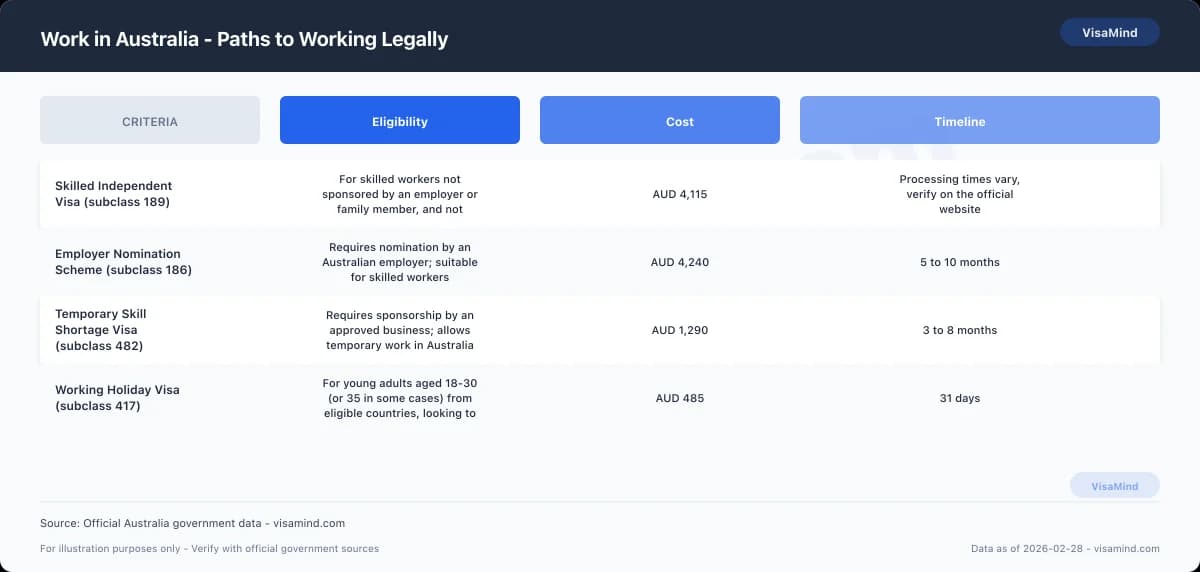
Australia offers a range of work visa options, each catering to different employment needs and circumstances. If you're considering working in Australia, selecting the right visa is crucial. Below is a comprehensive overview of the primary work visa categories available through the Department of Home Affairs:
| Visa Type | Eligibility | Cost (AUD) | Processing Time |
|---|---|---|---|
| Temporary Skill Shortage Visa (subclass 482) | Must be sponsored by an approved business and have the skills for an occupation on the Skilled Occupation List | From $1,290 | 3-5 months |
| Skilled Independent Visa (subclass 189) | No employer sponsorship required, must have skills for an occupation on the Skilled Occupation List | From $4,240 | 8 months |
| Employer Nomination Scheme (subclass 186) | Requires employer nomination and occupation on the Skilled Occupation List | From $4,240 | 5-8 months |
| Working Holiday Visa (subclass 417) | For young people aged 18-30 (or 18-35 in some countries) wanting to holiday and work | From $510 | 3-7 days |
| Skilled Nominated Visa (subclass 190) | Requires nomination by a state or territory government and a relevant occupation | From $4,240 | 7-9 months |
| Temporary Graduate Visa (subclass 485) | For recent graduates with skills in demand, must meet English proficiency | From $1,730 | 4-5 months |
| Global Talent Visa (subclass 858) | For individuals with internationally recognized records of exceptional achievement | From $4,180 | 3 months |
Key Requirements for Work Visas
Before applying, it's essential to understand the general requirements for work visas in Australia:
-
Skills and Qualifications: You must possess the relevant skills and qualifications for the nominated occupation. This often requires a skills assessment from a recognized authority.
-
Employer Nomination: Many work visas, such as the Employer Nomination Scheme (subclass 186), require nomination by an approved Australian employer.
-
Health and Character: Applicants must meet health and character requirements set by the Department of Home Affairs. This includes undergoing medical examinations and providing police clearances.
Important: Ensure your skills assessment is valid and recognized by the relevant Australian authority. Failing to provide a valid assessment can delay your application.
Tips for Choosing the Right Visa
Selecting the appropriate visa depends on your individual circumstances, such as your age, qualifications, and whether you have an employer willing to sponsor you.
-
For Independent Workers: The Skilled Independent Visa (subclass 189) is ideal if you have credentials in a high-demand occupation and do not require employer sponsorship.
-
For Employer-Sponsored Workers: Consider the Temporary Skill Shortage Visa (subclass 482) or Employer Nomination Scheme (subclass 186) if you have an Australian employer ready to sponsor your application.
-
For Young Workers: The Working Holiday Visa (subclass 417) suits those seeking short-term employment while exploring Australia, available to specific age groups from eligible countries.
Tip: Regularly check the Department of Home Affairs website for updates on visa fees and processing times, as these can change.
For detailed guidance on the application process or to explore how you can transition from a work visa to permanent residency, explore related guides such as How To Apply and Pr Pathway Guide.
Employer Sponsorship Requirements
#Australia's immigration system allows employers to sponsor foreign workers, enabling them to live and work in Australia. However, to sponsor an employee, there are specific requirements that must be met by both the employer and the employee.
What Are the Key Employer Requirements?
To sponsor an employee, an Australian employer must generally meet the following criteria:
- Business Legitimacy: The employer must be an established and active business in Australia. This includes proving the business is legally registered and operational.
- No Adverse Information: The employer should not have any adverse records, such as breaches of immigration or workplace laws.
- Labour Market Testing (LMT): Employers might need to demonstrate that they have made genuine efforts to fill the position with a local Australian worker before opting for an international candidate. This typically involves advertising the position in Australia for a specified period.
Important: Failing to conduct proper Labour Market Testing could lead to delays or refusal of the sponsorship application.
Which Visas Require Employer Nomination?
Several Australian work visas require an employer to nominate a foreign worker. These include:
- Temporary Skill Shortage Visa (subclass 482): This visa allows employers to address labour shortages by bringing in skilled workers.
- Employer Nomination Scheme Visa (subclass 186): This is a permanent visa for skilled workers who are nominated by their employer.
- Skilled Employer Sponsored Regional (Provisional) Visa (subclass 494): Designed for regional positions, this visa supports employers in less populated areas of Australia.
For more detailed information on these visas, you can refer to Employer Nomination 186 and Skilled Employer Sponsored 494.
How Does the Nomination Process Work?
The nomination process is a critical step in employer-sponsored visa applications. Here is a typical sequence of actions an employer must take:
- Identify the Position: Determine the genuine need for a position that cannot be filled locally.
- Check Skilled Occupation List: Ensure the position is listed on the current skilled occupation list relevant to the visa category.
- Nominate the Employee: Lodge a nomination application with the Department of Home Affairs, including detailed evidence of the business operations and the need for the role.
- Pay the Nomination Fee: A fee is required when lodging the nomination. Fees may vary based on the visa subclass.
Tip: Use the How To Apply guide to ensure all necessary steps are completed correctly.
In summary, employer sponsorship is a structured process that requires diligent adherence to Australian immigration laws. Employers must ensure they meet all the criteria and complete each step accurately to facilitate a successful application for their nominated employees.
How to Apply for a Work Visa
#To work in Australia, applying for a work visa involves several specific steps. The process is managed by the Department of Home Affairs and requires careful preparation and submission of documents. Here’s a step-by-step guide to help you navigate the application process:
Step 1: Determine Your Eligibility
Before you apply, ensure you meet the necessary eligibility criteria for the work visa you are interested in. Basic requirements typically include:
- Skills and Qualifications: You must possess the necessary skills and qualifications for the job you intend to perform in Australia. A skills assessment from a relevant authority may be required.
- Employer Nomination: You need to be nominated by an Australian employer for certain visa types, such as the Skilled Employer Sponsored 494.
- Health and Character Requirements: You must meet specific health and character standards set by the Department of Home Affairs.
Tip: Check the current Skilled Occupation List to ensure your occupation is eligible for the visa you are applying for.
Step 2: Gather Necessary Documents
Collect all required documents to support your application. This might include:
- Valid passport
- Skills assessment results
- Health examinations
- Police certificates for character requirements
- Proof of nomination by an employer (if applicable)
Having a comprehensive Documents Checklist can help ensure you don’t miss anything crucial.
Step 3: Lodge Your Application
-
Create an ImmiAccount: Register for an ImmiAccount Portal on the Department of Home Affairs website. This is where you will manage your application, submit documents, and track progress.
-
Complete the Online Application: Fill out the necessary sections of the online application form related to your specific visa category. Be sure to carefully review all instructions provided for your visa type.
-
Pay the Application Fee: The fee will vary depending on the visa category. As of 2023, fees can range from AUD 1,290 for a Temporary Skill Shortage visa to several thousand dollars for other categories. Verify the current fees on the official website before proceeding.
-
Submit Your Application: Once your application is complete and all documents are uploaded, submit it through the ImmiAccount portal.
Important: Ensure that your application is complete and accurate. Submitting incomplete applications can lead to delays or rejections.
Step 4: Await Processing and Decision
After submission, your application will undergo processing by the Department of Home Affairs. Processing times can vary, so it’s beneficial to consult the Processing Times Guide for an estimate.
Note: Keep track of any correspondence from the Department of Home Affairs. They may request additional information or documents to support your application.
By following these steps and ensuring all requirements are met, you’ll be well on your way to obtaining a work visa for Australia. For more detailed guidance, consult the How To Apply Guide on the official website.
What You Can and Cannot Do
#- Temporary Skill Shortage Visa (subclass 482): If you hold this visa, you may change employers, but you must be nominated by your new employer and approved by the Department of Home Affairs. Your new role must also be on the relevant skilled occupation list.
- Employer Nomination Scheme Visa (subclass 186): Changing employers is not straightforward with this visa, as it is tied to a specific employer nomination. If you wish to change, you may need to apply for a new visa.
Important: You must notify the Department of Home Affairs if there are changes to your employment status to maintain compliance with your visa conditions.
Can Family Members Join You?
- Dependent Family Members: Most work visas allow you to bring eligible family members, such as a spouse or dependent children, to Australia. This includes visas like the Skilled Work Regional (Provisional) Visa (subclass 491) and the Global Talent Visa (subclass 858).
- Application Process: Family members can be included in your initial visa application or added later, but additional fees and documentation will be required. Ensure they meet health and character requirements.
Can You Study in Australia?
- Work Visas with Study Rights: Most work visas, such as the Temporary Graduate Visa (subclass 485), permit holders to study in Australia. However, you may need to balance study commitments with work obligations, as work must remain your primary purpose.
- Student Visa Option: If you plan to undertake substantial study, consider applying for a Student Visa (subclass 500), which is specifically designed for full-time study and offers certain work rights.
Tip: If you're considering further education, verify eligibility and the impact on your current visa with the Department of Home Affairs to make informed decisions about your stay in Australia.
From Work Visa to PR
#Navigating the journey from a work visa to permanent residency (PR) in Australia involves understanding the available pathways and timeframes. The Australian immigration system, managed by the Department of Home Affairs, offers several routes for skilled workers to transition from temporary work visas to permanent residency.
Transition Pathways to Permanent Residency
Australia provides multiple pathways for work visa holders to apply for PR. One prominent option is the Employer Nomination Scheme (ENS) visa (subclass 186), which allows skilled workers to live and work in Australia permanently. To be eligible, you must:
- Be nominated by an Australian employer.
- Meet the necessary skills and qualifications for the job.
- Fulfill health and character requirements.
Another pathway is the Skilled Independent Visa (subclass 189), which does not require employer sponsorship but does require a skills assessment and an invitation to apply.
Timeline for Transition
Transitioning from a work visa to PR can vary in duration based on the visa type and individual circumstances. Here is a general timeline:
- Temporary Work Visa: Initially, you may enter Australia on a temporary work visa, such as the Temporary Skill Shortage Visa (subclass 482), which can last up to four years.
- Eligibility for PR: After gaining work experience in Australia, you may become eligible to apply for PR. This typically requires at least two to three years of work experience in your nominated occupation.
- PR Application: Once eligible, you can lodge an application for a PR visa. Processing times may vary, but you can check the Processing Times for current estimates.
Tip: Lodging an application via the IMMIACCOUNT Portal ensures faster processing and helps track your application status.
Considerations for Skilled Workers
When planning your transition to PR, consider the following:
- Skilled Occupation List: Ensure your occupation is on the current list of eligible skilled occupations.
- Skills Assessment: Obtain a positive skills assessment from the relevant authority for your occupation.
- Nomination by Employer: For sponsored pathways, maintain a strong relationship with your employer, as their nomination is crucial.
Key Points to Remember
- The process can be complex, and gathering the necessary documentation, such as a skills assessment and employer nomination, is essential.
- Review the Documents Checklist to ensure you submit a complete application.
- Changes in immigration policy or occupation lists can affect eligibility, so stay informed by regularly checking the official Home Affairs website.
Understanding these pathways and timelines will help you navigate the journey from a work visa to permanent residency in Australia successfully.
What Goes Wrong
#It's important to understand the common pitfalls that could lead to a refusal and how to avoid them. Here are some key issues that often arise:
Eligibility and Documentation Issues
-
Incomplete or Incorrect Documentation:
- Failing to provide a valid skills assessment from the relevant authority can result in application denial. Ensure all required documents are complete and accurate before lodging your application. For additional guidance, refer to the Documents Checklist.
-
Not Meeting Health and Character Requirements:
- All applicants must meet specific health and character standards. A lack of appropriate medical examinations or police certificates can lead to visa refusal.
Employer and Nomination Challenges
-
Lack of Employer Nomination:
- For visas that require employer sponsorship, such as the Employer Nomination Scheme (subclass 186), it's crucial that your employer submits the appropriate nomination. Verify that your employer is eligible and willing to sponsor you.
-
Ineligible Occupation:
- Ensure that the job you are applying for is on the current list of eligible skilled occupations. Applications for roles not recognized as skilled occupations are likely to be rejected.
Process and Application Errors
- Submitting an Incomplete Application:
- Incomplete applications are a common reason for refusal. Double-check all sections of your application and ensure every part is filled out correctly.
Tip: Use the ImmiAccount Portal to manage and double-check your application, as it allows you to track progress and correct errors before submission.
Changing Circumstances
- Changes in Personal or Employment Circumstances:
- If your situation changes (e.g., job offer retracted, change in health status), you must notify the Department of Home Affairs immediately. Failing to do so can invalidate your application.
For more detailed insights into reasons for visa refusal, visit the Visa Refusal Reasons guide. Being aware of these potential issues and ensuring your application is thorough and accurate can significantly increase your chances of a successful application.
Credential Requirements
#It is crucial to understand the credential requirements necessary for your specific situation. These requirements ensure that your skills and qualifications meet Australian standards and that you are eligible for the visa category you are applying for. Below is a breakdown of the key credential requirements.
Skills Assessment
- Relevant Authority: A skills assessment is required from a relevant skills assessment authority. This verifies that your qualifications and experience meet Australian standards for your nominated occupation.
- Nominated Occupation: Ensure that your occupation is on the current skilled occupation list for the visa you are applying for. This list can be found in the legislative instruments related to the specific visa.
- Post-Vocational Education Work Stream: If applying through this stream, additional requirements set by the relevant authority must be met.
Important: A valid skills assessment is crucial. Failure to obtain one can result in your application being denied.
Qualification Recognition
- International Qualifications: If you obtained your qualifications outside of Australia, they need to be recognized by the relevant Australian authority.
- Australian Qualifications Framework (AQF): Your qualifications may need to be compared against the AQF to determine equivalency.
Degree Requirements
- Specific Degree Requirements: Some visa categories may require specific degrees or qualifications. For instance, engineering positions might require an engineering degree recognized by Engineers Australia.
- Professional Accreditation: For certain professions, professional accreditation or registration might be necessary. Ensure you meet these requirements prior to lodging your application.
Additional Considerations
- Employer Nomination: Most employer-sponsored visas, such as the Employer Nomination Scheme (subclass 186), require a nomination from an Australian employer.
- Health and Character Requirements: Meeting health and character requirements is mandatory across all visa types. This includes undergoing health examinations and providing police clearance certificates.
For those considering long-term residency, transitioning from a work visa to permanent residency is a common pathway. You might explore options like the Skilled Independent Visa (subclass 189) or the Skilled Nominated Visa (subclass 190), which do not necessarily require employer sponsorship.
Tip: For detailed guidance on how to navigate these requirements, you can refer to our Documents Checklist to ensure you compile all necessary documentation before proceeding with your application.
Salary Thresholds and Fees
#Australia offers a variety of work visas to cater to different employment needs. Each visa type may have specific salary thresholds and associated fees. Understanding these requirements is crucial to ensure compliance and a successful application process. Below, we provide a comparison of key work visas, highlighting their eligibility, associated costs, and timelines.
Salary Thresholds
For work visas, salary thresholds often play a significant role in determining eligibility. Some visas require applicants to meet minimum income requirements, typically aligned with the Australian market salary rates to ensure fair compensation.
Application Fees and Processing Times
Visa application fees and processing times can vary significantly depending on the type of visa you pursue. It is important to factor in these costs when planning your move to Australia.
| Visa Type | Eligibility | Cost (AUD) | Processing Time (Approximate) |
|---|---|---|---|
| Temporary Skill Shortage Visa (subclass 482) | Must be sponsored by an approved business and meet skill requirements | From $1,330 | 5 - 9 months |
| Employer Nomination Scheme (subclass 186) | Requires employer nomination and skills assessment | From $4,045 | 5 - 11 months |
| Skilled Independent Visa (subclass 189) | For points-tested skilled workers without employer sponsorship | From $4,240 | 12 months |
| Skilled Nominated Visa (subclass 190) | State or territory nomination required | From $4,240 | 7 - 9 months |
| Working Holiday Visa (subclass 417) | For young adults aged 18 to 30 (inclusive) to work and holiday in Australia for up to a year | $510 | 14 days - 4 months |
Important: Ensure that you check the current Processing Times and fees directly on the Department of Home Affairs website, as these can change.
Key Considerations
- Salary Requirements: Ensure your job offer meets the market salary rate for your occupation. This is particularly relevant for visas like the Temporary Skill Shortage Visa.
- Fees: Application fees must be paid in full when submitting your visa application. Consider additional costs such as health assessments or police certificates.
- Processing Times: Allow ample time for your application to be processed. Delays can occur if documentation is incomplete or further information is required.
If you are considering transitioning from a work visa to permanent residency, refer to the PR Pathway Guide for more detailed information. Additionally, understanding the Financial Requirements is essential for ensuring that you meet all necessary criteria for your intended visa.
By comparing the various work visa options and understanding the associated costs and timelines, you can make informed decisions about your move to Australia.
Tax Rules for Foreign Workers
#Foreign workers in Australia have several tax obligations and contributions to consider. As a temporary resident, your tax responsibilities can differ from those of an Australian resident.
Income Tax Obligations
When you work in Australia, your income is subject to Australian taxation laws. The Australian Taxation Office (ATO) oversees these regulations. It's important to apply for a Tax File Number (TFN) upon arrival, as this will allow you to be taxed at the correct rate.
- Resident for Tax Purposes: If you are considered an Australian resident for tax purposes, you will be taxed on your worldwide income. Factors such as the length of stay and intention to remain in Australia influence your tax residency status.
- Non-Resident for Tax Purposes: Non-residents are only taxed on their Australian-sourced income, typically at a higher marginal rate than residents.
Tip: Use the Tax File Number application online to streamline the process.
Social Security Contributions
Australia does not have a universal social security system like some other countries. Instead, contributions to the pension system, known as superannuation, are mandatory for most workers.
- Superannuation: Employers are required to contribute a percentage of your earnings to a superannuation fund. As of 2023, the contribution rate is 11% of your ordinary time earnings. You can access these funds upon retirement or permanent departure from Australia.
Double Taxation Treaties
Australia has agreements with several countries to avoid double taxation, allowing you to be taxed only once on your income. These treaties can affect how your income is taxed in Australia and your home country.
- Check Eligibility: It's crucial to check if your home country has a treaty with Australia. This can significantly impact your tax liability.
- Tax Offset: If applicable, you may be entitled to a foreign income tax offset to reduce your Australian tax liability.
Important: Verify your eligibility for tax treaties with a qualified tax advisor to maximize your benefits.
For further details on working in Australia, including visa options like the Skilled Work Regional (Provisional) Visa (subclass 491) and Temporary Graduate Visa (subclass 485), refer to the Department of Home Affairs resources. Always consult with a tax professional to ensure compliance with Australian tax laws.
Real Scenarios
#"I'm a skilled engineer, and I was anxious about whether I could secure a position in Australia that matched my qualifications. My primary concern was ensuring that my job title aligned with the skilled occupation list for the relevant visa program. To address this, I worked closely with my prospective employer to tailor the job description and ensure it reflected my skills and the visa requirements. We meticulously gathered all necessary evidence, including a thorough skills assessment. The effort paid off when I received my nomination under the Employer Nomination Scheme (subclass 186), allowing me to work and live in Australia permanently."
"As a recent graduate, I was worried about applying for the Temporary Graduate Visa (subclass 485) because my field of study was not directly related to my current job. I knew I needed to demonstrate how my education equipped me with transferable skills relevant to my occupation. I prepared detailed explanations and examples from my course projects and assignments to highlight these skills. Additionally, I obtained references from professors and employers to support my case. Ultimately, my application was successful, affirming that articulating the relevance of my education to my current role was key."
"I was concerned about my employer's ability to sponsor me while working in a small startup with limited resources. I feared that the Department of Home Affairs might question the company's capacity to sustain my employment. To mitigate this, I worked with the company to prepare comprehensive documentation showcasing its financial stability and growth potential. We emphasized the strategic importance of my role to the company's future success. This proactive approach helped us secure sponsorship through the Skilled Employer Sponsored Regional (Provisional) Visa (subclass 494), enabling me to contribute to the company while living in a vibrant regional community."
FAQs
Can I apply for Australian permanent residency with a Skilled Work Regional (Provisional) Visa (subclass 491)?
Are there any fees associated with the Global Talent Visa (subclass 858) in Australia?
What are the tax rules for foreign workers on a Temporary Graduate Visa (subclass 485) in Australia?
How does the Department of Home Affairs prioritize applications in the Employer Nomination Scheme program?
What is the salary threshold for a Temporary Skill Shortage Visa (subclass 482) in Australia?
Can I combine a Working Holiday Visa (subclass 417) with other visa goals in Australia?
What happens if my work visa application for Australia is incomplete?
VisaMind provides informational guidance only and is not a government agency. This is not legal advice. Requirements can change and eligibility depends on your specific facts. If your case is complex or high-stakes, consult a licensed immigration attorney.
Next steps
Requirements vary by nationality, purpose, timeline, and case details. Use Find My Visa to get a personalized checklist for Australia with official sources and deadlines.
Find my visa