
What Can Go Wrong
#Most Canada eTA problems involve rejected applications, failed payments, or eligibility mistakes. Many of these issues can be avoided by double-checking your details and confirming you’re applying under the right entry category.
Common application rejections
IRCC may refuse your Electronic Travel Authorization if your application contains incorrect or inconsistent information. Even small errors in personal details can cause problems.
You increase your risk of refusal if you:
- Enter passport information that doesn’t match your passport exactly
- Select the wrong travel document type
- Apply for an eTA when you actually require a Temporary Resident Visa (Visitor Visa)
- Apply under the wrong travel purpose, such as when a Super Visa (Parents and Grandparents) would be more appropriate
IRCC reviews the information you submit. If your answers conflict with your travel document or your intended stay, your file can be flagged for review or refusal.
Review every field before submission. You’re responsible for the accuracy of your application, even if someone else fills it out for you.
| Issue | What Happens |
|---|---|
| Incorrect passport details | Application may be refused or delayed |
| Wrong visa category | You may need to reapply under the correct program |
| Inconsistent answers | IRCC may not approve the eTA |
Payment and document delays
Incomplete or failed payment will stop your application from moving forward. If your payment doesn’t process, IRCC won’t finalize your file.
You must ensure:
- Your payment information is entered correctly
- The transaction completes successfully
- You receive confirmation of payment
A pending or declined transaction can delay processing. If your payment doesn’t go through, check with your financial institution.
If your application requires examinations or supporting documents, every required exam must remain valid at the same time. If one expires before the others, IRCC can’t complete processing until all requirements are valid together.
| Problem | Result |
|---|---|
| Unsuccessful payment | Processing does not continue |
| Missing confirmation | Application may remain incomplete |
| Exams not valid at the same time | Processing delays |
Monitor deadlines closely. Expired documents can set you back.
Eligibility pitfalls
You need to confirm that the eTA matches your travel situation. Not every traveler qualifies for an Electronic Travel Authorization.
You may run into problems if:
- You require a Temporary Resident Visa (Visitor Visa) instead of an eTA
- Your purpose of travel is better suited to a Super Visa (Parents and Grandparents)
- You misunderstand the entry category that applies to you
Applying under the wrong program wastes time and may require starting over.
IRCC processes applications based on the category you select. If your eligibility doesn’t match that category, approval is unlikely. Review the eligibility criteria published by IRCC before submitting your application.
At the Border
#A Canada Electronic Travel Authorization lets you travel to Canada, but a border services officer makes the final call on your entry. You must present the correct documents and answer questions clearly and truthfully.
What to expect at arrival
When you arrive in Canada, the Canada Border Services Agency (CBSA) reviews your entry.
An officer confirms your identity using your passport from a visa-exempt country and checks that you hold a valid Electronic Travel Authorization (eTA) linked to that passport. The eTA is issued by IRCC, but CBSA decides whether you may enter.
You may complete primary inspection at a kiosk or directly with an officer, depending on the airport or port of entry. If the officer needs more information, they may refer you to secondary inspection for extra review.
Your eTA doesn’t guarantee admission. CBSA checks if you meet the conditions of temporary entry at the time you arrive.
| Authority | Role at the Border |
|---|---|
| IRCC | Issues the Electronic Travel Authorization |
| CBSA | Determines admissibility and grants or refuses entry |
If you require a Temporary Resident Visa (Visitor Visa) or a Super Visa (Parents and Grandparents) instead of an eTA, you must hold the correct document before travel.
Documents to carry
You must travel with the same passport you used when you applied for your eTA. If you renew or replace your passport, you’ll need a new eTA linked to the new passport.
Carry:
- Valid passport from a visa-exempt country
- Confirmation of your Electronic Travel Authorization
- Access to the email address you used for your application
Airlines verify your eTA electronically before boarding. At the border, CBSA officers access your eTA through your passport details.
If you hold a Temporary Resident Visa (Visitor Visa) or Super Visa (Parents and Grandparents) instead of an eTA, bring the valid visa placed in your passport.
Keep documents accessible in your carry-on bag. Don’t pack them in checked luggage.
Questions officers commonly ask
CBSA officers ask direct questions to confirm the purpose and length of your stay.
Expect questions like:
-
Why are you coming to Canada?
-
How long do you plan to stay?
-
Which passport did you use to apply for your eTA?
-
What is the email address associated with your application?
Answer clearly and be consistent with the information linked to your Electronic Travel Authorization. Officers compare your responses with your passport record and the eTA issued by IRCC.
If your answers don’t match your application details, the officer may conduct further examination. Always provide accurate information and present the same passport connected to your approved eTA.
When to Consult a Professional
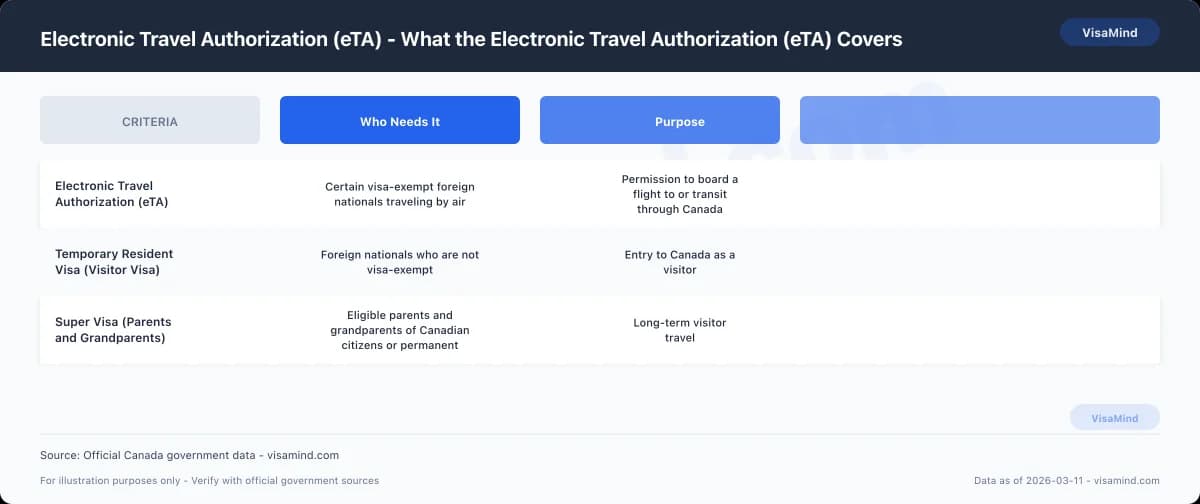
#
Most travelers complete an Electronic Travel Authorization application on their own. Sometimes, eligibility concerns or prior immigration issues make professional guidance a better idea.
Most applications you can self-prepare
You can usually prepare and submit your own Electronic Travel Authorization (eTA) request directly to IRCC.
The application is filed with IRCC, and you complete it yourself unless you choose to appoint a representative. If you meet the basic eligibility criteria and have no prior refusals or status issues, self-preparation is often enough.
You may not need professional help if:
- You have no previous visa refusals.
- You’ve never been found ineligible by IRCC.
- You haven’t overstayed in Canada.
- You’re not unsure about your admissibility.
If your situation is straightforward, you can rely on the instructions provided by IRCC.
Situations that benefit from expert help
Consider consulting a licensed immigration professional if your eligibility is uncertain.
If you or a family member might not qualify, or if you’ve received a prior refusal for a Temporary Resident Visa (Visitor Visa), a Super Visa (Parents and Grandparents), or another temporary status, it’s wise to seek advice before submitting a new eTA request.
Professional review is particularly important if:
- IRCC has previously refused an application.
- You were found ineligible in a past filing.
- A family member’s status affects your application.
- You’re unsure whether to apply for an eTA or a Temporary Resident Visa.
An advisor can assess whether you should proceed with an Electronic Travel Authorization or apply under a different category.
| Situation | Self-Prepare | Seek Professional Help |
|---|---|---|
| No prior refusals | ✔ | |
| Prior IRCC refusal | ✔ | |
| Unclear eligibility | ✔ | |
| Straightforward travel plans | ✔ |
Who the authority is (IRCC)
Immigration, Refugees and Citizenship Canada (IRCC) processes eTA applications and other temporary entry requests.
IRCC determines eligibility, reviews the forms you submit, and issues decisions. If you file an application, it goes to IRCC, and only IRCC decides whether you qualify.
Rely on IRCC instructions for:
- Application forms
- Document requirements
- Eligibility criteria
- Processing updates
For current forms, fees in CAD (CA$), and procedural details, refer to IRCC’s published guidance. IRCC—not private agencies or third parties—makes all final decisions on Electronic Travel Authorization, Temporary Resident Visa (Visitor Visa), and Super Visa (Parents and Grandparents) applications.
Who Qualifies
#You qualify for an Electronic Travel Authorization if you travel to Canada by air with the correct passport and status.
Your nationality, passport type, and U.S. immigration status determine whether you need an eTA, a Temporary Resident Visa (Visitor Visa), or no authorization at all.
Eligible nationalities and passport types
A valid passport from a visa‑exempt country is required to apply for a Canada eTA.
The eTA links electronically to that passport and allows you to board a flight to Canada.
If you don’t hold a passport from a visa‑exempt country, you must apply for a Temporary Resident Visa (Visitor Visa) through IRCC.
Here’s a quick comparison:
| Your Status | Travel by Air to Canada | What You Need |
|---|---|---|
| Citizen of a visa‑exempt country | Yes | Electronic Travel Authorization (eTA) |
| Citizen of a non‑visa‑exempt country | Yes | Temporary Resident Visa (Visitor Visa) |
| Lawful permanent resident of the United States | Yes | No eTA required |
Always travel with the same passport you use for your eTA application. If you renew or replace your passport, you’ll need to get a new eTA.
For confirmation of your country’s visa exemption, refer to IRCC’s country list.
Specific country updates
Starting November 25, 2025, citizens of Qatar no longer need a Temporary Resident Visa (Visitor Visa) for air travel to Canada.
You now apply for an Electronic Travel Authorization instead.
This change applies only to air travel.
If you already hold a valid visitor visa, you can continue to use it until it expires. You don’t need to switch to an eTA unless your visa is no longer valid.
IRCC manages these authorization rules.
The Canada Border Services Agency (CBSA) makes the final admissibility decision at the port of entry.
Exemptions
You do not need an eTA if you’re a lawful permanent resident of the United States. This exemption has applied since April 26, 2022.
Your exemption is based on U.S. permanent resident status—not your nationality.
Even if your country would otherwise require an eTA, your U.S. lawful permanent resident status removes that requirement for air travel.
You may still need other documents, depending on your circumstances.
- If you are not visa‑exempt and don’t qualify for an exemption, you must apply for a Temporary Resident Visa (Visitor Visa).
- If you plan an extended stay to visit your child or grandchild in Canada, you may need a Super Visa (Parents and Grandparents) instead of an eTA.
The eTA only authorizes you to travel to Canada by air. It doesn’t guarantee entry.
CBSA officers assess your admissibility when you arrive.
How Long It Lasts
#A Canada Electronic Travel Authorization (eTA) is not permanent status.
It authorizes short-term travel to Canada by air and stays valid for a fixed period tied to your passport.
Duration of permission
Your eTA is generally valid for up to five years or until your passport expires, whichever comes first.
If your passport expires sooner, your eTA ends automatically.
An approved eTA allows you to travel to Canada multiple times during its validity period. Each visit is temporary.
In most cases, you can stay in Canada for up to six months per visit.
A CBSA officer makes the final decision on your period of stay when you enter Canada.
| Item | Key Rule |
|---|---|
| eTA validity | Up to 5 years or until passport expiry |
| Length of each stay | Usually up to 6 months |
| Final decision at entry | CBSA officer |
If you plan to stay longer than a typical visitor stay, you may need a Temporary Resident Visa (Visitor Visa) or another status from IRCC.
Multiple-entry and transit rules
An eTA is a multiple-entry authorization.
You can travel to Canada as many times as you want while it’s valid, as long as each visit is temporary.
You must use the same passport you listed in your eTA application.
If you get a new passport, you’ll need to apply for a new eTA through IRCC.
You also need an eTA if you:
- Transit through a Canadian airport on your way to another country
- Enter Canada by air from a visa-exempt country
If you’re not eligible for an eTA, apply for a Temporary Resident Visa (Visitor Visa) instead.
Parents or grandparents planning extended stays may need a Super Visa (Parents and Grandparents) rather than relying on repeated short visits.
Next steps after an eTA
Before you travel, make sure:
- Your eTA status is still valid
- Your passport number matches your approved eTA
- Your passport will remain valid for your trip
When you arrive in Canada, a CBSA officer will assess your admissibility.
The officer may ask about your purpose of travel, length of stay, and financial support.
If you want to extend your stay from inside Canada, apply to IRCC before your current authorized stay expires.
An eTA alone does not allow you to work or study without separate authorization.
Border Denial Triggers
#Border officers review your documents and immigration history against Canadian requirements.
Problems with past compliance, your passport, or the stated purpose of travel can stop your trip before or at arrival.
Prior overstays and inadmissibility grounds
IRCC reviews your Electronic Travel Authorization application.
CBSA decides admissibility when you arrive at the port of entry.
If you previously failed to comply with Canadian immigration rules or left issues unresolved in your record, officers will examine that history closely.
You need to make sure your past entries, exits, and applications align with the information you submit now.
Review your prior applications for:
- Accuracy and consistency in biographical details
- Clear explanations for any past refusals
- Complete disclosure of previous stays in Canada
Inconsistencies between what you declare and what appears in your file can delay or stop travel.
You remain responsible for the accuracy of every answer you provide.
Passport and travel-document problems
Your passport must be valid and issued by a visa-exempt country to qualify for an Electronic Travel Authorization.
If you don’t hold a valid passport from a visa-exempt country, IRCC will refuse your application.
Check these points before you apply:
| Requirement | What You Must Verify |
|---|---|
| Passport validity | Your passport is valid at the time of application and travel |
| Country of issuance | Your passport is from a visa-exempt country |
| Document consistency | The passport details match your application exactly |
Errors in passport number, country of issuance, or expiry date can result in refusal.
If you hold a passport from a country that requires a Temporary Resident Visa (Visitor Visa) instead, apply for that visa rather than an eTA.
Parents and grandparents seeking extended stays should review the Super Visa (Parents and Grandparents) requirements before making travel plans.
Purpose-of-travel mismatches
You must state your purpose of travel clearly and make sure it aligns with the document you use.
Officers check whether your declared activities match the authorization you obtained.
Discrepancies between your stated reason for travel and your supporting documents raise concerns.
Presenting documents that suggest a different intent than what you declared can lead officers to question your eligibility.
Keep your travel plans, supporting documents, and application answers consistent.
Accurate information reduces the risk of refusal or denial at the border.
What Documents Do You Need?
#You must provide a valid passport, accurate personal details, and reliable contact information when you apply for a Canada Electronic Travel Authorization (eTA).
IRCC reviews the information you submit and may request additional documents in some cases.
Passport and identity
Your passport is the primary document for a Canada eTA application.
It must be valid at the time you apply.
You’ll enter passport details exactly as they appear, including:
- Full legal name
- Passport number
- Country of citizenship
- Passport issue and expiry dates
Any mismatch between your application and your passport can delay processing or lead to refusal.
You must use the same passport for travel that you used in your eTA application.
If you renew or replace your passport, you must submit a new Electronic Travel Authorization linked to the new passport.
The eTA is not the same as a Temporary Resident Visa (Visitor Visa) or a Super Visa (Parents and Grandparents). Those applications may require more documentation.
The eTA process focuses primarily on your passport and identity details.
| Document | Required for eTA | Notes |
|---|---|---|
| Valid passport | Yes | Must match travel document exactly |
| Temporary Resident Visa (Visitor Visa) | No | Separate application process |
| Super Visa (Parents and Grandparents) | No | Different requirements and review |
Contact and personal information
You must provide a valid email address.
IRCC uses this email to send updates and decisions about your application.
You’ll also submit personal information such as:
- Telephone number
- Basic biographical details
- Other identifying information requested in the form
Enter your information accurately and consistently.
Errors in spelling, dates, or numbers can cause delays.
Do not provide false or incomplete information.
IRCC assesses the details you submit as part of its review process.
If IRCC needs clarification, it may contact you using the email address you provided.
You do not submit documents by mail for a standard eTA application.
The process is electronic.
Additional supporting documents
In some cases, IRCC may request extra documents to verify the information in your application.
These may include:
- Proof of residence
- Additional identity documents
- Other records relevant to your personal details
Submit any requested documents promptly and as instructed.
Failure to respond can result in refusal.
The eTA application generally requires fewer documents than a Temporary Resident Visa (Visitor Visa) or a Super Visa (Parents and Grandparents).
However, IRCC can request further evidence if needed to assess your eligibility.
Always follow the document instructions provided in your application account.
How Long Will It Take?
#Most Electronic Travel Authorization (eTA) applications receive a decision within minutes, but some take up to 72 hours if officers need to review additional details.
Processing begins when IRCC receives your complete application and ends when it makes a decision.
Typical decision times
IRCC issues most eTA approvals within minutes of submission.
You apply online, and the system automatically checks your information.
If there are no issues, you usually receive a decision quickly by email.
IRCC measures processing time from the day it receives your complete application to the day it makes a decision.
For an eTA, this period is often very short compared to applications such as a Temporary Resident Visa (Visitor Visa) or a Super Visa (Parents and Grandparents).
| Application Type | Where You Apply | Typical Processing Pattern |
|---|---|---|
| Electronic Travel Authorization (eTA) | Online | Most decisions within minutes |
| Temporary Resident Visa (Visitor Visa) | Online or paper | Varies; longer than eTA |
| Super Visa (Parents and Grandparents) | Online or paper | Varies; longer than eTA |
Apply before booking travel.
Even though most decisions are fast, IRCC does not guarantee instant approval.
When additional checks are needed
Some eTA applications require manual review.
In these cases, IRCC may take up to 72 hours to issue a decision.
This happens when the system flags information for an officer to examine more closely.
The processing time starts when IRCC receives your complete application. It ends only when IRCC makes a final decision.
You cannot speed up this review.
If IRCC needs more time, you must wait for the decision before travelling to Canada by air.
If you expect complex screening or have concerns about admissibility, apply well in advance of your departure date.
CBSA officers make final admissibility decisions at the port of entry, not IRCC.
Special processing notes
IRCC calculates processing times based on when it receives a complete application.
For applications submitted outside Canada and the United States, longer timelines may apply to other immigration categories because of mailing or regional factors.
This does not usually affect eTA applications, which are submitted online.
If IRCC receives more applications than it can process within a given period, timelines may shift.
The published processing time reflects IRCC’s estimate for applications received at that time.
Key points:
- Processing starts when IRCC receives your complete application.
- Processing ends when IRCC makes a decision.
- Most eTA decisions arrive within minutes.
- Some applications take up to 72 hours if additional checks are required.
Fees
#| Component | Amount |
|---|---|
| Application feeExtracted from guide content — verify against official source | CA$7 (approx $5 USD) |
Fees change; always verify on IRCC.
Plan your Electronic Travel Authorization (eTA) with free Canada tools
#Itemized government fees for Electronic Travel Authorization (eTA) and other Canada categories.
See how your profile scores against Electronic Travel Authorization (eTA) and other Canada visas.
Typical wait times and stage breakdowns for Electronic Travel Authorization (eTA) and related Canada visas.
Common interview questions and feedback for Canada visa applicants.