
Visitor Visa Types at a Glance
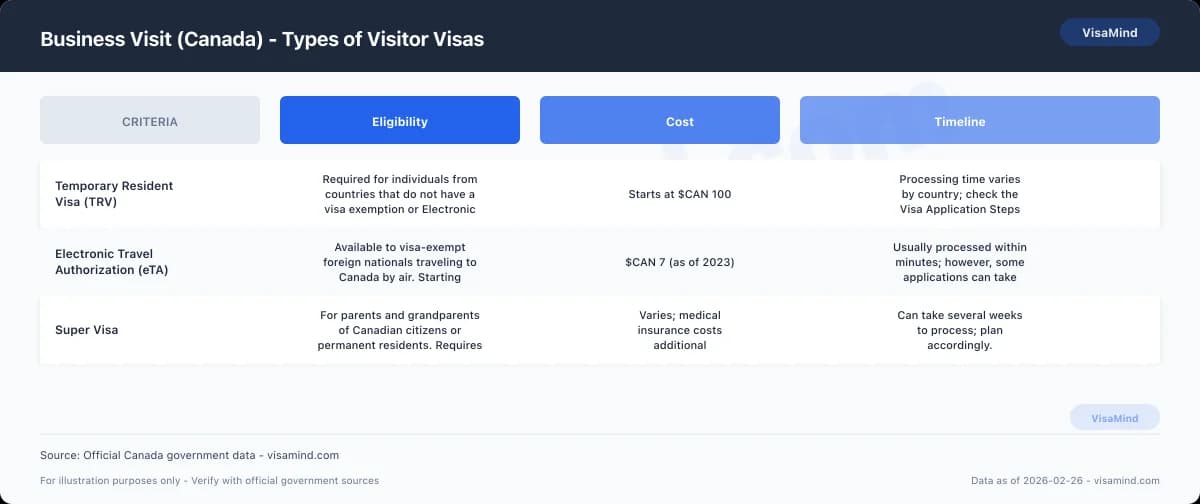
#The table below summarizes the main visa options for this goal, including who qualifies, the key filing requirement, and reported processing times.
| Visa Option | Who It’s For | Key Filing | Processing Time |
|---|---|---|---|
| Temporary Resident Visa (Visitor Visa) | Temporary Resident Visa (Visitor Visa) is a temporary entry pathway for travel to Canada under specific conditions. Applicants must meet eligibility and admissibility requirements set by IRCC. | Form IMM-5257 | 2-6 months (country-dependent; verify in IRCC processing times). |
| Electronic Travel Authorization (eTA) | Electronic Travel Authorization (eTA) is a temporary entry pathway for travel to Canada under specific conditions. Applicants must meet eligibility and admissibility requirements set by IRCC. | Online application (no paper form) | Most eTA decisions are issued within minutes; some take up to 72 hours if additional checks are required. |
Use the linked visa pages for full eligibility details, required documents, and step-by-step instructions.
Do You Need a Visa?
#
Whether you need a visa depends on your nationality and travel plans.
Immigration, Refugees and Citizenship Canada (IRCC) decides who must apply for a Temporary Resident Visa (Visitor Visa) and who may qualify for an Electronic Travel Authorization (eTA).
Resolve this before booking travel.
Airlines will deny boarding if you don't have the required document.
Visitor Visa (Temporary Resident Visa)
You need a Temporary Resident Visa (TRV) if you're from a visa-required country and don't qualify for an eTA.
When you apply, IRCC will check your eligibility and admissibility for business activities such as:
- Attending meetings
- Participating in conferences
- Engaging in other short-term business events
Your application usually needs:
- Details of your travel history, including previous visas and entry/exit stamps
- Biometrics (fingerprints and photograph)
- A letter of invitation from a person or organization in Canada, if required
Some applicants have to complete a medical exam.
Meeting requirements doesn't guarantee approval.
IRCC reviews each application individually.
Electronic Travel Authorization (eTA)
If you're a citizen of a select visa-required country and traveling to Canada by air, you might qualify for an Electronic Travel Authorization (eTA) instead of a visitor visa.
An eTA isn't available for everyone.
Eligibility depends on your citizenship and how you travel.
If you don't meet the criteria for an eTA, you need a Temporary Resident Visa.
Processing Times and Practical Steps
The processing times can vary.
Current timelines are available through IRCC tools, which need JavaScript.
Apply well in advance of your planned business trip.
Delays can happen if:
- You miss required documents
- You forget a needed invitation letter
- You wait to complete biometrics
IRCC makes the visa or eTA decision.
At the border, the Canada Border Services Agency (CBSA) decides your admissibility.
If you plan extended stays, confirm your residency status after entry.
Your status may affect tax obligations and eligibility for certain federal or provincial payments.
Costs and Fees
#Official government fees for the main visa options associated with this goal are listed below. Fees may change — verify the current schedule through the linked visa pages.
| Visa / Route | Fee | Amount |
|---|---|---|
| Temporary Resident Visa (Visitor Visa) | Filing fee (IMM-5257) | C$100 |
| Temporary Resident Visa (Visitor Visa) | Biometrics | C$85 |
| Electronic Travel Authorization (eTA) | Application fee | C$7 |
Document Requirements
#Gather complete and accurate documents before you apply through Immigration, Refugees and Citizenship Canada (IRCC).
Missing or unclear documents slow processing and can lead to refusal.
Required documents depend on whether you need a Temporary Resident Visa (Visitor Visa) or an Electronic Travel Authorization (eTA).
IRCC determines eligibility based on your nationality and travel plans.
Identity and Travel Documents
Hold a valid passport or travel document.
You can't apply with an invalid or ineligible passport.
Provide:
- A clear colour copy of your passport
- The page showing your birth date and country of origin
- Any relevant travel history
If you don't include a clear copy of your travel document, IRCC may return or refuse your application.
If you're joining a vessel as a seafarer, carry:
- A valid passport or travel document
- A seafarer’s identity document
Proof of Ties and Financial Support
You must show an immigration officer you'll leave Canada at the end of your stay.
Strong evidence of ties to your home country is important.
Gather:
- Recent bank statements
- Proof of ongoing employment or business activity
- Documents showing family or economic ties abroad
Short or incomplete financial statements can lead to refusal.
Biometrics and Application Completeness
Some applicants must provide biometrics, including fingerprints and a digital photo.
Check early if this applies to you.
Follow these steps:
1. Confirm your travel document validity.
Make sure your passport is valid and eligible for use in your application.
2. Identify your entry requirement.
Determine whether you need a Temporary Resident Visa (Visitor Visa) or an Electronic Travel Authorization (eTA).
3. Gather supporting documents.
Collect identity documents, financial records, travel history, and business-related materials.
4. Review your application for complexity.
Outdated contact information, added dependants, or criminal or security concerns can trigger additional review.
5. Submit complete copies.
Ensure all scans are clear, legible, and accurate.
Complex or non-routine applications get closer review.
Errors, omissions, or inconsistent information slow processing.
You have to prove you meet Canada’s entry requirements before you travel.
Submitting Your Visitor Visa
#For a Temporary Resident Visa (Visitor Visa) for business travel, submit your application to Immigration, Refugees and Citizenship Canada (IRCC).
Provide a complete and accurate application package.
If you're visa-exempt and need an Electronic Travel Authorization (eTA), apply through IRCC using the online system.
Choose the correct document before submitting anything.
Where and How to Submit
Follow these steps:
-
Complete the Application Form – Fill out the required form with accurate details about your identity, employment status, and business purpose in Canada. Review every answer before submission.
-
Gather Supporting Documents – Include official documents confirming your employment. Add copies of flight details, proof of accommodation, or event registration if available. Provide bank statements that show financial stability.
-
Check Passport Validity – Don't submit an expired passport. Your passport must be valid when you apply.
-
Submit Through the Correct Channel – Apply through the IRCC Portal or your IRCC secure account. You may submit online or by mail. If you must provide biometrics, submit your application in person as instructed.
-
Upload or Include All Required Documents – Attach the completed form and all supporting documents with your application. Missing documents can delay processing or result in refusal.
IRCC reviews the application after submission.
Even if you provide every requested document, approval isn't guaranteed.
Document Checklist
Check these items before submitting:
- Completed and signed application form
- Official proof of employment
- Bank statements showing available funds
- Flight details (if booked)
- Proof of accommodation
- Event or meeting registration (if applicable)
- Valid passport copy
Incomplete financial records or missing proof of employment can weaken your application.
IRCC looks at whether your visit is temporary and business-related based on your documents.
Your tax obligations in Canada depend on your residency status.
A short business visit doesn't automatically change your status, but know your responsibilities before traveling.
Submit carefully, keep copies, and monitor your IRCC account for updates.
What to Avoid
#Don't assume you can travel without the correct authorization.
Confirm whether you need a Temporary Resident Visa (Visitor Visa) or an Electronic Travel Authorization (eTA) before making business plans.
Submitting the wrong application to Immigration, Refugees and Citizenship Canada (IRCC) can delay your trip.
Review your eligibility and apply under the correct category.
Avoid incomplete documentation.
If IRCC requests a letter of invitation, provide it in the detail and format requested.
Failing to submit requested documents can cause processing delays or refusal.
Don't treat a document request as optional.
If your family members apply with you and medical exams are required, make sure:
- Each family member completes the exam as instructed
- All results remain valid at the same time
- No one’s medical results expire before a decision is made
If one person’s medical results lapse while others remain valid, IRCC may delay processing until the issue is fixed.
Don't ignore correspondence from IRCC.
Check your account and respond within the given timeframe.
Avoid booking non‑refundable travel before you receive approval.
A pending Visitor Visa or eTA doesn't guarantee entry or approval.
Don't rely on informal advice from colleagues or business contacts.
Your eligibility depends on your specific situation.
Keep your documents consistent.
Make sure:
- Names and passport details match
- Dates align across forms and supporting records
- Information is consistent in every submission
Small discrepancies can slow down your application.
Careful preparation helps prevent delays and protects your business travel plans.
What Happens at Immigration
#When you arrive in Canada, border officials decide if you meet the conditions to enter as a business visitor.
Immigration, Refugees and Citizenship Canada (IRCC) manages visa and permit applications.
Border officers determine admissibility at the port of entry.
Be ready to explain your reason for visiting Canada and the specific business activities you plan.
Keep your answers clear and consistent with your application.
Documents You Must Present
Bring documents that match your travel authorization:
- A valid passport
- Your Temporary Resident Visa (Visitor Visa), if required
- Your Electronic Travel Authorization (eTA), if required
U.S. citizens don't need an eTA, but must carry a valid U.S. passport.
If you applied for a Temporary Resident Visa, officers may review the approval details.
If you traveled with an eTA, officers confirm it is valid and linked to your passport.
Questions You Should Expect
Officers focus on your business purpose and compliance with Canadian rules.
They may ask about:
- The company or partners you'll meet
- The nature of your meetings or activities
- The length of your stay
Answer directly.
Don't provide information that conflicts with what you submitted to IRCC.
If You Plan Ongoing Business Activity
If your activities connect to tax matters or revenue-generating operations, the Canada Revenue Agency (CRA) handles tax collection and government payments.
Immigration officers don't handle tax registration, but your business activities may trigger CRA obligations once you start operating.
1. Document Review:
The officer checks your passport and confirms your visa or eTA status, if applicable.
2. Purpose Assessment:
The officer asks about your business activities and checks if they match a business visit.
3. Admissibility Decision:
The officer decides whether you may enter Canada under your authorization.
If your documents and answers match your approved purpose, the officer admits you as a business visitor under the conditions that apply to your status.
Options If You Want More Time
#Business visitor status lets you stay in Canada for up to six months.
If you need more time, act before your authorized stay ends.
You must continue to meet the main conditions for business visitors.
Your main place of business and income must stay outside Canada, and you can't enter the Canadian labour market.
Apply to Extend Your Stay as a Visitor
If meetings or negotiations last longer than expected, you can apply to extend your stay through Immigration, Refugees and Citizenship Canada (IRCC).
IRCC will check if you still qualify as a visitor.
You must show:
- You remain in good health
- You have enough money to support your extended stay
- You will leave Canada at the end of your visit
- Your business activities remain temporary
Include updated proof of funds, like recent bank statements.
A letter from your employer confirming your role and expected return date helps.
The processing time starts the day IRCC gets your complete application and ends when a decision is made.
If you live outside Canada or the United States, add 3 to 4 months for mailing time when planning.
Consider the Right Travel Document
If you plan to leave Canada and return, confirm your travel document is valid.
Depending on your nationality, you may need either:
- A Temporary Resident Visa (Visitor Visa)
- An Electronic Travel Authorization (eTA)
Both documents must stay valid for re-entry.
IRCC processes these applications, and timelines vary by application volume and location.
When a Work Permit May Be Required
If your activities change and you begin performing services that enter the Canadian labour market, you may need a work permit.
The standard fee for a work permit (including extensions) is CA$155 per person.
A maximum group fee may apply to qualifying performing artists and their staff who apply together.
Review your activities carefully.
Business visitor status doesn't allow you to take employment in Canada.
Tax and Residency Considerations
If your stay gets longer or more frequent, your tax position may change.
The Canada Revenue Agency (CRA) decides your residency status for income tax purposes.
Your immigration status and your residency status are not the same.
Keep the CRA informed if your residency situation changes.
This helps ensure you receive the correct benefit and credit payments, if eligible.
What Other Visitors Experienced
#Many business visitors underestimate how closely Immigration, Refugees and Citizenship Canada (IRCC) reviews supporting documents. Treat your application for a Temporary Resident Visa (Visitor Visa) or an Electronic Travel Authorization (eTA) as a formal submission.
Several applicants have reported delays after IRCC requested additional documents. When you receive a request, respond promptly and provide exactly what’s asked for.
Delays or ignoring a request can slow your application. A common issue involves employer letters.
IRCC expects a clear letter from your employer confirming your role and the business purpose in Canada. Here’s what applicants learned about employer letters:
- Use official company letterhead.
- Ensure the document clearly identifies your employer.
- Submit the letter at the time of application whenever possible.
Some visitors uploaded informal confirmation emails rather than a proper letter. IRCC later requested a formal version on company letterhead, which added extra steps and time.
You can avoid this by reviewing your documents before submission. Confirm that every supporting document looks official and is complete.
Others received follow-up questions from IRCC after submitting a Temporary Resident Visa (Visitor Visa) application without detailed business documentation. Once they provided the requested employer letter, processing continued.
Business travelers applying for an eTA sometimes faced document requests as well. Even when the process appears simple, IRCC can ask for clarification or more proof.
Monitor your email and account regularly. The pattern is consistent:
3. Respond quickly and accurately.
Applicants who followed these steps ran into fewer complications. Those who missed employer letters or failed to use official letterhead had to correct their applications later.
Your best move is to prevent avoidable requests. Careful preparation reduces the chance that IRCC will need to contact you for missing information.
The Visa Interview
#If Immigration, Refugees and Citizenship Canada (IRCC) requires you to attend an interview, you must show that your trip has a clear and legitimate business purpose. The officer will assess whether you qualify for a Temporary Resident Visa (Visitor Visa) or, if relevant, whether you meet the conditions for your Electronic Travel Authorization (eTA).
You must demonstrate:
- A valid reason for entering Canada for business
- Sufficient funds to cover your stay
- Strong ties to your employment outside Canada
- Proper supporting documentation
If your application lacks key documents, such as an employer verification letter, expect detailed questions.
Documents You Must Be Ready to Explain
Bring complete and consistent documentation. Every document should support the same timeline and purpose of travel.
Be prepared to discuss:
- Your employer’s letter confirming your position and supporting your business visit
- Proof that you have enough money for your stay in Canada
- Evidence that required exams (if applicable) are all valid at the same time
- Any prior time you have spent in Canada, including living part of the year or earning no income there
If you are including family members, confirm whether your spouse, common-law partner, dependent children, or their dependent children qualify for the family biometrics fee.
How to Prepare
Approach the interview as a structured review of your application. Follow these steps:
-
Review Your Application – Ensure all answers match your documents, including employment details and travel purpose.
-
Confirm Financial Readiness – Be ready to explain how you will pay for your stay and any related expenses.
-
Verify Employer Support – Your employer letter must clearly confirm your role and the business reason for travel.
-
Check Family Details – If family members apply with you, confirm dependency status and biometrics fee eligibility.
-
Prepare to Clarify Canadian Ties – If you have lived in Canada for part of the year or stayed for several years previously, explain your status and activities clearly.
Biometrics and Related Fees
You may need to provide biometrics as part of your application process. Certain family members qualify for a family biometrics fee, including your spouse or common-law partner and dependent children.
A group of performing artists applying for a work permit may qualify for a group biometrics fee. Confirm current fee amounts directly with IRCC, as they can change.
During the interview, answer directly and stick to facts. The officer evaluates whether your visit is temporary and business-focused, not personal or long-term.
The Immigration Inspection
#When you arrive in Canada for business, you must pass an inspection at the port of entry. A border services officer assesses whether you meet the conditions of entry.
Your prior approval—such as a Temporary Resident Visa (Visitor Visa) or an Electronic Travel Authorization (eTA)—does not guarantee admission. It allows you to travel to Canada, but the officer makes the final decision on entry.
You must be admissible. This means you cannot have criminal or immigration-related convictions, and you must meet the conditions tied to your visit.
Expect the officer to review your documents and ask direct questions about your business purpose. Answer clearly and consistently with the information you provided to Immigration, Refugees and Citizenship Canada (IRCC) in your application.
Bring only documents that support your eligibility, such as:
- A valid Temporary Resident Visa (Visitor Visa) or approved eTA, if required
- A letter of invitation from a Canadian business, if applicable
- Proof of your business activities in Canada
- Evidence of employment, including proof of work on a vessel at a Canadian port if relevant
- Any additional documents IRCC requested during processing
If you submitted forms with your application, ensure they were complete and accurate. This includes conditional forms such as IMM5476, if you used a representative.
The inspection process generally follows these steps:
-
Identity Verification – The officer confirms your identity using your passport and travel authorization.
-
Purpose of Visit Review – You explain your business activities and expected length of stay.
-
Document Examination – The officer reviews supporting documents to confirm eligibility.
-
Admissibility Assessment – The officer checks for criminal or immigration concerns.
-
Decision – The officer authorizes entry or may request further clarification.
If your case involved delays or additional scrutiny during processing, you may need to provide explanations again at the border. Keep your answers consistent with your original application.
If you travel with family members, each person must meet admissibility requirements. One person’s ineligibility can affect the group.
Prepare in advance. Organized documents and clear answers reduce complications during inspection.
Useful Things to Know
#You must deal directly with Immigration, Refugees and Citizenship Canada (IRCC) for visa and travel authorization applications. IRCC processes Temporary Resident Visa (Visitor Visa) applications and Electronic Travel Authorization (eTA) requests.
Make sure you choose the correct document before you travel. Some business visitors need a Temporary Resident Visa (Visitor Visa), while visa-exempt foreign nationals who fly to or transit through a Canadian airport must obtain an Electronic Travel Authorization (eTA).
If you are visa-exempt and arriving by air, you need an eTA before boarding your flight. Without it, the airline will not let you travel.
Canadian citizens, including dual citizens, must travel with a valid Canadian passport. If you hold permanent resident status in Canada, you must carry a valid permanent resident card or permanent resident travel document when returning.
Prepare your application carefully. IRCC expects complete and accurate information, especially about your travel history.
Include:
- Details of past visas
- Dates of previous international travel
- Accurate information about your planned trip to Canada
- Full personal identification details
Failing to provide a complete travel history can delay processing or affect the decision on your application.
If IRCC requires biometrics, follow the instructions exactly. You must:
-
Review the fee requirements and confirm the correct amount before paying.
-
Pay the required fees as instructed by IRCC.
-
Provide biometrics within the timeframe given after payment.
If you are unsure about the current fee amounts, confirm directly with IRCC. Do not guess or rely on outdated information.
Keep copies of everything you submit, including confirmation pages and payment receipts. Bring proof of your authorization, visa, or status documents when you travel.
Accurate documentation, correct fees, and complete travel history records reduce the risk of delays. When you prepare thoroughly, you make the business entry process more predictable.
Free Canada planning tools
#Estimate Canada government fees for the visa categories tied to this goal.
See which Canada visas may match your profile for visit canada for business.
Typical Canada processing wait times for the visas relevant to this goal.
Rehearse common Canada interview questions before your appointment.