
About the Visitor Visa — Canada visitor visa
#
A Canada visitor visa is a Temporary Resident Visa (TRV) issued by IRCC for short-term travel. You use it for tourism, business visits, or transit through Canada, and you must apply before you travel.
What it permits
A Canada visitor visa allows you to enter Canada temporarily for specific short-term purposes.
These include:
- Tourism
- Business visits
- Transit through Canada
This visa falls under the Temporary Resident Visa (TRV) category. It does not grant permanent status.
You apply to IRCC, which checks if you meet the requirements to travel to Canada on a temporary basis. The Canada Border Services Agency (CBSA) decides on admissibility when you arrive at the border.
Some travelers may need an Electronic Travel Authorization (eTA) instead, while parents and grandparents might look at the Super Visa. If you’re otherwise inadmissible but need to enter Canada temporarily, you may need a Temporary Resident Permit (TRP) instead of a standard visitor visa.
| Travel Document | Purpose | Filed With |
|---|---|---|
| Temporary Resident Visa | Tourism, business, transit | IRCC |
| Electronic Travel Authorization (eTA) | Travel authorization (eligibility varies) | IRCC |
| Super Visa (Parents and Grandparents) | Extended visits for eligible parents/grandparents | IRCC |
| Temporary Resident Permit (TRP) | Temporary entry despite inadmissibility | IRCC |
Who applies
You apply for a Canada visitor visa if you plan to travel to Canada temporarily and require a Temporary Resident Visa to do so.
Common applicants include:
- Tourists visiting Canada for a short stay
- Business visitors attending meetings or events
- Travelers transiting through a Canadian airport
You must submit your application to IRCC and show that your visit is temporary. This visa applies only to short-term travel and does not cover permanent immigration.
If your purpose doesn’t fit tourism, business, or transit, you may need a different application type.
How it is filed
You file your visitor visa application with Immigration, Refugees and Citizenship Canada (IRCC). The required form is:
- Form IMM 5257 — Application for Temporary Resident Visa
You complete and submit this form as part of your application package. IRCC uses it to assess if you meet the requirements for temporary travel to Canada.
The processing times differ by country. Current estimates range from 2 to 6 months, depending on where you apply.
Make sure you apply for the correct document—Temporary Resident Visa, eTA, Super Visa, or Temporary Resident Permit—based on your situation.
Required Documents (Canada tourist visa)
#You must submit clear identity records, financial evidence, and travel details to support your Temporary Resident Visa application. IRCC reviews your documents to confirm who you are, your travel purpose, and how you’ll pay for your stay.
Mandatory identity and travel documents
You must provide a valid passport.
Include personal and contact details in your application, such as your telephone number, email address, and other requested information. Make sure all entries match your passport and other records.
Most applicants submit Form IMM 5257 as part of the Temporary Resident Visa process. Complete every section accurately and consistently.
If you booked transportation, include confirmation from your airline, transportation company, or travel agent. This should show your planned entry and exit dates.
If you hold status in another country, include copies of residence documents. Provide full mailing details where requested, including any Post Office Box information.
If you require a different document, such as a Temporary Resident Permit (TRP) or you’re applying under the Super Visa (Parents and Grandparents) category, submit the documents specific to that program. If you’re visa-exempt and need an Electronic Travel Authorization (eTA) instead, follow the document checklist for that process.
| Document | What to Provide | Key Point |
|---|---|---|
| Passport | Clear copy of biographical page | Must match all forms |
| IMM 5257 | Fully completed form | No blank fields |
| Travel confirmation | Booking from airline or agent | Show entry and exit dates |
| Residence documents | Status documents (if applicable) | Must be valid |
Proof of funds and itinerary
You must prove you can pay for your trip.
Provide 3–6 months of bank statements that show consistent balances. IRCC wants to see stable funds over time, not sudden increases.
Avoid large recent deposits without explanation. Unexplained lump sums often lead to refusal.
Your itinerary must match your financial evidence. If you state you’ll stay for a set period, your funds should reasonably support that duration.
Include transportation details and any planned travel arrangements. Dates should be consistent across your bank records, forms, and itinerary.
Relationship and supporting evidence
If you’re visiting family, submit proof of your relationship.
Acceptable documents may include a marriage certificate or licence when visiting a spouse. Names and dates should match your passport and application.
Provide any additional supporting records that clarify your purpose of travel. This may include residence documentation or other identity records that support your declared ties.
All documents must align with the information in your IMM 5257 and other forms. Inconsistent names, dates, or personal details can delay or harm your application.
Fees and Processing Times
#You must pay the correct government fees and plan for realistic processing timelines before you submit your application to IRCC. Costs depend on the type of application, whether biometrics apply, and where you apply.
Fees and representative notes
Most applicants for a Temporary Resident Visa (TRV) file Form IMM 5257 and pay a standard processing fee.
| Application type | Fee (CAD) |
|---|---|
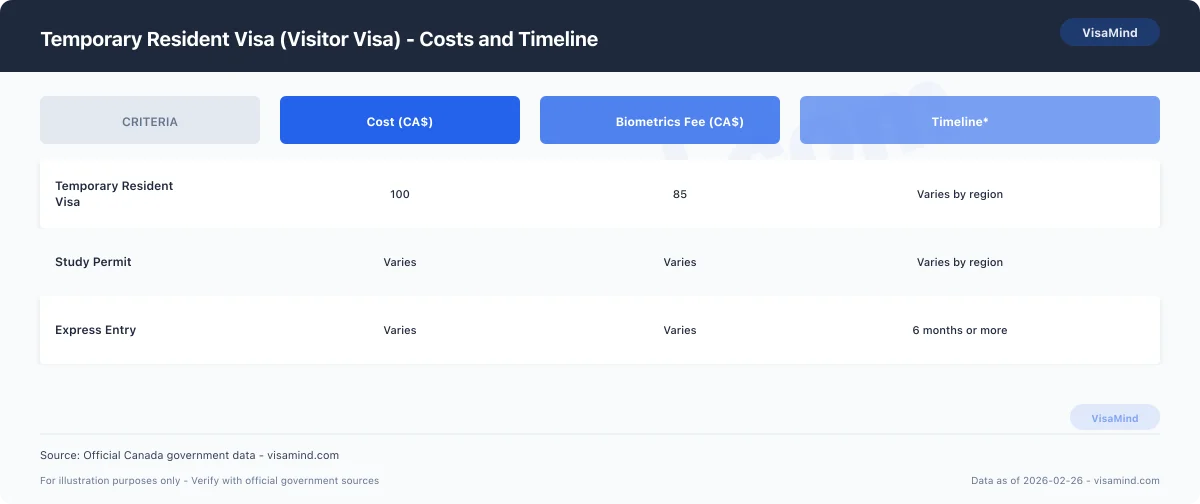
| Temporary Resident Visa (IMM 5257) | CA$100 |
IRCC sets the filing fee for a visitor visa at CA$100 per person. This applies to standard visitor visa applications submitted inside or outside Canada.
If you apply as a family, you may qualify for a maximum total fee of CA$500.
To qualify:
- All family members must apply at the same time and place.
- Your children must meet the definition of dependants.
If you hire a representative, make sure they are authorized. Lawyers, licensed consultants, and Quebec notaries may represent you before IRCC.
You can also apply for related status types, such as a Super Visa (Parents and Grandparents) or a Temporary Resident Permit (TRP), but fee structures vary.
An Electronic Travel Authorization (eTA) is a separate entry requirement and does not replace a Temporary Resident Visa.
Biometrics and extra charges
Many visitor visa applicants must provide biometrics as part of the process.
| Service | Fee (CAD) |
|---|---|
| Biometrics services fee | CA$85 per person |
You pay the biometrics fee in addition to the CA$100 visa processing fee. IRCC will not begin final processing until you complete biometrics, if required.
The processing times do not include the time you need to schedule and attend your biometrics appointment. Delays in giving biometrics will delay your overall case.
Other applications have different fee structures.
For example:
| Application type | Fee (CAD) |
|---|---|
| Work permit (including extensions) – per person | 155 |
Work permits are separate from visitor visas, but applicants sometimes apply for multiple statuses. Each application requires its own fee.
Always review your payment summary before submission. IRCC may return incomplete applications, which can increase your total timeline.
Processing time guidance
The processing times for a Temporary Resident Visa vary by country, category, and visa office.
As of March 2026, standard TRV processing ranges from 2 to 6 months.
Your actual timeline depends on:
- Where you apply from
- Application volume at your visa office
- Whether IRCC requests additional documents
- When you complete biometrics
If you apply from outside Canada or the United States, add 3 to 4 months for mailing time.
IRCC calculates processing times based on completed cases. These timelines do not guarantee approval or a fixed decision date.
Conditions of Stay
#Your visitor status depends on how IRCC processes your application and whether your case requires extra review. Processing times start when IRCC receives your complete application—such as Form IMM 5257 for a Temporary Resident Visa—and end when a decision is made.
Processing-time exceptions and regions
IRCC calculates processing times from the date it receives a complete application to the date it issues a decision. If your file is incomplete, the clock does not start until you submit all required documents.
IRCC may not provide accurate estimates for certain regions. For example, due to the evolving situation in Afghanistan and surrounding countries, published processing times may not reflect current realities.
The processing times can also differ based on:
- Your country or region of residence
- Whether you apply for a Temporary Resident Visa, Super Visa (Parents and Grandparents), or Temporary Resident Permit (TRP)
- Whether you require an Electronic Travel Authorization (eTA) instead of a visa
| Key Point | What It Means for You |
|---|---|
| Processing time starts | When IRCC receives your complete application |
| Processing time ends | When IRCC makes a decision |
| Regional disruptions | Estimates may be unavailable or inaccurate |
Non-routine reviews and volume effects
IRCC may take longer if your application requires a non-routine review. This can include additional document checks or closer examination of your eligibility.
Non-routine files do not follow standard timelines. IRCC reviews them individually, and published estimates may not apply.
The processing times also change when application volumes increase. If more people apply to immigrate or visit Canada than annual intake levels allow, IRCC may adjust timelines across categories.
You should plan for variability if:
- Your case includes unusual circumstances
- IRCC requests additional documents
- Overall application volumes rise significantly
IRCC updates its estimates monthly. Always confirm the processing time for the month and year you apply.
Minors and special-case timing
Applications for minors under 18 who live outside Canada may follow different timelines. IRCC may post separate estimates for these cases.
If you apply on behalf of a child, submit a complete package at the outset. Missing documents delay the start of processing.
Special categories—such as the Super Visa (Parents and Grandparents) or a Temporary Resident Permit (TRP)—may also involve different review considerations. Each application type follows its own assessment process, even though IRCC measures processing time in the same way: from receipt of a complete file to final decision.
When you prepare a minor’s or special-case application:
- Use the correct application form (such as IMM 5257, where required)
- Submit all supporting documents at once
- Monitor the processing estimate for the specific category and month you applied
Accurate filing reduces delays. IRCC will not finalize a decision until it completes its full review.
Eligibility Requirements
#You must determine whether you need a Temporary Resident Visa (TRV) or can apply for an Electronic Travel Authorization (eTA) before you submit any application to IRCC. The correct form, category, and travel document depend on your nationality and purpose of travel.
Who must complete the form
Each person applying for a Temporary Resident Visa must complete their own Application for Temporary Resident Visa (Form IMM 5257).
This rule applies even if you travel with family members. Every applicant submits a separate form with their personal details.
Use the table below to understand who completes which document:
| Situation | Required Application |
|---|---|
| You require a Temporary Resident Visa | IMM 5257 (one per person) |
| You are eligible to travel by air with an Electronic Travel Authorization (eTA) | eTA application (no IMM 5257) |
You do not complete IMM 5257 if you qualify for an eTA instead of a visa.
If you apply under a different category, such as a Super Visa (Parents and Grandparents) or request a Temporary Resident Permit (TRP), IRCC may require additional or different forms. Follow the specific instructions for that program.
Purpose and background details
IMM 5257 asks for clear information about your visit and your personal history.
You’ll need to provide:
- Your purpose of travel (tourism, visiting family, business, etc.)
- Details of your previous immigration status, if any
- Personal background information
Each question must be answered accurately. IRCC uses this information to decide whether you qualify for a Temporary Resident Visa.
If you’re applying for a Super Visa or a Temporary Resident Permit, you still have to explain your purpose of travel and disclose your prior immigration history.
Incomplete or inconsistent answers can slow things down. The details you provide need to match your travel plans and personal records.
Nationality-specific notes
Your nationality determines whether you need a Temporary Resident Visa or can apply for an Electronic Travel Authorization (eTA).
Starting November 25, 2025, citizens of Qatar don’t need a visitor visa for air travel to Canada. Instead, you may apply for an eTA.
| Nationality | Travel Document for Air Travel to Canada |
|---|---|
| Citizen of Qatar | Electronic Travel Authorization (eTA) |
| Other nationalities (if not eTA‑eligible) | Temporary Resident Visa (IMM 5257 required) |
If you’re not eligible for an eTA, you must apply for a Temporary Resident Visa using IMM 5257.
Check your document type before applying. IRCC processes visas and eTAs, but border admissibility is decided separately at entry.
Avoid These Errors
#Many Temporary Resident Visa refusals happen because of weak proof of ties, unclear financial records, or simple mistakes on the form.
You can avoid most issues by submitting complete, consistent, and current documents to Immigration, Refugees and Citizenship Canada (IRCC).
Evidence and ties
IRCC expects to see that you’ll leave Canada when your stay ends. If you don’t show this clearly, your Temporary Resident Visa can be refused.
You need to document strong ties to your home country. General statements about returning aren’t enough.
Focus on evidence like:
- Ongoing, stable employment
- Property ownership or a long-term lease
- Immediate family members who remain at home
- Financial obligations such as loans or business commitments
Organize these documents and label each file so details match your answers on Form IMM 5257.
If you’re applying under a different category, like a Super Visa (Parents and Grandparents) or a Temporary Resident Permit (TRP), you still need to show you intend to comply with your authorized stay.
An Electronic Travel Authorization (eTA) doesn’t replace the need to show temporary intent when a visa is required.
Financial documentation
You must show that you can pay for your entire stay in Canada.
Incomplete or inconsistent financial records are a common reason for refusal.
Your bank statements should reflect regular income over time. Unexplained large deposits can raise concerns.
Provide:
- Recent bank statements with consistent activity
- Evidence of ongoing income, such as salary deposits
- Documents explaining any large or unusual transactions
Avoid submitting only a balance certificate. Officers want to see patterns, not just totals.
Here’s a quick checklist for your financial documents:
| Requirement | What IRCC Looks For | Common Error |
|---|---|---|
| Bank statements | Steady income history | One-time lump-sum deposit |
| Income proof | Regular deposits matching employment | No link between job and income |
| Full stay coverage | Funds sufficient for visit duration | Funds that appear borrowed |
Make sure your financial evidence matches the purpose and length of your visit as stated in your application.
Form-version and common submission mistakes
Submitting the wrong version of IMM 5257 can get your application rejected before it’s even reviewed.
Download the latest IMM 5257 directly from IRCC before you apply. Check the date printed at the bottom of each page; if it doesn’t match the current version, replace it.
Common errors include:
-
Using an outdated form
-
Leaving required fields blank
-
Giving answers that contradict your supporting documents
-
Uploading incomplete or unsigned forms
Even small inconsistencies can create doubts about your credibility. Double-check every answer for accuracy and consistency.
IRCC assesses your application based on what you submit. Clear, current, and complete documentation reduces the risk of refusal.
How to Apply Step by Step
#You’ll need to complete Form IMM 5257 correctly, validate it to generate barcodes, and submit it with all required evidence.
Incomplete or unsigned applications are returned, which causes delays.
Download and prepare the IMM 5257
Download the most recent version of IMM 5257 (Application for Temporary Resident Visa) from Immigration, Refugees and Citizenship Canada (IRCC).
Check the version date at the bottom of each page to confirm it matches the current version.
Open the form on your computer using Adobe Acrobat Reader. Don’t fill it out by hand if you plan to validate it; handwritten forms can’t generate barcode pages.
Answer every question unless the form specifically tells you not to. Don’t leave blanks.
Key requirements for IMM 5257:
- Use a computer to fill out the form
- Complete all mandatory fields
- Follow the instructions for your specific category (Temporary Resident Visa, Super Visa, or Temporary Resident Permit)
- Review your eligibility category before starting
If you only need an Electronic Travel Authorization (eTA), IMM 5257 is not used. Confirm your document type before you begin.
Validate, sign and assemble your package
After completing the form, click the “Validate” button to create barcode pages.
Print or save the validated form with the barcode page. IRCC uses these barcodes to process your application.
If you submit the form without the barcode page, IRCC may treat it as incomplete.
Sign the form as required:
| Application Method | Signature Method |
|---|---|
| Online submission | Digital signature |
| Paper submission | Handwritten signature |
Unsigned forms are returned.
Gather all required supporting documents for your Temporary Resident Visa category. Use the document checklist for your situation and confirm each item is included.
Submit and follow instructions
Submit your completed application according to IRCC instructions for your chosen method (online or paper).
Follow the specific guidance for your visa category, whether it’s a Temporary Resident Visa, Super Visa (Parents and Grandparents), or Temporary Resident Permit (TRP).
Before submitting, make sure you have:
- Validated IMM 5257 with barcode pages
- Signed the form correctly
- Completed all required fields
- Included all required supporting evidence
After submission, follow any further instructions from IRCC. Respond quickly if IRCC asks for more information or corrections.
When to Consult a Professional
#Most people can complete a Canada visitor visa application on their own by following IRCC instructions.
Professional help makes sense if you have eligibility concerns or complex circumstances.
Most applications can be self-prepared
You can prepare your own Temporary Resident Visa application if your situation is straightforward and you meet IRCC eligibility requirements.
Start by downloading the current application package, including Form IMM 5257, from IRCC. Use the latest version and follow the guide step by step.
Self-preparation works well if:
- You clearly meet visitor visa eligibility requirements
- You have no known admissibility concerns
- You understand the differences between a Temporary Resident Visa, an Electronic Travel Authorization (eTA), and other programs like the Super Visa
- You can accurately complete forms and gather supporting documents
If you’re applying for a standard visitor visa and your background is uncomplicated, you can manage the process yourself by following IRCC’s written instructions.
| Scenario | Self-Prepared Application |
|---|---|
| Clear eligibility | Suitable |
| Correct form (IMM 5257) completed | Suitable |
| No known inadmissibility issues | Suitable |
| Applying for standard Temporary Resident Visa | Suitable |
Situations that benefit from expert help
Consult a professional if you’re unsure whether you or a family member qualifies.
Not everyone is eligible for a visitor visa, and applying without meeting requirements can lead to refusal.
Professional guidance is especially important if:
- You believe you may be inadmissible
- You need to apply for a Temporary Resident Permit (TRP)
- You’re unsure whether to apply for a Temporary Resident Visa, eTA, or Super Visa
- You’ve had a prior refusal
IRCC processes visa and permit applications, but the Canada Border Services Agency (CBSA) makes admissibility decisions at the border.
If admissibility is a concern, legal advice can help you assess your risk before applying.
| Scenario | Consider Professional Help |
|---|---|
| Possible inadmissibility | Yes |
| Need for Temporary Resident Permit (TRP) | Yes |
| Prior refusal | Yes |
| Uncertain eligibility | Yes |
How Your Application Is Assessed
#Immigration, Refugees and Citizenship Canada (IRCC) doesn’t approve a Temporary Resident Visa automatically.
An officer reviews your forms, documents, and travel purpose to decide whether you meet the legal requirements and whether you’ll leave Canada at the end of your stay.
What officers look for
IRCC officers assess whether you qualify for a Temporary Resident Visa (TRV) based on your application, including Form IMM 5257, and your supporting documents.
They focus on:
- Clear purpose of travel (tourism, family visit, business meeting)
- Strong ties to your home country
- Consistency across all documents
You need to state why you’re coming to Canada, your planned activities, and your travel dates.
Support this with documents such as:
- Invitation letters
- Hotel bookings
- Travel plans
To show you’ll leave Canada, include proof of:
- Employment
- Property ownership
- Immediate family members remaining at home
- Ongoing financial obligations
If you’re applying under a specific category, like the Super Visa (Parents and Grandparents), officers review your documents within that framework.
If you’re otherwise inadmissible and request a Temporary Resident Permit (TRP), the assessment focuses on the reasons for inadmissibility and your justification for entry.
An Electronic Travel Authorization (eTA) is different from a TRV and follows its own process, but accuracy and consistency still matter.
Inconsistencies and refusal triggers
Many refusals happen because of contradictions between your application form and your documents.
Officers compare details across:
- IMM 5257
- Your passport
- Employment letters
- Financial records
- Travel history
If dates, names, or job titles don’t match, the officer may doubt your credibility.
Even small differences, like using initials instead of your full legal name as shown in your passport, can cause problems.
Serious discrepancies can lead to:
| Issue | Possible Outcome |
|---|---|
| Conflicting dates or employment history | Refusal |
| Mismatched identity details | Refusal |
| Major factual contradiction | Procedural fairness letter or refusal for misrepresentation |
A procedural fairness letter gives you a chance to respond, but it delays processing. In more serious cases, IRCC may refuse the application outright.
You’re responsible for the accuracy of your application. Review every detail before you submit.
Common interview and documentation red flags
If IRCC requests an interview, the officer checks whether your answers match your written application.
You need to explain your travel plans clearly and consistently.
Common red flags include:
- Vague or changing explanations about your trip
- Inability to describe your itinerary
- Answers that contradict your IMM 5257
- Weak evidence of ties to your home country
Your purpose-of-visit statement must be specific. State where you’ll go, who you’ll see, and how long you’ll stay.
Avoid general statements like “tourism” without details.
Documentation issues also raise concern. Officers look for:
- Missing supporting documents
- Financial records that don’t support your claimed income
- Employment letters that lack clear details
A TRV is discretionary. If the officer isn’t satisfied that you’ll leave Canada at the end of your authorized stay, they will refuse the application.
What to Do Next
#Plan your next steps before your authorized stay ends. You must either leave Canada on time or apply to change your status through Immigration, Refugees and Citizenship Canada (IRCC).
After a visitor stay
Check the date by which you must leave Canada. IRCC issues your Temporary Resident Visa (TRV) using form Form IMM 5257.
The Canada Border Services Agency (CBSA) determines how long you may remain when you enter.
Before your status expires, you should:
- Confirm the expiry date stamped in your passport or listed on your visitor record
- Apply through IMM 5708 before status expires if you need more time as a visitor
- Prepare proof of departure if you plan to return later
If you entered with an Electronic Travel Authorization (eTA), the same rule applies. You must leave Canada when your authorized stay ends.
Parents and grandparents who need longer visits should review the Super Visa (Parents and Grandparents). This has different conditions than a standard visitor visa.
If you overstayed or face inadmissibility concerns, you may need a Temporary Resident Permit (TRP) before returning. IRCC assesses TRP applications, while CBSA makes final admissibility decisions at the border.
| Situation | Your Next Step | Authority Involved |
|---|---|---|
| Status still valid | Apply to extend through IRCC | IRCC |
| Status expired | Seek legal advice before applying | IRCC / CBSA |
| Inadmissibility issue | Consider a Temporary Resident Permit (TRP) | IRCC / CBSA |
Pathways and permit changes
A visitor visa doesn’t grant work or study authorization. You’ll need to apply separately if your plans change.
You may consider:
- Applying for a study permit through IRCC
- Applying for a work permit if eligible
- Switching to a different temporary status before your visitor status expires
Submit any new application to IRCC before your current status ends. Use the correct form and category; visitor visa applicants use IMM 5257.
Other permits require different forms listed by IRCC.
If your situation changes significantly, such as family sponsorship eligibility or long-term plans with Canadian relatives, review official program requirements directly through IRCC.
Fees
#| Component | Amount |
|---|---|
| Filing fee (IMM-5257)Extend stay as visitor (in Canada). | CA$100 (approx $73 USD) |
| BiometricsBiometrics: CA$85 (approx $62 USD) (as of 2026-02). Verify the current fee on the official schedule before filing. | CA$85 (approx $62 USD) |
Fees change; always verify on IRCC.
Required forms
#Plan your Temporary Resident Visa (Visitor Visa) with free Canada tools
#Itemized government fees for Temporary Resident Visa (Visitor Visa) and other Canada categories.
See how your profile scores against Temporary Resident Visa (Visitor Visa) and other Canada visas.
Typical wait times and stage breakdowns for Temporary Resident Visa (Visitor Visa) and related Canada visas.
Common interview questions and feedback for Canada visa applicants.