
Canada TRP: Overview
#A Temporary Resident Permit (TRP) lets you enter or remain in Canada even if you’re otherwise inadmissible. IRCC decides whether your reason justifies granting this temporary permission.
A TRP isn’t a visa. It’s a discretionary permit for a specific purpose and period.
Purpose and scope
A Canada TRP gives you temporary legal status despite inadmissibility. You’ll need to show a clear, justified reason for being in Canada.
IRCC officers consider whether your need outweighs the concerns about your inadmissibility. The permit covers only the period and purpose approved.
You might seek a TRP in situations such as:
- Entering Canada for a specific, time-limited reason
- Staying in Canada when you can’t meet standard admissibility rules
- Dealing with circumstances that don’t qualify under a Temporary Resident Visa (Visitor Visa) alone
If you’re already in Canada and need to extend your stay, you might use Form IMM 5708 if it applies. A TRP doesn’t replace other processes like a Refugee Claim (Asylum) or Humanitarian and Compassionate Considerations, but it can be relevant depending on your case.
| Feature | Temporary Resident Permit (TRP) |
|---|---|
| Who decides | IRCC officer |
| Purpose | Allows temporary entry or stay despite inadmissibility |
| Validity | Limited to approved reason and timeframe |
| Nature | Discretionary, case-by-case decision |
Who it's for
A TRP is meant for individuals who are inadmissible to Canada but have a legitimate reason to enter or remain temporarily. Inadmissibility means you don’t meet standard entry requirements.
You might consider a TRP if:
- You can’t get in through regular temporary status
- You have a time-sensitive reason to be in Canada
- Your case doesn’t fit permanent immigration remedies
You’ll need to provide documentation supporting your reason for being in Canada. IRCC will look at your circumstances and the specific reason for your request.
This permit is temporary. It doesn’t grant permanent resident status or lead there automatically.
Limits and officer discretion
A TRP is entirely discretionary. There’s no automatic right to one.
IRCC weighs your justification against your inadmissibility. The officer decides:
-
Whether your reason is compelling
-
Whether to issue the permit
-
How long it’s valid
The permit applies only to the approved purpose and timeframe. If your situation changes, you may need to apply again.
Approval varies by case. You’ll have to provide focused evidence explaining why your presence is justified despite inadmissibility.
Application Process (Temporary Resident Permit)
#You apply for a TRP through IRCC using the correct form and supporting documents. Accuracy, completeness, and proper signatures are essential for IRCC to process your request.
Forms and who files them
You need to complete Form IMM 5708 – Application to Change Conditions, Extend my Stay or Remain in Canada as a Visitor or Temporary Resident Permit Holder if you:
- Apply for an initial Temporary Resident Permit
- Request an extension of your TRP
- Apply to change conditions on your stay
- Seek to remain in Canada as a visitor or TRP holder
Each applicant submits their own form.
Applications go to IRCC, not the Canada Border Services Agency (CBSA). CBSA handles border decisions, but IRCC processes in-Canada applications.
Use the latest version of IMM 5708, and download it with Adobe Acrobat Reader version 10 or higher. Outdated or improperly completed forms might be returned.
You may use IMM 5708 if you entered Canada on a Temporary Resident Visa (Visitor Visa) and now need to regularize or extend your status through a TRP. Submitting a TRP application doesn’t guarantee approval.
| Form | Who Uses It | Purpose |
|---|---|---|
| IMM 5708 | Visitors and TRP holders in Canada | Initial TRP, TRP extension, or change of conditions |
How to complete and submit
Answer every question on IMM 5708 unless the form says otherwise. Don’t leave blanks.
Be careful with personal details. Mistakes in your name, date of birth, or document numbers can lead to refusal.
For Question 4, provide the document number from your most recent:
- Visitor Record
- Study permit
- Work permit
Sign and date the form. Use the actual date and include the place of your most recent entry into Canada.
Check the official TRP instructions from IRCC that fit your eligibility category before submitting. If you have a Humanitarian and Compassionate Considerations request or a pending Refugee Claim (Asylum), make sure your explanation matches your current status and documents.
Send the completed form with all required evidence. Incomplete applications are returned, which slows things down.
Common procedural pitfalls
Delays usually happen when applicants submit incomplete forms.
IRCC will return your application if you:
- Leave required sections blank
- Forget to sign or date the form
- Use an outdated version of IMM 5708
- Miss required supporting documents
Clerical mistakes can also cause refusal. Incorrect document numbers or mismatched entry dates can raise concerns.
Filing a TRP doesn’t automatically protect your status. Approval is always discretionary, even if you present humanitarian factors or other reasons.
Review every answer before submitting and check that all required documents are included.
Getting Legal Help
#A TRP application often depends on how you present risk, purpose, and supporting documents. A licensed representative can organize your evidence, complete forms, and communicate with IRCC for you.
When to get help
Consider legal help if your inadmissibility is complex or recent.
For example, seek advice if you:
- Have criminal charges or convictions affecting eligibility
- Previously received a refusal for a Temporary Resident Visa (Visitor Visa) or TRP
- Plan to submit Humanitarian and Compassionate Considerations
- Are also looking at a Refugee Claim (Asylum)
- Need to extend status using Form IMM 5708
A representative can help assess if a TRP is the best route or if another process fits better.
If you have trouble explaining your circumstances in writing, get help. TRP decisions rely heavily on documents, and clear submissions prevent misunderstandings.
Confirm fees in advance. Some representatives offer services starting from CA$100, but total costs vary depending on your case. Always ask for a written fee agreement.
Choosing a licensed representative
Only use an authorized representative. This means a licensed immigration consultant, lawyer, or Quebec notary.
Before hiring anyone:
- Check they’re licensed and in good standing
- Confirm their full name, business address, and email
- Ask for a written service agreement
- Clarify what services are included
If you appoint a representative, complete Use of a Representative (IMM 5476) and include their contact details in your application.
| What to Check | Why It Matters |
|---|---|
| License status | Protects you from unauthorized advice |
| Written agreement | Defines fees and scope of work |
| Clear contact details | Ensures IRCC correspondence reaches the right person |
Even if you hire someone, you’re responsible for your application. Review every form and document before it goes out.
Your Rights During Processing
#You have certain rights while IRCC processes your TRP application. These include rules on biometrics, clarity about your status while waiting, and limits on what IRCC can require during review.
Biometrics and reporting
IRCC may ask you to provide biometrics with your TRP application. This step is separate from the main review.
The processing times don’t include the time you need to give biometrics. The application clock starts only when IRCC gets a complete application, not when you book or attend a biometrics appointment.
Follow instructions from IRCC, which can include:
- Giving biometrics at an approved location
- Submitting extra documents
- Responding by the deadline in your notice
If you separately need a Temporary Resident Visa (Visitor Visa), use that visa's application process rather than IMM 5708. If you raise Humanitarian and Compassionate Considerations or a Refugee Claim (Asylum), IRCC may treat your case as non-routine. These cases can take longer.
Use the IRCC processing times tool for current estimates. Some regions may not have accurate timelines due to changing conditions.
| Key Point | What It Means for You |
|---|---|
| Biometrics required | You must complete them as instructed |
| Clock start date | The day IRCC receives your complete application |
| Processing time limits | Excludes biometrics appointment time |
| Non-routine cases | May require longer review |
Status while waiting
A TRP application doesn’t automatically give you legal status in Canada. You need to already hold valid temporary status, such as under a Temporary Resident Visa (Visitor Visa), or apply separately to extend your stay if eligible.
Your processing time starts when IRCC receives your complete TRP application and ends when a decision is made. It doesn’t pause and restart unless IRCC requests more information and you don’t respond.
You’re responsible for:
- Keeping valid temporary status
- Following all conditions on your stay
- Leaving Canada if your authorized stay expires and no extension is approved
If you’ve also submitted a Refugee Claim (Asylum) or requested Humanitarian and Compassionate Considerations, those follow their own processes. A pending TRP doesn’t override them.
Processing obligations
IRCC must assess your application based on the information and documents you provide. Officers review whether your case is routine or non-routine and may ask for more evidence before deciding.
The processing times change by country and can shift if application volumes rise beyond annual immigration levels. In some regions, IRCC can’t provide accurate timelines due to local conditions.
IRCC’s obligations include:
-
Starting the clock when your complete application is received
-
Reviewing the application before deciding
-
Ending processing time when a final decision is made
If IRCC asks for more documents, respond fully and on time. Delays in responding can keep your file under review longer.
For current timelines, use the IRCC processing times tool.
Eligibility Criteria
#You must show a clear, temporary reason to enter or stay in Canada and support it with documents. IRCC looks at your purpose, the evidence you provide, and the validity of required examinations for you and any family members included.
Basic eligibility
You need to explain why you need a Temporary Resident Permit (TRP) and how long you plan to stay in Canada. IRCC reviews whether your situation justifies temporary entry despite inadmissibility.
Provide documents that back up your request. These must directly relate to the reason you give for seeking temporary residence.
If you apply from inside Canada to extend your stay, you may use Form IMM 5708. If you also need a Temporary Resident Visa (Visitor Visa), you must meet those requirements separately.
All required examinations for each person included must be valid at the same time. If one family member’s results expire, it can affect the whole application.
You must ensure:
- Your reason for entering Canada is clearly stated
- Your intended length of stay is specific
- Your supporting documents match your explanation
- All required exams remain valid for every applicant
| Requirement | What IRCC Looks For |
|---|---|
| Purpose of stay | Clear, specific, temporary reason |
| Duration | Defined and limited timeframe |
| Documents | Evidence supporting your explanation |
| Examinations | Valid for all applicants at the same time |
Reasons and justification
You need to show IRCC why you should be granted temporary status, even if you're inadmissible. Be direct about your circumstances and back up your explanation with documents.
If you base your application on Humanitarian and Compassionate Considerations, your reasons must specifically relate to your temporary need to stay in Canada. Vague statements without proof won't help.
A Refugee Claim (Asylum) is a separate legal process. Filing or planning to file a refugee claim doesn't remove the need to justify your TRP request with details and evidence.
IRCC reviews your documents to decide if your situation justifies temporary entry.
Dependent and group notes
If you include family, each person must meet the examination validity requirement on their own. A single invalid or expired exam can delay or weaken the request for everyone.
Eligibility is determined for each individual. IRCC doesn't just look at the principal applicant.
When applying as a group:
- Submit supporting documents for each person
- Make sure all required exams are valid at the same time
- Clearly state each person’s intended length of stay
Incomplete or inconsistent information for any family member can affect the outcome for the entire group.
What documents do I need?
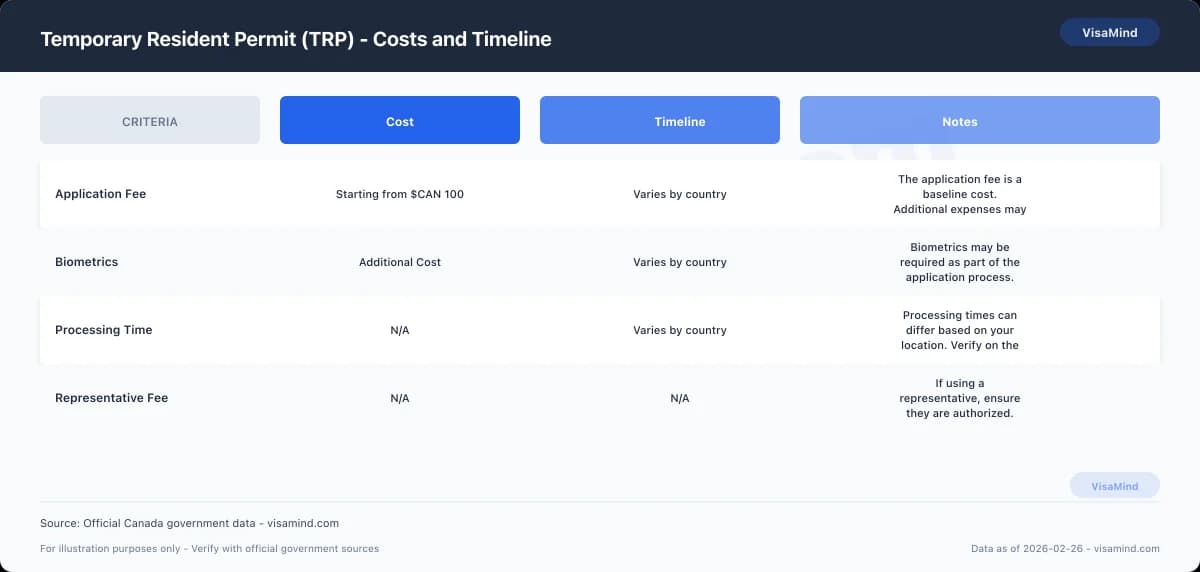
#
You need to prove who you are, why you want to stay in Canada, and what your current status is. IRCC checks your identity, immigration history, and supporting evidence before making a decision.
Identity and travel documents
Submit a valid passport or travel document. It must show your full name, date of birth, and passport number.
Include:
- Full legal name and any aliases
- Date of birth
- Current immigration status in Canada
- Contact information (telephone and email)
If you have or had a Temporary Resident Visa (Visitor Visa), include copies of those pages.
List your employment history for the past 10 years, or the 10 years before retirement. If the form doesn’t have enough space, add an extra page.
If you’re applying from inside Canada, you may need to use Form IMM 5708, depending on your situation.
| Document | What to Submit | Key Details |
|---|---|---|
| Passport or travel document | Copy of valid document | Must be current and legible |
| Immigration status proof | Copy of visa or permit | Include Visitor Visa if applicable |
| Employment history | 10-year record | Include employer names and dates |
| Contact details | Phone and email | Ensure accuracy |
Evidence of reason to stay
You must explain why you need to remain in Canada despite inadmissibility.
Provide written details describing:
- The specific reason you need to stay
- The length of time you’re requesting
- Any urgent or compelling factors
If relying on Humanitarian and Compassionate Considerations, include documents showing hardship or personal circumstances.
If your case involves a Refugee Claim (Asylum), provide proof of your claim status.
You can also include:
- Financial records
- Medical documentation
- Work-related letters
Family and extra documents
If family members are included, submit proof of your relationship.
You may need:
- Marriage certificate or marriage license
- Documents confirming common-law or dependent relationships
Provide copies, not originals, unless IRCC specifically asks for originals.
Include residence documents showing where you live in Canada. If you list family, make sure their personal information matches their identity documents.
Organize your documents clearly.
| Situation | Supporting Document |
|---|---|
| Married | Marriage certificate or license copy |
| Family included | Identity and relationship documents |
| Canadian address | Residence documentation |
Incomplete or inconsistent documents often delay processing. Double-check that all names, dates, and details match across your documents.
After Approval
#Once IRCC approves your Temporary Resident Permit (TRP), you’re legally allowed to enter or stay in Canada even though you’re otherwise inadmissible. Your status and next steps depend on the conditions printed on your permit.
Status after approval
A TRP gives you temporary resident status for the period shown on your document. You must follow all conditions set by Immigration, Refugees and Citizenship Canada (IRCC).
Your permit might limit:
- Length of stay
- Work or study authorization
- Geographic location
- Reporting requirements
Check your document carefully. If you want to extend your stay from within Canada, use Form IMM 5708 before your current status expires.
If your situation changes—such as new inadmissibility—IRCC may reassess your eligibility. The Canada Border Services Agency (CBSA) will check admissibility each time you seek entry at a port of entry.
A TRP doesn’t automatically lead to permanent residence. Some people later apply under Humanitarian and Compassionate Considerations or submit a Refugee Claim (Asylum) if eligible. Each route has its own legal requirements.
| Issue | What You Need to Know |
|---|---|
| Validity period | Printed on your TRP document |
| Extensions | Apply with IMM 5708 before expiry |
| Work/study | Only if specifically authorized |
| Re-entry | Subject to CBSA examination |
Family reunification
Your TRP approval doesn’t automatically give status to your family. Each family member must qualify and apply separately.
Depending on their situation, your spouse, partner, or children may need:
- A Temporary Resident Visa (Visitor Visa)
- Their own Temporary Resident Permit
- A study or work permit, if that applies
IRCC reviews each application individually. If your inadmissibility is due to criminality or misrepresentation, officers may look into whether similar issues affect your family.
If you apply for permanent residence through Humanitarian and Compassionate Considerations later, you may include eligible family members there. Refugee Claims have different rules for dependants.
Don’t assume your TRP covers your family. Check each person’s immigration documents before travel or entry.
Travel documents and next steps
If you need a visa to travel to Canada, you may also need a Temporary Resident Visa (Visitor Visa) in addition to the TRP approval. IRCC will tell you about document issuance.
Before you travel, confirm:
- TRP validity dates
- Whether you need a Visitor Visa
- Passport validity
- Any conditions on your permit
At the port of entry, CBSA makes the final call on admission. Bring your approval letter and supporting documents.
If you want to stay in Canada longer, apply for an extension before your status expires. Keep an eye on your document dates. Missing a deadline can put you out of status and affect future applications.
Processing Times and Costs
#You’ll pay a fixed fee and should expect several months of processing. Timelines depend on where you apply, how complete your file is, and the specifics of your inadmissibility.
How long it takes
IRCC currently estimates 4 to 12 months to process a Temporary Resident Permit (TRP) under standard processing (as of March 2026). This period starts when IRCC receives your complete application and ends when a decision is made.
The processing time depends on:
- Your country of residence
- The office that handles your file
- The complexity of your inadmissibility
- Whether you’re applying from inside or outside Canada
If you apply from outside Canada or the US, add 3 to 4 months for mailing and document transit.
If you submit your TRP with a Temporary Resident Visa (Visitor Visa) or through Form IMM 5708 from inside Canada, IRCC may process them together, but the TRP timeline still applies.
| Application Type | Estimated Processing Time |
|---|---|
| Temporary Resident Permit (Standard) | 4–12 months |
| Outside Canada/US (mailing addition) | +3–4 months |
Fees for the Temporary Resident Permit
The government fee for a Temporary Resident Permit is CA$200 per person (as of February 2026). Pay this fee when you submit your application to IRCC.
| Fee Type | Amount (CAD) |
|---|---|
| Temporary Resident Permit | CA$200 |
This applies whether you apply:
- From inside Canada
- From outside Canada
- Alongside a Temporary Resident Visa (Visitor Visa)
If you’re requesting a work permit too, you’ll pay a separate work permit fee. A work permit costs CA$155 per person. Different rules may apply for certain group applicants, such as performing artists.
TRP fees are separate from any permanent residence application, including those based on Humanitarian and Compassionate Considerations or after a Refugee Claim (Asylum).
Processing time details and exceptions
IRCC measures processing time from the date they get your complete application. Missing documents, unpaid fees, or incomplete forms will delay your file.
Processing can take longer if:
- Your inadmissibility involves criminal history
- IRCC asks for more documents
- Medical or police records arrive late
- You have a complicated immigration history
Applications related to Humanitarian and Compassionate Considerations or a pending Refugee Claim (Asylum) have their own processing timelines. A TRP linked to those doesn’t speed up or delay the other application.
For minors (under 18) outside Canada or the US, expect extra mailing and handling time.
IRCC updates processing estimates regularly.
Credibility and Procedural Risks
#A Canada Temporary Resident Permit (TRP) application relies on credible documents and following IRCC procedures closely. If you don’t provide valid identity documents, officers may end the process before looking at your reasons for entry.
Why claims fail
IRCC checks if your identity and supporting documents are reliable. Without a valid passport, IRCC can refuse your application without considering your circumstances.
A passport confirms your identity and nationality. Without it, IRCC can’t process a TRP, a Temporary Resident Visa (Visitor Visa), or an application on Form IMM 5708.
You also risk refusal if you provide inconsistent identity details across applications, including TRP, Refugee Claim (Asylum), or requests under Humanitarian and Compassionate Considerations. Officers compare documents across files.
| Issue | Consequence |
|---|---|
| No valid passport | Application may be rejected |
| Expired passport | Application may be rejected |
| Conflicting identity details | Credibility concerns |
Submit clear, consistent, and valid identity documents with every application.
Common procedural risks
Submitting incomplete forms or missing identity documents creates avoidable risk. A TRP request without a valid passport will likely fail at intake.
Be careful when filing IMM 5708 or related applications with IRCC. Your passport must be valid at submission.
Common mistakes:
- Submitting an expired passport
- Forgetting to include a passport copy
- Giving different identity details in separate applications
- Relying on explanations instead of documentation
IRCC looks at documentation first. If you don’t meet identity requirements, officers won’t consider discretionary factors, even Humanitarian and Compassionate Considerations.
What pathways lead to and from this permit?
#A Temporary Resident Permit (TRP) often connects to other immigration processes, both temporary and permanent. You might need a TRP because you’re inadmissible, and you might move off it by restoring status, applying on humanitarian grounds, or seeking protection.
Typical pathways in People
usually seek a TRP when they’re inadmissible to Canada but have a strong reason to enter or stay.
Common situations:
- You applied for a Temporary Resident Visa (Visitor Visa) and IRCC found you inadmissible.
- You’re in Canada and lost status, then request authorization to remain despite inadmissibility.
- You present yourself at a port of entry and the Canada Border Services Agency (CBSA) finds an inadmissibility issue.
- You have an active Refugee Claim (Asylum) but face a separate inadmissibility concern.
Most in‑Canada TRP applications go to IRCC. CBSA can issue a TRP at the border after reviewing admissibility.
If you’re in Canada as a visitor, you may use Form IMM 5708 to change or extend your status, and sometimes request a TRP at the same time if you’re inadmissible.
| Situation | Authority Involved | Typical Action |
|---|---|---|
| Inadmissible visa applicant | IRCC | TRP requested with application |
| Inadmissible at border | CBSA | TRP considered at entry |
| In Canada, out of status | IRCC | TRP requested from within Canada |
Next steps after entry
A TRP doesn’t give you permanent status. You’re expected to keep valid authorization at all times.
After you get a TRP, you can:
-
Apply to extend the TRP before it expires.
-
Submit an application based on Humanitarian and Compassionate Considerations if you want permanent residence.
-
Continue or start a Refugee Claim (Asylum), if you qualify.
-
Apply for a different temporary status, if your inadmissibility is no longer an issue.
If anything in your situation changes, IRCC will reassess admissibility when you apply for a new permit or permanent residence.
| Your Goal | Possible Path |
|---|---|
| Remain temporarily | TRP extension through IRCC |
| Become a permanent resident | Humanitarian and Compassionate application |
| Seek protection | Refugee Claim process |
You need to track expiry dates and file applications before your current document runs out.
Fees
#| Component | Amount |
|---|---|
| Application feeApplication fee: CA$200 (approx $146 USD) (as of 2026-02). Verify the current fee on the official schedule before filing. | CA$200 (approx $146 USD) |
Fees change; always verify on IRCC.
Required forms
#Plan your Temporary Resident Permit (TRP) with free Canada tools
#Itemized government fees for Temporary Resident Permit (TRP) and other Canada categories.
See how your profile scores against Temporary Resident Permit (TRP) and other Canada visas.
Typical wait times and stage breakdowns for Temporary Resident Permit (TRP) and related Canada visas.
Common interview questions and feedback for Canada visa applicants.