
On this page
- Canada caregiver immigration: Overview
- Sponsor Requirements (caregiver program Canada)
- Fees and Processing Times
- How to check processing times
- Renewal and Extension
- Path to Permanent Residence
- When to Get Professional Help
- How to Apply
- Dependents
- Eligibility Requirements
- Conditions and Portability
- Common Petition Challenges
- Fees
- Required forms
- Related visa types
- Related guides
- Related goals
- Next steps
Canada caregiver immigration: Overview
#Canada’s caregiver immigration process allows you to apply for temporary work or permanent residence through specific caregiver pathways.
You file your application with Immigration, Refugees and Citizenship Canada (IRCC) using the required immigration forms and supporting documents.
Form purpose and scope
The caregiver immigration form package lets you request authorization to work in Canada as a caregiver or to seek permanent residence through a Caregiver Program pathway.
You use this process to:
- Apply for a Work Permit (Employer-Specific) as a caregiver
- Apply for permanent residence through an eligible caregiver pathway
- Submit required permanent residence forms such as Form IMM 0008
- Complete medical requirements, including Form IMM 1017, if instructed
The scope of your application depends on the pathway you choose.
Some applicants apply for temporary work first, while others pursue permanent residence if eligible under a caregiver stream.
If you apply for permanent residence, you must complete the full application package required by IRCC.
This may differ from economic programs such as Express Entry (Federal Skilled Worker) or certain Provincial Nominee Program (PNP) streams, which follow separate processes.
| Pathway Type | Main Purpose | Key Forms Commonly Used |
|---|---|---|
| Temporary caregiver | Work in Canada for a specific employer | Work permit forms |
| Permanent residence caregiver | Obtain permanent resident status | IMM 0008, supporting PR forms, IMM 1017 (if required) |
Who uses the form
You use this process if you plan to work in Canada as a caregiver or immigrate permanently through a caregiver pathway.
Typical applicants include individuals who:
- Intend to work as caregivers under a recognized Caregiver Program
- Seek a temporary employer-specific work permit
- Plan to transition from temporary caregiver status to permanent residence
- Apply directly for permanent residence under an available caregiver stream
You must ensure that your situation matches the caregiver pathway requirements listed by IRCC.
Not all caregiving roles qualify, and different streams may apply depending on whether you are outside Canada or already working in Canada.
If you are considering other immigration programs, such as Express Entry (Federal Skilled Worker) or a Provincial Nominee Program (PNP), you must follow those separate processes instead of the caregiver-specific forms.
Filing authority
You file your caregiver immigration application with Immigration, Refugees and Citizenship Canada (IRCC).
IRCC:
- Receives and processes work permit applications
- Assesses permanent residence applications
- Issues requests for medical exams (such as IMM 1017)
- Makes final decisions on eligibility under caregiver pathways
You must submit your completed forms, supporting documents, and applicable fees to IRCC using the method specified in the official instructions.
Only IRCC can approve your caregiver work permit or permanent residence application.
Sponsor Requirements (caregiver program Canada)
#You must meet specific sponsorship conditions before a caregiver can obtain or rely on a valid work authorization.
IRCC reviews your past permit history and any required Labour Market Impact Assessment to confirm the job offer fits an approved caregiver category.
Labour Market Impact Assessment (LMIA) issues
If you supported a caregiver under a closed stream, you must address any Labour Market Impact Assessment (LMIA) tied to that work authorization.
A caregiver applying under a closed program must show that a required LMIA supported the earlier Employer-Specific Work Permit.
IRCC will review:
- Whether the LMIA was issued for an approved caregiver category
- Whether the work permit matched the employer and position listed
- Whether the caregiver’s past permit details align with the LMIA
If the caregiver later applies for permanent residence through a pathway connected to the Caregiver Program, IRCC may cross-check past LMIA and permit records with the information listed in forms such as Form IMM 0008.
| Issue Reviewed | What IRCC Looks For |
|---|---|
| LMIA existence | Proof that a required LMIA was obtained |
| Job match | Same employer and caregiver role |
| Permit history | Consistency with prior employer-specific permits |
If your case involves permanent residence through Express Entry (Federal Skilled Worker) or a Provincial Nominee Program (PNP), ensure all prior caregiver work was authorized and properly documented.
Evidence employers/sponsors may rely on
You must keep clear records that support the caregiver’s eligibility under an approved category.
IRCC relies on documentary proof, not informal explanations.
You may need:
- A copy of the LMIA decision, if one was required
- Copies of prior Employer-Specific Work Permits
- Employment details confirming the caregiver role
- Any related immigration forms submitted to IRCC, including IMM 0008
If the caregiver completed an immigration medical exam, documentation linked to Form IMM 1017 may also appear in the application record.
| Evidence Type | Purpose |
|---|---|
| LMIA document | Shows labour market approval when required |
| Work permit copies | Confirms authorized employment |
| Immigration forms | Aligns employment history with application details |
Provide documents that match the exact caregiver category used.
Inconsistencies between the LMIA, work permit, and permanent residence application can delay or complicate processing with IRCC.
Fees and Processing Times
#You must pay government fees to IRCC when you submit your caregiver application and any related work permit or permanent residence forms.
Processing times vary by program and stream, so you should confirm current timelines directly with Immigration, Refugees and Citizenship Canada (IRCC) before filing.
Application fees and biometrics
IRCC charges specific fees for permanent residence applications under a Caregiver Program stream that requires Form IMM 0008 (Generic Application Form for Canada).
| Fee type | Amount (CAD) | Notes |
|---|---|---|
| Permanent residence filing fee (IMM 0008) | CA$1,525 | As of February 2026 |
| Biometrics fee | CA$85 | As of February 2026 |
You must pay the biometrics fee if IRCC instructs you to provide fingerprints and a photo.
IRCC will issue a biometrics instruction letter after you apply.
If you apply for an Employer-Specific Work Permit before or alongside permanent residence, separate work permit fees apply.
Confirm current amounts using the IRCC fee calculator, as fees change periodically.
If you apply through Express Entry (Federal Skilled Worker) or a Provincial Nominee Program (PNP) pathway connected to caregiving work, review the fee schedule for that specific stream.
Fees-related filing notes
You must submit the correct payment with your application package.
IRCC will not process your file if required fees are missing or incorrect.
- Pay fees in Canadian dollars (CA$).
- Include payment for each adult applicant where required.
- Pay the biometrics fee at the time of filing to avoid delays.
- Retain proof of payment for your records.
If IRCC requests a medical exam, you will complete it using Form IMM 1017 (Medical Report) instructions.
Medical exam costs are paid directly to the panel physician and are not included in IRCC filing fees.
Processing times differ by stream, location, and application volume.
Check the current processing time tool for your specific Caregiver Program, Express Entry, PNP, or work permit category before you apply.
How to check processing times
#You must check current timelines directly with Immigration, Refugees and Citizenship Canada (IRCC).
Processing times depend on the program, category, and where IRCC processes your application.
As of March 2026, standard processing for a Caregiver Program permanent residence application ranges from 12 to 24 months.
You must confirm the current estimate before you apply.
What the processing time estimate means
IRCC publishes estimated processing times through its online tool.
You need a browser with JavaScript enabled to access it.
Processing time starts on the day IRCC receives your complete application.
It ends when IRCC makes a decision.
For permanent residence applications, including caregiver streams submitted with Form IMM 0008, the estimate reflects how long IRCC expects to take to finalize an application filed in the same month and year as yours.
The estimate does not guarantee approval within that period.
It reflects IRCC’s service commitment for most complete applications.
| Key Point | What It Means for You |
|---|---|
| Start date | Date IRCC receives your complete file |
| End date | Date IRCC makes a decision |
| Applies to | Applications submitted in the same month/year as yours |
| Guarantee? | No — it is an estimate |
If your file is incomplete, IRCC may delay processing.
Location-, category- and case-specific notes
Processing times vary by program and stream.
A caregiver applying for permanent residence may face a different timeline than someone applying for an employer-specific work permit.
For example, a Work Permit (Employer-Specific) application under a caregiver pathway follows a separate timeline from a permanent residence application under the Caregiver Program.
Other immigration programs, such as Express Entry (Federal Skilled Worker) or the Provincial Nominee Program (PNP), use different processing systems.
Do not rely on those timelines for caregiver applications.
IRCC also calculates timelines based on where it processes your file.
Applications processed in different locations may move at different speeds.
As of March 2026:
| Application Type | Processing Time (Standard) |
|---|---|
| Caregiver Program (Permanent Residence) | 12–24 months |
Always verify current estimates through IRCC before submitting your application.
Service limitations and special cases
IRCC’s posted times apply to most routine, complete applications.
Non-routine cases take longer.
IRCC may need extra time if:
- Your application is incomplete.
- Your case requires additional review.
- You must complete further steps, such as a medical exam using Form IMM 1017.
- IRCC requests additional documents.
Processing times also reflect when IRCC receives your full package, including required forms such as IMM 0008 for permanent residence.
IRCC does not include delays caused by missing documents or unanswered requests.
If IRCC asks for more information and you respond late, your timeline extends beyond the posted estimate.
You must check the IRCC processing times tool regularly, especially if you apply under a caregiver pathway linked to a work permit and later permanent residence.
Renewal and Extension
#You must plan renewals early, especially when IRCC cannot publish reliable processing times for a specific province.
Delays can affect your legal status, work authorization, and transition to permanent residence pathways such as Express Entry (Federal Skilled Worker) or a Provincial Nominee Program (PNP).
Province and location timing differences
Processing times for renewals under the Caregiver Program can vary by province.
In at least one province, IRCC has stated that it cannot provide accurate processing times due to evolving conditions in Afghanistan and surrounding countries.
This means you cannot rely on standard posted timelines when you hold a Work Permit (Employer-Specific) tied to that province.
You should:
- Monitor your IRCC online account regularly
- Submit extension applications as early as permitted
- Keep copies of all submitted forms, including Form IMM 0008 if applying for permanent residence
- Complete required medical steps such as Form IMM 1017 when instructed
The table below shows what you should verify before filing:
| Item | What You Must Confirm |
|---|---|
| Province of employment | Whether IRCC lists normal or unavailable processing times |
| Permit expiry date | Exact date your status ends |
| PR pathway | Whether you are also applying through Express Entry (Federal Skilled Worker) or a PNP |
Always check current processing updates directly through Immigration, Refugees and Citizenship Canada (IRCC).
Special processing limitations
When IRCC cannot publish accurate timelines for a province, you should expect uncertainty in decision dates.
This affects both temporary extensions and permanent residence applications connected to your caregiver work experience.
You must ensure your application is complete at submission.
Incomplete forms, missing signatures, or absent documents can cause additional delays when timelines are already unpredictable.
Pay close attention to:
- Correctly completed IMM 0008 for permanent residence
- Timely submission of extension applications for your Work Permit (Employer-Specific)
- Compliance with any medical instructions linked to IMM 1017
- Alignment between your caregiver employment and any Provincial Nominee Program (PNP) nomination
IRCC controls application processing.
The Canada Border Services Agency (CBSA) determines admissibility at the border, not permit validity decisions.
Check IRCC’s official processing time tool before each filing, as posted information may change without advance notice.
Path to Permanent Residence
#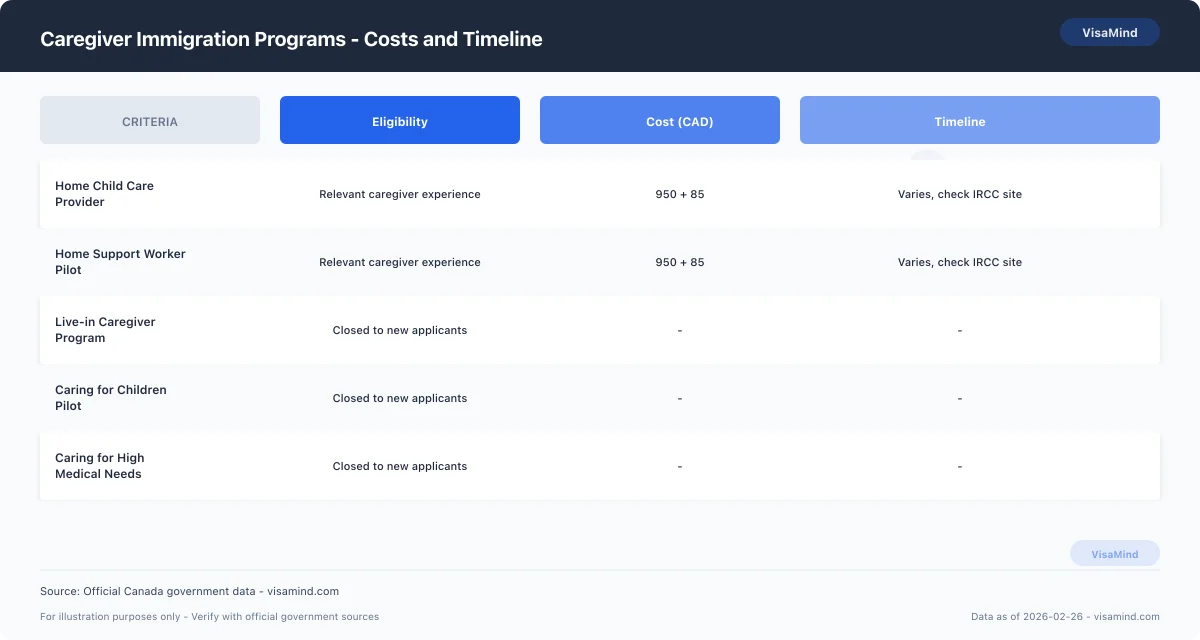
Moving from temporary caregiver status to permanent residence in Canada involves federal or provincial pathways. Your approach depends on your current Work Permit (Employer-Specific), your Canadian work experience, and whether you qualify under a federal or provincial stream.
Typical immediate pathways
Most caregivers start with an Employer-Specific Work Permit under a Caregiver Program approved by Immigration, Refugees and Citizenship Canada (IRCC).
If you meet the requirements, you may apply for permanent residence through:
- A caregiver-specific permanent residence stream managed by IRCC
- Express Entry (Federal Skilled Worker), if you qualify independently
- A Provincial Nominee Program (PNP) stream targeting caregivers or in-demand workers
When you apply, you generally submit:
- Form IMM 0008 (Generic Application Form for Canada)
- Supporting civil documents and proof of work experience
- Form IMM 1017 if IRCC issues medical examination instructions
IRCC reviews eligibility, admissibility, and document completeness. The Canada Border Services Agency (CBSA) makes admissibility decisions at the border.
| Pathway | Who It Suits | Key Requirement |
|---|---|---|
| Caregiver PR stream | Current caregivers in Canada | Eligible Canadian caregiver work experience |
| Express Entry (Federal Skilled Worker) | Skilled workers meeting federal criteria | Qualifying work history and selection score |
| Provincial Nominee Program (PNP) | Caregivers aligned with provincial labor needs | Provincial nomination |
Common next steps toward PR
After confirming eligibility, prepare your permanent residence application thoroughly.
You should:
-
Gather proof of authorized caregiver work in Canada.
-
Confirm your work permit conditions were respected.
Complete all required forms, including IMM 0008, with care.
If IRCC issues IMM 1017 instructions, complete your medical exam.
For Express Entry (Federal Skilled Worker), create a profile and wait for an invitation before submitting your full application.
For a Provincial Nominee Program (PNP), secure a nomination certificate from the province first, then submit your permanent residence application to IRCC.
Keep copies of everything you submit and monitor your IRCC account for updates.
When to Get Professional Help
#Caregiver applications sometimes fail due to incomplete proof of past permits or misunderstanding eligibility rules. Legal guidance is valuable if your record is complex, your status history is unclear, or your filing approach could affect future options under programs like Express Entry (Federal Skilled Worker) or a Provincial Nominee Program (PNP).
Complex documentation or past-permit evidence
You’ll need organized proof of your past status before applying under a Caregiver Program. Missing records or inconsistent dates often cause delays or refusals by IRCC.
Consider professional help if you must gather:
- Copies of prior Work Permit (Employer-Specific) approvals
- Evidence of any labour market assessments tied to those permits
- Proof of valid status during each period of work
- Complete and accurate forms such as Form IMM 0008 and Form IMM 1017
If your employment history spans multiple employers or permit periods, small inconsistencies create risk. A representative can review timelines and confirm your documentation aligns with IRCC’s expectations.
| Issue | Why It Matters |
|---|---|
| Missing past permits | IRCC may question your work history |
| Incomplete labour assessment records | Your authorization to work may be unclear |
| Conflicting dates | Delays or refusal risk increases |
| Incorrect forms (IMM 0008, IMM 1017) | Application may be returned or refused |
When eligibility is unclear
Filing under a caregiver pathway doesn’t guarantee approval. You or a family member included in your application might not meet eligibility requirements.
Seek advice if:
- You’re unsure whether your past work qualifies
- A dependent family member has status or admissibility concerns
- You’re considering switching from a caregiver pathway to Express Entry (Federal Skilled Worker) or a Provincial Nominee Program (PNP)
A refusal under one category can impact future filings. A professional review of your facts before submission can help.
When filing strategies matter
Your filing strategy affects processing order, program options, and future permanent residence plans. This matters if you qualify under more than one pathway.
You may need structured advice if:
-
You can apply under a Caregiver Program but also meet criteria for Express Entry (Federal Skilled Worker).
-
A province may nominate you through a Provincial Nominee Program (PNP).
-
Your current Work Permit (Employer-Specific) status affects timing.
Choosing the wrong sequence limits flexibility. Coordinating forms like IMM 0008 and medical documentation such as IMM 1017 with the correct program reduces risk and protects your long-term immigration plan.
How to Apply
#You must apply online through IRCC and submit a complete, signed application with supporting evidence. Accuracy, valid documents, and following the Caregiver Program instructions determine whether IRCC accepts your file for processing.
Prepare your online account and forms
Create or sign in to your Permanent Residence Portal account with IRCC. Use this account to complete, upload, and submit your Caregiver Program application.
Download the current application package and instruction guide from IRCC. Review the guide for your specific eligibility category before you start.
Prepare all required forms, including:
- Form IMM 0008 – Generic Application Form for Canada
- Any additional forms listed in the caregiver instruction guide
- Form IMM 1017 (if instructed for your medical exam)
Make sure all personal details match your identity documents. This includes:
- Full legal name
- Date and place of birth
- Contact information (email and phone)
- Biographical and identity details
All medical and other required exams for each family member must be valid at the time you submit.
If you also hold or plan to apply for a Work Permit (Employer-Specific), ensure your information is consistent across applications. Inconsistent details can cause delays.
If you’re applying through a Provincial Nominee Program (PNP) or after selection under Express Entry (Federal Skilled Worker), confirm your caregiver application reflects the same personal history and supporting records.
Complete, sign and submit with evidence
Fill out every required field in your forms. Don’t leave questions blank unless the form specifically instructs you to.
Upload clear copies of supporting documents, such as:
- Identity and civil status documents
- Residence documents
- Work history evidence
- Medical documentation, if required
- Any additional documents listed in the IRCC checklist
Use this checklist format to avoid omissions:
| Requirement | Action Required |
|---|---|
| Forms | Complete all required forms, including IMM 0008 |
| Signatures | Sign electronically where required |
| Medical | Follow IMM 1017 instructions, if issued |
| Supporting documents | Upload all listed evidence |
| Fees | Pay required fees in CA$ and keep receipts |
Pay all required fees in CAD (CA$) through your IRCC account and upload proof of payment if requested.
Electronically sign your application before submitting. An unsigned application won’t move forward.
Submit your full application package through the Permanent Residence Portal and confirm you receive a submission confirmation.
Download and follow IRCC instructions
Use the most recent caregiver forms and guides from IRCC. Forms change, and outdated versions can cause refusal or return.
Read the instruction guide carefully before completing your application. Focus on:
- Eligibility criteria for your Caregiver Program category
- Required documents for your situation
- Specific instructions tied to each form
If you’re applying under a pathway connected to Express Entry (Federal Skilled Worker) or a Provincial Nominee Program (PNP), follow the caregiver-specific instructions in addition to any nomination or selection requirements.
IRCC processes visa and permit applications. For admissibility at the border, the Canada Border Services Agency (CBSA) makes those decisions.
Review your full application before submission. Confirm that all exams remain valid, all forms are signed, and every required document is included. Missing items cause delays or returned applications.
Dependents
#You can include your spouse or partner and dependent children in your Canada Caregiver Program application. IRCC requires you to apply correctly, pay the right fees, and ensure each family member qualifies as a dependent.
Applying together — timing and fees
IRCC allows family members to apply at the same time and place as you. If all eligible family members submit applications together, you may qualify for a maximum family processing fee of CA$500, provided each child meets the definition of a dependent.
If you apply separately, IRCC does not apply the family maximum. Each person may need to pay individual fees.
For work permits under the Caregiver Program, the standard fee structure includes:
| Application type | Fee (CAD) |
|---|---|
| Work Permit (including extensions) – per person | CA$155 |
If your spouse or dependent child also needs a Work Permit (Employer-Specific), IRCC charges the per-person fee. Confirm current amounts using the IRCC fee tool before submitting payment.
Submit all required forms, including Form IMM 0008, accurately and at the same time to avoid delays.
Children and minor applicant timing
Your children must qualify as dependants under IRCC rules when you apply. If they do not meet the definition, IRCC will not include them under your application.
If you apply for a minor (under 18) who lives outside Canada, IRCC processes the application separately based on the child’s residence and circumstances.
Medical examinations may be required. When IRCC issues medical instructions, the child must complete the exam using the form provided, such as Form IMM 1017, if applicable.
Submit applications together when possible. This can help you qualify for the family maximum fee, reduce the risk of inconsistent decisions, and keep your family’s immigration timelines aligned.
Who may not be eligible
Not every family member qualifies as a dependent under the Caregiver Program. IRCC limits eligibility to specific family relationships and age categories.
You may not include:
- Children who do not meet IRCC’s definition of a dependent
- Family members who apply separately and do not meet timing requirements for the family maximum fee
- Individuals who do not submit required forms, such as IMM 0008, properly completed
If you plan to immigrate through another pathway, such as Express Entry (Federal Skilled Worker) or a Provincial Nominee Program (PNP), dependent eligibility rules may differ. Review the specific program guide before submitting your application.
CBSA officers make final admissibility decisions at the border. Even with IRCC approval, each family member must meet entry requirements on arrival in Canada.
Eligibility Requirements
#You must show that you fit an approved caregiver category and can prove your employment or eligibility in that role. IRCC reviews your occupation, your job duties, and the program or permit you apply under.
Occupation and category eligibility
IRCC requires proof that you work, or are eligible to work, in a recognized caregiver category such as home care workers. Your job duties must match the caregiver role you claim in your application.
You should be prepared to provide:
- Proof of employment as a caregiver, or
- Evidence that you meet the criteria for a caregiver category under the applicable program
- Documentation supporting your job title and duties
IRCC reviews this information when processing your application under the Caregiver Program, a Work Permit (Employer-Specific), or a permanent residence pathway such as Express Entry (Federal Skilled Worker) or a Provincial Nominee Program (PNP), if applicable.
You must submit required forms, which may include:
- Form IMM 0008 (Generic Application Form for Canada) for permanent residence
- Form IMM 1017 for medical examination processing, when instructed
IRCC checks whether your declared occupation aligns with the caregiver category. If your duties don’t match the category requirements, IRCC can refuse your application.
| Requirement عنصر | What IRCC Looks For |
|---|---|
| Occupation title | Caregiver or home care-related role |
| Job duties | Duties consistent with caregiver work |
| Supporting proof | Employment or category eligibility evidence |
| Forms | IMM 0008, IMM 1017 (if required) |
Who qualifies as a home care worker
You qualify as a home care worker if your employment involves providing care in a private home setting. IRCC pays attention to the nature of your duties rather than just your job title.
Your role must involve caregiving responsibilities performed in a home environment. The setting and tasks must clearly reflect home-based care.
You should demonstrate:
- That your work takes place in a private household
- That your primary duties involve caregiving functions
- That you have employment documentation confirming this role
IRCC evaluates whether your job aligns with the home care worker category under the Caregiver Program or an Employer-Specific Work Permit.
If you apply for permanent residence through Express Entry (Federal Skilled Worker) or a Provincial Nominee Program (PNP), your occupation must still correspond to recognized caregiver duties. IRCC reviews your forms and supporting documents to confirm consistency across your application.
Who qualifies under the caregiver program Canada
You qualify under the Caregiver Program if you meet the caregiver category requirements and can show eligible employment. IRCC expects clear documentation that backs up your claim.
To qualify, you’ll need:
- Evidence of employment or eligibility in a caregiver category
- Completed application forms, such as IMM 0008 (for permanent residence)
- Medical exam documentation through IMM 1017, if requested
IRCC checks eligibility based on your occupational category and supporting documents. For an Employer-Specific Work Permit, your job offer and duties must match the caregiver classification.
If you’re applying for permanent residence through Express Entry (Federal Skilled Worker) or a Provincial Nominee Program (PNP), you still have to prove your work experience fits the caregiver category. IRCC reviews your caregiver employment to confirm it matches the immigration pathway you choose.
Conditions and Portability
#Your location and the annual intake levels set by Immigration, Refugees and Citizenship Canada (IRCC) both affect how quickly your Caregiver Program application moves forward. Mailing time and annual caps can tack on months, even if you’ve submitted everything correctly.
Mailing and location-related timing
Applying from outside Canada and the United States? Add 3 to 4 months to the standard IRCC processing time to cover mailing and document transit.
This extra time applies to paper-based submissions like Form IMM 0008 and related forms. It also affects supporting documents and medical instructions issued on Form IMM 1017.
| Applicant Location | Additional Time to Add | Reason |
|---|---|---|
| Inside Canada or U.S. | None beyond posted time | Standard delivery and processing |
| Outside Canada and U.S. | + 3 to 4 months | International mailing and document transfer |
You can’t speed up this period by asking for faster review. Plan your Work Permit (Employer-Specific) validity and travel so you keep status while IRCC works on your file.
If you also qualify under Express Entry (Federal Skilled Worker) or a Provincial Nominee Program (PNP), double-check where you’ll submit your application. Your physical location at filing changes how long delivery and intake steps take.
When overall intake limits affect timing
IRCC sets annual limits for how many permanent residents Canada admits under economic categories, including caregiver pathways.
If more people apply under the Caregiver Program than the yearly cap, processing slows down. Your file waits in queue until there’s space in the annual target.
This affects:
- Permanent residence applications submitted with IMM 0008
- Applications linked to a Work Permit (Employer-Specific)
- Caregiver streams that are part of broader economic targets, including some PNP allocations
You can’t bypass annual limits by switching categories unless you qualify for programs like Express Entry (Federal Skilled Worker) or get a provincial nomination.
Common Petition Challenges
#Most refusals or delays happen if you leave out required proof, submit the wrong Labour Market Impact Assessment details, or send incomplete forms. IRCC reviews your file exactly as you submit it, and missing items will stop processing.
Missing LMIA or past-permit proof
You need to include proof of a valid Labour Market Impact Assessment (LMIA) if your application needs one. For a Work Permit (Employer-Specific), the LMIA details must match your employer information.
Common errors:
- Missing LMIA confirmation
- Outdated LMIA information
- Employer details that don’t match the LMIA
- No proof of a prior work permit under the closed Live-in Caregiver Program
If you worked under the Live-in Caregiver Program, include clear evidence of that closed work permit. IRCC wants documentary proof, not just a statement on your forms.
Use this checklist before you submit:
| Document | What to Confirm |
|---|---|
| LMIA details | Employer name and job info match your application |
| Work Permit (Employer-Specific) | Validity and employer consistency |
| Past Live-in Caregiver permit | Copy included, legible, complete |
If you apply through the Provincial Nominee Program (PNP) or Express Entry (Federal Skilled Worker), make sure any work authorization history lines up with your permanent residence forms, including Form IMM 0008.
Missing payment receipts and fee errors
IRCC won’t process your application without proof of correct fee payment. If you forget to include payment receipts for caregiver program or work permit fees, IRCC may send your application back.
Typical issues:
- Receipt missing
- Wrong fee category paid
- Partial payment
- Forgot to include both caregiver and work permit fees when needed
Verify the current amounts with IRCC before paying. Don’t guess.
Keep a copy of every receipt and include it in your application package. Make it easy for the officer to find.
If you’re applying under multiple streams, like a Caregiver Program work permit and then permanent residence with IMM 0008, confirm you paid each required fee separately and included proof for every one.
Incomplete or incorrect information
Incomplete or inaccurate forms cause delays. IRCC won’t fix errors for you.
Review every field in:
- IMM 0008 (Generic Application Form for Canada)
- Form IMM 1017, if you get medical instructions
- Work permit forms under the Caregiver Program
Common mistakes:
- Blank fields
- Inconsistent job history across forms
- Wrong employer names
- Dates that don’t match your LMIA or prior permits
Before you submit:
-
Compare all employment dates across every form.
-
Confirm employer names match your LMIA and Work Permit (Employer-Specific).
-
Make sure every required document in the IRCC instructions is in your package.
IRCC only considers what you provide. Missing or inconsistent information puts your application at risk for delays or refusal.
Fees
#| Component | Amount |
|---|---|
| Filing fee (IMM-0008)Includes processing fee ($950) + Right of Permanent Residence Fee ($575). Spouse: $1,525. Dependent child: $260. | CA$1,525 (approx $1,113 USD) |
| BiometricsBiometrics: CA$85 (approx $62 USD) (as of 2026-02). Verify the current fee on the official schedule before filing. | CA$85 (approx $62 USD) |
Fees change; always verify on IRCC.
Next steps
#Use Find My Visa to build a sequenced plan with official sources and deadlines.
FAQs
Can I apply through Express Entry or a Provincial Nominee Program (PNP)?
Some caregivers may qualify under Express Entry (Federal Skilled Worker) or a Provincial Nominee Program (PNP) if they meet the eligibility requirements.
Each program has its own requirements. Review the IRCC program guides before you apply.
How much are the fees and how long does processing take?
Fees are set in CAD (CA$) and may change.
Refer to IRCC and use the fee calculator for current amounts and processing times.
What is the caregiver form used for?
The Caregiver Immigration Programs form is used by people seeking to work or pursue permanent residency in Canada as caregivers; it enables applicants to navigate temporary-work and permanent-residence caregiver pathways and is filed with IRCC.
What are the main fees I should expect to pay?
Key fees include the principal filing fee (IMM-0008) of CA$1,525, a biometrics fee of CA$85, and a work permit fee (including extensions) of CA$155 per person; notes about group or maximum fees are applied in specific circumstances.
How long does processing usually take?
Standard processing for caregiver applications is estimated at 12–24 months; processing times vary by category and location, and the processing time starts the day IRCC receives your complete application and ends when they make a decision.
Do I need a Labour Market Impact Assessment (LMIA)?
Applicants must be in approved caregiver categories and may need to provide a Labour Market Impact Assessment for past permits if applying under a closed program; not providing correct or complete LMIA details can cause problems.
What documents should I gather before applying?
Typical documents include biographical and identity details, proof of employment or eligibility under caregiver categories, personal contact and background information, extra residence documents where required, and evidence of past permits and any labour market assessments.
How do I submit my application to IRCC?
You should sign in or create a Permanent Residence Portal account, download and review the current caregiver form and instructions from IRCC, complete and sign all required sections, and submit the application with the relevant fees and receipts.
Can family members apply together and does that affect fees?
To be eligible for certain maximum group fees, family members must all apply at the same time and in the same place; some fee rules reference submitting together and qualifying children as dependants.
If I file the caregiver form, am I guaranteed approval?
No — filing a caregiver application does not guarantee approval.
What common mistakes delay caregiver applications?
Delays commonly come from incomplete or incorrect information and from omitting required receipts or other fee documentation; follow the official instructions to avoid these errors.
Does this caregiver route lead to permanent residence?
Yes — the pathway commonly follows an employer-specific work permit (or study permit) and later steps can include provincial nomination (PNP) or Express Entry for permanent residence.
Official sources referenced
Last reviewed: 2026-03-11
VisaMind provides informational guidance only and is not a government agency. This is not legal advice. Requirements can change and eligibility depends on your specific facts. If your case is complex or high-stakes, consult a licensed immigration attorney.
Next steps
Every Canada visa case depends on your nationality, purpose, and timeline. Get a personalized plan with official sources and deadlines.
Get my Caregiver Immigration Programs plan